
What Is Self-Abandonment Trauma and How to Stop People-Pleasing
Self-abandonment trauma represents a deep pattern where you consistently prioritize others' needs, feelings, and expectations while ignoring or...

Key Takeaways
- Chronic difficulty identifying your own needs, preferences, or emotions
- Automatic tendency to defer to others' opinions and desires
- Feeling resentful while simultaneously unable to say no
- Sense of emptiness or lack of clear identity separate from your roles
- Intense anxiety or guilt when prioritizing yourself
Introduction
Self-abandonment trauma represents a deep pattern where you consistently prioritize others' needs, feelings, and expectations while ignoring or suppressing your own. When combined with people-pleasing behaviors, this creates a cycle where your sense of worth becomes tied to external validation rather than internal self-respect. Research in attachment theory and trauma psychology suggests that these patterns often develop as survival mechanisms during childhood, then persist into adulthood even when they're no longer necessary.
Understanding what self-abandonment trauma is and how to stop people-pleasing requires examining both the psychological roots of these behaviors and the practical techniques that can help you reclaim your authentic voice. This guide explores the mechanisms behind self-abandonment, distinguishes it from related patterns like codependency, and provides actionable strategies based on therapeutic approaches used by mental health professionals working with chronic people pleasers.
If you want a structured read on your own pattern before the theory, the am I a people pleaser quiz asks twelve behavioral questions and tells you which version of the habit you are running.
Understanding Self-Abandonment Trauma
Self-abandonment occurs when you systematically disconnect from your own needs, emotions, boundaries, and values in order to maintain relationships or avoid conflict. Unlike occasional compromise—a healthy part of relationships—self-abandonment involves a chronic pattern of self-neglect that erodes your sense of identity and self-worth.
Clinical research indicates that this pattern typically develops when expressing authentic needs or emotions in childhood was met with rejection, criticism, punishment, or emotional withdrawal. Children in these environments learn that their survival and connection depend on suppressing their true selves and becoming what others need them to be. The child's nervous system essentially learns: "My authentic self is not acceptable; I must abandon who I am to stay safe and loved."
The trauma component enters when these early experiences create lasting changes in how you relate to yourself and others. Your internal system remains on high alert for signs of disapproval, and you automatically shift into self-abandoning behaviors to prevent rejection—even in safe relationships where such protection is unnecessary.
Key characteristics of self-abandonment trauma include:
- Chronic difficulty identifying your own needs, preferences, or emotions
- Automatic tendency to defer to others' opinions and desires
- Feeling resentful while simultaneously unable to say no
- Sense of emptiness or lack of clear identity separate from your roles
- Intense anxiety or guilt when prioritizing yourself
- Pattern of attracting relationships where your needs remain unmet
The Connection Between Self-Abandonment and People-Pleasing
People-pleasing serves as the behavioral expression of self-abandonment trauma. While self-abandonment describes the internal process of disconnecting from yourself, people-pleasing refers to the external actions you take to gain approval and avoid rejection.
Studies on attachment patterns suggest that people-pleasing often develops alongside anxious attachment styles, where maintaining connection feels precarious and requires constant effort. The underlying belief system typically includes thoughts like: "If I stop pleasing others, they'll leave me," "My value comes from what I do for others," or "Conflict means the relationship is ending."
Neurobiological research indicates that for chronic people pleasers, the anticipation of saying no or disappointing someone can trigger genuine threat responses in the nervous system. This isn't weakness or overthinking—it reflects how deeply these protective patterns become wired through repeated childhood experiences. Your body learned to perceive authentic self-expression as dangerous.
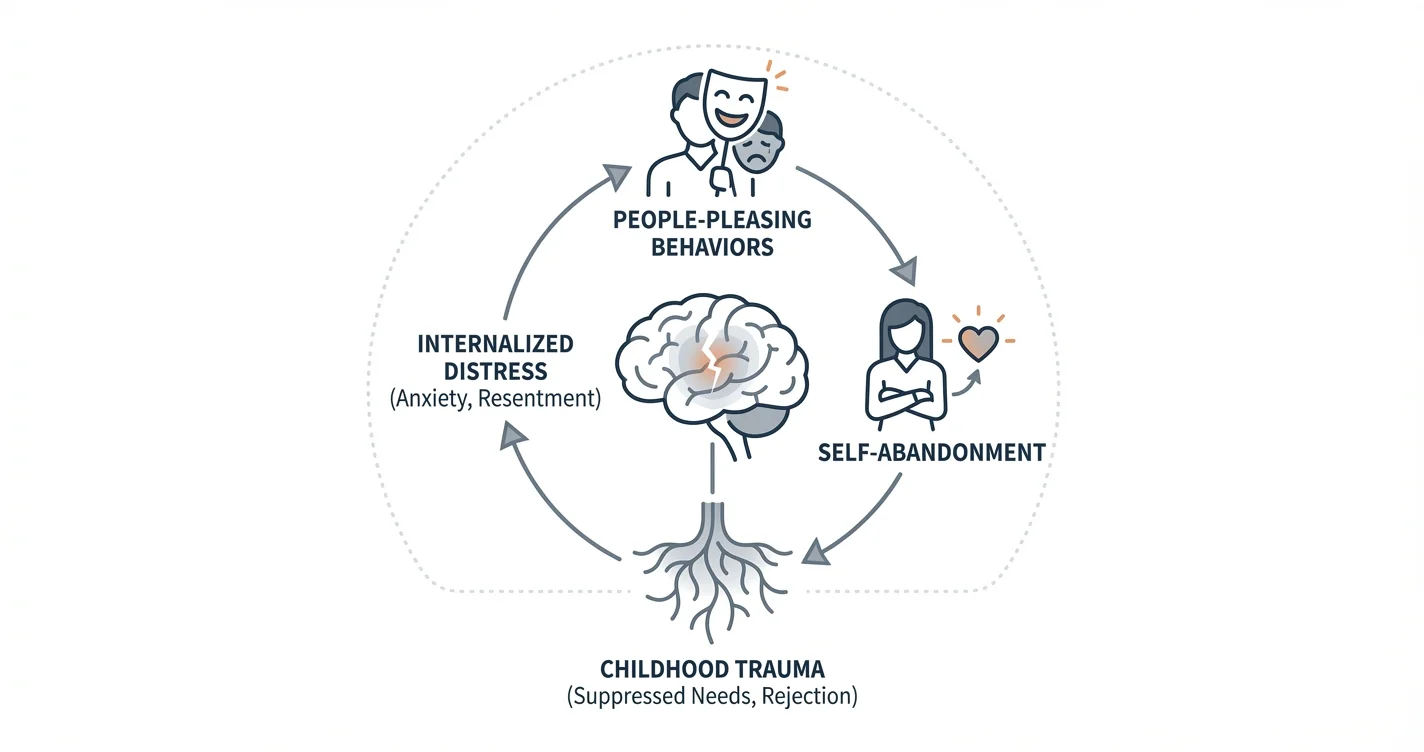
The relationship between self-abandonment and people-pleasing creates a reinforcing cycle:
- You abandon your needs and boundaries to please others
- Others learn they don't need to consider your needs
- Relationships become one-sided, increasing your resentment
- You fear that asserting yourself will destroy the relationship
- This fear triggers more self-abandonment and people-pleasing
Breaking this cycle requires addressing both the trauma-based beliefs driving the behavior and developing new neural pathways that support authentic self-expression.
Self-Abandonment Versus Codependency
While self-abandonment and codependency share similarities, understanding their distinctions helps clarify your recovery path. Both involve difficulty maintaining boundaries and excessive focus on others' needs, but they differ in underlying motivation and relationship dynamics.
Codependency typically involves attempting to control or fix others, often with an underlying belief that you're responsible for their emotions, choices, or wellbeing. There's an element of enmeshment where you can't distinguish where you end and another person begins. Research on codependency patterns shows they often develop in families affected by addiction, mental illness, or other forms of dysfunction where children assumed inappropriate caretaking roles.
Self-abandonment, while it may include codependent elements, centers more specifically on the disconnection from your own internal experience. The primary issue isn't excessive focus on others (though that occurs) but rather the abandonment of your own self as a strategy for maintaining connection.
Key differences include:
Codependency tends toward controlling behaviors, caretaking that others haven't requested, difficulty allowing others to face natural consequences, and identity deeply tied to the helping role.
Self-abandonment tends toward excessive accommodation, suppression of authentic needs and emotions, difficulty knowing what you want independently, and identity loss rather than over-identification with caretaking.
In practice, many people experience overlapping patterns. Someone might abandon their needs (self-abandonment) and then become controlling about how others respond (codependency) to manage the anxiety this creates. Therapy approaches that address relational trauma typically work with both patterns simultaneously.
Tools like Lovon.app can provide accessible support for exploring these patterns between therapy sessions, helping you process the emotions that arise as you begin recognizing how these dynamics play out in your relationships.
Childhood Trauma Leading to Self-Abandonment Patterns
The developmental origins of self-abandonment trauma vary, but common childhood experiences create the foundation for these patterns. While genetic factors and individual temperament also contribute to how these patterns develop, early relational experiences play a significant role in shaping your relationship with yourself.
Research on developmental trauma suggests several childhood environments commonly associated with self-abandonment patterns:
Emotionally dismissive or invalidating caregivers who consistently ignored, minimized, or rejected your emotional expressions taught you that your feelings were wrong, too much, or unimportant. You learned to suppress emotions to maintain the relationship.
Highly critical or conditional parenting where love and approval depended on performance, achievement, or perfect behavior created the belief that your inherent self wasn't worthy of love—only your compliant, achieving self deserved connection.
Role-reversal dynamics where you became the emotional caretaker for a parent overwhelmed by their own struggles meant your needs consistently came second. You learned that your role was to manage others' emotions, not have your own needs met.
Overt abuse or neglect created environments where drawing attention to yourself felt dangerous. Invisibility and compliance became survival strategies that carried forward into adult relationships.
Enmeshed or boundary-less family systems where individual needs and preferences were seen as selfish or threatening to family unity taught you that maintaining your authentic self meant risking rejection from everyone you depended on.
The child's developing brain is wired for attachment above all else. When authenticity threatens attachment, the child will sacrifice authenticity every time. This represents adaptive intelligence in childhood, but becomes maladaptive when these same strategies persist in adult relationships that don't require such self-abandonment for safety.
Understanding these origins isn't about blaming parents or caregivers, many of whom were doing their best within their own limitations. Rather, it's about recognizing that your people-pleasing and self-abandonment developed for legitimate reasons—and that what once protected you may now be constraining your capacity for genuine connection and fulfillment.
Step-by-Step Therapy Techniques to Stop Self-Abandonment
Recovery from self-abandonment trauma and chronic people-pleasing involves both healing the underlying trauma and developing new relational skills. Mental health professionals working with these patterns typically integrate several evidence-based approaches.
Internal Family Systems (IFS) for Self-Abandonment
IFS therapy views the psyche as composed of different "parts," each with its own perspective and protective role. In self-abandonment, parts that suppress your needs developed to protect you from childhood rejection or harm. IFS helps you develop a compassionate relationship with these protective parts while also accessing your core "Self"—the part of you that knows your authentic needs and values.
Practitioners typically guide clients through identifying the people-pleasing part, understanding what it's trying to protect you from, and gradually helping it trust that you can stay safe while being more authentic. This internal work often precedes external boundary-setting, since attempting new behaviors while your internal system still perceives them as dangerous rarely succeeds long-term.
Somatic Approaches for Nervous System Regulation
Since people-pleasing often involves automatic nervous system responses, somatic therapies help you recognize and regulate the physical sensations that arise around boundary-setting. When you consider saying no, you might notice chest tightness, stomach dropping, or breath holding—signs your nervous system has activated a threat response.
Therapists using somatic approaches teach clients to notice these sensations without immediately acting to relieve them through people-pleasing. Techniques include grounding practices, conscious breathing, and gradually building tolerance for the physical discomfort that accompanies authentic self-expression. Over time, your nervous system learns that disappointing someone doesn't actually threaten your survival.
Cognitive Restructuring for Core Beliefs
Self-abandonment rests on trauma-based beliefs that feel absolutely true but may not reflect current reality. Cognitive approaches help identify and challenge thoughts like "If I say no, they'll leave me" or "Other people's needs matter more than mine."
The process involves examining evidence for and against these beliefs, considering alternative perspectives, and conducting behavioral experiments—small boundary-setting attempts where you observe actual outcomes versus feared catastrophes. Many people discover that relationships actually improve when they bring more authenticity, since self-abandonment prevents genuine intimacy.
Practical Boundary-Setting Skills
Recovery requires not just understanding patterns but developing concrete skills for expressing needs and limits. Therapists typically work with clients on:
- Identifying and naming your own needs, preferences, and emotions (many people-pleasers have suppressed this capacity so thoroughly they genuinely don't know what they want)
- Using clear, direct communication rather than hinting or hoping others will guess
- Tolerating others' disappointment or disagreement without immediately accommodating
- Distinguishing between temporary discomfort and actual danger in relationships
- Recognizing that "no" is a complete sentence that doesn't require justification
Professionals emphasize starting with lower-stakes situations to build skills and confidence gradually. Setting a major boundary with your most important relationship when you've never practiced boundary-setting often leads to overwhelming anxiety that reinforces avoidance.
Accessible resources like Lovon.app can help you prepare for difficult conversations, process the emotions that arise when you begin setting boundaries, and reflect on relationship patterns between therapy sessions.
Creating a Recovery Plan for Chronic People-Pleasing
Breaking lifelong patterns of self-abandonment requires a structured approach that addresses multiple layers simultaneously. Therapists working with chronic people pleasers typically help clients develop personalized recovery plans that include these elements:
Build self-awareness through tracking. Many people-pleasers operate on autopilot, automatically saying yes before considering their actual capacity or desires. Keeping a simple log of situations where you abandoned yourself—what happened, what you actually wanted, what you feared would happen if you were authentic—reveals your specific patterns and triggers.
Develop emotion identification skills. Self-abandonment often involves such chronic disconnection from internal experience that you may not readily identify what you're feeling or needing. Regular check-ins asking "What am I feeling right now?" and "What do I need right now?" gradually rebuild this internal connection. Feelings wheels or emotion lists can help when your internal vocabulary feels limited.
Practice micro-boundaries in safe relationships. Choose relationships where you feel relatively secure and practice small assertions: expressing a preference for where to eat, declining an invitation, sharing a different opinion. Notice what happens—both internally (your nervous system's response) and externally (the other person's actual reaction versus your feared reaction).
Work with a trauma-informed therapist. While self-help strategies provide valuable support, self-abandonment rooted in developmental trauma typically requires professional guidance to address effectively. Therapists trained in trauma, attachment, and relational patterns can provide the safe relationship context where you practice staying connected to yourself while remaining in connection with another person—the core healing experience for self-abandonment.
Build a values-based life. Self-abandonment leaves many people unclear about their actual values, preferences, and life direction. Exploring "Who would I be if I wasn't constantly adjusting myself to others' expectations?" helps clarify what authentic living might look like for you specifically.
Prepare for relationship changes. As you stop self-abandoning, some relationships will deepen and improve, while others—particularly those that depended on your self-sacrifice—may end or transform significantly. This often involves grief, and having support during this transition proves essential.
When to Seek Professional Help
While understanding self-abandonment patterns and practicing boundary-setting can begin independently, several situations indicate professional support would be beneficial:
- Self-abandonment and people-pleasing significantly impair your daily functioning, work performance, or physical health
- You experience depression, anxiety, or other mental health symptoms alongside these patterns
- You have trauma history including abuse, neglect, or complex relational trauma that contributed to self-abandonment
- Attempts to change these patterns on your own have been unsuccessful
- You're experiencing suicidal thoughts or self-harm urges related to these struggles
- Your relationships are causing significant distress but you feel trapped in people-pleasing dynamics
Mental health professionals who can help include therapists specializing in trauma, attachment, and relational patterns, particularly those trained in modalities like IFS, EMDR, somatic experiencing, or emotionally focused therapy. Some people also benefit from working with a psychiatrist if anxiety or depression symptoms require medication support alongside therapy.
Group therapy specifically for people-pleasers or codependency can provide valuable normalization and peer support, showing you that others share these struggles and recovery is possible.
Conclusion
Understanding what self-abandonment trauma is and how to stop people-pleasing opens a path toward reclaiming your authentic self and building relationships based on genuine connection rather than fear-driven accommodation. These patterns developed as intelligent adaptations to childhood environments where being yourself felt unsafe, but they no longer serve you in adult relationships that can handle your authenticity.
Recovery involves addressing both the trauma-based beliefs and nervous system patterns underlying self-abandonment while simultaneously developing practical skills for boundary-setting and authentic self-expression. This process takes time and often feels uncomfortable—your system learned over years that self-abandonment kept you safe, so changing these patterns may initially trigger significant anxiety.
The encouraging reality is that as you gradually reconnect with your own needs, emotions, and values, relationships generally improve rather than deteriorate. Authentic connection requires two people bringing their real selves to the relationship, which self-abandonment prevents. The people worth keeping in your life can handle—and often welcome—your greater authenticity, while relationships requiring your self-sacrifice to survive may need to end for your wellbeing.
Whether you work with a trauma-informed therapist, use accessible tools like Lovon.app for ongoing support, or begin with self-reflection and small boundary-setting experiments, the journey from self-abandonment toward self-honoring represents profound healing. Your needs matter, your feelings are valid, and you deserve relationships where you can be authentically yourself.
Disclaimer: This is general information, not medical advice or diagnosis. If symptoms are severe, affecting your daily life, or you're having thoughts of self-harm—seek professional help. In the US: call or text 988 (Suicide & Crisis Lifeline). For immediate danger: 911 or local emergency services.
How AI Support Helps You Heal
AI emotional support isn't about replacing human connection — it's about filling the gaps. The moments when you need to talk at 2 AM, when you don't want to burden your friends again, or when you simply need someone to listen without judgment.
Here's what happens in a typical Lovon session:
You share what's on your mind
There's no script, no intake form, no waiting room. You speak or type whatever you're feeling — in your own words, at your own pace.
Lovon validates and explores
Using frameworks from CBT (Cognitive Behavioral Therapy) and motivational interviewing, Lovon acknowledges your feelings first, then gently helps you explore them. No dismissive "just move on" advice.
You build coping skills together
Lovon doesn't just listen — it actively works with you on evidence-based techniques: thought reframing, urge surfing, behavioral experiments, and more.
What a Session with Lovon Looks Like

Lovon is AI support, not a replacement for professional care. If things have been hard to get through for weeks, or you are thinking about harming yourself, talk to a doctor or a licensed therapist.
Ready to Start?
Your healing journey can begin right now
A 7-day trial. No judgment. Just a safe space to process what you're going through.
Frequently Asked Questions
Is Lovon a replacement for a real therapist?
Is my conversation with Lovon AI private?
How is Lovon different from ChatGPT for emotional support?
Can I use Lovon if I'm already seeing a therapist?
Can I try Lovon before subscribing?
About the Author

The Lovon Editorial Team
Mental Health & Wellness Content Team
The Lovon Editorial Team develops mental health and wellness content designed to make psychological concepts accessible and actionable. Our goal is to bridge the gap between clinical research and everyday life - helping you understand why your mind works the way it does and what you can do about it....
Related articles
- Chronic Guilt: Why You Feel Guilty All the Time (2026)
Chronic guilt runs even when you've done nothing wrong. Learn the 6 steps to identify its root cause and break the cycle…
- Best AI App for Codependency Recovery in 2026: Lovon Wins
Lovon ranks best AI app for codependency recovery in 2026, compared against Wysa, Replika, BetterHelp, and Youper on…
- What Is High-Functioning Anxiety Signs Automatic Yes-Saying Guilt
High-functioning anxiety can be deceptively difficult to recognize, particularly when automatic yes-saying and guilt…
- ADHD — Emotional Costs of Undiagnosed Cases Including Rejection Sensitivity Dysphoria and Chronic Loneliness
Living with undiagnosed ADHD creates an invisible emotional burden that extends far beyond difficulty focusing or…
See also
Quizzes
- Defense Mechanisms Test: Which Ones Do You Use Most?
See what your defenses do with hard feelings, in 3 minutes.
- Self-Acceptance Test: What Are You Still Arguing With?
See where you are still fighting yourself, in 3 minutes.
Free tools
- How to End a Friendship Without a Scene
A chat for working out how to end a friendship clearly, without a grievance list or a slow ghost. Tell it how long you…
- How to Say No Politely (Without Over-Explaining)
A chat for how to say no politely when you have already decided and cannot get the word out. Tell it what you were…
From the wiki
- What is the bare minimum in a relationship?
The bare minimum is the smallest amount of effort a partner can give and still technically count as your partner…
Disclaimer: This article is for informational purposes only and does not constitute medical advice, diagnosis, or treatment. Always seek the advice of your physician or other qualified health provider with any questions you may have regarding a medical condition. If you are in crisis or think you may have an emergency, call 988 (Suicide & Crisis Lifeline) or go to the nearest emergency room. Outside the US? Find a crisis line in your country.