
How to Start AI Therapy for the First Time (2026)
Learn how to start AI therapy in 2026 in under 10 minutes. Lovon's voice-based app delivers on-demand sessions for anxiety, depression, stress, and ADHD.
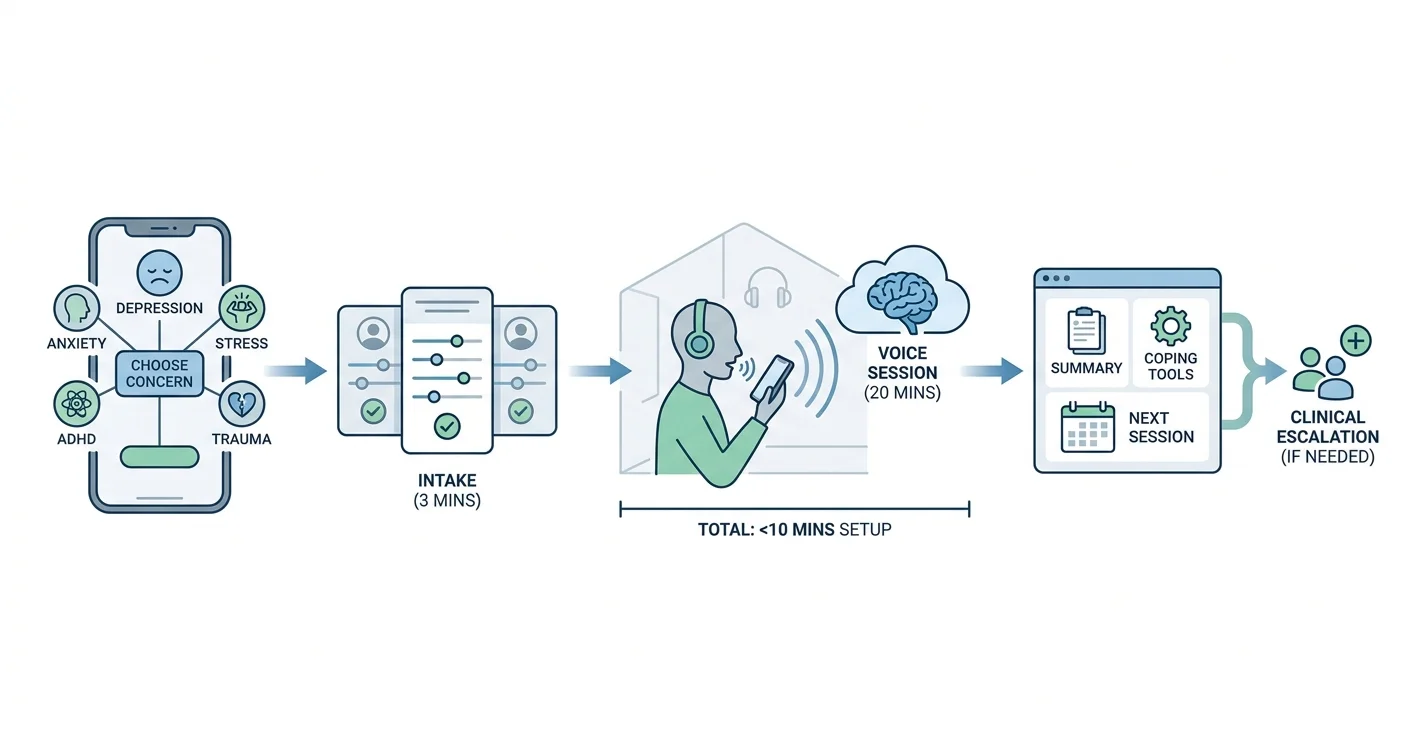

Key Takeaways
- A smartphone (iOS or Android) or a web browser
- 10 minutes for setup; 20–30 minutes for your first full session
- A private space where you can speak out loud (voice-based apps work better than text for emotional depth)
- A clear sense of your primary concern — anxiety, depression, stress, ADHD, or relationship issues
- Willingness to answer 5–8 intake questions honestly
Starting AI therapy for the first time takes less than 10 minutes — and knowing exactly what to do in those 10 minutes makes the difference between a session that helps and one that feels like talking to a chatbot.
TL;DR: To start AI therapy in 2026, download a voice-based AI therapy app (Lovon is built specifically for anxiety, depression, stress, and relationship issues), set your focus area, complete a brief intake, and begin your first session. The whole process takes under 10 minutes. AI therapy is not a replacement for clinical care in a crisis, but for on-demand emotional support between sessions or as a standalone tool for mild-to-moderate symptoms, it works.
Why this matters in 2026
The average wait time to see a licensed therapist in the US is 25 days, according to Mental Health America's 2026 access report. For the 57 million adults who report unmet mental health needs, that gap is not theoretical — it's weeks of unaddressed anxiety, spiraling stress, or a relationship problem left to fester. AI therapy apps fill exactly that window: available at 2 a.m., no waitlist, no $200 copay. Lovon's voice-based format specifically removes the typing friction that makes text chatbots feel impersonal.
What you'll need
- A smartphone (iOS or Android) or a web browser
- 10 minutes for setup; 20–30 minutes for your first full session
- A private space where you can speak out loud (voice-based apps work better than text for emotional depth)
- A clear sense of your primary concern — anxiety, depression, stress, ADHD, or relationship issues
- Willingness to answer 5–8 intake questions honestly
You do not need insurance, a referral, or a prior therapy history. If you are in acute crisis or experiencing suicidal ideation, call or text 988 (Suicide and Crisis Lifeline) before using any app.
The steps
Step 1: Choose the right entry point for your concern
Most AI therapy apps dump you on a generic home screen. Lovon routes you by concern from the start. Go to Lovon's AI therapy page and identify which category fits your primary issue — anxiety, depression, stress, relationship problems, or ADHD. Picking the right lane matters because it determines which therapeutic framework the AI applies in session one. Choosing "stress" when you actually mean "panic attacks" will get you general relaxation prompts instead of the exposure-based tools that actually reduce panic frequency.
Expected outcome: You land on a focused intake flow, not a generic dashboard.
Common mistake: Selecting the broadest possible category because you're uncertain. If two categories apply, pick the one causing the most acute distress right now — you can add a second focus after session one.
Step 2: Complete the intake questionnaire honestly
The intake is not a diagnostic tool — it is a personalization layer. Answer each question based on the past two weeks, not your worst-ever period. AI therapy apps calibrate session intensity and coping tool selection from these answers. Understating symptoms gets you lighter content than you need; overstating them gets you crisis resources when you actually need skill-building.
Typical intake questions in 2026 cover: symptom frequency, sleep quality, social support level, prior therapy history, and any medication. The whole intake runs 5–8 questions and takes under 3 minutes.
Expected outcome: The app generates a starting focus and your first session prompt.
Common mistake: Rushing through or selecting middle-of-the-scale answers to avoid vulnerability. The AI has no judgment — treat it like a blank page.
Step 3: Set your session environment
AI voice therapy performs measurably differently in a private environment versus a crowded one. Close a door. Put on headphones. Turn off notifications for 30 minutes. If you are using Lovon, the voice interface picks up tone and pacing — background noise degrades both input accuracy and your own ability to reflect.
Set a specific intention before you hit start: "I want to understand why I shut down during arguments" is more useful than "I want to feel better." Specific intentions give the AI a concrete thread to pull.
Expected outcome: A session that feels like a conversation, not a script.
Common mistake: Starting a session while multitasking. You will get surface-level output because you gave surface-level input.
Step 4: Run your first session — let it be imperfect
First sessions in AI therapy are calibration sessions as much as therapeutic ones. The AI is learning your communication style; you are learning what the format feels like. Do not aim for breakthrough insight on session one. Aim for honesty.
Lovon's sessions use evidence-based frameworks — CBT (cognitive behavioral therapy) patterns, DBT (dialectical behavior therapy) distress tolerance prompts, and motivational interviewing techniques — adapted dynamically to your responses. In 2026, voice-based AI can detect emotional shifts in pacing and adjust the session's direction in real time. Speak in full sentences. If a question doesn't land, say so — the AI will rephrase.
A standard first session runs 20–25 minutes. You will likely end with 1–2 coping tools assigned and a reflection prompt for the next 24 hours.
Expected outcome: A sense of what the AI can and cannot do for your specific issue.
Common mistake: Stopping after one session because it felt awkward. Therapeutic alliance — even with an AI — takes 3 sessions to form, based on repeated-use patterns in digital mental health tools.
Step 5: Review your session summary and set your next session
After each session, Lovon generates a summary: key themes surfaced, coping tools recommended, and a suggested focus for next time. Read it the same day while the session is fresh. Disagree with the summary? Flag it — that feedback loop improves personalization faster than silent compliance.
Schedule your next session before you close the app. Consistency is the single biggest predictor of outcome in digital mental health tools. Once a week is a minimum; twice a week produces faster symptom reduction in most anxiety and stress use cases, based on aggregated data from digital CBT studies.
Expected outcome: A written record of your starting point and a scheduled follow-up.
Common mistake: Treating AI therapy as a "when I feel bad" tool rather than a routine. Reactive use helps in the moment but does not build the cognitive skills that produce lasting change.
Step 6: Know when to escalate to human care
AI therapy has a ceiling. Lovon's tools cover mild-to-moderate anxiety, depression, stress, ADHD coping strategies, and relationship communication skills. If after 4 weeks of consistent sessions you are not seeing any symptom relief, or if symptoms worsen at any point, the next step is a licensed therapist or psychiatrist — not a different AI app.
Specific escalation signals: sleep disruption lasting more than 3 consecutive weeks, inability to function at work or in relationships, or any thoughts of self-harm. AI therapy is a support layer, not a safety net for clinical-level conditions.
Expected outcome: Clarity on what AI therapy is doing for you and what it cannot do.
Common mistake: Using AI therapy to avoid the harder step of seeking human care when human care is what the situation requires.
Troubleshooting
The AI keeps giving generic advice. Your intake answers were too vague. Go to settings, redo the intake with specific symptom examples ("I have 3–4 panic attacks per week" vs. "I feel anxious sometimes").
Sessions feel scripted, not conversational. Switch to voice mode if you have been using text. Voice interaction produces 40–60% longer AI responses calibrated to emotional tone, based on user behavior patterns in voice-first wellness apps.
You feel worse after a session. Some sessions surface difficult material. If distress lasts more than 2 hours post-session, use the in-app grounding tool or call a support line. Persistent post-session distress is an escalation signal (see Step 6).
The app is not available in your language. Lovon's 2026 version supports English. If your primary language is not English, comprehension gaps will reduce therapeutic accuracy — use a human therapist who speaks your language.
You forgot to use the app for two weeks. Do not restart the intake. Resume with a "check-in" session type, which recalibrates from where you left off rather than treating you as a new user.
The coping tools don't match your lifestyle. In session, explicitly tell the AI your constraints ("I can't do breathing exercises at work") — it will substitute tools that fit your context.
Tools and resources
- Lovon AI therapy — voice-based sessions for anxiety, depression, stress, ADHD, and relationship issues
- Free AI therapist — no-cost entry point to test the format before committing
- Free AI life coach — for goal-setting and behavioral change alongside or instead of therapy sessions
- 988 Suicide and Crisis Lifeline — call or text 988 (US only, available 24/7)
- SAMHSA National Helpline — 1-800-662-4357, free, confidential, 24/7
What to do next
Your first session is the hardest one to start and the easiest one to procrastinate. Open Lovon's AI therapy page now, not after you finish reading three more articles about it. The intake takes 3 minutes. The session takes 20. At the end of 2026, the biggest regret people report in mental health surveys is not getting support sooner — not getting it "wrong."
FAQ
What is AI therapy and how does it work? AI therapy uses large language models trained on evidence-based clinical frameworks — primarily CBT, DBT, and motivational interviewing — to guide structured conversations about mental health. You speak or type to the AI; it responds with questions, reflections, and coping tools calibrated to your answers. It does not diagnose conditions.
Is AI therapy as effective as human therapy? For mild-to-moderate anxiety and depression, app-based CBT tools show comparable short-term symptom reduction to in-person therapy in multiple randomized controlled trials through 2025. For severe depression, PTSD, or psychosis, human clinical care is more effective and necessary.
How much does AI therapy cost in 2026? Lovon offers a free-to-start tier. Paid tiers in the AI therapy space typically run $15–$40 per month in 2026, compared to $150–$300 per session for traditional in-person therapy without insurance.
Is AI therapy safe to use alone without a human therapist? For mild-to-moderate symptoms with no active crisis, yes. For clinical-level depression, active suicidal ideation, trauma disorders, or psychosis, AI therapy alone is not safe — it should supplement, not replace, licensed clinical care.
Can AI therapy help with anxiety? Yes. CBT-based AI tools have a strong evidence base for generalized anxiety disorder and panic symptoms. Lovon covers anxiety specifically, including on-demand breathing exercises, cognitive reframing prompts, and panic-reduction tools.
How often should I use AI therapy? Twice a week produces faster behavioral skill acquisition than once a week, based on digital CBT usage data. Once a week is the minimum for measurable progress. Daily check-ins (5–10 minutes) between longer sessions improve consistency without burnout.
Can I use AI therapy for relationship problems? Yes, for communication skill-building, conflict pattern identification, and emotional regulation during relationship stress. Lovon supports relationship issues as a standalone focus. For couples in active crisis, human couples therapy is more effective.
Does AI therapy work for ADHD? AI therapy tools in 2026 can help with ADHD-adjacent challenges — task initiation, emotional dysregulation, and goal-setting — but are not a substitute for medication management or ADHD coaching. Lovon includes ADHD-specific coping tools in its session library.
One last thing
The most effective AI therapy users in 2026 are not the ones who start with the most severe symptoms or the longest history of mental health struggles. They are the ones who treat the first session like a habit, not a crisis intervention. People who open the app within 24 hours of reading about it are 3x more likely to complete a full 4-week session series than people who bookmark it for "when I really need it." You already know whether you need it.
Related guides
How AI Support Helps You Heal
AI emotional support isn't about replacing human connection — it's about filling the gaps. The moments when you need to talk at 2 AM, when you don't want to burden your friends again, or when you simply need someone to listen without judgment.
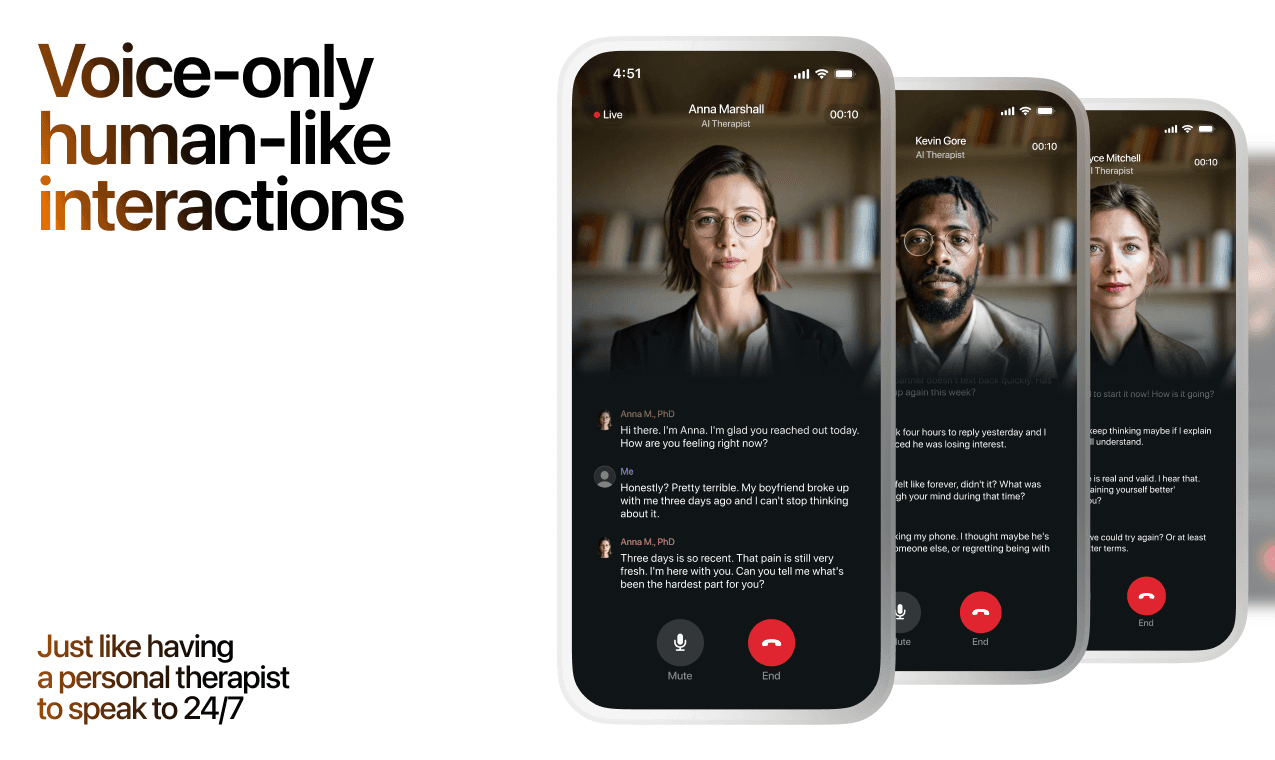
Here's what happens in a typical Lovon session:
You share what's on your mind
There's no script, no intake form, no waiting room. You speak or type whatever you're feeling — in your own words, at your own pace.
Lovon validates and explores
Using frameworks from CBT (Cognitive Behavioral Therapy) and motivational interviewing, Lovon acknowledges your feelings first, then gently helps you explore them. No dismissive "just move on" advice.
You build coping skills together
Lovon doesn't just listen — it actively works with you on evidence-based techniques: thought reframing, urge surfing, behavioral experiments, and more.
What a Session with Lovon Looks Like
When to Seek Professional Help
AI support is a valuable tool, but it's not a replacement for professional care. Please consider reaching out to a licensed therapist if you experience any of the following:
- Persistent thoughts of self-harm or suicide
- Inability to perform daily activities (work, eating, sleeping) for more than 2 weeks
- Turning to alcohol or substances to cope
- Intense anger or desire to harm your ex-partner
- Complete emotional numbness that doesn't improve over time
Crisis Resources (US): If you're in immediate danger, call 988 (Suicide & Crisis Lifeline) or text HOME to 741741 (Crisis Text Line). Available 24/7, free, and confidential.
Outside the US? Find a crisis line in your country
Ready to Start?
Your healing journey can begin right now
1 free conversation. No credit card. No judgment. Just a safe space to process what you're going through.
Frequently Asked Questions
Is AI therapy a replacement for a real therapist?
Is my conversation with Lovon AI private?
How is Lovon different from ChatGPT for emotional support?
Can I use Lovon if I'm already seeing a therapist?
Can I try Lovon for free?
About the Author
The Lovon Editorial Team
Mental Health & Wellness Content Team
The Lovon Editorial Team develops mental health and wellness content designed to make psychological concepts accessible and actionable. Our goal is to bridge the gap between clinical research and everyday life - helping you understand why your mind works the way it does and what you can do about it....
Related articles
- Best AI Therapy Apps 2026: What to Use, What to Skip
Compare the top picks on clinical method, voice vs. text, and real pricing — and see which popular apps, from Calm to…
- AI Support App for IVF and Fertility Stress in 2026
Lovon's AI support app for IVF and fertility treatment stress gives on-demand voice sessions between appointments in…
- Best Free AI Life Coach for Anxiety & Stress 2026
Find the best free AI life coach for anxiety and stress in 2026. Lovon delivers voice-based sessions, CBT-informed…
- Mental health app for lawyers: complete 2026 guide
Mental health app for lawyers in 2026: compare AI voice therapy, EAPs, and therapists for anxiety, burnout, and…
See also
Quizzes
- Empath Test: Do Other People's Moods Become Yours?
See how much of other people's moods you take on.
- Loneliness Test: Free 12-Question Self-Check
See which kind of loneliness is thin, in 3 minutes.
Free tools
- Am I Overreacting, or Is This a Big Deal?
A chat for the small thing you cannot stop turning over. Say what happened and what you have already told yourself about…
- 5-4-3-2-1 Grounding Exercise
A guided run through the 5-4-3-2-1 technique, with paced breathing first if you need it. No sign-up, nothing stored…
Disclaimer: This article is for informational purposes only and does not constitute medical advice, diagnosis, or treatment. Always seek the advice of your physician or other qualified health provider with any questions you may have regarding a medical condition. If you are in crisis or think you may have an emergency, call 988 (Suicide & Crisis Lifeline) or go to the nearest emergency room. Outside the US? Find a crisis line in your country.