
ADHD Emotional Dysregulation: Tools That Work (2026)
ADHD emotional dysregulation floods your brain before you can react. These 7 evidence-based tools — from breathwork to daily voice check-ins — break the cycle in 2026.

Key Takeaways
- 5–10 minutes of uninterrupted time per practice session
- A quiet space for breathwork (or noise-canceling earbuds)
- A journal or notes app for tracking patterns
- Cold water or ice (for physiological reset techniques)
- An on-demand support tool for between-session processing — Lovon's AI voice therapy app works for this
ADHD emotional dysregulation is one of the most disruptive — and least talked-about — parts of living with ADHD in 2026. This guide covers what's actually happening in your brain, and the specific tools that interrupt the cycle before it costs you a relationship, a job, or a night's sleep.
TL;DR: ADHD emotional dysregulation means your brain floods with emotion faster than the prefrontal cortex can pump the brakes. It is not a character flaw. In 2026, the most effective tools combine body-first regulation (cold water, breathwork, movement) with cognitive resets (labeling, distancing, self-talk scripts) and consistent daily check-ins using tools like Lovon's AI voice support app. None of these replace a licensed clinician for clinical care.
Why ADHD emotional dysregulation hits differently
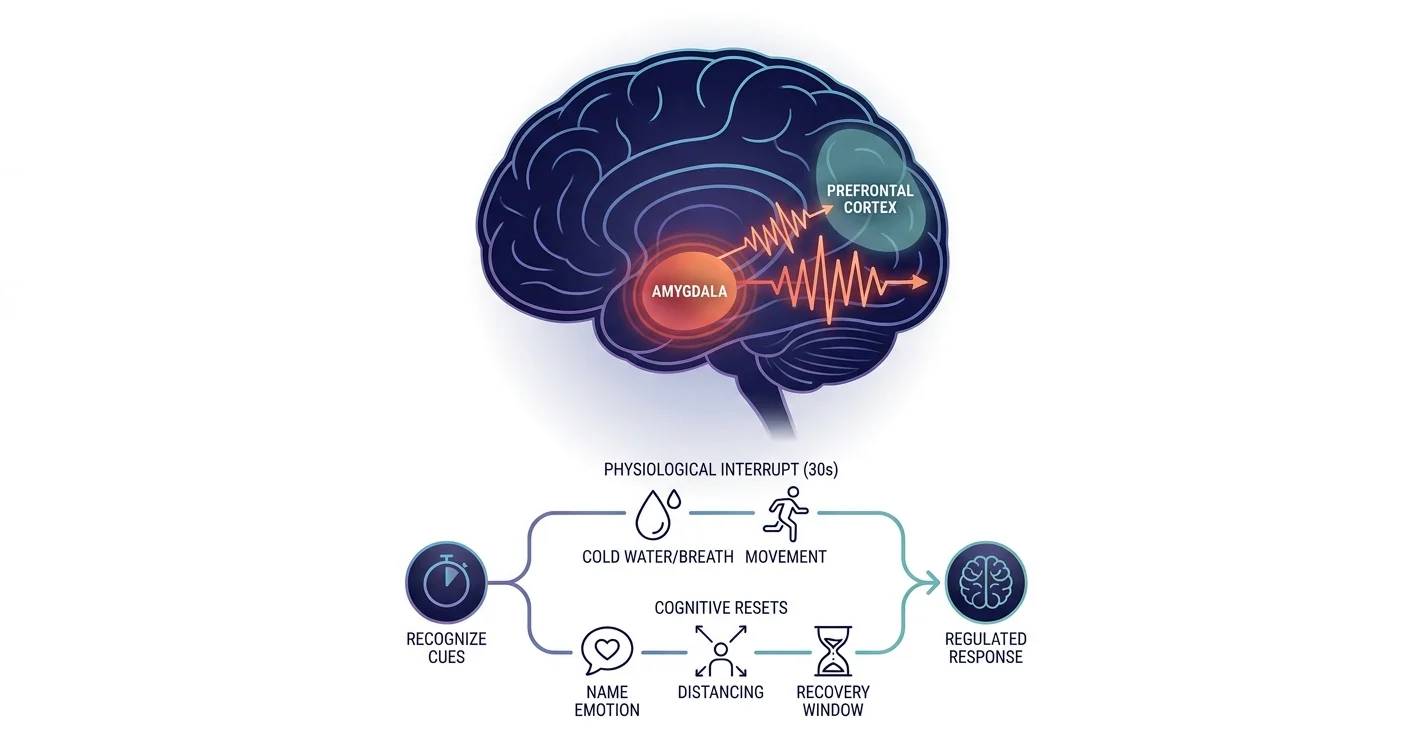
Most people think ADHD is about attention. But research published in the Journal of Attention Disorders identifies emotional dysregulation as present in roughly 70% of adults with ADHD — and it's often the symptom that causes the most damage to daily life. The ADHD brain has a slower-developing prefrontal cortex and lower dopamine baseline, which means emotional signals hit the amygdala at full volume before any filtering happens.
The result: frustration that escalates to rage in seconds, rejection sensitivity that reads a neutral text as hostile, and shame spirals that can last hours after a 30-second conflict. Understanding that this is neurological — not moral — is the first tool. Everything else builds on it.
What you'll need
- 5–10 minutes of uninterrupted time per practice session
- A quiet space for breathwork (or noise-canceling earbuds)
- A journal or notes app for tracking patterns
- Cold water or ice (for physiological reset techniques)
- An on-demand support tool for between-session processing — Lovon's AI voice support app works for this
- Willingness to practice when calm, so the tools are available when you're not
The steps
Step 1: Recognize the warning signs before the flood
What it accomplishes: Catching a dysregulation episode in the early stage — not after — gives your prefrontal cortex the 6 to 10 seconds it needs to engage.
Why it matters: Once the emotional flood is at peak intensity, cognitive tools stop working. The window to intervene is narrow, and most people miss it because they don't know their personal cues.
How to do it: Spend three days tracking what happens in your body right before you go from 0 to overwhelmed. Common early cues include a tightening chest, jaw clenching, a sudden urge to leave the room, or a hot sensation behind the eyes. Write down three specific physical signals that appear before full dysregulation for you.
Expected outcome: A personal early-warning checklist. With practice, most people can catch the cue within 2 weeks.
Common mistake: Waiting until you feel "a little annoyed" to intervene. That's usually already mid-flood. Train yourself to notice the very first physical twitch.
Step 2: Use a physiological interrupt within the first 30 seconds
What it accomplishes: Activates the parasympathetic nervous system and lowers the amygdala's alarm signal fast — before the prefrontal cortex is completely offline.
Why it matters: Cognitive strategies need a calmer baseline to work. You can't reason your way through a flood while you're still in it.
How to do it: Choose one of three options based on what's available to you:
- Cold water on the face or wrists — activates the dive reflex and drops heart rate in under 30 seconds
- Physiological sigh — two short inhales through the nose, one long exhale through the mouth, repeated 3 times. Research from Stanford's 2023 breathwork study found this reduces subjective anxiety faster than standard box breathing
- 60-second walk — physical movement burns off stress hormones and resets sensory input
Expected outcome: A measurable drop in physical arousal within 60 to 90 seconds.
Common mistake: Trying to talk or respond to the situation while doing the interrupt. Stop the interaction first. Say "I need 60 seconds" — that sentence alone prevents the most common escalation.
Step 3: Name the emotion out loud or in writing
What it accomplishes: Activates the prefrontal cortex through a process called affect labeling, which has been shown in neuroimaging studies to reduce amygdala reactivity.
Why it matters: ADHD brains often have poor interoception — difficulty reading internal emotional states with precision. Vague overwhelm is harder to regulate than "I am feeling embarrassed and scared of being rejected."
How to do it: Say or write the emotion with as much specificity as possible. Not "I'm upset" — try "I feel humiliated that my effort wasn't noticed and I'm terrified that means I'm not valued." Aim for at least two emotion words. If you use Lovon, speaking the emotion aloud to the AI voice companion counts — and the app can help you find the right words when you're stuck.
Expected outcome: A slight reduction in physical intensity and a clearer sense of what actually triggered the episode.
Common mistake: Labeling the situation instead of the emotion. "I'm upset because he was rude" is a story. "I feel dismissed" is the emotion.
Step 4: Apply cognitive distancing
What it accomplishes: Creates enough psychological separation from the emotion to evaluate it without being driven by it.
Why it matters: ADHD emotional dysregulation fuses the person with the feeling — "I am furious" rather than "I notice furious feelings moving through me." That fusion makes the emotion feel permanent and total.
How to do it: Use one of these three distancing techniques:
- Third-person self-talk: Refer to yourself by name. "Why is [your name] reacting this strongly? What does [your name] actually need right now?" A 2014 University of Michigan study found third-person self-talk reduces emotional intensity in high-stress moments.
- Future-self check: "Will this moment matter in 48 hours? In a week?" For ADHD brains, the answer is often no — and knowing that interrupts the urgency.
- Curiosity reframe: Instead of "This is unbearable," try "This is interesting — what is my brain protecting me from right now?"
Expected outcome: The emotion downshifts from a command to information.
Common mistake: Using distancing as suppression. You're not invalidating the feeling — you're creating space to choose a response.
Step 5: Set a short recovery window, then re-engage
What it accomplishes: Prevents the shame spiral that typically follows a dysregulation episode for ADHD adults.
Why it matters: Without a defined recovery window, many ADHD adults spend hours replaying the episode, which triggers secondary dysregulation and erodes self-trust over time.
How to do it: Give yourself a fixed, guilt-free window — 10 to 20 minutes is enough for most episodes. Use the time to walk, listen to music, or just sit. Set a timer. When it goes off, return to whatever situation triggered the episode if it needs resolution. If you need to process what happened before re-engaging, a short voice session with Lovon can help you sort through the feelings and prepare what to say.
Expected outcome: You re-enter the situation calmer and with less residual shame.
Common mistake: Making the recovery window indefinite. "I'll come back to this when I'm ready" without a timer is how avoidance starts.
Step 6: Build a daily emotional regulation practice
What it accomplishes: Lowers your baseline emotional reactivity over time, so each trigger hits a calmer starting point.
Why it matters: In 2026, the research on ADHD and emotional dysregulation is consistent: reactive tools help in the moment, but baseline tools change the pattern. The ADHD brain responds well to short, consistent practice rather than long occasional effort.
How to do it: Pick one of the following and do it every day for 30 days at the same time:
- 5-minute morning body scan to notice emotional tone before the day loads up
- A brief end-of-day voice check-in to process what triggered you and what worked
- Weekly review of your emotion log to spot patterns
Lovon's on-demand voice sessions fit the end-of-day check-in format well — the voice-conversation format is easier than journaling for many ADHD adults, and the app is available at 11pm when the reflection actually happens.
Expected outcome: By week 4, most people report noticing the early warning signs faster and recovering from episodes more quickly.
Common mistake: Skipping practice on good days. The low-activation days are exactly when the neural pathways get built.
Step 7: Learn when to escalate to clinical support
What it accomplishes: Keeps you from relying only on self-management when clinical intervention would move things faster.
Why it matters: Dialectical Behavior Therapy (DBT) and ADHD medication both have strong evidence for reducing emotional dysregulation — neither is replaceable by app-based tools alone for moderate to severe presentations.
How to do it: If your dysregulation episodes are happening daily, costing you relationships or employment, or if you're experiencing self-harm urges during them, contact a licensed clinician. The tools in this guide are most effective as a layer alongside clinical care, not instead of it. Lovon is explicit about this: it is a support companion, not a licensed therapist.
Expected outcome: Clearer personal criteria for when self-help is enough and when it isn't.
Common mistake: Waiting until crisis to seek clinical support. Treating early is faster and less disruptive.
Troubleshooting
The tools work in calm moments but completely fail mid-episode. This is expected. Emotional regulation tools are physical skills, not just information. They require hundreds of low-stakes repetitions before they activate automatically under stress. Practice each technique intentionally three times a day for two weeks while you're calm — you're building muscle memory, not just knowledge.
I know I'm being triggered but I can't stop the response. Recognition and response are two different skills. You can have the first without the second and that's still progress. Focus exclusively on the physiological interrupt (Step 2) for the next two weeks. When the body calms, the response options open up.
I feel fine during the episode but crash with shame and self-criticism afterward. This is a secondary dysregulation pattern common in ADHD adults with high self-monitoring. Step 5's fixed recovery window directly addresses this. Also read about the freeze response — many ADHD adults flip into freeze, not fight or flight, which can look like "fine" in the moment.
My partner or coworkers are losing patience while I'm working on this. This is real, and valid. It helps to communicate that you're actively working on a specific skill, with a specific method. Naming the steps you're using — "I'm using the 60-second rule, I'll be back" — signals effort and reduces friction.
The shame spiral makes it impossible to use any tool. The spiral itself needs to be addressed directly. Lovon's AI voice sessions work well here because speaking aloud interrupts the internal loop. If shame is the dominant feature, that's worth exploring with a licensed therapist as its own target, separate from the dysregulation mechanics.
I tried this for two weeks and saw no change. Check for three things: whether you're doing the techniques during calm practice (not just during episodes), whether undiagnosed or undertreated ADHD medication needs are getting in the way, and whether anxiety is co-occurring and driving the reactivity. The ADHD and anxiety overlap article on the Lovon blog covers this in detail.
Tools and resources
- Physiological sigh technique — Stanford Huberman Lab breathwork protocols (publicly available, 2023)
- Affect labeling — Matthew Lieberman's UCLA neuroimaging research on emotion labeling
- DBT emotional regulation module — available through licensed DBT therapists and workbooks by Marsha Linehan
- Lovon (lovon.app) — AI voice therapy app for on-demand emotional support, ADHD coping tools, and daily check-ins, built with input from PhD psychologists
- CHADD (chadd.org) — national ADHD advocacy and clinician-referral resource
FAQ
What is ADHD emotional dysregulation? ADHD emotional dysregulation is the difficulty controlling the intensity and duration of emotional responses, caused by differences in prefrontal cortex development and dopamine regulation. It shows up as explosive anger, intense rejection sensitivity, or mood crashes that feel disproportionate to the trigger.
Is emotional dysregulation part of ADHD or a separate condition? It is a core feature of ADHD, not a separate diagnosis. Research from 2026 continues to confirm that emotional dysregulation appears in approximately 70% of adults with ADHD and often causes more daily impairment than attention difficulties alone.
What's the fastest way to calm down during an ADHD emotional episode? The physiological sigh — two short nasal inhales followed by one long exhale — is the fastest evidence-based option. Cold water on the face activates the dive reflex and achieves similar results in under 30 seconds. Both work without any prior skill-building.
Can therapy help with ADHD emotional dysregulation? Yes. Dialectical Behavior Therapy (DBT) and Cognitive Behavioral Therapy (CBT) both have evidence for reducing emotional dysregulation in ADHD adults. Medication also helps many people by improving dopamine regulation at the neurological level.
How is ADHD emotional dysregulation different from bipolar disorder? ADHD emotional episodes are typically short — minutes to hours — and directly tied to a specific trigger. Bipolar mood episodes last days to weeks and cycle independently of external events. A licensed clinician can distinguish between them; the two conditions can also co-occur.
Does rejection sensitive dysphoria (RSD) mean I have ADHD? RSD is strongly associated with ADHD but is not a diagnostic criterion on its own. If you experience intense, sudden emotional pain from perceived rejection and it's been a pattern since childhood, it's worth discussing with a clinician who is familiar with ADHD presentations.
Can an AI therapy app actually help with emotional dysregulation? An AI voice support app like Lovon can support regulation through daily check-ins, guided breathwork prompts, and structured self-reflection — especially in the hours when a therapist isn't available. It does not replace clinical care for moderate to severe presentations, but it fills a real gap for daily maintenance and between-session processing.
What age does ADHD emotional dysregulation start? It typically appears in early childhood alongside other ADHD symptoms. Many adults report that it was the dominant feature throughout school but went unrecognized as part of ADHD until a formal diagnosis in adulthood, often in their 20s or 30s.
One last thing
ADHD emotional dysregulation in 2026 is still underdiagnosed because most screening tools focus on attention and hyperactivity, not emotional intensity. If you've spent years being told you're "too sensitive" or "overreacting," there's a good chance the real story is neurological. The tools in this guide work — but the single biggest shift for most people is recognizing that the problem was never about willpower.
Related guides
How AI Support Helps You Heal
AI emotional support isn't about replacing human connection — it's about filling the gaps. The moments when you need to talk at 2 AM, when you don't want to burden your friends again, or when you simply need someone to listen without judgment.
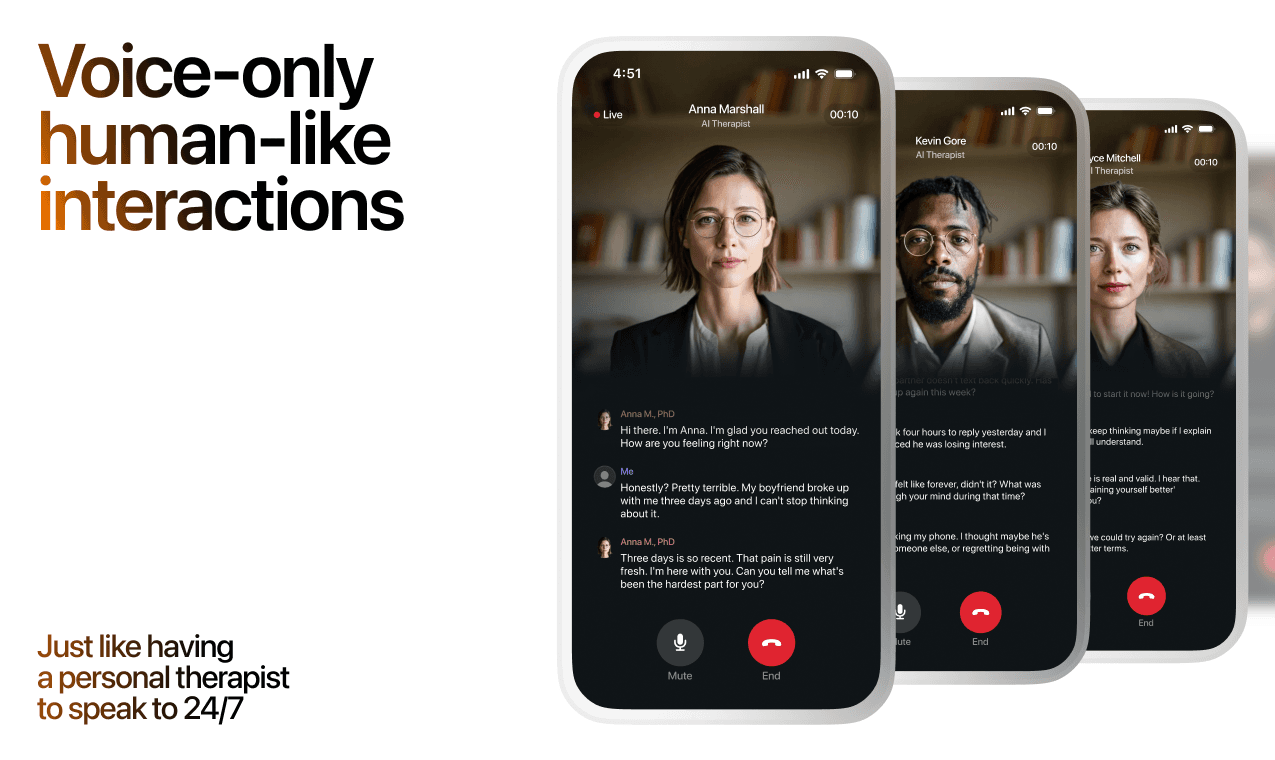
Here's what happens in a typical Lovon session:
You share what's on your mind
There's no script, no intake form, no waiting room. You speak or type whatever you're feeling — in your own words, at your own pace.
Lovon validates and explores
Using frameworks from CBT (Cognitive Behavioral Therapy) and motivational interviewing, Lovon acknowledges your feelings first, then gently helps you explore them. No dismissive "just move on" advice.
You build coping skills together
Lovon doesn't just listen — it actively works with you on evidence-based techniques: thought reframing, urge surfing, behavioral experiments, and more.
What a Session with Lovon Looks Like
When to Seek Professional Help
AI support is a valuable tool, but it's not a replacement for professional care. Please consider reaching out to a licensed therapist if you experience any of the following:
- Persistent thoughts of self-harm or suicide
- Inability to perform daily activities (work, eating, sleeping) for more than 2 weeks
- Turning to alcohol or substances to cope
- Intense anger or desire to harm your ex-partner
- Complete emotional numbness that doesn't improve over time
Crisis Resources (US): If you're in immediate danger, call 988 (Suicide & Crisis Lifeline) or text HOME to 741741 (Crisis Text Line). Available 24/7, free, and confidential.
Outside the US? Find a crisis line in your country
Ready to Start?
Your healing journey can begin right now
A 7-day trial. No judgment. Just a safe space to process what you're going through.
Frequently Asked Questions
Is Lovon a replacement for a real therapist?
Is my conversation with Lovon AI private?
How is Lovon different from ChatGPT for emotional support?
Can I use Lovon if I'm already seeing a therapist?
Can I try Lovon before subscribing?
About the Author
The Lovon Editorial Team
Mental Health & Wellness Content Team
The Lovon Editorial Team develops mental health and wellness content designed to make psychological concepts accessible and actionable. Our goal is to bridge the gap between clinical research and everyday life - helping you understand why your mind works the way it does and what you can do about it....
Related articles
- Nervous System Dysregulation: Signs & Reset Guide 2026
Nervous system dysregulation signs and a 7-step reset for 2026, plus troubleshooting for panic, freeze, and sleep…
- ADHD Motivation: Why You Freeze and How to Start (2026)
ADHD motivation stalls because of how the brain regulates dopamine, not willpower. Learn 7 steps to break the freeze and…
- AI Therapy for ADHD Emotional Regulation 2026
AI therapy for ADHD gives you on-demand voice support for emotional dysregulation, RSD, and mood swings. See which tools…
- ADHD Time Blindness: Why It Happens & How to Cope (2026)
ADHD time blindness is a neurological wiring difference, not laziness. Learn what causes it and 7 practical coping steps…
See also
Quizzes
- Loneliness Test: Free 12-Question Self-Check
See which kind of loneliness is thin, in 3 minutes.
- Empath Test: Do Other People's Moods Become Yours?
See how much of other people's moods you take on.
Free tools
- Am I Overreacting, or Is This a Big Deal?
A chat for the small thing you cannot stop turning over. Say what happened and what you have already told yourself about…
- Self-Esteem Check-In
Eight statements, one read on three sides of self-esteem: your self-talk, how you act with people, and what you do with…
From the wiki
- How to stop maladaptive daydreaming?
Maladaptive daydreaming is immersive waking fantasy that eats hours, usually with music and pacing attached. You rarely…
Disclaimer: This article is for informational purposes only and does not constitute medical advice, diagnosis, or treatment. Always seek the advice of your physician or other qualified health provider with any questions you may have regarding a medical condition. If you are in crisis or think you may have an emergency, call 988 (Suicide & Crisis Lifeline) or go to the nearest emergency room. Outside the US? Find a crisis line in your country.