
Erikson Stage of Intimacy vs Isolation
Many people find themselves in situations where their current social circles feel unfamiliar or distant.

Key Takeaways
- Partners who are open with each other and share their emotions tend to feel more satisfied with both their lives and
- Nearly 40% of adults report feeling lonely at least sometimes
- A strong sense of identity makes intimacy easier
Introduction
Many people find themselves in situations where their current social circles feel unfamiliar or distant. Even when they are surrounded by many people, they may still feel lonely. Psychologist Erik Erikson described this period as the intimacy vs isolation stage. We help you better understand his theory to improve your life.
Erik Erikson and the Stages of Psychosocial Development
Erik Erikson created a well-known psychological theory that explains how people grow and change emotionally throughout life.
| Stage | Core Conflict | Emotional Outcome |
|---|---|---|
| Infancy (birth to ~18 months) | Trust vs Mistrust | Hope |
| Early Childhood (2 to 3 years) | Autonomy vs Shame and Doubt | Will |
| Preschool (3-5 years) | Initiative vs Guilt | Purpose |
| School Age (6-11 years) | Industry vs Inferiority | Confidence |
| Adolescence (12-18 years) | Identity vs Role Confusion | Fidelity |
| Young Adulthood (19-40 years) | Intimacy vs Isolation | Love |
| Middle Adulthood (40-65 years) | Generativity vs Stagnation | Care |
| Later Life (65+ years) | Ego Integrity vs Despair | Wisdom |
According to Erikson, human development unfolds through the eight stages of psychosocial development. Let’s take a closer look at these stages to understand what healthy development looks like and when it may be a sign that something isn’t going quite right.
Trust vs Mistrust
The first stage happens in the earliest years of life, when children are completely dependent on the adults who care for them. The development of trust or mistrust depends on how consistently adults respond to the child’s basic needs. For example, when a child is fed on time and adults respond attentively to signs of distress, the child begins to feel safe and develops trust. When these needs are ignored, the child may experience ongoing anxiety and develop mistrust, beginning to see the world as an unsafe place.
Autonomy vs Shame and Doubt
The second stage usually appears during early childhood. Children begin exploring independence as they learn basic physical and cognitive skills. During this period, children begin making their first independent decisions, such as how to move and choose what to interact with. However, the caregiver’s role remains critical in shaping the child’s development. When caregivers support exploration and respond calmly when a child makes mistakes, children develop a healthy sense of autonomy. If caregivers criticize or punish the child for small missteps, the child may begin to feel shame and hesitate before taking action in the future.
Initiative vs Guilt
The third stage focuses on curiosity and initiative. Kids begin actively exploring the world around them and learning about boundaries.
Developmental psychologists have studied how this early initiative shapes later confidence. Research from the NICHD Study of Early Child Care and Youth Development, which followed more than 1,300 children across the United States, found that children whose caregivers encouraged exploration and decision-making in early childhood demonstrated significantly higher levels of social confidence and classroom engagement by age 7.
When a child receives consistent support while exploring the world, they develop positive experiences and become more open to trying new things and taking initiative. If support is missing, they may become more passive and avoid taking action because they begin to feel constant guilt.
Industry vs Inferiority
School-age children enter the fourth stage. At this stage, children begin comparing themselves with others and try to be successful. If they build positive relationships with other children and achieve success in school, they develop a sense of industry. They start to believe that effort leads to improvement and positive results. However, if they repeatedly struggle and comparisons with others lead to negative feelings, feelings of inferiority may develop. In this situation, children may begin to see themselves as less capable than others and may stop putting effort into future challenges.
Identity vs Role Confusion
Adolescence introduces one of the most significant psychosocial stages: identity formation. Teenagers begin asking fundamental questions about values and personal identity. They explore interests and social roles while trying to understand where they belong. When this exploration leads to a clear sense of identity, individuals gain internal stability. They understand their boundaries and priorities. If identity remains unclear, role confusion may develop. This uncertainty can later affect the ability to form stable partnerships and meaningful relationships, which becomes central in the next stage.
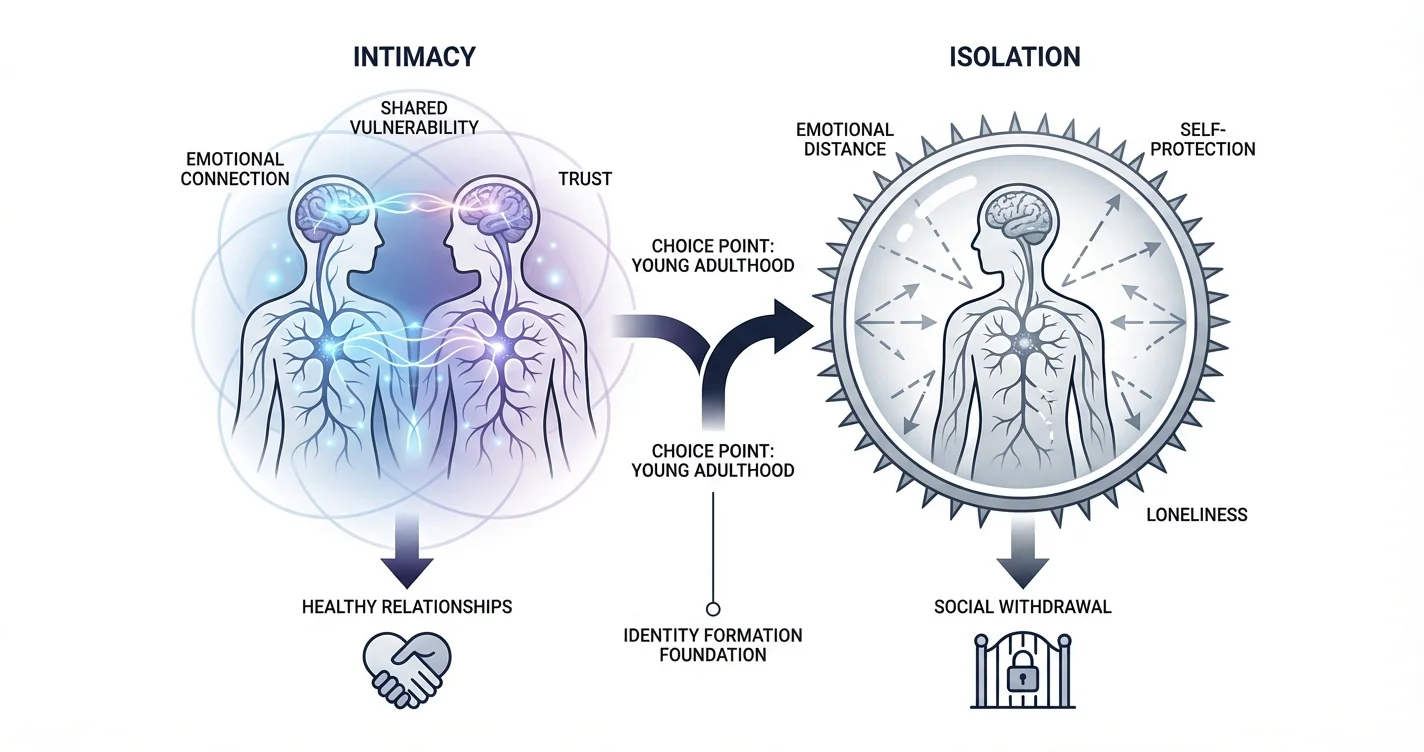
Intimacy vs Isolation
Erikson’s sixth stage focuses on the conflict between intimacy and isolation. This stage usually appears when young adults begin forming deeper emotional connections with others. According to Erikson, individuals at this stage attempt to form close bonds through romantic partnerships, friendships, and emotional collaboration. Intimacy involves trust, vulnerability, and the willingness to share personal experiences with another person. Successful resolution of this stage allows individuals to build meaningful relationships that provide emotional support and stability. When intimacy feels unsafe or overwhelming, isolation may develop. Isolation in Erikson’s model does not only mean physical solitude. It refers to difficulty forming deep emotional connections. This outcome may lead to loneliness or hesitation to trust others.
Generativity vs Stagnation
The seventh stage appears during middle adulthood. Navigating this stage, people begin not only taking from life but also giving back in order to support future generations. Many become mentors, teachers, or researchers who want to contribute to society. When people see that their work is valued and recognized, they receive positive reinforcement, feel a sense of purpose and productivity, and are motivated to contribute even more. However, when this recognition is missing, people may fall into stagnation and lose not only their sense of purpose but sometimes even their motivation to keep moving forward in life.
Integrity vs Despair
The final stage typically occurs later in life. Individuals reflect on their experiences and evaluate how they lived. Integrity develops when people feel their life had meaning and coherence. They accept successes and failures as part of a complete story. This stage also includes a negative outcome. Despair may appear when someone feels regret about how life unfolded.
What Is Intimacy?
Intimacy means emotional closeness that feels safe. It is the moment when you can speak honestly about your fears or insecurities and the other person responds with care.
Many people think intimacy appears automatically inside a romantic relationship. In reality, intimacy develops through repeated moments of emotional openness and trust. Two people share something personal. The other person responds with empathy rather than criticism. Over time this process leads to intimacy.
Research supports this idea. A study published in the Journal of Social and Personal Relationships analyzed emotional disclosure in couples and found that partners who regularly shared personal feelings reported 36 percent higher relationship satisfaction than those who avoided emotional conversations.
Another large study from the University of Chicago examined loneliness across the United States. Researchers found that nearly 40 percent of adults report feeling lonely at least sometimes, even when they are surrounded by people. People who maintained intimate relationships were significantly less likely to report chronic loneliness.
Intimacy also connects closely to identity. Erik Erikson’s theory explains that the ability to develop intimacy appears during the stage called intimacy and isolation. This stage usually occurs when people start building long-term partnerships and deeper friendships. Emotional closeness becomes possible when a person feels secure enough in their own identity to share vulnerability with someone else. Without that sense of safety, people may keep conversations on the surface. From the outside the relationship may look stable, yet the emotional distance remains.
Benefits of Intimacy
Intimacy changes how people experience relationships and stress. Emotional closeness makes it easier to navigate conflict and difficult life events.
Studies consistently show measurable psychological benefits. The Harvard Study of Adult Development, one of the longest running studies on human well being, tracked participants for more than 80 years. Researchers concluded that the strongest predictor of happiness and long-term health was the presence of close supportive relationships. People in healthy relationships often experience lower anxiety levels and stronger emotional regulation. Emotional support from a partner can reduce the intensity of stressful experiences such as work pressure or family conflict.
Intimacy strengthens communication. Couples who feel emotionally safe inside a loving relationship are more likely to discuss problems early rather than avoiding them.
Intimacy brings happiness and reduces the anxious feeling of loneliness and social isolation. When you see that someone understands and accepts you, you feel less stress and become more willing to share different parts of your life with that person.
The Consequences of Isolation
Isolation is a concept that refers to a state where close relationships feel difficult or unsafe, even when other people are physically present. Isolation examples: Someone may have coworkers or even a partner and still experience isolation if real emotional connection is missing. This idea sits at the center of Erikson’s intimacy vs isolation stage. The conflict appears when a person wants closeness but struggles to trust emotional vulnerability. This isolation conflict represents a turning point in adult development. The outcome of the stage often leads to intimacy or isolation depending on how a person navigates emotional risk and connection.
A person does not usually notice this process immediately. Isolation tends to grow quietly. You might see the pattern in everyday situations. For example, someone stops sharing personal thoughts with their partner because previous conversations felt misunderstood. The person is not completely alone, but emotional distance still exists.
Psychologists describe this state as emotional isolation. Emotional isolation appears when someone no longer feels comfortable expressing vulnerability. Conversations remain polite or functional, yet deeper emotions stay hidden. Research shows how widespread this experience has become. A national survey conducted by Cigna reported that 58 percent of adults in the United States say they sometimes feel lonely, and nearly one third report frequent loneliness.
This is why loneliness and isolation are closely connected but not identical. Loneliness describes the emotional pain of disconnection. Isolation describes the psychological pattern that often creates that pain. Many people slowly retreat into isolation after repeated experiences of rejection or emotional disappointment. The brain learns to protect itself by avoiding vulnerability.
However, this protective strategy has consequences. The effects of isolation appear both emotionally and physically. Research published in Perspectives on Psychological Science found that long term social isolation increases the risk of premature mortality by around 26 percent, a level comparable to major health risk factors such as obesity.
Isolation also affects how the brain interprets social signals. When someone remains emotionally disconnected for long periods, they may begin to expect rejection even in neutral situations. The psychological conflict pushes people to decide whether they will risk emotional closeness or continue protecting themselves through distance.
The outcome is not permanent. A person can still move from isolation to intimacy when emotional safety becomes possible again. That transition often begins with small steps. For example, a relationship where vulnerability is respected rather than dismissed. These moments slowly rebuild emotional trust.
When emotional openness becomes possible again, the same relationships that once felt risky can begin to feel supportive. Over time, that change allows individuals to build deeper bonds and move toward the kind of connection that reduces loneliness and strengthens long-term well-being.
How to Build Intimacy?
Most people expect connection to appear naturally inside a relationship, but research shows that deep intimacy develops through specific behaviors repeated over time. The process begins with a stable sense of self. People who understand their own needs, values, and emotional boundaries are more likely to create relationships where openness feels safe. This idea sits at the center of Erik Erikson’s theory and his stage of intimacy versus isolation.
This conflict happens in young adulthood. During this life stage, individuals are often still strengthening their identity in young adulthood, which can make emotional closeness feel both exciting and intimidating. Self understanding makes intimacy possible because it reduces fear of vulnerability.
Another important factor is emotional transparency. Intimacy grows when people talk about real experiences instead of only sharing surface-level information. Conversations about stress, hopes, fears, and personal values slowly create emotional trust. A study from the University of Rochester found that couples who regularly share personal experiences and emotional concerns report 30 to 40 percent higher relationship satisfaction than couples who avoid these conversations.
Intimacy also requires stability. To strengthen it, people need to maintain regular contact and show consistent care. For example, staying in touch through messages and being attentive to the other person’s problems and feelings.
How to Overcome Isolation?
Isolation develops slowly when someone begins protecting themselves from emotional risk. Repeated disappointment, misunderstanding, or rejection can push a person toward distance. Over time the mind may decide that avoiding vulnerability feels safer than risking connection. However, isolation can lead to deeper loneliness if it continues long enough.
Research from the National Academies of Sciences found that chronic social isolation increases the risk of depression and anxiety and is associated with a 50 percent higher likelihood of cognitive decline later in life. This is why Erikson’s intimacy versus isolation stage plays such a significant role in emotional development. The outcome of this stage often shapes relationship patterns for years to come. In Erikson’s framework, the conflict stage leads either toward intimacy or toward emotional withdrawal.
Isolation does not mean someone lacks social contact. A person may still have colleagues, acquaintances, or casual friendships and yet feel emotionally disconnected. Isolation appears when vulnerability feels unsafe.
The first step in overcoming isolation is rebuilding emotional safety. This often begins with small interactions. For example, sharing one honest thought during a conversation.
Another important step involves reconnecting with identity. Many people experience isolation during periods when their direction or values feel unclear. In this state, they may feel closed off from others and even from themselves. That is why it is important to pause and reflect on what truly matters to you and who you are. This can help you choose the right circle of people and connect with them more easily.
Real connection rarely appears all at once. For many people, this stage simply becomes the moment when they realize they want something deeper, some fulfilling relationships. If you sometimes notice distance between yourself and others, it does not mean something is wrong with you. It may simply mean you are still learning how to let someone see the real you. And that process takes time and relationships where you feel safe enough to be honest.
How AI Support Helps You Heal
AI emotional support isn't about replacing human connection — it's about filling the gaps. The moments when you need to talk at 2 AM, when you don't want to burden your friends again, or when you simply need someone to listen without judgment.
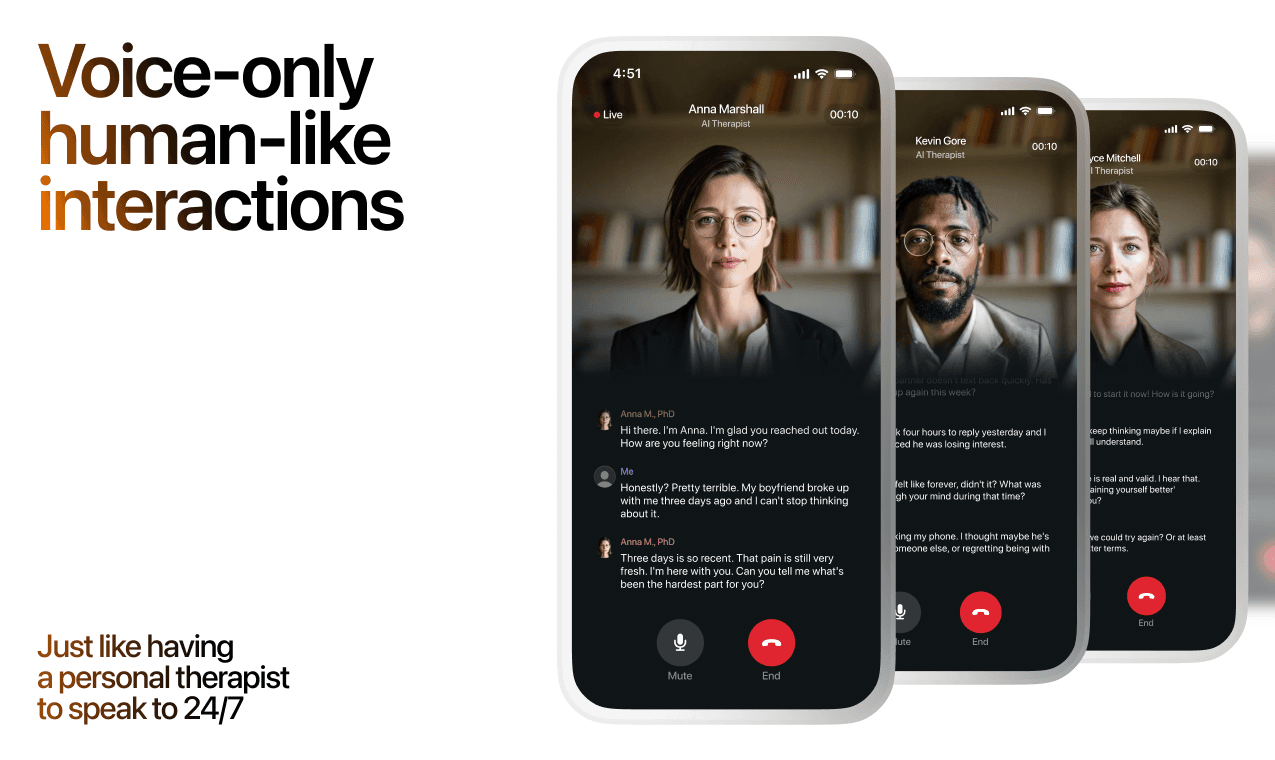
Here's what happens in a typical Lovon session:
You share what's on your mind
There's no script, no intake form, no waiting room. You speak or type whatever you're feeling — in your own words, at your own pace.
Lovon validates and explores
Using frameworks from CBT (Cognitive Behavioral Therapy) and motivational interviewing, Lovon acknowledges your feelings first, then gently helps you explore them. No dismissive "just move on" advice.
You build coping skills together
Lovon doesn't just listen — it actively works with you on evidence-based techniques: thought reframing, urge surfing, behavioral experiments, and more.
What a Session with Lovon Looks Like
When to Seek Professional Help
AI support is a valuable tool, but it's not a replacement for professional care. Please consider reaching out to a licensed therapist if you experience any of the following:
- Persistent thoughts of self-harm or suicide
- Inability to perform daily activities (work, eating, sleeping) for more than 2 weeks
- Turning to alcohol or substances to cope
- Intense anger or desire to harm your ex-partner
- Complete emotional numbness that doesn't improve over time
Crisis Resources (US): If you're in immediate danger, call 988 (Suicide & Crisis Lifeline) or text HOME to 741741 (Crisis Text Line). Available 24/7, free, and confidential.
Outside the US? Find a crisis line in your country
Ready to Start?
Your healing journey can begin right now
A 7-day trial. No judgment. Just a safe space to process what you're going through.
Frequently Asked Questions
Q: What is stage six in Erikson’s theory of psychosocial development?
Q: Why does intimacy require a strong sense of identity?
Q: How do intimacy skills affect adult relationships?
Q: Can someone experience intimacy and isolation at the same time?
Q: What helps reduce feelings of isolation in adulthood?
About the Author

Mireya Tabasa
Mental Health Support Specialist & AI Advisor
Mireya Tabasa is a Mental Health Support Specialist working at the intersection of clinical care and technology. With over 4 years of hands-on experience supporting diverse populations facing mental health challenges in educational and healthcare settings, she brings frontline clinical insight to ev...
Related articles
- Can a relationship survive without physical intimacy?
Can a relationship survive without physical intimacy? Yes, if both partners accept it. Learn how to discuss unmet needs…
- Best Couples Compatibility Quiz for New Couples 2026
Take the best couples compatibility quiz in 2026. Covers attachment, values, and communication style — with AI-guided…
- Feedback vs Criticism in Relationships: Healthy Intimacy or Harsh Judgment
Every intimate relationship encounters moments where partners need to address concerns, express disappointment, or…
- Marriage Compatibility Quiz Before Marriage (2026)
A marriage compatibility quiz reveals values gaps on finances, parenting, and conflict style. See the top picks for 2026…
See also
Quizzes
- Am I in Love? 13-Question Gut Check
Know what you feel in 2 minutes.
- Should I Move In With My Boyfriend? 12-Question Quiz
Check what is settled before the lease.
Free tools
- How to Tell Someone You Love Them
How to tell someone you love them is rarely about the words, which are short. It is about the moment and the answer…
- Words of Affirmation Examples, Written for Your Partner
Words of affirmation examples are easy to find. Ones that fit your partner are not. Tell it what they did lately, what…
From the wiki
- How many dates before a relationship?
There is no set number. People often say five to ten dates, but that range is really describing five to ten weeks of…
Disclaimer: This article is for informational purposes only and does not constitute medical advice, diagnosis, or treatment. Always seek the advice of your physician or other qualified health provider with any questions you may have regarding a medical condition. If you are in crisis or think you may have an emergency, call 988 (Suicide & Crisis Lifeline) or go to the nearest emergency room. Outside the US? Find a crisis line in your country.