
How to Let Go of Someone You Love & Move On Gracefully
Letting go of someone you love is one of the hardest things. Sometimes you may feel okay, but then you walk down the street, hear a song you shared with...

Key Takeaways
- Allow yourself to still feel the love, even if the relationship was unhealthy, healing does not require denying your
- Learn to let go gracefully, by accepting what happened without reopening the same wound
- When looking back, try not to idealize the past or deny the reasons why things did not work
Introduction
Letting go of someone you love is one of the hardest things. Sometimes you may feel okay, but then you walk down the street, hear a song you shared with that person, and suddenly it feels very painful. There is no magic solution, but we will try to explain why this happens and what you can do to feel better.
Why Is It So Hard to Forget Someone You Love?
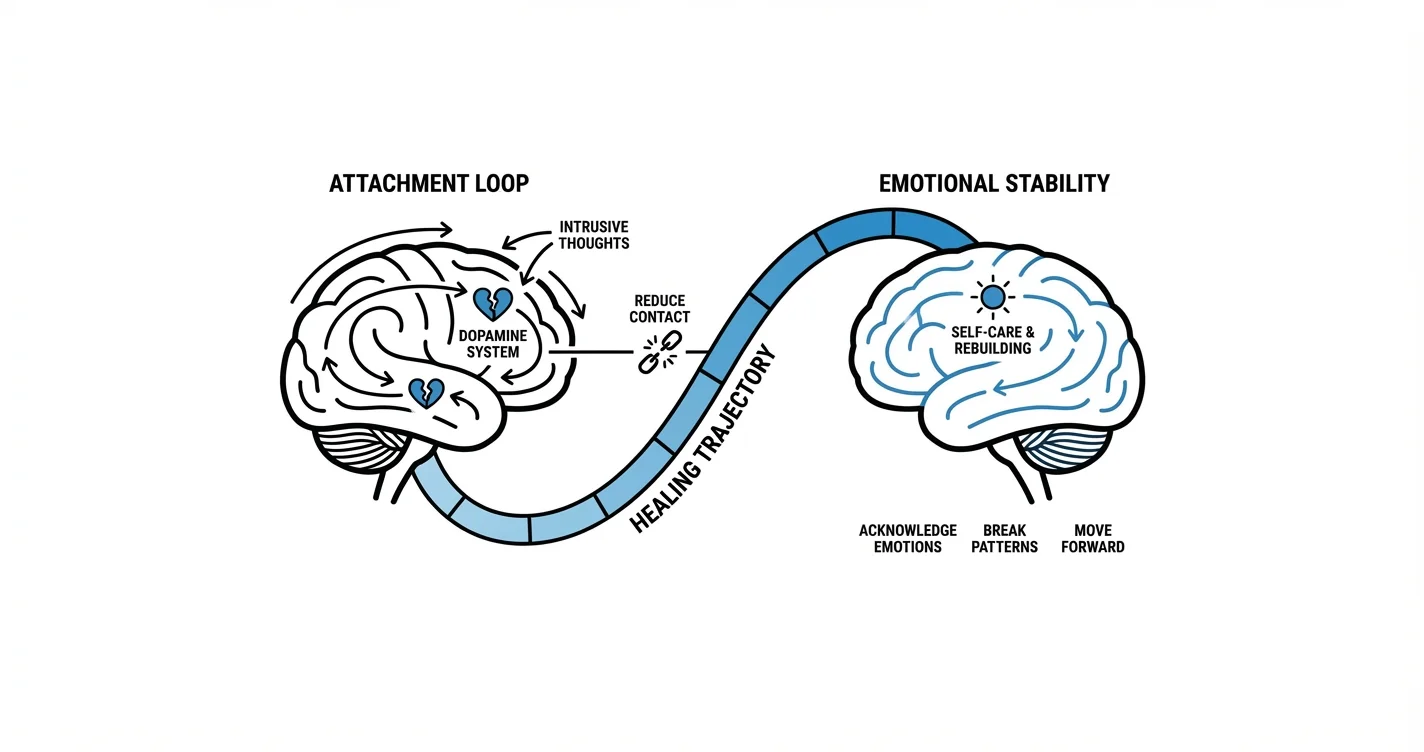
Forgetting someone you love is difficult because your brain treats that connection as something important for your survival, not just your happiness. Neuroscience research helps explain why. Studies by Helen Fisher using brain imaging show that after a breakup, the same areas linked to reward and craving remain active. In one study, participants who had recently gone through a breakup still showed strong activation in the dopamine system when looking at photos of their ex, similar to patterns seen in addiction. This is why thoughts about an ex can feel intrusive and repetitive.
There is also a time factor. Longitudinal studies on breakup recovery show that emotional attachment does not decline in a straight line. In one dataset, individuals still reported strong emotional connection 6 to 12 months after a breakup, especially if the relationship had high emotional intensity. This is why you can logically know it is over and still feel love at the same time.
How to Forget Someone You Love: 7 Effective Strategies for Healing
There is no single solution to let go of someone you loved very much. But there are some strategies that help many people move forward step by step.
Acknowledge What You Feel Instead of Avoiding It
Research in psychology shows that trying to suppress emotions often makes them stronger. Studies by psychologist James J. Gross from Stanford University found that emotional suppression increases physiological stress responses and reduces emotional clarity. When people try to push emotions away instead of recognizing them, the feelings often return with greater intensity.
Additional research by Matthew Lieberman at University of California, Los Angeles shows that naming and acknowledging emotions can reduce activity in the brain’s threat response systems. In brain imaging studies, participants who labeled their emotions showed lower activity in the amygdala, which is linked to emotional stress.
This is why many therapists encourage people to recognize emotions instead of avoiding them. Acknowledging feelings such as sadness or loss helps the nervous system process the experience rather than storing it as unresolved stress.
Validate Your Experience Without Minimizing It
After a breakup, it is common to question whether your reaction is “too much.” People often minimize their own feelings, especially if the relationship was complicated or not perfect.
Work by psychologist Leslie S. Greenberg, a developer of Emotion-Focused Therapy, shows that acknowledging and accepting emotions is an important step in processing them. Studies in emotion regulation also show that when people recognize and label their emotional experience, their stress response becomes more stable and emotional intensity decreases over time.
Additional research by psychologist Matthew Lieberman from University of California, Los Angeles found that simply putting feelings into words can reduce activity in the brain’s threat response systems. This suggests that validating emotions instead of dismissing them helps the brain process difficult experiences more effectively.
An example is actress Jennifer Aniston. After her widely publicized divorce from Brad Pitt, she spoke in interviews about allowing herself to acknowledge the emotional impact of the breakup rather than pretending everything was fine.
Reduce Contact to Break the Attachment Loop
Reducing contact after a breakup can help interrupt the emotional attachment loop. Studies by psychologist Helen Fisher from Rutgers University used brain imaging to examine people who had recently experienced romantic rejection. The research found that reminders of an ex-partner activated brain regions linked to craving and reward, including areas associated with dopamine. This helps explain why continued contact can make it harder for the brain to move on.
Reducing exposure gives the nervous system time to recalibrate. Instead of constantly triggering the emotional response tied to the relationship, distance allows those reactions to gradually weaken.
Adele used this approach and it helped her. She spoke about stepping back from contact and focusing on her own life after a difficult breakup. She later described how creating distance helped her regain emotional stability and perspective.
Talk to Friends and Family Instead of Isolating
It is important to remember that you are not alone and not to feel ashamed of what you are going through. Have the courage to ask your friends and family for help. Their support can help reduce stress and negative feelings and remind you that life continues, and you can still be happy.
Pay Attention to Unconscious Patterns Around Love
Breakups often reveal patterns that were difficult to see during the relationship. Many people assume that attraction and relationship behavior are purely personal choices, but research shows that these patterns often follow predictable psychological mechanisms.
Attachment research based on the work of John Bowlby and later expanded by Cindy Hazan and Phillip R. Shaver demonstrates that early relational experiences shape expectations about closeness and conflict in adulthood. In their landmark 1987 study on adult romantic attachment, researchers found that attachment styles identified in childhood reliably predicted how adults approached intimacy, trust, and separation.
Large-scale reviews of attachment research show that roughly 40-50% of adults fall into insecure attachment categories, which are associated with recurring relationship dynamics such as staying in unstable relationships longer, difficulty leaving unhealthy dynamics, or repeatedly choosing emotionally unavailable partners.
Clinical observations show that breakups often make these patterns visible. A person may realize, for example, that they tend to remain in relationships long after warning signs appear, or that they avoid ending relationships even when they recognize that the situation is not healthy.
Recognizing these patterns is a first step in moving to a healthy life and healthy relationship.
Focus on Self-Care and Rebuilding Stability
Research in sleep and emotional regulation shows that insufficient sleep increases emotional reactivity and reduces the brain’s ability to regulate stress. Studies by neuroscientist Matthew P. Walker from University of California, Berkeley found that sleep deprivation increases activity in the amygdala, the brain region involved in emotional threat responses, by up to about 60% compared with well-rested individuals.
Research summarized by Harvard Medical School shows that regular exercise improves mood regulation and reduces symptoms of stress and depression by influencing neurotransmitters such as serotonin and dopamine.
Self-care is not just a word. It is about caring for yourself and remembering that you deserve it. Pay more attention to your thoughts and feelings. Spend time with people who make you feel good and choose activities that bring you positive emotions. This will not remove the hurt right away, but it can help you slowly let go of painful feelings and live a better life.
Allow Yourself to Move Forward Without Replacing the Past
Many people think the best thing to do is erase the past and forget it. But this is not always the healthiest approach. In the long term, those feelings often return. You do not need to get rid of your past. It is better to accept it and remember it, especially the good parts. But do not let the past define who you are or become the only thing you live with. Allow yourself to move forward with that past and the experience it gave you. You can build a future that is meaningful and good both for yourself and for others.
How Long Does It Take to Forget Someone You Love?
There is no exact timeline because every situation is different. For some people, six days may be enough. For others, even a year may not be enough. Do not rush yourself. Give your feelings time and space so you can move forward. It is also important to understand what you need in order to move on. Sometimes it helps to stop overthinking about what could have been and allow yourself to close that chapter. If the relationship was toxic, recovery may take much longer, and in some cases support from a professional can help.
When to Seek Professional Help?
There is a difference between going through a healing process and feeling stuck in it. Grief after a breakup is expected. You need time to grieve, especially if the relationship was meaningful. But if the intensity does not decrease over time or begins to interfere with your daily life, it may be a sign that additional support would help.
Research in mental health shows that people who engage in counseling after a breakup often experience faster emotional stabilization and improved coping compared to those who try to process everything alone. This is because structured support helps organize thoughts and reduce emotional overload.
If you feel unable to move forward, if thoughts about the relationship dominate your day, or if your self-worth has been significantly affected, especially after a toxic relationship, these are indicators that the process may need more support.
How AI Support Helps You Heal
AI emotional support isn't about replacing human connection — it's about filling the gaps. The moments when you need to talk at 2 AM, when you don't want to burden your friends again, or when you simply need someone to listen without judgment.
Here's what happens in a typical Lovon session:
You share what's on your mind
There's no script, no intake form, no waiting room. You speak or type whatever you're feeling — in your own words, at your own pace.
Lovon validates and explores
Using frameworks from CBT (Cognitive Behavioral Therapy) and motivational interviewing, Lovon acknowledges your feelings first, then gently helps you explore them. No dismissive "just move on" advice.
You build coping skills together
Lovon doesn't just listen — it actively works with you on evidence-based techniques: thought reframing, urge surfing, behavioral experiments, and more.
What a Session with Lovon Looks Like

When to Seek Professional Help
AI support is a valuable tool, but it's not a replacement for professional care. Please consider reaching out to a licensed therapist if you experience any of the following:
- Persistent thoughts of self-harm or suicide
- Inability to perform daily activities (work, eating, sleeping) for more than 2 weeks
- Turning to alcohol or substances to cope
- Intense anger or desire to harm your ex-partner
- Complete emotional numbness that doesn't improve over time
Crisis Resources (US): If you're in immediate danger, call 988 (Suicide & Crisis Lifeline) or text HOME to 741741 (Crisis Text Line). Available 24/7, free, and confidential.
Outside the US? Find a crisis line in your country
Ready to Start?
Your healing journey can begin right now
A 7-day trial. No judgment. Just a safe space to process what you're going through.
Frequently Asked Questions
Is Lovon a replacement for a real therapist?
Is my conversation with Lovon AI private?
How is Lovon different from ChatGPT for emotional support?
Can I use Lovon if I'm already seeing a therapist?
Can I try Lovon before subscribing?
About the Author

Mireya Tabasa
Mental Health Support Specialist & AI Advisor
Mireya Tabasa is a Mental Health Support Specialist working at the intersection of clinical care and technology. With over 4 years of hands-on experience supporting diverse populations facing mental health challenges in educational and healthcare settings, she brings frontline clinical insight to ev...
Related articles
- Why Am I So Angry? Understanding & Dealing With Anger
Anger is a normal emotion that everyone experiences at some point. What makes it different from emotions like joy is…
- Why Do I Zone Out So Much? Reasons and How to Fix Your Brain Function
Imagine you are talking with a friend and suddenly stop because you lose the context and forget what you were saying.
- Emotionally Unavailable Man: Signs You Keep Attracting Him
Sometimes it may feel like you’re unlucky, like things just never work out with your partner and every relationship goes…
- Grief after a breakup: why it hurts like a death
Why the end of a relationship sets off real grief, how it differs from mourning a death, and what helps when nobody…
See also
Quizzes
- Should I Break Up With My Boyfriend? 12-Question Quiz
Twelve questions on whether the doubt has settled.
- Am I Over My Ex? 12-Question Gut Check
Post-breakup check-in in 2 minutes.
Free tools
- Breakup Message Writer
A chat for saying it once. Tell it how long it has been and why now, and get a message you could actually send, plus the…
- How to Ask for Space Without Ending It
A chat for when you need distance but not a breakup. Say the sentence you keep rehearsing and what you are afraid they…
From the wiki
- How do you move on from an ex?
Moving on is two jobs at once. Grief takes the time it takes and is mostly out of your control. The other job is the…
Disclaimer: This article is for informational purposes only and does not constitute medical advice, diagnosis, or treatment. Always seek the advice of your physician or other qualified health provider with any questions you may have regarding a medical condition. If you are in crisis or think you may have an emergency, call 988 (Suicide & Crisis Lifeline) or go to the nearest emergency room. Outside the US? Find a crisis line in your country.