
Not Good Enough? Therapy for Feeling Good Enough
You just finished a very hard task and helped the company succeed. You felt happy for a moment, but then a quick thought came to your mind that it was not...

Key Takeaways
- Take time to reflect on your progress instead of immediately moving to the next goal
- Build a healthier mindset by recognizing effort, not just outcomes
- Avoid constant comparison and the need to compete, especially during the adolescent years
Introduction
You just finished a very hard task and helped the company succeed. You felt happy for a moment, but then a quick thought came to your mind that it was not enough. Many people feel this way, and it is something you can work on. We’ll be glad to explain how.
Why You Might Feel Like You’re Never Good Enough?
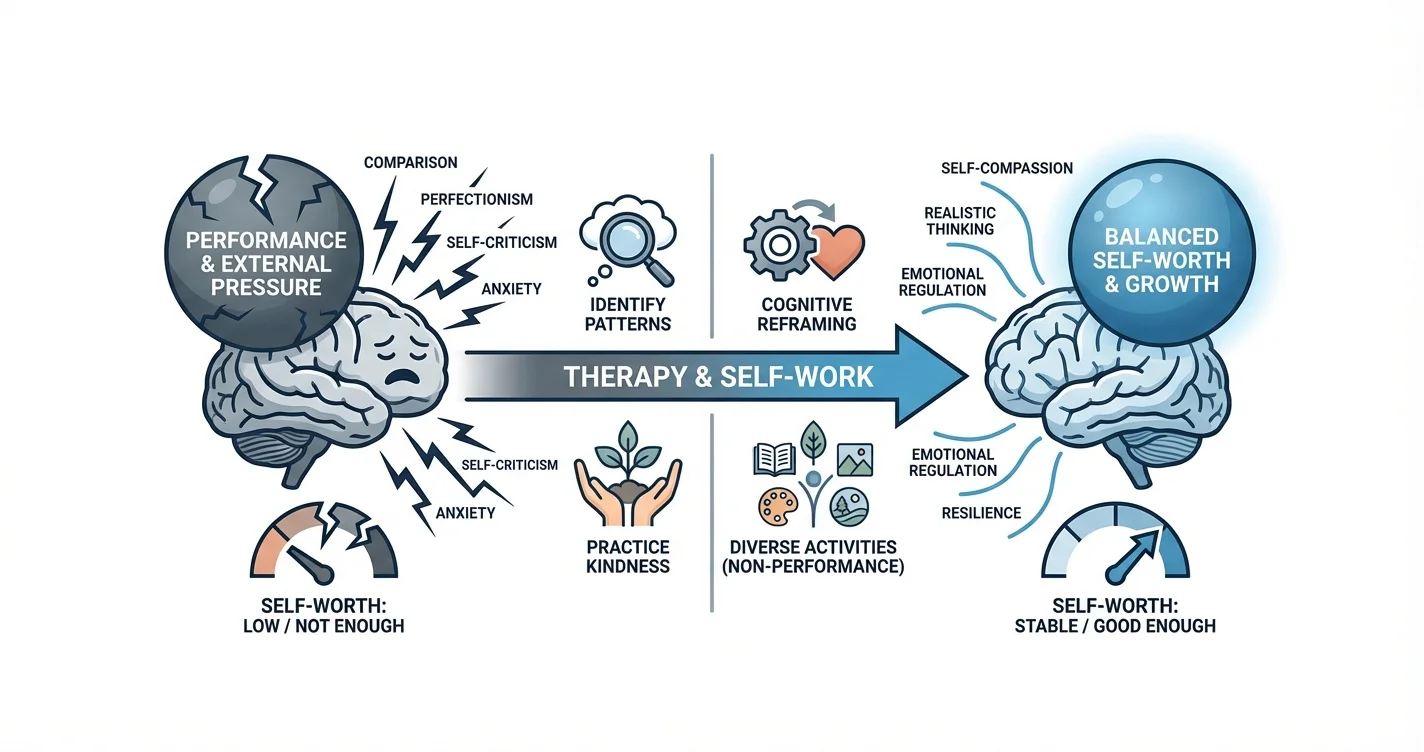
The reasons can be different, and they usually develop over time, not in one single moment. Here are some of the most common reasons:
- low self-esteem and strong self-criticism
- perfectionism that leads to anxiety and frequent dissatisfaction with yourself
These patterns can come from different backgrounds, for example from extremely difficult and demanding conditions in your family in the past, and then continue into your adult life.
Over time, these patterns reinforce a single belief: “Whatever I do, it’s not enough.”
What Therapy for Self-Worth Can Look Like?
A therapist will usually start by helping you identify the specific negative thoughts that appear automatically. These thoughts can be so familiar that you may not notice them yourself, but when the therapist listens to your story, they will help point them out. Once they become clear, the therapist will help you understand where these patterns came from. Very often these patterns develop in childhood, so you can expect many questions about that part of your life.
Research on cognitive behavioral therapy shows that working with these patterns directly can reduce negative thinking and improve emotional regulation over time. But it requires repetition and consistency.
How Long Does It Take to Feel Good Enough?
Unfortunately, there is no single answer here because people and their situations are different. For some people, 8 sessions may be enough. For others, even half a year may not be enough. The total time will be different depending on your unique situation, your openness, and your willingness to work on your problems. A specialist can guide you, but cannot force you to work on yourself and cannot guarantee how many sessions it will take for you to feel much better. The only thing you can be sure of is that, over time, things can improve.
Can You Build Self-Worth Without a Therapist?
Yes, you can build self worth without seeking therapy, but the outcome depends on how deeply the pattern is rooted and how consistently you work with it.
A real example is entrepreneur Howard Schultz, the former CEO of Starbucks. Schultz grew up in a very poor neighborhood in Brooklyn and often spoke about feeling like he did not belong in business environments early in his career. Instead of therapy, he worked on his confidence through education, mentorship, and gradually taking on leadership roles. Over time, building skills and proving to himself that he could succeed helped strengthen his sense of self-worth.
What You Can Start Doing Right Now?
You do not need to be a superhero who fixes all negative patterns in one day and becomes perfect. Moving toward healthy relationships is a process, and it starts with small steps. Here are some things you can start doing today.
Notice Negative Self-Talk Without Immediately Believing It
Research in cognitive therapy shows that creating distance from negative thoughts can reduce their emotional impact. This idea is widely used in Cognitive Behavioral Therapy (CBT) developed by psychiatrist Aaron T. Beck and later expanded in related therapies.
Studies in cognitive psychology show how common negative thoughts are. For example, research by psychologists Matthew A. Killingsworth and Daniel T. Gilbert from Harvard University found that people spend about 47% of their waking time mind wandering, and much of this internal thinking includes self-evaluation and worry.
In therapeutic practice, a common technique is to notice the thought without immediately accepting it as truth. For example, a person may think “I am failing” after making a small mistake at work. Instead of accepting the thought, they pause and reframe it as “I am having the thought that I am failing.” This small shift creates psychological distance and reduces the emotional intensity of the reaction.
Stop Comparing Yourself to Others in a Way That Feels Harmful
Research by psychologist Leon Festinger introduced Social Comparison Theory, which explains that people naturally evaluate themselves by comparing with others. Modern studies from University of Pennsylvania led by psychologist Melissa G. Hunt found that reducing social media use to about 30 minutes per day significantly lowered feelings of loneliness and depression in students.
This does not mean you should never compare yourself to others. It means noticing when comparison starts to interfere with how you see yourself and reinforces the belief that you are inferior.
A simple real-life example is a student who felt confident about their progress during the semester. After spending an hour scrolling through social media and seeing posts about internships and achievements, they suddenly felt behind and inadequate, even though their real situation had not changed.
Challenge the Perfectionism Standard Instead of Trying to Meet It
Psychologist Paul L. Hewitt and researcher Gordon L. Flett have studied perfectionism for decades and found that people with strong perfectionist traits often report higher anxiety and lower life satisfaction because their expectations keep rising after each achievement.
Another widely cited study by psychologist Thomas Curran from University of Bath and Andrew P. Hill from York St John University analyzed data from more than 40,000 students between 1989 and 2016. The researchers found that perfectionism has significantly increased over time, and higher levels of perfectionism are strongly linked to anxiety and constant self-criticism.
Let's see an example: A person finishes a complex project and receives positive feedback from their team. Instead of feeling satisfied, they immediately focus on the one small detail that could have been better. Even though the overall result was successful, their attention stays on the flaw.
The important shift is not lowering your standards. It is recognizing when the standard itself is unrealistic and adjusting it to something practical and functional.
Replace Harsh Self-Talk With More Accurate Thinking
Research in CBT developed by psychiatrist Aaron T. Beck shows that extreme negative thinking often strengthens anxiety and self-doubt. Instead of forcing overly positive statements, CBT focuses on balanced and realistic thinking.
Studies by psychologist Ethan Kross from University of Michigan found that changing the way people talk to themselves can help regulate emotions and reduce stress in difficult situations.
A real example often discussed publicly is tennis player Serena Williams. After losing important matches early in her career, she spoke about learning to change the way she talked to herself during competition. Instead of thinking “I’m playing terribly” or “I can’t win this,” she trained herself to use more balanced thoughts like focusing on the next point or the next serve. Sports psychologists often highlight this shift because replacing harsh self-talk with more realistic thinking helps athletes maintain focus under pressure.
Spend Time on Things That Are Not Based on Performance
Studies in mental health show that when a person’s self-worth depends only on achievement, emotional pressure becomes much higher. Research by psychologist Kristin Neff from University of Texas at Austin on self-compassion found that people who build value from multiple areas of life report lower anxiety and more stable self-esteem than those whose self-worth depends only on performance.
Psychologists often explain that adding activities that are not evaluated helps balance the mind. These activities can include hobbies, volunteering, spending time with friends, or creative work where there is no pressure to succeed.
Keanu Reeves is a good example. Despite being one of the most successful actors in Hollywood, he is known for spending time on simple activities like riding motorcycles, reading, and supporting charities quietly without publicity. He has often said that these parts of life help him stay grounded and prevent his sense of value from depending only on career success.
Practice Kindness Toward Yourself in Difficult Moments
Research by Kristin Neff from University of Texas at Austin shows that self-compassion improves emotional resilience and reduces negative self-evaluation. In her studies with thousands of participants, people with higher self-compassion reported lower anxiety and more stable self-esteem compared with those who relied mainly on self-criticism.
An example is gymnast Simone Biles. During the 2020 Summer Olympics she stepped back from several competitions to protect her mental health. Later she explained that learning to treat herself with more understanding instead of constant pressure helped her recover and return to training.
Small changes in internal tone can make a noticeable difference. Many people realize that they would never speak to a friend as harshly as they speak to themselves after a mistake. When that tone becomes even slightly more supportive, emotional reactions often become less intense and less exhausting.
We all have different reasons why we are so critical of ourselves. Everyone struggles with different feelings. Self-criticism will not disappear right away, but it is important to slowly move toward more positive self-talk, because you are already good enough. You may just need time to understand that.
How AI Support Helps You Heal
AI emotional support isn't about replacing human connection — it's about filling the gaps. The moments when you need to talk at 2 AM, when you don't want to burden your friends again, or when you simply need someone to listen without judgment.
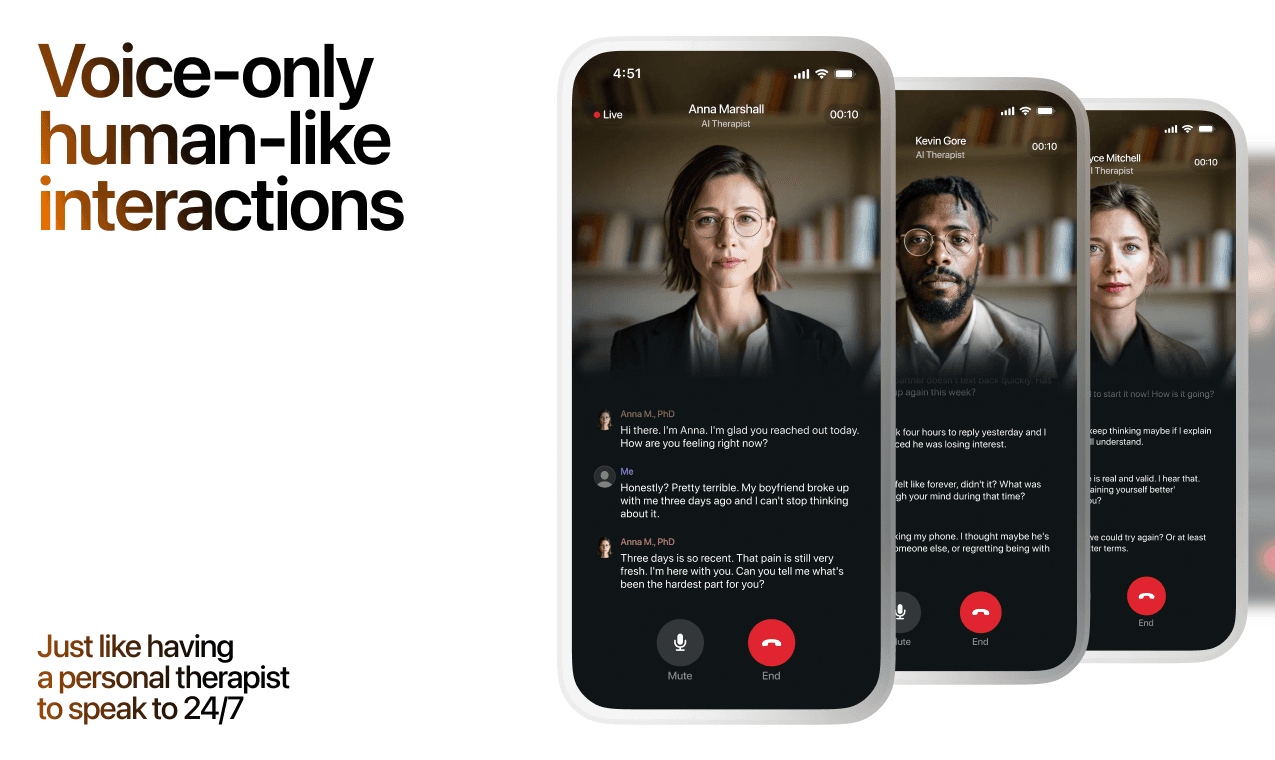
Here's what happens in a typical Lovon session:
You share what's on your mind
There's no script, no intake form, no waiting room. You speak or type whatever you're feeling — in your own words, at your own pace.
Lovon validates and explores
Using frameworks from CBT (Cognitive Behavioral Therapy) and motivational interviewing, Lovon acknowledges your feelings first, then gently helps you explore them. No dismissive "just move on" advice.
You build coping skills together
Lovon doesn't just listen — it actively works with you on evidence-based techniques: thought reframing, urge surfing, behavioral experiments, and more.
What a Session with Lovon Looks Like
When to Seek Professional Help
AI support is a valuable tool, but it's not a replacement for professional care. Please consider reaching out to a licensed therapist if you experience any of the following:
- Persistent thoughts of self-harm or suicide
- Inability to perform daily activities (work, eating, sleeping) for more than 2 weeks
- Turning to alcohol or substances to cope
- Intense anger or desire to harm your ex-partner
- Complete emotional numbness that doesn't improve over time
Crisis Resources (US): If you're in immediate danger, call 988 (Suicide & Crisis Lifeline) or text HOME to 741741 (Crisis Text Line). Available 24/7, free, and confidential.
Outside the US? Find a crisis line in your country
Ready to Start?
Your healing journey can begin right now
A 7-day trial. No judgment. Just a safe space to process what you're going through.
Frequently Asked Questions
Q: What’s a word for “not good enough”?
Q: What is the trauma of not being good enough?
Q: What does loathing feel like?
Q: Can not wiping well enough cause hemorrhoids?
Q: What does “not good enough” mean in clichés about truth?
Q: Why am I not good enough for anyone?
About the Author

Mireya Tabasa
Mental Health Support Specialist & AI Advisor
Mireya Tabasa is a Mental Health Support Specialist working at the intersection of clinical care and technology. With over 4 years of hands-on experience supporting diverse populations facing mental health challenges in educational and healthcare settings, she brings frontline clinical insight to ev...
Related articles
- Chronic Guilt Complex: Why You May Feel Guilty All the Time & How to Stop Feeling Guilty?
Most people feel guilty sometimes. For example, you say something unkind and guilt shows up to tell you that your…
- Self-Compassion When You Hate Yourself: 2026 Steps
Practicing self-compassion when you hate yourself starts with naming the voice, not silencing it. Get the 2026…
- AI Life Coach for Actors Managing Rejection (2026)
An AI life coach for actors managing rejection: Lovon offers same-day voice support between auditions. See the 2026…
- Ego Defense Mechanisms Protecting from Unprocessed Emotions
When something painful happens—a rejection, a loss, a humiliating moment—your mind has a split-second decision to make…
See also
Quizzes
- Guilt Test: Is Your Guilt Doing Its Job?
See whether your guilt repairs or just hurts.
- Light Triad Test: Are People Ends or Means?
See how you treat people when there is nothing to gain.
Free tools
- Self-Esteem Check-In
Eight statements, one read on three sides of self-esteem: your self-talk, how you act with people, and what you do with…
- How to Come Out to Your Parents
A chat about how to come out to your parents that starts with whether now is safe, not with the speech. Tell it your…
From the wiki
- Why do I have no friends?
Usually nothing is wrong with you. Adult friendship runs on proximity and repetition, and most people lose both at once…
Disclaimer: This article is for informational purposes only and does not constitute medical advice, diagnosis, or treatment. Always seek the advice of your physician or other qualified health provider with any questions you may have regarding a medical condition. If you are in crisis or think you may have an emergency, call 988 (Suicide & Crisis Lifeline) or go to the nearest emergency room. Outside the US? Find a crisis line in your country.