
Should I Break Up With My Girlfriend? Signs It's Time To Break Up
Many of us believe a relationship will last forever. But at some point, you might start asking yourself a difficult question: should I break up with my...

Key Takeaways
- Around 60% of people experience serious doubts before a breakup, and instead of ignoring them, it’s important to
- If your core values and long-term goals don’t align, the relationship may feel stable on the surface but still move
- Feeling consistently attracted to another person or thinking about something “greener” outside the relationship
- Many people delay decisions because they need time, but staying in uncertainty for too long can increase emotional
- Choosing the right way to end a relationship can be difficult, but sometimes it creates space to grow and eventually
Introduction
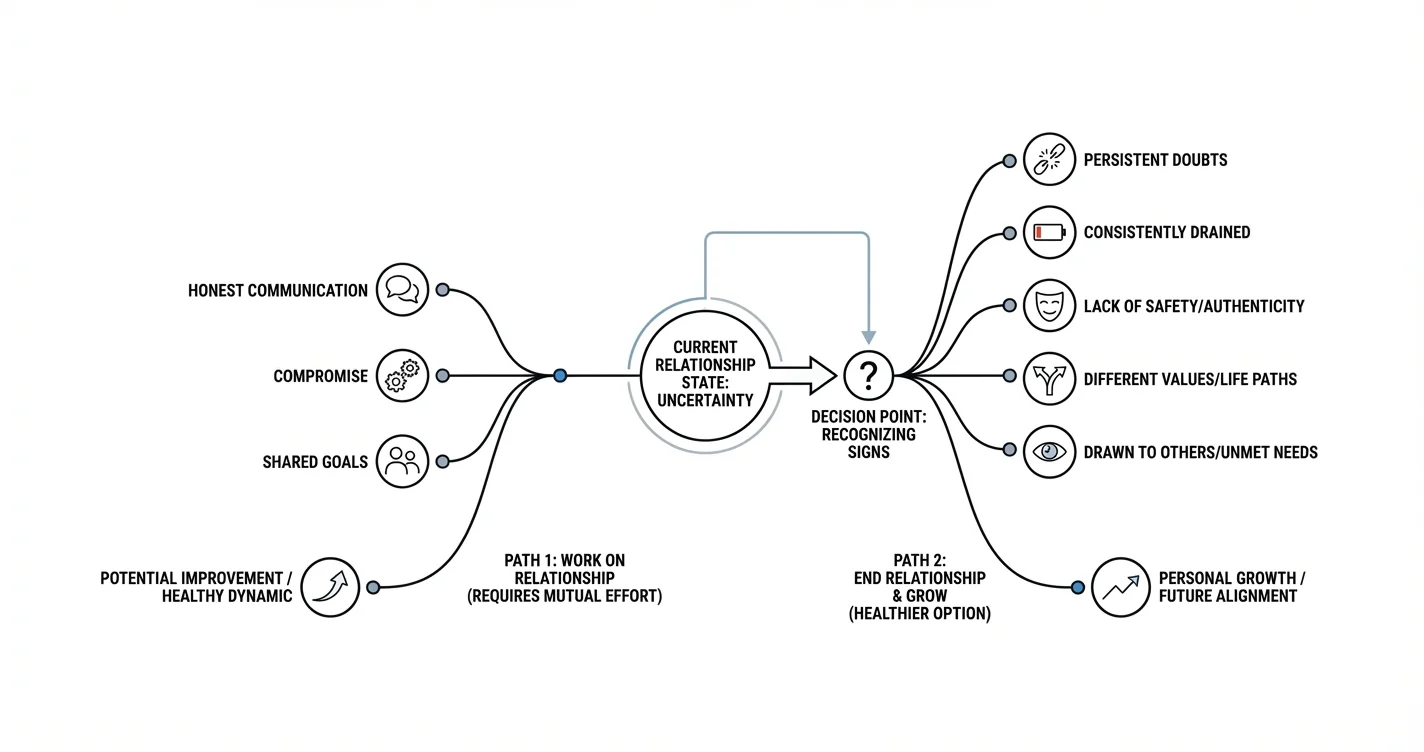
Many* *of us believe a relationship will last forever. But at some point, you might start asking yourself a difficult question: should I break up with my girlfriend? There can be different reasons behind this feeling. Sometimes it means there are issues in the relationship that need attention. With honest communication and effort, it’s possible to work through them and build a healthy relationship. In other situations, choosing to end the relationship may actually be the healthier option. We’ll help you understand how to recognize when it may be time to let go.
Should I Break up with My Girlfriend? 6 Surefire Signs
On the surface, the present and the future of your relationship may seem completely fine. But underneath, something keeps pulling you back to the same thought that it might be time to end things. According to a study published in the Journal of Social and Personal Relationships, around 60% of people report having serious doubts before a breakup. So if you’re thinking about this, you’re not alone. Let’s look at what those doubts might actually mean.
You Feel Drained More Than You Feel Good
Life comes with enough challenges that bring unhappiness on their own. In a healthy relationship, things feel like support, not another source of stress. It’s normal to have different opinions and occasional conflict with your partner. But the key word here is "occasional". If over time you consistently feel drained, and you’d rather stay longer at work than go home, that could be a sign that it’s time to end things.
The Same Problems Keep Repeating (And Nothing Changes)
The Gottman Institute, which has studied couples for over 40 years, found that about 69% of relationship conflicts are “perpetual problems.” This means they don’t fully go away. If you recognize this pattern in your own life, then the thought “should I break up with my girlfriend” may not be as wrong as it seems. The reasons can be different. It could be a lack of intimacy, feeling unheard, or something harder to explain. But if you took time to reflect and put in effort to fix things, and it only leads to temporary rough patches that fall apart and come back worse, it may be better to end your relationship for your own well-being.
You Don’t Feel Safe Being Honest Anymore With Your GF
Trust and the ability to be yourself in a relationship are the foundation of a strong connection. One clear sign it’s time to end things is when you no longer feel safe being that version of yourself with your partner. Selena Gomez and Justin Bieber have spoken publicly about how communication issues and emotional pressure affected their relationship over time. Selena later shared that she often felt not fully heard. Justin admitted he struggled with emotional maturity during that period. Over time, this created a dynamic where being fully open did not always feel safe.
You Want Different Things From Life
It’s completely normal to have different interests and even work in completely different fields. But one of the signs you should break up with your partner is when there is almost no overlap at all. As a result, you’re not able to support each other in what truly matters. You may feel like your partner doesn’t understand your world, and you may struggle to show up for theirs. Relationships like this are difficult to fix. Completely different interests are not a problem by themselves, but when there is no shared ground, it can become a sign that you are simply not aligned.
You Start Feeling Drawn to Other Women
Attraction to other people can happen even in a healthy relationship. But there’s a difference between noticing someone and consistently feeling drawn to other women in a way that makes you question your current relationship.
If you feel like you need something you’re not getting from your partner, that matters. Sometimes people tell themselves they are just going through a rough patch and still want to work things out. And that can be true in some cases. But if this feeling keeps coming back, it’s worth paying attention to the pattern. For example, you might catch yourself thinking about what it would be like dating other women, comparing your current girlfriend to others, or feeling emotionally more engaged with someone outside the relationship than inside it. Over time, this creates distance and makes it harder to stay fully present where you are.
Many people also feel bad for wanting something different. They may think it makes them disloyal or unfair. But the feeling itself is not the problem. It can point to unmet needs, lack of connection, or a deeper misalignment. If you’re consistently drawn to other women and it doesn’t feel like a temporary phase, that could be a sign it’s time to end your relationship, even if nothing dramatic has happened.
You Keep Thinking About Ending It
The reasons can be different. Sometimes it’s the hope that if you work on the relationship, things will get better. Sometimes it’s your nature. You understand the relationship is not right for you, but you don’t want to end it because you know your partner will be hurt and you don’t want them to suffer. Whatever the reason is, if you wake up most mornings with the thought that it might be worth ending things, that feeling matters. It’s often a sign that something isn’t working at a deeper level. At that point, moving on with your life may be the step you actually need.
Before You Decide: Identifying the Real Problem
If you want to separate a bad month from a real ending before reading further, the should I break up quiz is twelve questions on exactly that distinction: how long the doubt has lasted, what happens in the gaps between fights, and whether the future still has her in it.
Before you decide to break up with your girlfriend, it’s important to slow down and look at what is actually happening. Many people experience this while dating someone, especially during periods of pressure or change. According to data from the American Institute of Stress, about 77% of people regularly experience physical symptoms of stress, and 73% report psychological symptoms. That level of stress can directly affect how you react in relationships.
You might notice you get irritated faster, small things suddenly make you angry, and conversations escalate more easily. In that state, it’s easy to feel like you want to leave, even if the relationship is not fundamentally broken. For example, imagine you’ve had a long week with little sleep and constant pressure. Your partner says something neutral, but it triggers a strong reaction. At that moment, you may feel like you’re done and want to end things. Later, when you calm down, the feeling is less intense.
At the same time, there are situations where the issue is not temporary. You may feel like you’re constantly unheard or the only one trying to fix things. If the same problem keeps coming back over months, not days, and nothing changes, that might be a sign of something deeper. A helpful way to check is to step slightly outside the situation. If nothing changed in this relationship for the next six months, would you still choose it? If the honest answer is no, that might be a sign that the relationship is no longer working in the way you need.
Sometimes it’s hard to step back and look at the situation clearly on your own. When you’re inside it, your judgment is often influenced by emotions and attachment. In those moments, it can help to share what you’re going through with someone who is not deeply involved and not biased toward you or your partner. You can also consider professional support. Talking things through with a therapist or counselor can help you understand what you’re feeling and what you actually want, without pressure or judgment.
Can the Relationship Work With Compromise?
Compromise is a normal part of any relationship. When you’re dating someone, you naturally adjust to each other. But not every situation should be solved through compromise.
Healthy compromise feels mutual. Both people adjust and neither person feels like they are losing themselves. Unhealthy compromise feels different. It often happens slowly. At first, you adjust a little to avoid conflict. Then a little more. Over time, you may feel like you’re the only one adapting.
According to surveys by Pew Research Center, about 44% of adults say arguments about effort and expectations are a major source of relationship stress. If you feel like you’re constantly adjusting or avoiding honest conversations, that might be a sign that the relationship is not balanced. It’s important to assess not just whether the relationship could work in theory, but whether both people are willing to work on it consistently.
How to Make the Most of a Relationship Break?
Taking a break can feel unclear, especially when you’re trying to understand whether the relationship is worth continuing or if it’s already time to say goodbye. A break becomes useful when you treat it as structured time to observe your thoughts and emotions.
Research in relationship psychology gives fairly practical guidance here. Dr. Terri Orbuch (University of Michigan), who has studied couples for over 30 years, found that temporary distance can increase clarity only when people actively reflect, not when they avoid the issue. In other words, a break works when you use it intentionally.
Start by paying attention to your internal state without daily interaction. Notice how your body and mind respond. Do you feel calmer and able to enjoy your time, or do you feel pulled back into the same emotional tension even without contact? According to Dr. John Gottman, patterns matter more than isolated moments, so what you feel consistently during the break is more important than occasional spikes of emotion.
It also helps to be specific about what was happening before the break. Dr. Sue Johnson, founder of Emotionally Focused Therapy, explains that many relationship conflicts come from unmet emotional needs. If those needs were not being met, distance alone will not change that. A break only helps if it allows you to recognize what you actually need and whether that need is being met in the relationship.
Another useful step is to create some structure. Instead of staying in constant contact or checking in emotionally every day, agree on boundaries for the break. Research suggests that unclear boundaries often keep couples emotionally stuck rather than helping them move forward. Giving yourself real space allows your nervous system to settle, which makes it easier to think clearly.
Talking to someone you trust can also make a difference. External perspective provides support and encouragement, especially when your own thinking becomes repetitive. Studies in social psychology show that discussing decisions with a neutral, supportive person can reduce cognitive bias and help people make more balanced choices.
If you’ve had multiple relationships with women or past relationships that ended in a similar way, this is also a moment to notice patterns. Dr. Amir Levine, co-author of Attached, explains that attachment patterns often repeat across relationships unless they are consciously addressed. A break can help you see whether you are reacting to this relationship specifically or repeating something familiar.
Most importantly, be honest with yourself about what the break is showing you. If you begin to feel lighter, more grounded, and more like yourself, that may suggest the relationship was taking more than it was giving. If you feel a stable sense of missing the connection, not just fear or habit, that may suggest the relationship still has value.
When Is It Time to Start Dating Again?
Trust your gut, because there is no same timing for everyone. If you feel that your past relationship is not holding you back and you are not comparing new partners to your ex, that is a good sign. The most important thing is do not rush. Do not start a relationship just to fill an empty feeling inside, because it can bring bigger problems. Also, think about your past relationship before starting a new one. What was not good on your side, and what can you improve so your new relationship does not become bad?
Doubts come to almost everyone at some point, when you start to feel that something is not right in the relationship. Sometimes these are problems you can talk about, and the relationship can get better. But sometimes it is a bad relationship that is not worth holding on to. Respect your partner, but do not forget that you matter too. Make a choice that helps you build a healthy relationship. Sometimes that means ending the current one.
How AI Support Helps You Heal
AI emotional support isn't about replacing human connection — it's about filling the gaps. The moments when you need to talk at 2 AM, when you don't want to burden your friends again, or when you simply need someone to listen without judgment.
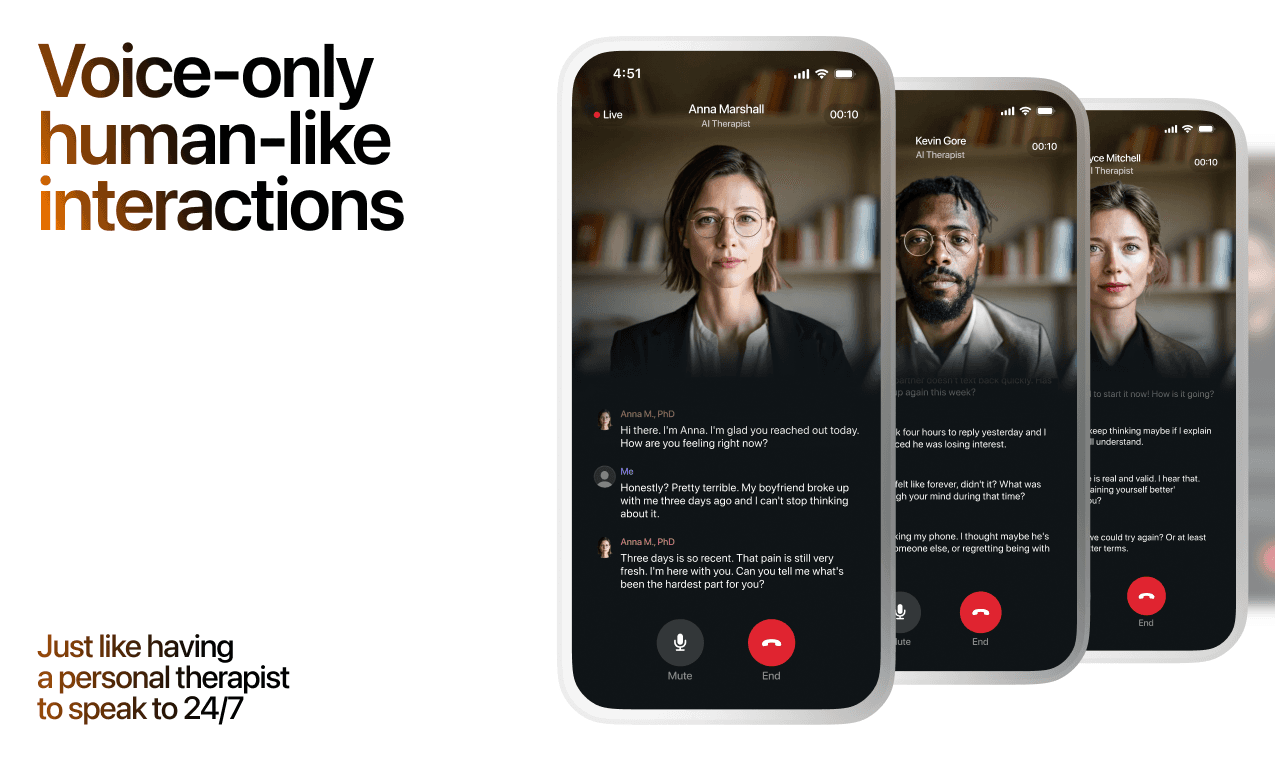
Here's what happens in a typical Lovon session:
You share what's on your mind
There's no script, no intake form, no waiting room. You speak or type whatever you're feeling — in your own words, at your own pace.
Lovon validates and explores
Using frameworks from CBT (Cognitive Behavioral Therapy) and motivational interviewing, Lovon acknowledges your feelings first, then gently helps you explore them. No dismissive "just move on" advice.
You build coping skills together
Lovon doesn't just listen — it actively works with you on evidence-based techniques: thought reframing, urge surfing, behavioral experiments, and more.
What a Session with Lovon Looks Like
When to Seek Professional Help
AI support is a valuable tool, but it's not a replacement for professional care. Please consider reaching out to a licensed therapist if you experience any of the following:
- Persistent thoughts of self-harm or suicide
- Inability to perform daily activities (work, eating, sleeping) for more than 2 weeks
- Turning to alcohol or substances to cope
- Intense anger or desire to harm your ex-partner
- Complete emotional numbness that doesn't improve over time
Crisis Resources (US): If you're in immediate danger, call 988 (Suicide & Crisis Lifeline) or text HOME to 741741 (Crisis Text Line). Available 24/7, free, and confidential.
Outside the US? Find a crisis line in your country
Ready to Start?
Your healing journey can begin right now
A 7-day trial. No judgment. Just a safe space to process what you're going through.
Frequently Asked Questions
Q: What are the definitive signs you should break up with your current girlfriend?
Q: How do you know when to break up if nothing “bad” is happening?
Q: Can love alone fix a relationship?
Q: Should you try family therapy or counseling before ending things?
Q: What if you and your current girlfriend are moving in different directions?
Q: How do you handle your partner’s reaction when you decide to break up?
About the Author

Mireya Tabasa
Mental Health Support Specialist & AI Advisor
Mireya Tabasa is a Mental Health Support Specialist working at the intersection of clinical care and technology. With over 4 years of hands-on experience supporting diverse populations facing mental health challenges in educational and healthcare settings, she brings frontline clinical insight to ev...
Related articles
- Should I Break Up With Him Quiz: Honest 2026 Check
An honest should i break up with him quiz that scores real patterns, not moods. Get a clear verdict in 2 minutes and…
- Why Am I So Angry? Understanding & Dealing With Anger
Anger is a normal emotion that everyone experiences at some point. What makes it different from emotions like joy is…
- Retroactive Jealousy: Why It Happens, How to Stop It (2026)
Retroactive jealousy explained: causes, triggers, and 8 steps to break the loop in 2026. Practical, evidence-based…
- Understanding Anxious Attachment Patterns in Relationships
If you find yourself constantly checking your phone for messages, worrying whether your partner still cares, or feeling…
See also
Quizzes
- Should I Forgive Him for Cheating? 12-Question Quiz
Twelve questions on whether rebuilding is possible.
- Should I Text My Ex? 12-Question Quiz
Find out what the urge to text is made of.
Free tools
- How to End a Situationship
Nothing was ever named, so anything you say either claims more than was agreed or ends nothing at all. Tell it how long…
- How to Respond to a Breakup Text
A chat for the minutes after a breakup text arrives and you have no idea how to respond. Paste what they sent and say…
From the wiki
- What is a rebound relationship?
A rebound is a relationship that starts while someone is still attached to the last one, and is doing a job the old…
Disclaimer: This article is for informational purposes only and does not constitute medical advice, diagnosis, or treatment. Always seek the advice of your physician or other qualified health provider with any questions you may have regarding a medical condition. If you are in crisis or think you may have an emergency, call 988 (Suicide & Crisis Lifeline) or go to the nearest emergency room. Outside the US? Find a crisis line in your country.