
Am I Over My Ex Quiz: 8 Real Markers (2026)
Take the am I over my ex quiz: 8 honest emotional markers that reveal whether you're truly ready to move on in 2026 — with scored results and next steps.

Key Takeaways
- Find yourself comparing new people to your ex
- Feel a physical reaction when their name comes up
- Have avoided dating not by choice but by fear
- Keep "checking in" on them through mutual friends or social media
- Forcing yourself to date before you're ready. A score below 20 on this quiz means you'll project unresolved material
Whether you still check their Instagram at midnight or genuinely can't remember the last time you thought about them, the "am I over my ex quiz" question deserves an honest answer — not a hopeful one.
TL;DR: This guide walks you through a structured self-assessment to determine whether you've truly moved on from a past relationship in 2026. The quiz covers 8 emotional markers — from intrusive thoughts to readiness for new connection — and each result maps to a specific next step. If you score in the "not quite" range, Lovon's AI voice support app offers on-demand breakup recovery sessions that don't require scheduling a therapist weeks out.
Why This Quiz Actually Matters
Researchers studying grief and attachment consistently find that people overestimate their emotional recovery. A 2020 study in the Journal of Positive Psychology tracked 155 adults post-breakup and found that most participants underestimated how quickly positive emotions returned — but a significant subset remained stuck well past the 11-week mark without realizing it. The self-deception cuts both ways: you might think you're fine when you're not, or assume you're a wreck when you've already done the hard work.
This quiz doesn't diagnose you. It gives you eight concrete signals to evaluate honestly so you can stop guessing.
Who This Quiz Is For
This is for anyone who ended a relationship — whether last month or two years ago — and still isn't certain where they stand emotionally. It's especially relevant if you:
- Find yourself comparing new people to your ex
- Feel a physical reaction when their name comes up
- Have avoided dating not by choice but by fear
- Keep "checking in" on them through mutual friends or social media
If none of those apply, the quiz will confirm what you probably already know. If even one applies, keep reading.
The Am I Over My Ex Quiz — 8 Markers to Assess
Rate each statement honestly: 1 = Not at all true, 3 = Somewhat true, 5 = Completely true.
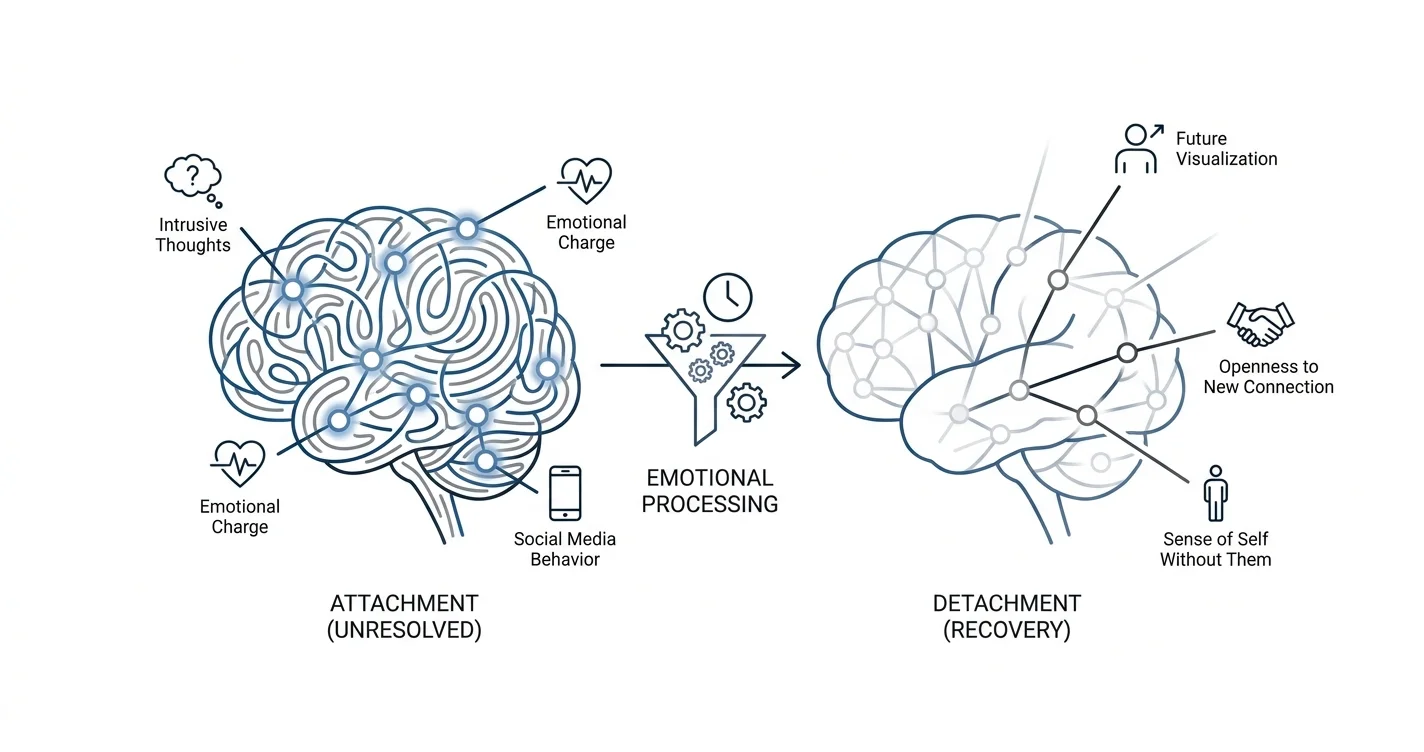
1. Intrusive Thoughts
Statement: "I can go a full day without thinking about my ex."
Intrusive thoughts are the clearest early signal. If your ex hijacks your attention during unrelated tasks — a commute, a work meeting, a meal — your nervous system is still treating them as unresolved. Score yourself based on the past two weeks, not your best day.
What it means: A 1 or 2 here doesn't mean you're broken. It means the neural pathway is still active. Consistent mindfulness practice or structured emotional processing — like what Lovon's AI relationship coach for breakup recovery sessions target — can interrupt the loop within weeks.
2. Emotional Charge on Their Name
Statement: "Hearing my ex's name doesn't produce a physical reaction in me."
The gut drop, the chest tightness, the involuntary exhale — these are somatic markers of unprocessed attachment. They're involuntary, which makes them more reliable than your conscious self-report.
What it means: Score 1-2 honestly if the name still lands physically. This is one of the last markers to resolve, so don't use it as the sole measure.
3. Social Media Behavior
Statement: "I don't check my ex's social media profiles."
This one is behavioral, not just emotional — which makes it harder to rationalize. If you're checking, you're maintaining a connection loop. "Curiosity" and "closure" are the most common justifications, but aggregated behavioral data on digital habits consistently shows that checking an ex's profile extends emotional attachment duration.
What it means: A 1 here is a hard signal. Delete, mute, or block — not as punishment, but as a structural intervention.
4. Comparison to New People
Statement: "When I meet someone new, I don't immediately measure them against my ex."
Comparison is attachment in disguise. Your ex becomes the benchmark, and no one clears it — either because they're different or because they're too similar. Both outcomes serve the same function: keeping your ex as the standard.
What it means: Scores of 1-2 here are common up to 6 months post-breakup. Beyond that, they suggest your attachment hasn't fully detached from the relational template they created.
5. Future Visualization
Statement: "When I picture my future, my ex is not in it."
Mental imagery is predictive. If your ex still populates your imagined future — even peripherally, even in scenarios where you've "moved on" — that future-self still hasn't written them out of the story.
What it means: This is one of the most actionable markers. Intentional future-visualization exercises, which are a core component of cognitive behavioral tools, can rewire this within 4-6 weeks of consistent practice.
6. Anger or Resentment
Statement: "I don't feel strong anger or resentment toward my ex when I think about what happened."
Unresolved anger is attachment through opposition. If you're still running a mental prosecution — building the case for why they were wrong — you're spending emotional energy on them. High resentment scores in 2026 often mean the grief stage hasn't completed.
What it means: Resentment isn't a character flaw. It's a stage. But if it's been more than a year and it's still at a 4 or 5, that warrants structured emotional processing, not just time.
7. Openness to New Connection
Statement: "I feel genuinely open to meeting someone new — not just willing, but actually interested."
There's a difference between "I should date again" and "I want to." The former is compliance with external expectations. The latter is a real signal of readiness. Score yourself on genuine internal state, not social performance.
What it means: A 3 is the floor for readiness. Scores of 1-2 suggest you'd be bringing unresolved material into a new relationship, which is unfair to both parties.
8. Sense of Self Without Them
Statement: "I have a clear sense of who I am and what I want that has nothing to do with my ex."
Identity enmeshment — where your self-concept absorbed parts of your partner — is the deepest recovery challenge. It's why long-term relationships take longer to process than short ones regardless of how "good" or "bad" the relationship was.
What it means: This is the anchor marker. You can score well on all seven others and still have a 1 here, which means the work isn't done.
Scoring Your Results
| Total Score | What It Means | Next Step |
|---|---|---|
| 32–40 | You're genuinely over them | Invest in the next chapter |
| 22–31 | Mostly healed, a few loose threads | Target the low-scoring markers specifically |
| 14–21 | Active processing still needed | Structured support will accelerate this |
| 8–13 | Early stage or stuck | Daily emotional processing is non-negotiable |
What to Do With Your Score in 2026
If you scored 32–40: The work is done. Your openness is real. The only move now is forward — meeting new people, building new relationship patterns, and not treating every new connection as a test of whether you're "ready enough."
If you scored 22–31: Pick the 2-3 lowest-scoring markers and treat them as the project. You don't need a full therapeutic intervention — you need targeted work on the specific things still pulling at you. Intrusive thoughts and social media behavior respond fast to behavioral interventions. Resentment and identity tend to need more time.
If you scored 8–21: This score doesn't mean you're broken or that something went wrong with you. It means the loss was significant and your nervous system is still integrating it. Lovon's AI therapy for anxiety and panic attacks addresses the somatic side — the physical anxiety response that often drives checking behaviors, rumination, and emotional flooding post-breakup.
The biggest mistake people make at this score range is waiting for time to do the work. Time doesn't process grief. Engagement does.
What to Avoid When You're Not Yet Over Someone
- Forcing yourself to date before you're ready. A score below 20 on this quiz means you'll project unresolved material onto someone new. That's not fair to them and it delays your own recovery.
- "Soft contact" with your ex. Liking old photos, watching their stories, asking mutual friends for updates — these reset the emotional clock every time.
- Treating the quiz score as fixed. These 8 markers shift with active work. A score of 15 today can be a 28 in 6 weeks if you engage with the right tools.
FAQ
What does it mean if I still think about my ex every day? Daily intrusive thoughts mean the attachment is still neurologically active. This is normal up to 3 months post-breakup, but past that point it's a signal to add structured emotional processing rather than waiting it out.
Is it possible to be over someone and still miss them? Yes. Missing someone and being emotionally attached to them are different states. You can feel occasional nostalgia for a past relationship while being fully ready to build a new one. The quiz markers distinguish between the two.
How long does it take to get over an ex? The 2020 Journal of Positive Psychology study found most participants reported significant emotional improvement by 11 weeks post-breakup. Long-term relationships, relationships involving infidelity or trauma, and anxious attachment styles all extend that timeline.
Can I be over my ex and still not want a new relationship? Absolutely. Readiness to move on from an ex doesn't equal readiness for a new relationship. Those are two separate emotional milestones. Scoring 35 on this quiz just means your ex is no longer holding the emotional space — what you fill it with is your choice.
What if I scored low but the breakup was months ago? Time elapsed is not a reliable proxy for healing. Emotional recovery depends on engagement, not duration. A low score after several months is a clear signal that passive waiting isn't working — active processing is needed.
Does this quiz work for long-term or married relationships? The 8 markers apply to any attachment-based relationship, but long-term and married relationships typically involve deeper identity enmeshment (marker 8) and more complex grief. Expect a longer timeline and place more weight on markers 5, 7, and 8.
What's the difference between being over someone and being indifferent? Being over someone means you've processed the loss and integrated it. Indifference, especially if it arrived quickly, can mask suppressed grief rather than genuine resolution. If your score seems unexpectedly high but you "feel nothing," that emotional flatness warrants its own investigation.
Can an AI therapy app actually help with breakup recovery? AI voice support apps like Lovon provide on-demand CBT-informed sessions specifically for relationship grief, attachment work, and emotional regulation. They don't replace clinical therapy for complex trauma, but for the emotional processing most breakups require, they're accessible, immediate, and structured in ways that passive journaling or talking to friends isn't.
One Last Thing
The most reliable single predictor of post-breakup recovery isn't time, social support, or even how bad the relationship was. A 2018 study in Social Psychological and Personality Science found that people who actively reflected on the breakup — even just for 7 minutes a day over 9 weeks — reported significantly stronger independent self-concept by the study's end. The mechanism isn't catharsis. It's re-authoring who you are without the relationship as the frame. That's exactly what structured daily emotional sessions build — and it's measurable within weeks, not years.
Related Guides
How AI Support Helps You Heal
AI emotional support isn't about replacing human connection — it's about filling the gaps. The moments when you need to talk at 2 AM, when you don't want to burden your friends again, or when you simply need someone to listen without judgment.
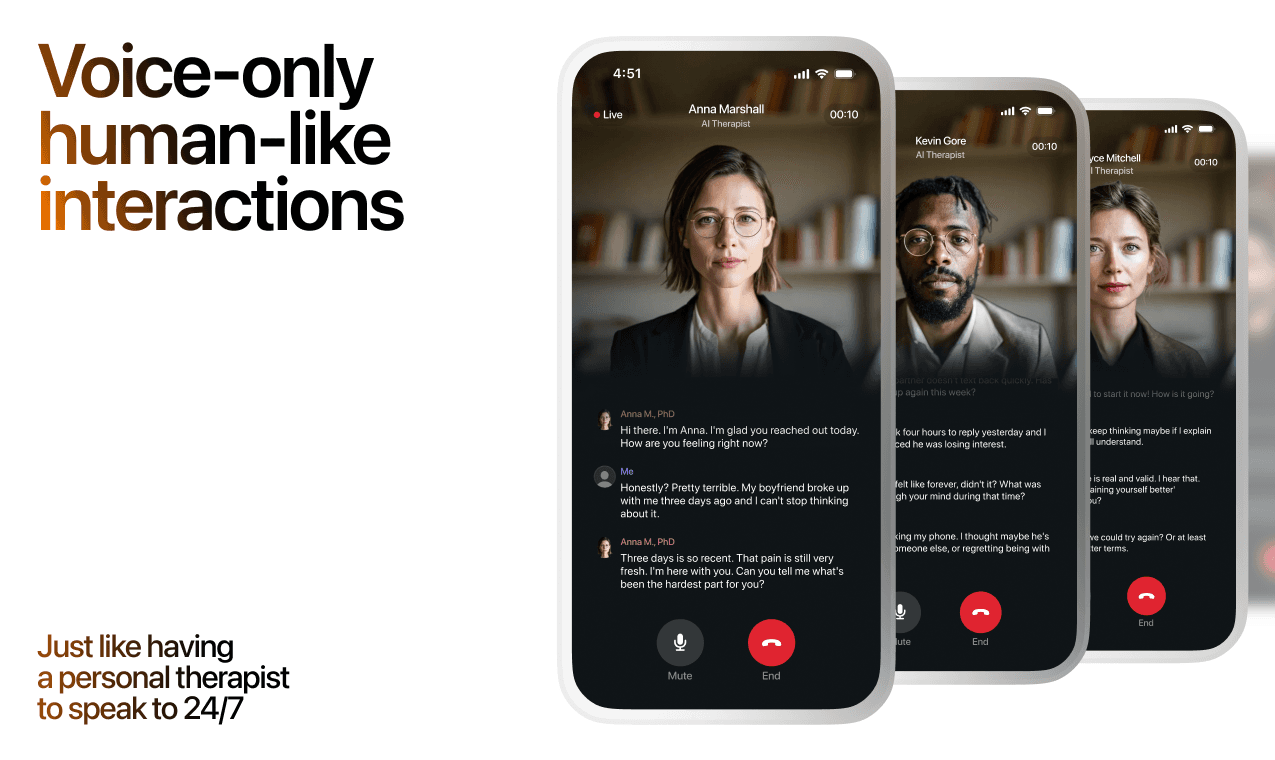
Here's what happens in a typical Lovon session:
You share what's on your mind
There's no script, no intake form, no waiting room. You speak or type whatever you're feeling — in your own words, at your own pace.
Lovon validates and explores
Using frameworks from CBT (Cognitive Behavioral Therapy) and motivational interviewing, Lovon acknowledges your feelings first, then gently helps you explore them. No dismissive "just move on" advice.
You build coping skills together
Lovon doesn't just listen — it actively works with you on evidence-based techniques: thought reframing, urge surfing, behavioral experiments, and more.
What a Session with Lovon Looks Like
When to Seek Professional Help
AI support is a valuable tool, but it's not a replacement for professional care. Please consider reaching out to a licensed therapist if you experience any of the following:
- Persistent thoughts of self-harm or suicide
- Inability to perform daily activities (work, eating, sleeping) for more than 2 weeks
- Turning to alcohol or substances to cope
- Intense anger or desire to harm your ex-partner
- Complete emotional numbness that doesn't improve over time
Crisis Resources (US): If you're in immediate danger, call 988 (Suicide & Crisis Lifeline) or text HOME to 741741 (Crisis Text Line). Available 24/7, free, and confidential.
Outside the US? Find a crisis line in your country
Ready to Start?
Your healing journey can begin right now
A 7-day trial. No judgment. Just a safe space to process what you're going through.
Frequently Asked Questions
Is Lovon a replacement for a real therapist?
Is my conversation with Lovon AI private?
How is Lovon different from ChatGPT for emotional support?
Can I use Lovon if I'm already seeing a therapist?
Can I try Lovon before subscribing?
About the Author
The Lovon Editorial Team
Mental Health & Wellness Content Team
The Lovon Editorial Team develops mental health and wellness content designed to make psychological concepts accessible and actionable. Our goal is to bridge the gap between clinical research and everyday life - helping you understand why your mind works the way it does and what you can do about it....
Related articles
- Intrusive Thoughts: Why They Happen, How to Stop Them 2026
Intrusive thoughts explained: why 94% of people get them, 7 steps to stop the spiral, and when to seek help. Practical…
- Friendship Breakup How to Heal: 2026 Recovery Guide
Friendship breakup how to heal in 2026: 8 concrete steps, common mistakes, and troubleshooting for grief, guilt, and…
- Can Divorce Cause PTSD? Symptoms & How to Heal (2026)
Yes, divorce can cause PTSD. Learn the exact symptoms to watch for in 2026 and the step-by-step process to stabilize…
- Attachment Style Compatibility Quiz for Partners 2026
The best attachment style compatibility quiz for partners in 2026 — dual scoring, pairing analysis, and AI coaching…
See also
Quizzes
- Do I Miss My Ex or Am I Just Lonely? 12-Question Quiz
Find out what the missing is actually about.
- Am I Over My Ex? 12-Question Gut Check
Post-breakup check-in in 2 minutes.
Free tools
- Breakup Message Writer
A chat for saying it once. Tell it how long it has been and why now, and get a message you could actually send, plus the…
- How to Tell Your Spouse You Want a Divorce
A chat for working out how to tell your spouse you want a divorce, after the decision rather than before it. Tell it…
From the wiki
- How to break up with someone you still love?
Loving someone does not mean the relationship works. If you have circled the same decision for months and the reasons…
Disclaimer: This article is for informational purposes only and does not constitute medical advice, diagnosis, or treatment. Always seek the advice of your physician or other qualified health provider with any questions you may have regarding a medical condition. If you are in crisis or think you may have an emergency, call 988 (Suicide & Crisis Lifeline) or go to the nearest emergency room. Outside the US? Find a crisis line in your country.