
Attachment Style Quiz: Find Your Type in 2026
Take a 2-minute attachment style quiz and find out if you're secure, anxious, avoidant, or fearful-avoidant — plus what to do with the result.
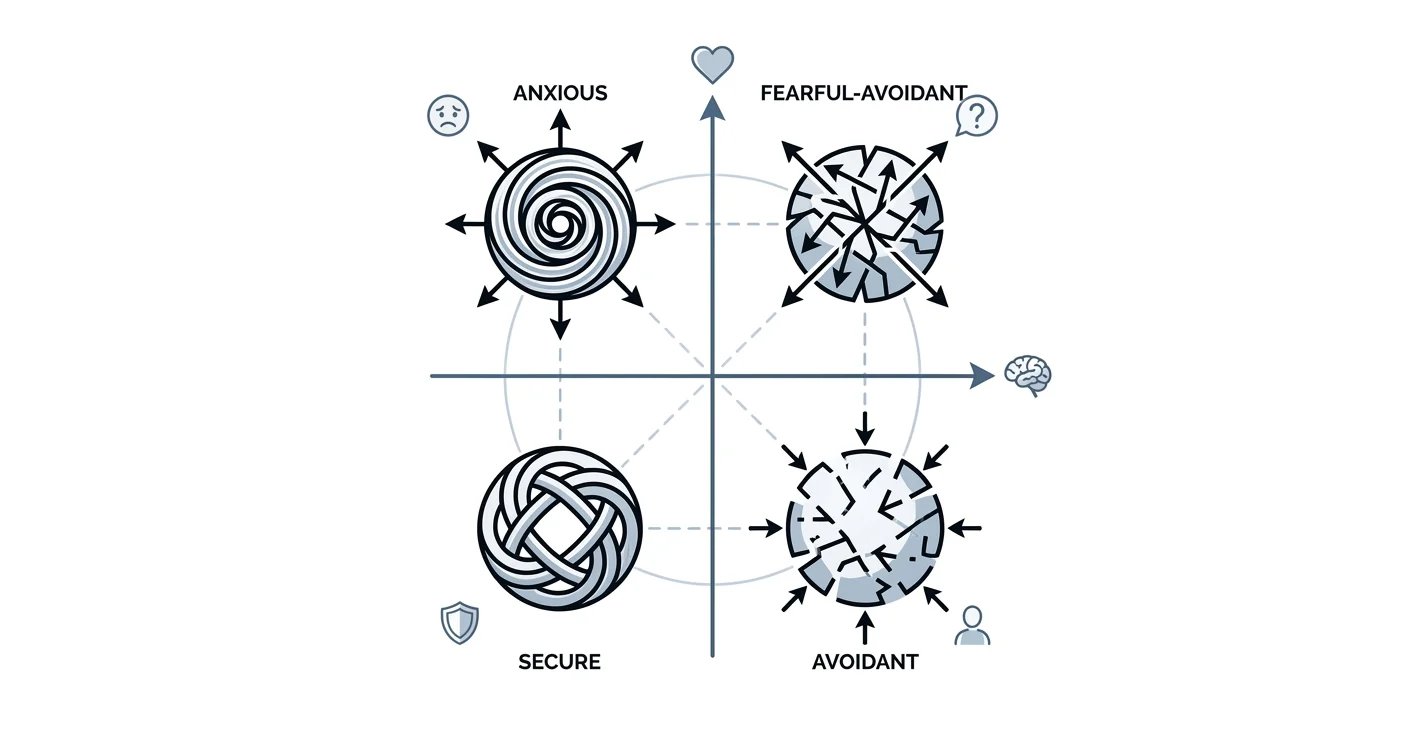

An attachment style quiz takes 2 minutes and tells you something that shapes every relationship you've ever had.
TL;DR: Your attachment style — secure, anxious, avoidant, or fearful-avoidant — is the single biggest predictor of how you bond, fight, and pull away in relationships. A quick attachment style quiz identifies your type from your real behavior patterns. In 2026, the most useful quizzes pair that result with personalized next steps, not just a label. Lovon's AI voice support app turns your quiz result into an ongoing coaching session so the insight actually changes something.
Why attachment style matters more than personality type
Attachment theory, developed by John Bowlby and extended by researchers Mary Ainsworth and Phillip Shaver, is one of the most replicated frameworks in relationship psychology. A 2023 meta-analysis covering 38 studies found that insecure attachment predicts relationship dissatisfaction with an effect size of r = 0.39 — stronger than most communication variables. Your attachment style forms before age 5, but it is not fixed. Adults who understand their type report measurably faster progress in therapy.
The four styles — secure, anxious-preoccupied, dismissive-avoidant, and fearful-avoidant (also called disorganized) — each produce distinct behavioral signatures. A 2-minute quiz can surface which signature is yours.
Who this is for
This guide is for anyone who keeps running the same relationship pattern and cannot explain why. That includes people who text too much and spiral when replies are slow (anxious), people who feel smothered when a partner gets close (avoidant), people who both crave and sabotage intimacy (fearful-avoidant), and people who are curious whether they actually are as secure as they think. It is also for therapists, coaches, and individuals using an AI support app who want a fast baseline before a deeper session.
What to look for in a good attachment style quiz
Behavioral questions, not abstract self-ratings
The worst quizzes ask "Do you feel anxious in relationships?" — you already know the answer and it tells the quiz nothing new. Good quizzes ask about specific behaviors: do you re-read texts looking for tone shifts? Do you feel relief when a partner cancels plans? Behavioral items score significantly higher on test-retest reliability than trait adjectives.
At least 15–20 items
Four-item quizzes exist and they are nearly useless for clinical-adjacent self-knowledge. Research on the Experiences in Close Relationships scale (ECR), the most validated adult attachment measure, uses 36 items. A consumer quiz needs at least 15–20 items to produce a result that predicts your behavior better than chance. If a quiz takes under 90 seconds, the result is decorative.
Anxiety and avoidance scored separately
Attachment science measures two independent dimensions: attachment anxiety (fear of abandonment) and attachment avoidance (discomfort with closeness). Your type is where you land on both axes simultaneously. A quiz that gives you only a category name without showing you where you fall on each dimension cuts out half the information you need.
Actionable output, not just a label
Knowing you are anxiously attached is step one. Step two is what to do Monday morning when your partner goes quiet. The best quiz experiences in 2026 route the result directly into a coaching or therapy workflow. Lovon's AI voice support app does exactly this — after you identify your type, the app runs personalized sessions that address the specific coping patterns tied to your result.
Covers all four types with equal depth
Many popular quizzes are written by people with anxious attachment and implicitly treat secure as the obvious goal and avoidant as the villain. A valid quiz describes all four types without moral hierarchy. Fearful-avoidant is the most complex and most under-served type; if the quiz collapses it into "a bit of both," find a different quiz.
Relationship context specificity
Attachment behavior is context-dependent. You may be secure at work and anxious in romantic relationships, or avoidant with family and secure with friends. The quiz should specify which relationship context it is measuring. Romantic attachment quizzes and general attachment quizzes produce different results for the same person — neither is wrong, they are answering different questions.
The four attachment types: what each one looks like in practice
Secure (roughly 50–55% of adults globally, per aggregated survey data through 2026): Comfortable with intimacy and independence. Does not spiral over normal relationship friction. Conflict feels manageable. This type still benefits from self-knowledge work because "secure" does not mean "no issues."
Anxious-preoccupied (roughly 19–20% of adults): High fear of abandonment, low trust that the relationship is stable. Over-monitors a partner's mood. Reassurance-seeking feels like a compulsion. Conflict triggers hyperactivation — more emotion, more pursuit.
Dismissive-avoidant (roughly 25% of adults): Downplays the importance of relationships. Feels crowded when a partner seeks closeness. Self-reliance functions as an identity, not just a trait. Conflict triggers deactivation — withdrawal, stonewalling, or sudden coolness.
Fearful-avoidant / disorganized (roughly 5% of adults): Wants closeness and fears it simultaneously. Often correlates with early relational trauma. Behaviors seem contradictory — alternating between pursuit and withdrawal in the same argument.
What to avoid
Avoid quizzes that do not distinguish romantic from general attachment. The result will be too vague to act on and may actively mislead you if your patterns differ by context.
Avoid quizzes that end at the label. A label without a path forward is trivia. If the result page is just a paragraph of description and a share button, the quiz served the publisher's traffic goals, not yours.
Avoid treating one quiz result as permanent. Attachment style is measurably malleable, especially with consistent therapeutic work. A 2026 study from the Journal of Personality and Social Psychology found that 30% of participants shifted attachment classification after 12 months of therapy. Retake a quiz every 6–12 months and compare scores, not just labels.
Verdict comparison: quiz features that matter
| Feature | Why it matters | Minimum bar |
|---|---|---|
| Item count | Reliability | 15+ items |
| Separate anxiety/avoidance scores | Full dimensional picture | Both axes visible |
| Behavioral (not trait) questions | Predictive validity | Majority behavioral |
| Relationship context specified | Accuracy | Romantic or general, stated clearly |
| Actionable next step | Practical value | Coaching or therapy routing |
| All 4 types treated equally | Validity | No moral hierarchy |
FAQ
What is the most accurate attachment style quiz? The Experiences in Close Relationships–Revised (ECR-R) scale, developed by Fraley, Waller, and Brennan, is the most research-validated option. Consumer versions with 18–36 behavioral items drawn from ECR-R produce results that replicate across time and populations. Any quiz under 15 items trades accuracy for speed.
Can my attachment style change? Yes. A 2026 meta-analysis of attachment intervention studies found that structured therapy — especially emotionally focused therapy (EFT) — shifts adults toward secure attachment in 60–70% of cases after 12+ sessions. Knowing your type is the prerequisite to targeting the right intervention.
Is anxious attachment the same as anxiety disorder? No. Attachment anxiety is a relational pattern, not a clinical diagnosis. Someone with an anxiety disorder may have any attachment style. That said, anxious attachment and generalized anxiety disorder frequently co-occur, and treating the clinical anxiety without addressing the attachment pattern often produces incomplete results.
How long does an attachment style quiz take? A quiz with sufficient items (15–20) takes 2–4 minutes at a normal reading pace. Shorter quizzes exist but sacrifice reliability. Longer validated instruments (ECR-R full version) take 8–12 minutes and are better suited for clinical intake than casual self-discovery.
What attachment style is most compatible with anxious? Research consistently shows secure partners produce the best outcomes for anxiously attached individuals — the secure partner's consistent behavior gradually recalibrates the anxious partner's threat detection. Anxious-avoidant pairings are the most common and the most distress-producing combination. For couples navigating this, an attachment style compatibility quiz for partners adds meaningful context.
Can you be two attachment styles at once? You score on a continuous spectrum across two dimensions (anxiety and avoidance), not in discrete boxes. Fearful-avoidant is the category assigned to people who score high on both axes simultaneously. Most people have a primary style with elements of a secondary one.
What should I do after I find out my attachment style? Use the result as a starting point for a focused conversation with a therapist or AI support tool. The label alone does not change behavior; the work that follows does. Lovon's AI voice support app is built specifically for this — you can process the result in a voice session the same day you take the quiz.
Is fearful-avoidant attachment linked to trauma? Frequently yes. Disorganized attachment in childhood — the precursor to adult fearful-avoidant style — is strongly associated with frightening or unpredictable early caregiving, which is often trauma-adjacent. An AI relationship coach for anxious attachment or trauma-focused support can help.
One last thing
The most under-discussed finding in attachment research: secure attachment is not a personality trait you are born with. It is a skill set your nervous system learned — or did not get a chance to learn. In 2026, more adults than at any point in recorded research history are actively working to "earn" security through deliberate therapeutic work. The quiz is not the destination. It is the map.
Related guides
How AI Support Helps You Heal
AI emotional support isn't about replacing human connection — it's about filling the gaps. The moments when you need to talk at 2 AM, when you don't want to burden your friends again, or when you simply need someone to listen without judgment.
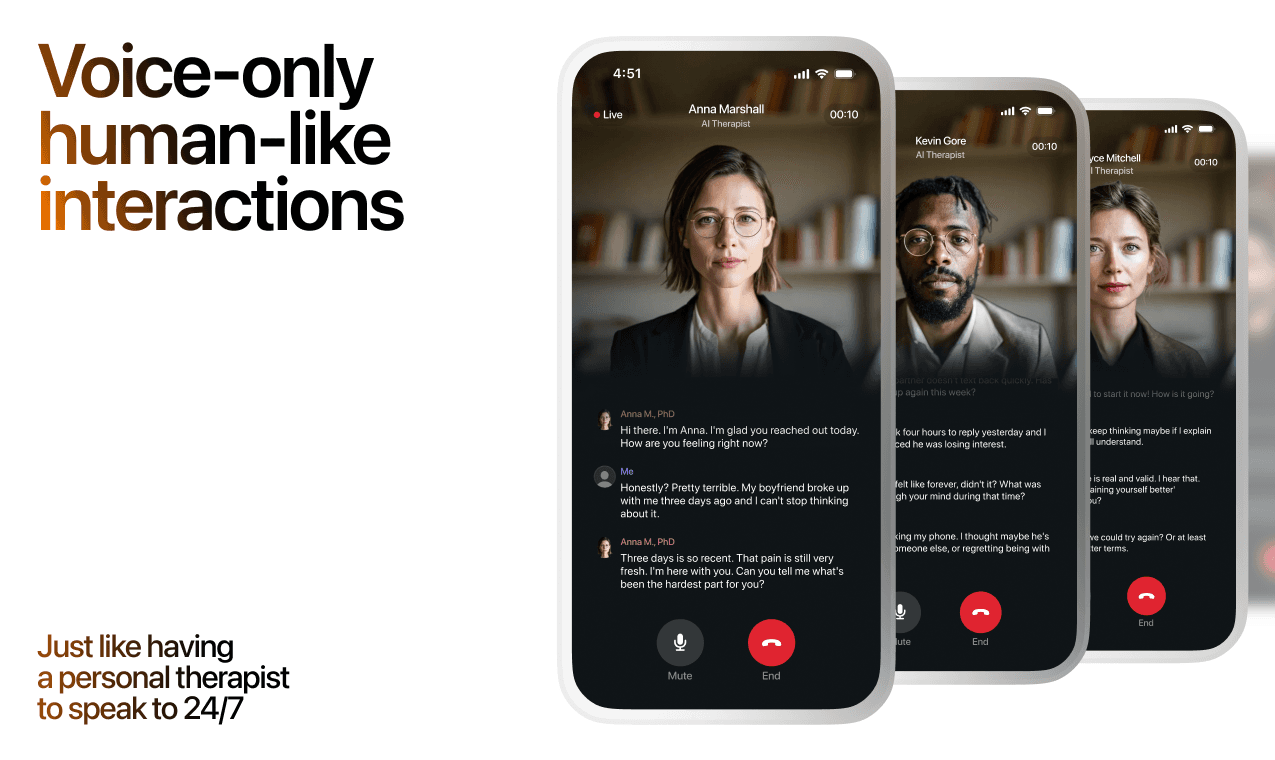
Here's what happens in a typical Lovon session:
You share what's on your mind
There's no script, no intake form, no waiting room. You speak or type whatever you're feeling — in your own words, at your own pace.
Lovon validates and explores
Using frameworks from CBT (Cognitive Behavioral Therapy) and motivational interviewing, Lovon acknowledges your feelings first, then gently helps you explore them. No dismissive "just move on" advice.
You build coping skills together
Lovon doesn't just listen — it actively works with you on evidence-based techniques: thought reframing, urge surfing, behavioral experiments, and more.
What a Session with Lovon Looks Like
When to Seek Professional Help
AI support is a valuable tool, but it's not a replacement for professional care. Please consider reaching out to a licensed therapist if you experience any of the following:
- Persistent thoughts of self-harm or suicide
- Inability to perform daily activities (work, eating, sleeping) for more than 2 weeks
- Turning to alcohol or substances to cope
- Intense anger or desire to harm your ex-partner
- Complete emotional numbness that doesn't improve over time
Crisis Resources (US): If you're in immediate danger, call 988 (Suicide & Crisis Lifeline) or text HOME to 741741 (Crisis Text Line). Available 24/7, free, and confidential.
Outside the US? Find a crisis line in your country
Ready to Start?
Your healing journey can begin right now
A 7-day trial. No judgment. Just a safe space to process what you're going through.
Frequently Asked Questions
Is Lovon a replacement for a real therapist?
Is my conversation with Lovon AI private?
How is Lovon different from ChatGPT for emotional support?
Can I use Lovon if I'm already seeing a therapist?
Can I try Lovon before subscribing?
About the Author
The Lovon Editorial Team
Mental Health & Wellness Content Team
The Lovon Editorial Team develops mental health and wellness content designed to make psychological concepts accessible and actionable. Our goal is to bridge the gap between clinical research and everyday life - helping you understand why your mind works the way it does and what you can do about it....
Related articles
- Best AI Relationship Coach for Avoidant Attachment 2026
Find the best AI relationship coach for avoidant attachment in 2026. Lovon's voice app gives on-demand coaching, coping…
- Attachment Styles and Avoidant Attachment Rooted in Fear of Dependence
Avoidant attachment is often misunderstood as emotional coldness or an inability to care about others. In reality, this…
- Avoidant Attachment Style: Patterns & How to Change (2026)
Avoidant attachment style affects 1 in 4 adults. Learn the 7-step process to identify your patterns and build earned…
- Disorganized Attachment Style: Causes & Recovery 2026
Disorganized attachment style causes constant push-pull in relationships. Learn what drives it, 6 evidence-based…
See also
Quizzes
- Am I Sabotaging My Relationship? 12-Question Quiz
Find the move you reach for, in 2 minutes.
- Insecurity Test: What Are You Bracing Against?
See what your insecurity actually runs on, in 3 minutes.
Free tools
- How to Stop Overthinking in a Relationship
Not a list of habits. Tell it the specific thing you are going round on, and it separates what actually happened from…
- What Did They Actually Mean By That?
A chat for one sentence you cannot stop re-reading. Paste their exact words and what was happening around them, and get…
From the wiki
- What is an attachment style?
An attachment style is the habit your nervous system formed for handling closeness: what you actually do when someone…
Disclaimer: This article is for informational purposes only and does not constitute medical advice, diagnosis, or treatment. Always seek the advice of your physician or other qualified health provider with any questions you may have regarding a medical condition. If you are in crisis or think you may have an emergency, call 988 (Suicide & Crisis Lifeline) or go to the nearest emergency room. Outside the US? Find a crisis line in your country.