
Chronic Guilt: Why You Feel Guilty All the Time (2026)
Chronic guilt runs even when you've done nothing wrong. Learn the 6 steps to identify its root cause and break the cycle for good in 2026.

Key Takeaways
- A journal or notes app for written reflections
- 10–15 minutes of uninterrupted time per session
- Willingness to say uncomfortable things out loud (or into a voice app)
- Basic familiarity with what guilt physically feels like in your body — chest tightness, stomach drop, jaw clench
- Optional: access to an AI voice therapy tool like Lovon for guided reflection between human therapy appointments
Chronic guilt is that low-level hum of wrongness that doesn't switch off — even when you haven't done anything wrong. This guide explains exactly why chronic guilt happens, what keeps it running, and the specific steps you can take to quiet it in 2026.
TL;DR: Chronic guilt is a persistent emotional pattern — not a fair response to real wrongdoing — rooted in early conditioning, people-pleasing habits, or trauma. It shows up as constant apologizing, ruminating over past decisions, and feeling responsible for other people's emotions. The steps below break the cycle by targeting the thought patterns and nervous-system responses that keep guilt looping. Lovon's AI voice support app offers on-demand support for working through these patterns between sessions with a licensed clinician.
Why this matters
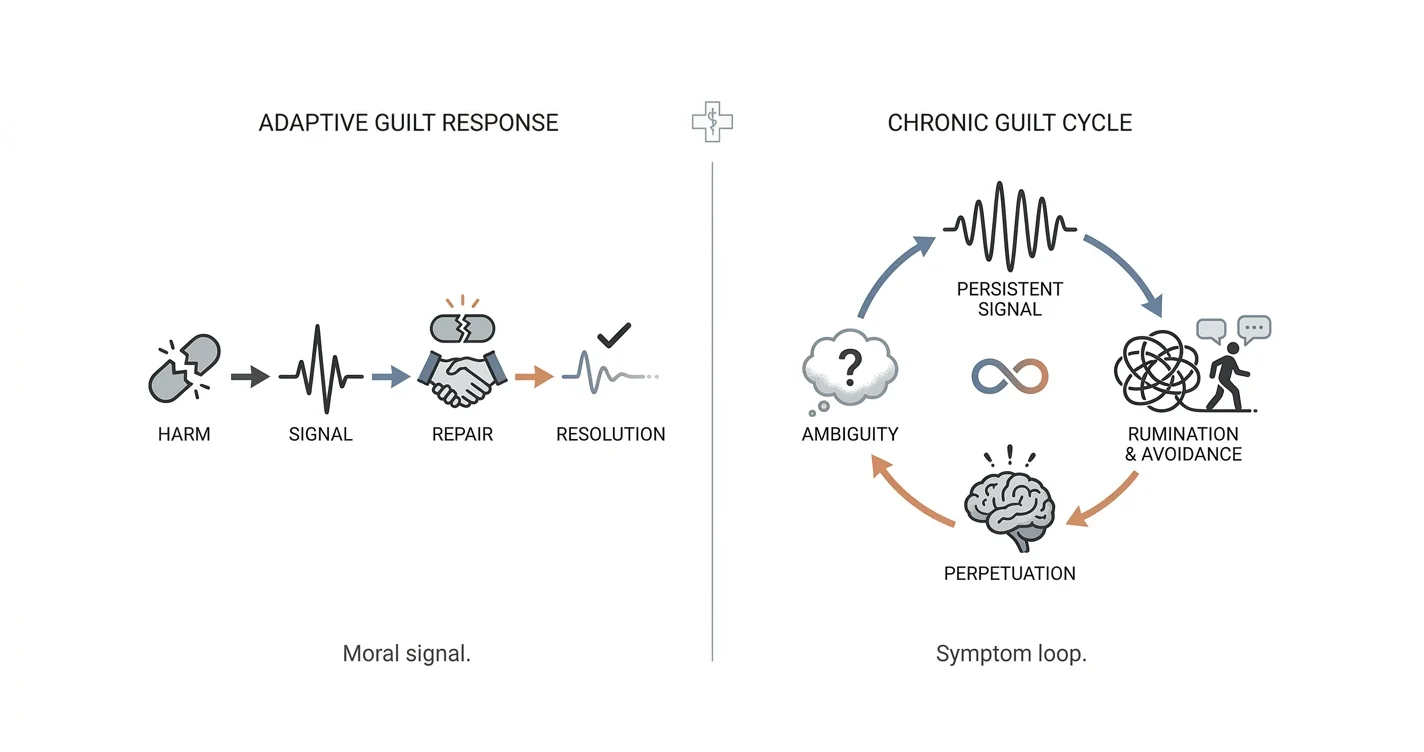
Guilt is useful exactly once: right after you hurt someone, it tells you to repair the damage. When guilt runs 24/7 regardless of what you've actually done, it stops being a moral signal and starts being a symptom. Research published in Clinical Psychology Review (2022) links chronic guilt to higher rates of anxiety, depression, and burnout. People searching for help with chronic guilt already know something is wrong — they just don't know where the feeling is coming from or how to stop it.
What you'll need
Before you work through the steps, have these in place:
- A journal or notes app for written reflections
- 10–15 minutes of uninterrupted time per session
- Willingness to say uncomfortable things out loud (or into a voice app)
- Basic familiarity with what guilt physically feels like in your body — chest tightness, stomach drop, jaw clench
- Optional: access to an AI voice support tool like Lovon for guided reflection between human therapy appointments
You do not need a diagnosis, a therapist on standby, or any prior experience with self-help techniques. You need honesty and repetition.
The steps
1. Name the type of guilt you're carrying
Not all chronic guilt looks the same. Identifying your flavor tells you which tool to reach for.
What it accomplishes: Precision. Treating "I feel guilty for saying no" the same as "I feel guilty about something I did at age 12" wastes effort.
How to do it: Write out your last three guilt episodes. For each one, answer: Did I actually cause harm? Did I violate my own values, or someone else's expectations? Is this guilt about a real event or a hypothetical ("what if I hadn't...")?.
Types to watch for:
- Survivor guilt — feeling bad for having things others don't
- Existential guilt — a vague sense you're not living correctly
- Relational guilt — feeling responsible for other people's emotions
- Retrospective guilt — replaying past decisions under current knowledge
Expected outcome: You'll see a pattern across the three episodes. Most people with chronic guilt land overwhelmingly in the relational or retrospective category.
Common mistake: Skipping this step because guilt "all feels the same." It doesn't — and mixing types means your interventions miss.
2. Trace it to its origin
Chronic guilt almost always has a training period — usually childhood, sometimes a long-term relationship.
What it accomplishes: Without a source, guilt feels like a personality trait. With a source, it becomes a learned response you can unlearn.
How to do it: Ask yourself: Who taught you that you were responsible for managing other people's feelings? Was praise in your family conditional on good behavior or emotional performance? Did a parent, partner, or authority figure regularly use guilt as leverage? Write the answer, then say it aloud. Hearing yourself name it activates a different kind of processing than reading it.
If your guilt traces back to a family system built on conditional love, the article on conditional love vs unconditional love maps that dynamic directly.
Expected outcome: At least one clear "that's where this came from" moment. That moment matters — it shifts the guilt from "what's wrong with me" to "what happened to me."
Common mistake: Protecting the source. If a parent trained you to feel guilty for having needs, acknowledging that isn't an accusation — it's data.
3. Challenge the guilt thought in real time
Chronic guilt runs on unchallenged thoughts. The thoughts feel like facts. They aren't.
What it accomplishes: Interrupts the loop at its weakest point — the moment the thought forms, before the emotion fully peaks.
How to do it: When guilt surfaces, pause and run the thought through three questions:
- What specifically did I do wrong here? (Force a concrete answer. "I just feel bad" doesn't count.)
- What would I say to a close friend who came to me with this exact situation?
- Is there a version of this story where I made a reasonable decision with the information I had at the time?
Write the answers. This isn't positive thinking — it's accuracy testing. Guilt often inflates responsibility ("everything is my fault") and minimizes context ("I should have known better").
Expected outcome: The guilt doesn't vanish, but it loses authority. You stop treating the feeling as evidence of wrongdoing.
Common mistake: Doing this in your head. Silent thought-challenging is too easy to short-circuit. Write it out or say it out loud.
4. Separate guilt from responsibility
If you did cause harm, repair it — then let it go. Guilt that lingers after genuine repair is no longer accountability; it's punishment.
What it accomplishes: Closes open loops that are actually closable. Many people carry guilt for things they could apologize for right now and haven't.
How to do it: List every guilt item from your journal. Sort them into two columns: actionable (you can still do something — apologize, correct, acknowledge) and non-actionable (too old, other person is gone, the "harm" was actually just disappointing someone). For actionable items, set a deadline of 72 hours to take the action. For non-actionable items, move to Step 5.
Expected outcome: Clearing even one actionable guilt item creates immediate relief and demonstrates to your nervous system that guilt can actually resolve — which reduces the baseline hum.
Common mistake: Over-apologizing to manage your discomfort rather than to repair the relationship. Over-apologizing often leaves the other person managing your emotions, which perpetuates the cycle.
5. Sit with discomfort without fixing it
Most people with chronic guilt are also high-functioning people-pleasers. The guilt spikes, and you immediately act to reduce it — apologize, over-explain, take responsibility for something that isn't yours. That short-term relief teaches the brain that guilt must be acted on immediately.
What it accomplishes: Breaks the action-relief loop that reinforces chronic guilt.
How to do it: When guilt spikes, set a 10-minute timer and do nothing about the guilt. Breathe. Notice where you feel it in your body. Let it be uncomfortable. Do not apologize, do not explain, do not fix. After 10 minutes, re-evaluate: does this require action, or did the urgency just fade on its own? Most non-actionable guilt fades.
If your guilt is tangled with a fear response — freezing, shutting down, feeling physically unable to act — the guide on freeze response and stress explains what's happening in the nervous system.
Expected outcome: Over 2–3 weeks of consistent practice, the urgency of chronic guilt spikes drops noticeably. You stop interpreting the feeling as an emergency.
Common mistake: Labeling the 10 minutes as "doing nothing." It's an active practice. You're teaching your nervous system that guilt doesn't require immediate resolution to be survivable.
6. Build a guilt budget
The goal isn't to feel zero guilt forever. The goal is proportionality: guilt that matches actual wrongdoing, fades after repair, and doesn't colonize your baseline mood.
What it accomplishes: Gives you a realistic finish line, which matters because "eliminate all guilt" is unachievable and sets you up to feel guilty about feeling guilty.
How to do it: Define what proportional guilt looks like for you. A useful benchmark: guilt that lasts no longer than 48 hours after you've either repaired the harm or determined no repair is possible. Write this number down. Track guilt episodes for two weeks against this benchmark. You're not grading yourself — you're collecting data.
Expected outcome: Most people find that 60–70% of their chronic guilt episodes don't reach the 48-hour mark once they've stopped compulsively acting on every spike. The remaining 30–40% are the ones worth examining more deeply with a therapist or in a structured session with an AI companion like Lovon.
Common mistake: Using the budget as another standard to fail. If you go over 48 hours, that's data, not a verdict on your character.
Troubleshooting
"I know I didn't do anything wrong, but the guilt won't go away." This is a nervous-system response, not a logic problem. Insight alone doesn't fix it. You need repetition — the same challenges, the same sit-with-it practice, over weeks, not days. The brain needs evidence, not arguments.
"My guilt always comes back to one specific relationship." That relationship is probably the training ground. Look at the power dynamic: was guilt used as a control mechanism? Read the guide on toxic parent patterns if the relationship is a parent, or consider whether narcissistic abuse dynamics are in play.
"I feel guilty for working on my guilt." This is meta-guilt — feeling bad for taking up space with your own needs. It's one of the clearest signs that your guilt is rooted in relational conditioning, not actual wrongdoing. Name it when it happens: "This is meta-guilt. It's a symptom."
"The steps work for a week and then the guilt floods back." Progress in chronic guilt is not linear. A flood-back after a week of relief usually means a trigger (a specific person, situation, or anniversary) re-activated the old pattern. Identify the trigger and treat it as new data, not failure.
"I grew up being told I was selfish whenever I had needs." That's a specific form of emotional conditioning. Inner child work is often what moves this needle when standard CBT-style challenges plateau. The guide on inner child healing is a practical starting point.
"My guilt feels physical — like actual dread in my chest." Somatic guilt is real. The body stores the pattern. Breathwork, body scans, and voice-based processing (saying things aloud rather than writing) often reach somatic guilt faster than written exercises alone.
Tools and resources
- Journal or notes app — analog works; the act of writing externalizes the thought
- 10-minute timer — for the sit-with-it practice in Step 5
- Lovon — AI voice support app for on-demand processing between licensed therapy sessions; built with input from PhD psychologists and designed for everyday struggles like chronic guilt, anxiety, and relationship stress
- Inner child healing guide — when guilt traces back to childhood conditioning
- Licensed therapist — for guilt rooted in complex trauma, abuse, or clinical-level anxiety and depression; Lovon is not a replacement for clinical care
FAQ
What is chronic guilt? Chronic guilt is a persistent, low-level sense that you've done something wrong — present even when you haven't caused any harm. Unlike situational guilt, it doesn't resolve after repair or apology. It functions as a baseline emotional state rather than a response to specific actions.
What causes chronic guilt? The most common causes are early conditioning (families where love was conditional on performance or emotional management), long-term relationships with people who used guilt as control, and cognitive patterns like over-responsibility and catastrophizing. It often co-occurs with anxiety and people-pleasing tendencies.
Is chronic guilt a mental health condition? Chronic guilt is not a standalone diagnosis, but it is a recognized feature of anxiety disorders, depression, PTSD, and complex PTSD. In 2026, it appears in clinical literature as a transdiagnostic symptom — meaning it shows up across multiple conditions rather than being specific to one.
How do I stop feeling guilty all the time? The most evidence-supported approach combines cognitive challenging (testing whether the guilt reflects actual wrongdoing), behavioral practice (not acting on every guilt spike), and tracing the guilt to its learned origin. Consistency over 4–6 weeks matters more than any single technique.
Can chronic guilt be a trauma response? Yes. In abusive or highly critical environments, people learn that feeling guilty — and showing it — reduces conflict and punishment. The guilt becomes a survival mechanism. When the environment changes, the mechanism stays active because the nervous system hasn't learned it's safe to let it go.
Is chronic guilt the same as low self-esteem? They overlap but aren't identical. Chronic guilt is specifically about feeling responsible for harm or wrongdoing. Low self-esteem is a broader belief about your worth. Many people with chronic guilt have high external standards and achievements — the guilt doesn't come from believing they're worthless, it comes from believing they're always on the verge of failing someone.
Does therapy actually help chronic guilt? Yes, particularly Cognitive Behavioral Therapy (CBT), Acceptance and Commitment Therapy (ACT), and trauma-focused therapies for guilt rooted in abuse or neglect. AI voice support tools like Lovon can support between sessions by helping you practice the thought-challenging steps consistently — though they don't replace licensed clinical care.
How long does it take to recover from chronic guilt? Most people see meaningful reduction in guilt intensity within 4–8 weeks of consistent daily practice. Full pattern change — where guilt is proportional and doesn't colonize your baseline — typically takes 3–6 months, faster with therapeutic support.
One last thing
Chronic guilt often feels like a personality trait — like you were just born more conscientious, more sensitive, more responsible than other people. That framing is worth questioning. In most cases, chronic guilt isn't a trait; it's a skill you developed to stay safe in a specific environment. Skills can be retrained. The fact that your guilt feels automatic doesn't mean it's permanent — it means it's practiced. You can practice something different.
Related guides
How AI Support Helps You Heal
AI emotional support isn't about replacing human connection — it's about filling the gaps. The moments when you need to talk at 2 AM, when you don't want to burden your friends again, or when you simply need someone to listen without judgment.
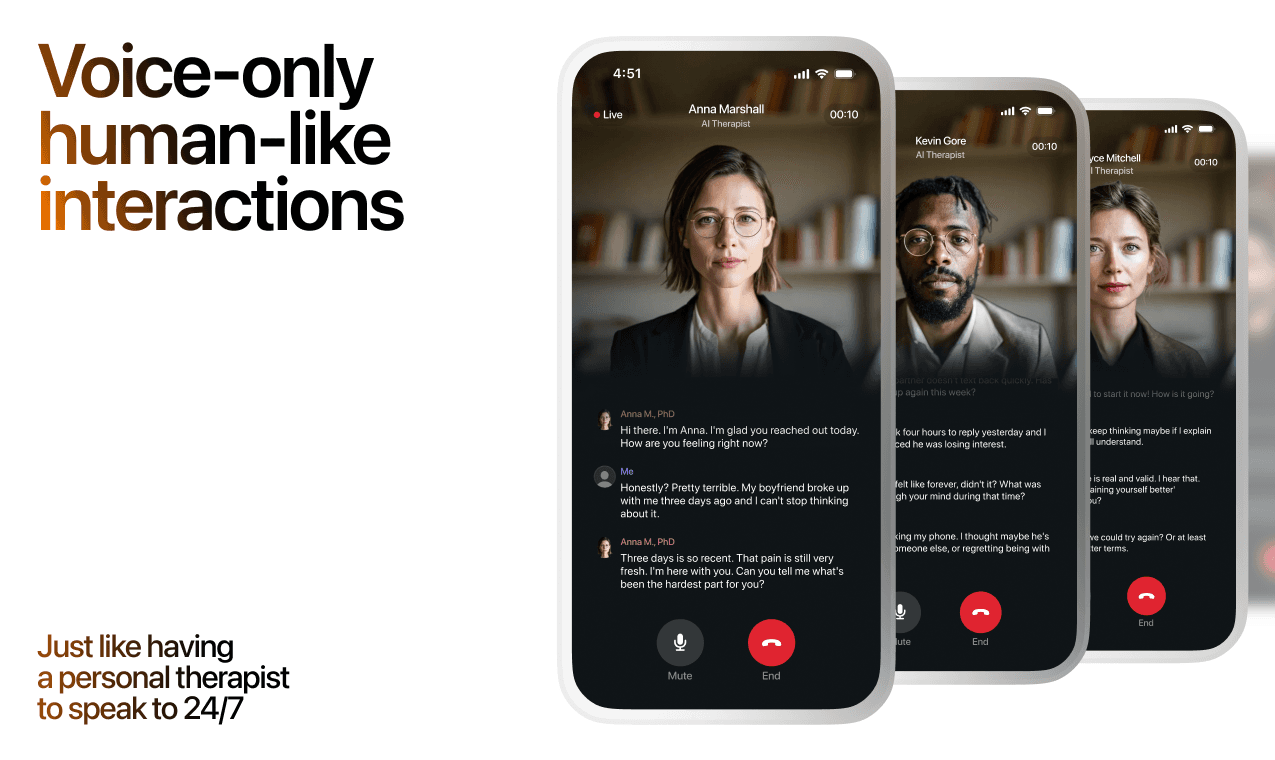
Here's what happens in a typical Lovon session:
You share what's on your mind
There's no script, no intake form, no waiting room. You speak or type whatever you're feeling — in your own words, at your own pace.
Lovon validates and explores
Using frameworks from CBT (Cognitive Behavioral Therapy) and motivational interviewing, Lovon acknowledges your feelings first, then gently helps you explore them. No dismissive "just move on" advice.
You build coping skills together
Lovon doesn't just listen — it actively works with you on evidence-based techniques: thought reframing, urge surfing, behavioral experiments, and more.
What a Session with Lovon Looks Like
When to Seek Professional Help
AI support is a valuable tool, but it's not a replacement for professional care. Please consider reaching out to a licensed therapist if you experience any of the following:
- Persistent thoughts of self-harm or suicide
- Inability to perform daily activities (work, eating, sleeping) for more than 2 weeks
- Turning to alcohol or substances to cope
- Intense anger or desire to harm your ex-partner
- Complete emotional numbness that doesn't improve over time
Crisis Resources (US): If you're in immediate danger, call 988 (Suicide & Crisis Lifeline) or text HOME to 741741 (Crisis Text Line). Available 24/7, free, and confidential.
Outside the US? Find a crisis line in your country
Ready to Start?
Your healing journey can begin right now
A 7-day trial. No judgment. Just a safe space to process what you're going through.
Frequently Asked Questions
Is Lovon a replacement for a real therapist?
Is my conversation with Lovon AI private?
How is Lovon different from ChatGPT for emotional support?
Can I use Lovon if I'm already seeing a therapist?
Can I try Lovon before subscribing?
About the Author

The Lovon Editorial Team
Mental Health & Wellness Content Team
The Lovon Editorial Team develops mental health and wellness content designed to make psychological concepts accessible and actionable. Our goal is to bridge the gap between clinical research and everyday life - helping you understand why your mind works the way it does and what you can do about it....
Related articles
- Pet Euthanasia Guilt: Too Soon, Too Late, Not There
The three shapes guilt takes after putting a dog or cat down, why "you did the right thing" does not land, and what to…
- How to Stop Being Codependent: Steps That Work (2026)
How to stop being codependent in 2026: 6 practical steps, common mistakes, and troubleshooting for boundary-setting…
- How to Stop Negative Self-Talk for Good (2026 Guide)
Learn how to stop negative self-talk with a 6-step method for 2026: catch the thought, name the distortion, and counter…
- How to Stop People Pleasing in 2026: 7-Step Guide
How to stop people pleasing in 2026: 7 concrete steps, a boundary script, and troubleshooting for guilt, pushback, and…
See also
Quizzes
- Shame Test: Do You Read Mistakes as Verdicts?
See which exit your shame takes, in 3 minutes.
- Empath Test: Do Other People's Moods Become Yours?
See how much of other people's moods you take on.
Free tools
- Self-Esteem Check-In
Eight statements, one read on three sides of self-esteem: your self-talk, how you act with people, and what you do with…
- How to End a Friendship Without a Scene
A chat for working out how to end a friendship clearly, without a grievance list or a slow ghost. Tell it how long you…
From the wiki
- Why do I feel sad when I'm alone?
Being alone does not create the sadness. It removes the noise that was keeping it out of earshot, so whatever queued up…
Disclaimer: This article is for informational purposes only and does not constitute medical advice, diagnosis, or treatment. Always seek the advice of your physician or other qualified health provider with any questions you may have regarding a medical condition. If you are in crisis or think you may have an emergency, call 988 (Suicide & Crisis Lifeline) or go to the nearest emergency room. Outside the US? Find a crisis line in your country.