
Does She Like Me Quiz: Read the Signs in 2026
Take our does she like me quiz in 2026. Score 6 behavioral signals — initiation, proximity, recall — and get a clear answer on whether she's interested.

Key Takeaways
- Friendliness as interest. Some people are warm, responsive, and physically expressive with everyone. Check whether
- Digital attention as real-world intent. Someone who replies fast and sends memes is engaged online. That doesn't
- One high-scoring moment. A single night where every signal fires doesn't outweigh 3 weeks of flat behavior. Patterns
If you've been replaying her texts, overanalyzing a smile, or Googling "does she like me quiz" at midnight, this page gives you a structured way to read the signals — no guesswork, no wishful thinking.
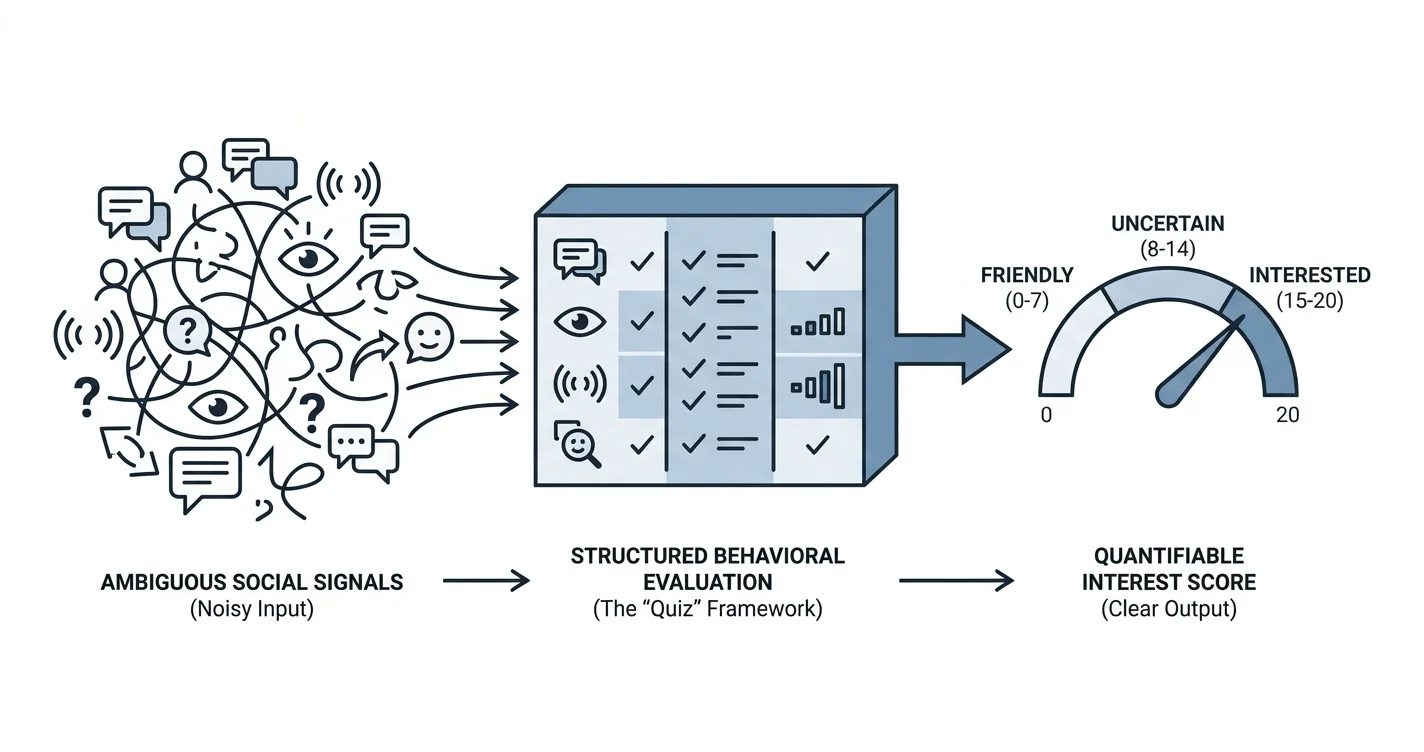
TL;DR: The most reliable "does she like me" signals in 2026 are consistent effort, physical proximity, and exclusive attention — not one-off moments. This guide walks you through 6 behavioral categories, scores each signal, and tells you exactly what the pattern means. If your score lands above 14 out of 20, she almost certainly likes you. Below 8, she's likely being friendly. The middle zone (8–14) is where most people get stuck — and where honest self-reflection matters most.
Why Reading Attraction Signs Is Harder Than It Looks
Human attraction signaling is noisy. Research in social psychology consistently shows that people misread neutral friendliness as romantic interest roughly 40% of the time — and miss genuine interest at a similar rate. The problem is confirmation bias: you weight the signals that confirm what you already want to believe.
A structured does-she-like-me quiz forces you to evaluate behaviors in isolation, then add them up. That's the only way to get an honest read in 2026.
Who This Guide Is For
You're someone who's noticed something — a lingering look, a text sent at 11 p.m., a laugh that felt personal — but you can't tell if it means anything. You're not looking to manipulate the situation. You want to know whether it's worth putting yourself out there, because rejection stings and you'd rather go in informed.
This is not for people in established relationships trying to gauge a partner's mood. It's for the early-stage read: a friend, a classmate, a coworker, someone you've been talking to for weeks.
What to Look For: 6 Signal Categories
Initiation Frequency
Who starts the conversations? If she texts first more than half the time across a 2-week window, that's a strong active signal. One-sided initiation (always you) doesn't mean she dislikes you — but it does mean she isn't chasing the connection. Score 0 if you initiate 80%+ of contact; score 3 if she initiates 50%+ of contact.
Response Quality vs. Response Speed
Speed matters less than depth. A quick "lol" tells you nothing. A paragraph response at any hour tells you she's investing mental energy in the exchange. Look for questions she adds to her replies — unprompted questions mean she wants the conversation to continue. Score 0 for low-effort replies; score 3 if she regularly adds follow-up questions.
Physical Proximity and Touch
In in-person settings, proximity is one of the least-faked signals. People physically move toward people they like and subtly away from people they don't. Does she close the distance between you without a practical reason to? Brief, non-functional touch (arm graze, shoulder tap while laughing) scores high. Score 0 if distance is always maintained; score 4 if she consistently closes proximity or initiates touch.
Exclusive Attention
In a group setting, does she angle toward you, find reasons to split off with you, or direct inside-joke energy specifically at you? Exclusive attention in social contexts is a reliable signal because it costs her social capital — she's choosing to invest it in you. Score 0 for equal group attention; score 4 if she singles you out repeatedly.
Memory and Personal Detail Recall
Does she remember what you told her two weeks ago — your sister's name, the thing you were stressed about, the band you mentioned once? Active retention of personal details signals that she's paying attention beyond surface-level politeness. This one is underweighted by most people. Score 0 for no recall; score 3 if she references specific things you've shared.
Mirroring and Engagement Body Language
Mirroring (matching your posture, pace, or word choice) happens below conscious awareness and is a documented marker of rapport and attraction. Sustained eye contact — longer than the conversational baseline — is another. Score 0 if her body language is closed or distracted; score 3 if you see consistent mirroring and eye contact.
Scoring Your Does-She-Like-Me Quiz
| Signal Category | Max Points |
|---|---|
| Initiation frequency | 3 |
| Response quality | 3 |
| Physical proximity / touch | 4 |
| Exclusive attention | 4 |
| Memory / personal detail recall | 3 |
| Mirroring / eye contact | 3 |
| Total | 20 |
15–20: She's interested. The signals are consistent and multi-channel. Act on it.
8–14: Mixed signals are real signals — they usually mean she's uncertain, not disinterested. More time or a direct conversation will resolve this faster than more analysis.
0–7: The pattern reads as friendly, not romantic. That can change, but don't build a strategy around hope right now.
What to Avoid Misreading
- Friendliness as interest. Some people are warm, responsive, and physically expressive with everyone. Check whether her behavior toward you is different from her baseline with others — not just whether it's positive.
- Digital attention as real-world intent. Someone who replies fast and sends memes is engaged online. That doesn't automatically transfer to in-person pursuit. Weight the in-person signals more heavily.
- One high-scoring moment. A single night where every signal fires doesn't outweigh 3 weeks of flat behavior. Patterns beat peaks.
What to Do With Your Score
If you score 15+, the bottleneck isn't her interest — it's you making a move. A direct, low-pressure expression of interest in 2026 still works better than any indirect strategy. Something specific ("I'd like to take you to dinner") beats something vague ("we should hang out sometime").
If you're in the 8–14 range and the uncertainty is causing real anxiety — loss of sleep, intrusive thoughts, difficulty concentrating — that's worth addressing on its own. Relationship anxiety often isn't about the specific person; it's a pattern that repeats. Lovon's AI-powered voice support gives you on-demand support to work through that kind of anxiety between sessions or before you have access to a therapist. The free AI therapist for relationship problems guide covers what that kind of support looks like in practice.
If you scored low and it stings, that's a normal response to unreciprocated feelings — and it passes faster when you process it directly rather than ruminate. Lovon also has tools specifically for that: the AI relationship coach for breakup recovery covers how to move through rejection and attachment pain without letting it spiral.
FAQ
What's the most reliable sign she likes me? Consistent initiation paired with exclusive attention in group settings. Either one alone is weak; both together are strong.
Is eye contact a good sign she likes me? Sustained eye contact beyond the conversational norm is a documented attraction signal — but it's more meaningful when it's paired with other behaviors like physical proximity or personal recall. Isolated eye contact can also just mean she's a focused conversationalist.
She texts me every day but hasn't made plans. Does she like me? Daily texting signals interest, but low in-person initiation is a gap. Some people use digital connection as a substitute for real-world risk. You'll get a clearer answer by proposing something specific in person.
Can friendly behavior look exactly like romantic interest? Yes. The difference is almost always in the exclusivity — whether her behavior toward you is noticeably different from how she treats other people she's friendly with. That's the variable most quizzes underweight.
My does-she-like-me quiz score is in the middle. What now? The middle range means the situation is genuinely ambiguous — not that she doesn't like you. A direct, low-stakes conversation resolves ambiguity faster than any amount of signal-reading. Frame it as curiosity, not a declaration.
Does attachment style affect how she shows interest? Significantly. Someone with an avoidant attachment style may like you and still pull back, avoid initiation, or keep responses short. If you suspect that dynamic is at play, the attachment style compatibility quiz for partners gives you a clearer framework for what you're actually dealing with.
How do I stop obsessing over whether she likes me? The obsessive loop is driven by uncertainty, not genuine threat. Either gather more data (see her again, propose something specific) or set a decision deadline. If the anxiety is disproportionate and recurring across relationships, that's a pattern worth exploring with a professional or a tool like Lovon.
Is this quiz accurate for long-distance situations? The initiation and response-quality categories apply directly to long-distance dynamics. Physical proximity and mirroring don't apply, so your maximum score drops to 12. Apply the same cutoffs proportionally: 9+ is positive, below 5 is flat.
One Last Thing
A 2023 study published in Psychological Science found that people who expressed romantic interest directly — even imperfectly — were rated as significantly more attractive by the recipient than people who relied on indirect signaling. The fear of rejection is almost always worse than the rejection itself. Your does-she-like-me quiz score is useful context, but it isn't a substitute for a real conversation. The quiz tells you whether it's reasonable to try. After that, the only move that actually changes the situation is yours.
Related Guides
How AI Support Helps You Heal
AI emotional support isn't about replacing human connection — it's about filling the gaps. The moments when you need to talk at 2 AM, when you don't want to burden your friends again, or when you simply need someone to listen without judgment.
Here's what happens in a typical Lovon session:
You share what's on your mind
There's no script, no intake form, no waiting room. You speak or type whatever you're feeling — in your own words, at your own pace.
Lovon validates and explores
Using frameworks from CBT (Cognitive Behavioral Therapy) and motivational interviewing, Lovon acknowledges your feelings first, then gently helps you explore them. No dismissive "just move on" advice.
You build coping skills together
Lovon doesn't just listen — it actively works with you on evidence-based techniques: thought reframing, urge surfing, behavioral experiments, and more.
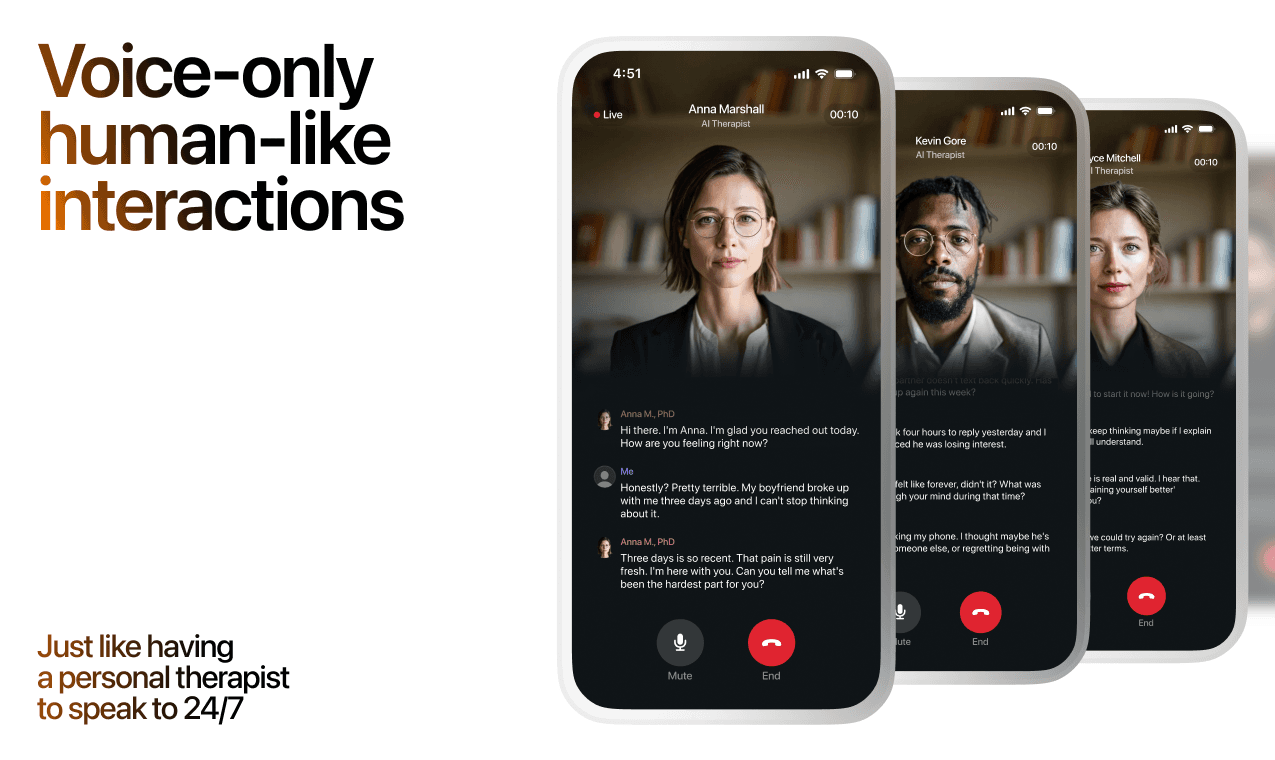
What a Session with Lovon Looks Like
When to Seek Professional Help
AI support is a valuable tool, but it's not a replacement for professional care. Please consider reaching out to a licensed therapist if you experience any of the following:
- Persistent thoughts of self-harm or suicide
- Inability to perform daily activities (work, eating, sleeping) for more than 2 weeks
- Turning to alcohol or substances to cope
- Intense anger or desire to harm your ex-partner
- Complete emotional numbness that doesn't improve over time
Crisis Resources (US): If you're in immediate danger, call 988 (Suicide & Crisis Lifeline) or text HOME to 741741 (Crisis Text Line). Available 24/7, free, and confidential.
Outside the US? Find a crisis line in your country
Ready to Start?
Your healing journey can begin right now
A 7-day trial. No judgment. Just a safe space to process what you're going through.
Frequently Asked Questions
Is Lovon a replacement for a real therapist?
Is my conversation with Lovon AI private?
How is Lovon different from ChatGPT for emotional support?
Can I use Lovon if I'm already seeing a therapist?
Can I try Lovon before subscribing?
About the Author
The Lovon Editorial Team
Mental Health & Wellness Content Team
The Lovon Editorial Team develops mental health and wellness content designed to make psychological concepts accessible and actionable. Our goal is to bridge the gap between clinical research and everyday life - helping you understand why your mind works the way it does and what you can do about it....
Related articles
- Is My Partner Emotionally Unavailable Quiz: 2026 Verdict
Take the 12-question is my partner emotionally unavailable quiz, score your pattern, and get a 2026 verdict on whether…
- Love Language Compatibility Quiz for Couples 2026
The best love language compatibility quiz in 2026 maps both partners' scores side-by-side, flags mismatches, and…
- Best Couples Compatibility Quiz for New Couples 2026
Take the best couples compatibility quiz in 2026. Covers attachment, values, and communication style — with AI-guided…
- Should I Break Up With Him Quiz: Honest 2026 Check
An honest should i break up with him quiz that scores real patterns, not moods. Get a clear verdict in 2 minutes and…
See also
Quizzes
- Do They Like Me? 12-Question Quiz
Read the signs in 2 minutes.
- Why Am I Single? 12-Question Quiz With 5 Real Reasons
Find which of five reasons is actually yours.
Free tools
- How to Tell Someone You Like Them
The wording depends on what you would lose. Tell it who they are to you and how you usually talk, and you get something…
- What Did They Actually Mean By That?
A chat for one sentence you cannot stop re-reading. Paste their exact words and what was happening around them, and get…
From the wiki
- How long does it take to fall in love?
There is no fixed timeline. Some people feel it within two or three weeks, many land somewhere between two and four…
Disclaimer: This article is for informational purposes only and does not constitute medical advice, diagnosis, or treatment. Always seek the advice of your physician or other qualified health provider with any questions you may have regarding a medical condition. If you are in crisis or think you may have an emergency, call 988 (Suicide & Crisis Lifeline) or go to the nearest emergency room. Outside the US? Find a crisis line in your country.