
Fearful Avoidant Attachment: Triggers & Healing (2026)
Fearful avoidant attachment explained: the 4 trigger categories, a 90-second distress protocol, and a 6-step healing sequence you can start today in 2026.

Key Takeaways
- A private journal or notes app for daily trigger logging (15 minutes per day minimum)
- Basic familiarity with your attachment history — knowing which early relationships shaped your blueprint
- A consistent emotional support resource: a therapist, a coach, or an on-demand tool like [Lovon's AI relationship
- A willingness to stay with discomfort for 90 seconds before acting — the length of time it takes for an emotion to
- Patience: published research on attachment change (Davila et al., 2007) shows measurable shifts over 6–12 months of
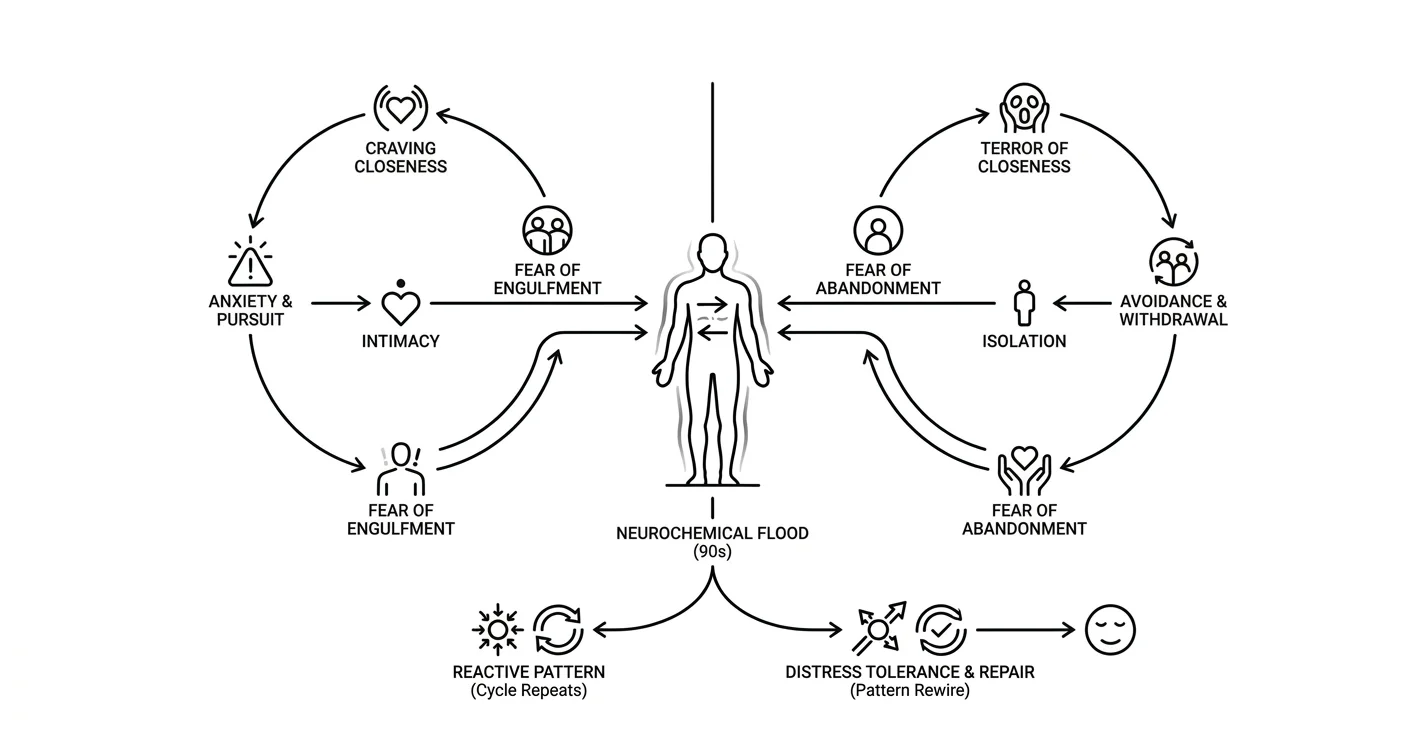
Fearful avoidant attachment sits at the intersection of two competing drives: the craving for closeness and the terror of it. This guide maps the specific triggers that activate that conflict and gives you a concrete sequence of steps to rewire the pattern in 2026.
TL;DR: Fearful avoidant attachment (also called disorganized attachment) is marked by wanting intimacy while simultaneously fearing abandonment and engulfment. Common triggers include emotional vulnerability, conflict, and early signs of commitment. Healing requires identifying your trigger stack, building distress tolerance, and gradually expanding your window of tolerance through consistent practice — tools like Lovon's AI-powered voice support can support that process between formal therapy sessions.
Why this matters
Fearful avoidant is the least common of the four attachment styles — research from the University of California puts it at roughly 5% of adults — but it produces the most relationship instability of any style. Unlike anxious or avoidant individuals, who have a consistent coping strategy, fearful avoidants switch between pursuit and withdrawal within the same relationship, sometimes within the same hour. That unpredictability strains partners and deepens shame in the person experiencing it. Understanding the mechanism in 2026 is the starting point for changing it.
What you'll need
- A private journal or notes app for daily trigger logging (15 minutes per day minimum)
- Basic familiarity with your attachment history — knowing which early relationships shaped your blueprint
- A consistent emotional support resource: a therapist, a coach, or an on-demand tool like Lovon's AI relationship coach for avoidant partners
- A willingness to stay with discomfort for 90 seconds before acting — the length of time it takes for an emotion to peak and begin to subside
- Patience: published research on attachment change (Davila et al., 2007) shows measurable shifts over 6–12 months of consistent work
The steps
Step 1 — Map your personal trigger stack
What it accomplishes: You cannot interrupt a pattern you cannot see. Trigger mapping turns vague dread into specific, predictable stimuli you can prepare for.
Fearful avoidant triggers cluster into four categories:
- Closeness requests: a partner saying "I love you" first, being asked to meet family, someone needing you emotionally
- Conflict signals: raised voices, a cold tone, the phrase "we need to talk"
- Abandonment cues: a slow text response, a cancelled plan, a partner seeming distracted
- Autonomy threats: a partner checking in frequently, being asked about the future, feeling monitored
Spend 7 days writing down every moment you felt the urge to pull away or cling. Note the trigger, your physical sensation (chest tightness, dissociation, heart rate spike), and what you actually did. After 7 days, review the log and circle the 3 most frequent entries. Those are your primary triggers for 2026.
Common mistake: Listing only external triggers. Internal triggers — a positive feeling that feels "too good" and therefore dangerous — are equally important and easier to miss.
Step 2 — Learn the dual-activation model
What it accomplishes: Understanding why you feel two opposite impulses at once reduces shame and gives you a framework for predicting your own behavior.
Fearful avoidant attachment is rooted in early caregiving that was both the source of comfort and the source of fear — a parent who was also frightening, or an environment where emotional expression was punished. The nervous system learned: "closeness = danger" AND "isolation = danger." Both survival systems fire simultaneously, which is why fearful avoidants describe feeling frozen or chaotic.
In practice: when a partner moves emotionally close, the anxious attachment system activates pursuit. Seconds or days later, the avoidant system activates withdrawal. The oscillation is not personality instability — it is a nervous system doing exactly what it was trained to do.
Write out your specific version of this: "When [trigger], I feel the pull to [pursue behavior], and then I feel the urge to [avoid behavior]." Naming both sides removes the judgment from the pattern.
Common mistake: Treating one side as the "real" you. Both responses are learned adaptations, not identity.
Step 3 — Build a 90-second distress tolerance protocol
What it accomplishes: Breaks the automatic link between trigger and behavior, creating a pause long enough for the prefrontal cortex to come back online.
Neuroscientist Jill Bolte Taylor's research established that an emotional wave — the neurochemical flood following a trigger — lasts approximately 90 seconds if you do not feed it with thought. Your protocol uses that window:
- Label the trigger out loud or in writing (5 seconds): "I'm triggered because they haven't texted back."
- Name the physical sensation (10 seconds): "I feel tightness in my chest and an urge to either send 3 messages or delete the conversation."
- Breathe at a 4-7-8 ratio (60 seconds): inhale 4 counts, hold 7, exhale 8. This directly activates the parasympathetic nervous system.
- Choose a deliberate response (15 seconds): not a reactive one.
Practice this protocol on low-stakes triggers first — minor irritations, not relationship crises. Build the neural pathway when the stakes are low so it's accessible when they're high.
Expected outcome: After 3–4 weeks of consistent use, most people report a 1–2 second natural pause appearing before reactive behavior. That pause is the entire goal of this step.
Common mistake: Attempting this protocol mid-conflict for the first time. It requires prior practice to work under pressure.
Step 4 — Create a graduated exposure ladder for intimacy
What it accomplishes: Incrementally expands your tolerance for closeness without triggering the full shutdown response.
Avoidance maintains fear. The only way to reduce the threat signal around intimacy is controlled, repeated exposure at an intensity the nervous system can tolerate. Build a 10-rung ladder where rung 1 is barely uncomfortable and rung 10 is your most dreaded intimacy behavior:
- Rung 1 example: making eye contact for 5 seconds during a neutral conversation
- Rung 3 example: sharing a minor personal feeling unprompted
- Rung 6 example: staying present during a partner's emotional disclosure without deflecting
- Rung 10 example: saying "I need you" directly
Spend at least 1 week at each rung before advancing. Do not advance while still experiencing strong avoidance at the current rung. This is not a race — moving through 10 rungs in 10 weeks is appropriate for 2026; moving through them in 10 days is not.
Common mistake: Skipping rungs during periods of feeling safe, then crashing back to rung 1 when anxiety spikes. Slow and sequential beats fast and erratic.
Step 5 — Install a repair ritual for after a trigger fires
What it accomplishes: Reduces shame accumulation and rebuilds connection after you've pulled away or pushed someone away.
Fearful avoidants often avoid the repair conversation as much as the original conflict, because repair requires vulnerability about having been dysregulated. A 3-part repair structure removes the guesswork:
- Acknowledge what happened (specific, no minimizing): "I went cold after you asked about meeting my family."
- Name your internal state (not the other person's behavior): "I got scared. It wasn't about you — my nervous system read 'danger.'"
- State what you want going forward (specific): "I want to try that conversation again when I've had 20 minutes to regulate."
Delivering repair within 24 hours of the rupture is the target. Research on relationship repair (Gottman Institute, aggregated data) indicates that the damage from a rupture is largely determined not by the rupture itself but by whether repair occurs and how quickly.
Common mistake: Over-explaining the attachment theory behind your behavior during repair. Keep it brief. The other person needs connection, not a lecture.
Step 6 — Build a consistent support rhythm
What it accomplishes: Prevents healing from being purely reactive (only doing the work after a crisis) and creates the repetition attachment change requires.
Attachment patterns are stored procedurally — in the body and in automatic behavior sequences, not in declarative memory. Changing them requires repetition across dozens or hundreds of interactions, not a single insight. A weekly support rhythm for 2026 might look like:
- Daily: 10-minute trigger log review
- 3x per week: one rung of exposure practice
- Weekly: one deeper session with a therapist, coach, or on-demand emotional support tool
- Monthly: review your trigger log for patterns that have shifted
Lovon's voice sessions are designed for exactly the between-session moments when a therapist isn't available — when a trigger fires at 11 pm on a Tuesday and you need to process it before it becomes a 3-day shutdown. The anxious attachment style signs and coping strategies guide covers the overlap between anxious and fearful avoidant patterns, which is worth reviewing if your trigger log shows more pursuit behaviors than you expected.
Troubleshooting
You complete the steps but the triggers keep firing at full intensity. This is normal for the first 4–6 weeks. The steps reduce reactivity over time, not immediately. If intensity hasn't dropped at all after 8 weeks of consistent practice, the pattern may be rooted in unprocessed trauma that requires a trauma-focused therapist rather than self-directed work alone.
Your partner is losing patience with your withdrawal cycles. Share the repair ritual structure with them. Giving a partner a predictable process ("I'll be back in 20 minutes; here's what I'll say") reduces their anxiety and makes the relationship safer for you — a direct feedback loop.
You feel fine in a new relationship, then the pattern resurfaces around 3–6 months. This is the classic fearful avoidant arc — the attachment system activates once real intimacy begins. The 3-6 month mark is not a sign the relationship is wrong; it is the sign that the work starts.
The exposure ladder feels impossible to move up. You may have started too high. Return to the last rung you completed without strong avoidance and spend another full week there. There is no minimum pace.
You understand everything intellectually but can't access any of it when triggered. Cognitive understanding and somatic response operate on different tracks. Add body-based practices — cold water on the face, vigorous movement, or box breathing — before attempting any cognitive protocol during a trigger episode.
You isolate completely after a rupture and can't initiate repair. Set a 24-hour timer when the rupture occurs. When it goes off, send the repair message — even imperfectly. A messy repair is worth 10x more than a perfect one that never arrives.
Tools and resources
- Daily trigger log: a plain notes app works; specificity matters more than format
- 90-second protocol: write it on a physical card you carry during high-stakes periods in 2026
- Exposure ladder template: 10 blank rungs in your journal, filled in with your specific behaviors
- Lovon app: on-demand voice sessions for processing attachment triggers between formal appointments — particularly useful for the Step 6 weekly rhythm
- Attachment style compatibility quiz for partners — useful if you want to understand how your fearful avoidant pattern interacts with a partner's style before or during the healing process
What to do next
If this guide surfaces more anxious behaviors than avoidant ones in your trigger log, your pattern may lean toward the anxious end of the fearful avoidant spectrum. The repair ritual and exposure ladder still apply, but the calibration differs.
FAQ
What is fearful avoidant attachment? Fearful avoidant attachment is a pattern where a person simultaneously wants closeness and fears it, producing unpredictable cycles of pursuit and withdrawal. It develops when early caregivers were both the source of comfort and the source of threat.
What triggers fearful avoidant behavior in relationships? The four main trigger categories are closeness requests ("I love you," meeting family), conflict signals (raised voices, "we need to talk"), abandonment cues (slow texts, cancelled plans), and autonomy threats (frequent check-ins, questions about commitment).
Can fearful avoidant attachment be healed? Yes. Research on earned secure attachment (Roisman et al., 2002) documents adults who shift from insecure to secure attachment through consistent relational and therapeutic work. The timeline is typically 6–18 months of active effort.
Is fearful avoidant the same as disorganized attachment? In most clinical literature, yes — fearful avoidant and disorganized attachment describe the same pattern. "Disorganized" is the term used in childhood research; "fearful avoidant" is more common in adult relationship literature.
How is fearful avoidant different from anxious attachment? Anxious attachment produces consistent hyperactivation — pursuit, reassurance-seeking, fear of abandonment. Fearful avoidant produces both hyperactivation and deactivation, often switching between them. Anxious individuals want closeness and pursue it; fearful avoidants want it and then flee from it once it appears.
How long does it take to heal fearful avoidant attachment? Aggregated data from attachment intervention studies suggests 6–12 months for measurable behavioral change with consistent practice. Full earned security typically takes longer and often requires a stable, patient relationship in addition to individual work.
Can someone with fearful avoidant attachment maintain a long-term relationship? Yes, but the 3–6 month activation point is the most vulnerable period. Partners who understand the pattern and can tolerate the repair cycle without escalating have significantly better outcomes.
What's the best support tool for fearful avoidant healing in 2026? A trauma-informed therapist is the gold standard. For between-session support, on-demand voice support tools like Lovon provide structured coping sessions when a therapist isn't available — particularly valuable given that fearful avoidant triggers don't follow a weekly schedule.
One last thing
Fearful avoidant attachment is the one style that produces shame about both the anxious and the avoidant moments — you feel weak for wanting closeness and cruel for running from it. The pattern is neither. It is a nervous system that learned two survival rules that contradict each other. Every step in this guide is essentially teaching your nervous system one new rule: connection is survivable. That is a slow rewrite, but it compounds. By the end of 2026, a trigger log from January and one from December will look like they belong to two different people.
Related guides
How AI Support Helps You Heal
AI emotional support isn't about replacing human connection — it's about filling the gaps. The moments when you need to talk at 2 AM, when you don't want to burden your friends again, or when you simply need someone to listen without judgment.
Here's what happens in a typical Lovon session:
You share what's on your mind
There's no script, no intake form, no waiting room. You speak or type whatever you're feeling — in your own words, at your own pace.
Lovon validates and explores
Using frameworks from CBT (Cognitive Behavioral Therapy) and motivational interviewing, Lovon acknowledges your feelings first, then gently helps you explore them. No dismissive "just move on" advice.
You build coping skills together
Lovon doesn't just listen — it actively works with you on evidence-based techniques: thought reframing, urge surfing, behavioral experiments, and more.
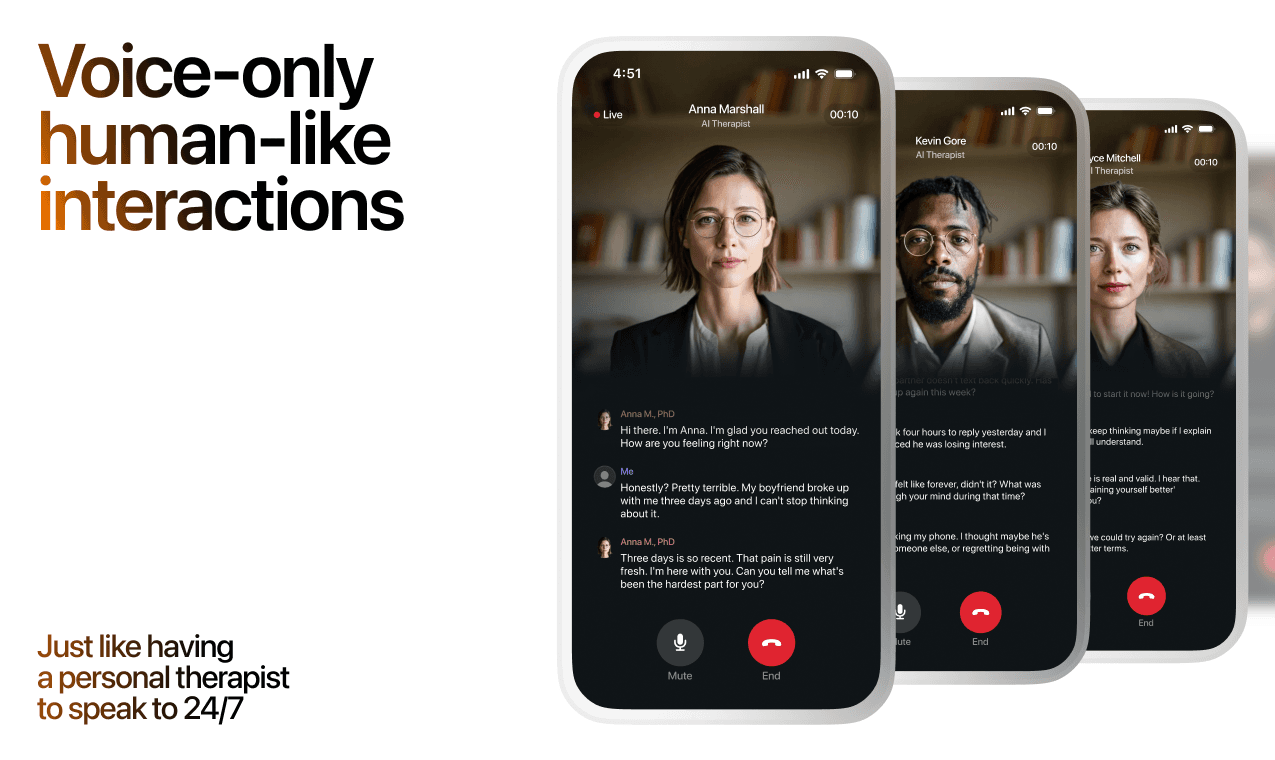
What a Session with Lovon Looks Like
When to Seek Professional Help
AI support is a valuable tool, but it's not a replacement for professional care. Please consider reaching out to a licensed therapist if you experience any of the following:
- Persistent thoughts of self-harm or suicide
- Inability to perform daily activities (work, eating, sleeping) for more than 2 weeks
- Turning to alcohol or substances to cope
- Intense anger or desire to harm your ex-partner
- Complete emotional numbness that doesn't improve over time
Crisis Resources (US): If you're in immediate danger, call 988 (Suicide & Crisis Lifeline) or text HOME to 741741 (Crisis Text Line). Available 24/7, free, and confidential.
Outside the US? Find a crisis line in your country
Ready to Start?
Your healing journey can begin right now
A 7-day trial. No judgment. Just a safe space to process what you're going through.
Frequently Asked Questions
Is Lovon a replacement for a real therapist?
Is my conversation with Lovon AI private?
How is Lovon different from ChatGPT for emotional support?
Can I use Lovon if I'm already seeing a therapist?
Can I try Lovon before subscribing?
About the Author
The Lovon Editorial Team
Mental Health & Wellness Content Team
The Lovon Editorial Team develops mental health and wellness content designed to make psychological concepts accessible and actionable. Our goal is to bridge the gap between clinical research and everyday life - helping you understand why your mind works the way it does and what you can do about it....
Related articles
- Anxious Avoidant Attachment: Styles, Patterns, & What They Mean
Although some people truly invest in relationships, they may find themselves thinking that they are the reason those…
- Anxious Attachment and Love Avoidant: Break the Cycle 2026
Anxious attachment and love avoidant partners create a push-pull cycle. Learn the pattern, 7 steps to break it, and…
- BPD Attachment Style: The Push-Pull Cycle Explained 2026
BPD attachment style is almost always disorganized. Learn what drives the push-pull cycle, the 5-step loop, and what…
- Signs of Insecure Attachment in Adults (2026 Guide)
Signs of insecure attachment in adults, explained step by step: fear of abandonment, withdrawal, reassurance-seeking…
See also
Quizzes
- Rejection Sensitivity Test: Free 12-Question Check
See how strongly you expect and read rejection.
- Do I Have Trust Issues? 12-Question Quiz
Check where your guard actually sits, in 2 minutes.
Free tools
- What Did They Actually Mean By That?
A chat for one sentence you cannot stop re-reading. Paste their exact words and what was happening around them, and get…
- How to Reassure Your Partner (and When It Stops Helping)
A chat for working out how to reassure your partner when the same worry keeps coming back. Say what sets it off and how…
From the wiki
- What does clingy mean in a relationship?
Clingy is what people call behavior that asks for more contact or reassurance than the other person wants to give…
Disclaimer: This article is for informational purposes only and does not constitute medical advice, diagnosis, or treatment. Always seek the advice of your physician or other qualified health provider with any questions you may have regarding a medical condition. If you are in crisis or think you may have an emergency, call 988 (Suicide & Crisis Lifeline) or go to the nearest emergency room. Outside the US? Find a crisis line in your country.