
How to Get Over Someone You Love: 7 Steps (2026)
Learn how to get over someone you love with evidence-based steps: no contact, grief processing, cognitive reappraisal, and identity rebuilding. Start today.
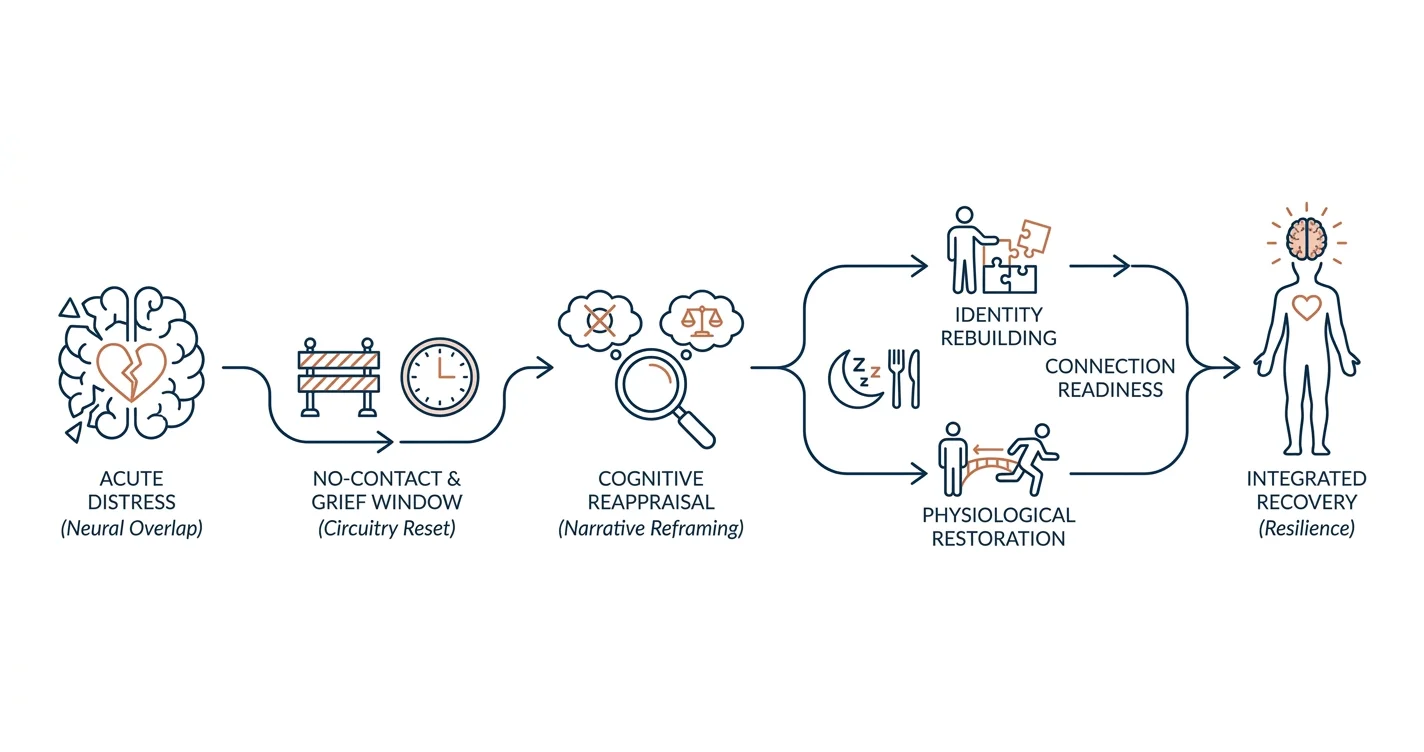

Key Takeaways
- A no-contact plan — a clear decision about blocking, muting, or limiting access to the person across every channel
- A support person — one friend, family member, or therapist you can call when the urge to reach out peaks
- A journal or voice note app — for daily emotional processing (5-10 minutes is enough)
- Time blocked daily — at least 20 minutes for intentional recovery work
- Willingness to feel bad — suppression prolongs recovery; processing shortens it
Getting over someone you love is one of the hardest emotional tasks a person faces — and in 2026, the science behind heartbreak gives you a real roadmap instead of just "give it time."
TL;DR: Learning how to get over someone you love takes deliberate action, not passive waiting. Evidence-based steps — including no-contact periods, cognitive reappraisal, grief processing, and rebuilding identity — consistently shorten recovery time. This guide walks through each step in sequence, explains why it works, and flags the mistakes that keep people stuck for months longer than necessary. Lovon's AI voice support app can support you through the hardest stretches, anytime you need to talk it out.
Why this matters
Heartbreak activates the same brain regions as physical pain. A 2010 study published in Science found that social rejection and physical pain share neural overlap in the secondary somatosensory cortex and the dorsal posterior insula. That is not a metaphor — it is neuroscience. Knowing that helps, because it means grief after a breakup is a real, biological process with a beginning, a middle, and an end. You are not broken. You are healing.
What makes the difference between three months and three years is what you do in the early weeks.
What you'll need
Before starting, get these in place:
- A no-contact plan — a clear decision about blocking, muting, or limiting access to the person across every channel
- A support person — one friend, family member, or therapist you can call when the urge to reach out peaks
- A journal or voice note app — for daily emotional processing (5-10 minutes is enough)
- Time blocked daily — at least 20 minutes for intentional recovery work
- Willingness to feel bad — suppression prolongs recovery; processing shortens it
The steps
Step 1: Enforce a no-contact period immediately
What it accomplishes: Cuts the reinforcement loop that keeps longing active.
Every time you check their Instagram, re-read old texts, or send a "just checking in" message, your brain releases a small dopamine hit followed by a crash. That cycle mimics the withdrawal pattern seen in substance dependence. Research from 2012 in Journal of Neuroimaging confirmed that viewing a photo of a rejected partner activates reward circuitry — the same circuits lit up by cocaine craving.
Mute, unfollow, or block across every platform. Archive the text thread. Remove their number from your favorites. This is not punishment; it is neuroscience-informed pacing. Aim for a minimum of 30 days before any contact decision.
Common mistake: Keeping one "harmless" channel open (watching their Stories, leaving them in a group chat) and wondering why you feel stuck.
Step 2: Let yourself grieve — with a time limit per session
What it accomplishes: Processes the emotional backlog without letting it consume the day.
Suppressing grief does not eliminate it; it stores it. A 2009 meta-analysis in Psychological Bulletin found that expressive suppression increases physiological stress markers and prolongs negative mood. Give yourself a structured grief window: 15-20 minutes daily, ideally in the morning, where you feel everything fully — cry, journal, or talk out loud.
When the window closes, close it. Redirect deliberately. This is not toxic positivity; it is regulating the dose so grief does not spill into every hour of 2026.
Common mistake: Allowing grief to be "on" all day with no boundary, which exhausts coping reserves and deepens depression.
Step 3: Audit the relationship accurately
What it accomplishes: Corrects the "highlight reel" memory bias that makes the person seem better than the relationship was.
After a breakup, the mind tends to replay only the good moments. This is called "rosy retrospection" and it inflates how good the relationship was in memory. Counter it deliberately. Write two lists: what worked, and what genuinely did not — the fights that never resolved, the needs that went unmet, the moments you felt small or dismissed.
This is not about vilifying the person. It is about seeing the full picture so you stop pining for something that was only partly real. If patterns of manipulation or narcissistic abuse were present, this step is especially important — idealization after that kind of relationship can be persistent and misleading.
Common mistake: Treating the relationship as flawless and yourself as the only reason it ended.
Step 4: Rebuild your identity outside the relationship
What it accomplishes: Restores the sense of self that merged with the partnership.
Long-term relationships reorganize your identity. A 2003 study in Personality and Social Psychology Bulletin found that breakups cause measurable "self-concept confusion" — people genuinely have a smaller, less clear sense of who they are after losing a relationship. Recovery accelerates when you actively reclaim or rebuild.
Pick one activity that was yours before the relationship — a hobby, a social group, a skill — and re-engage with it this week. Add one new one over the next 30 days. The goal is a daily life that does not have a missing-person-shaped hole in it.
Common mistake: Staying in the shared routines (same gym, same café, same Friday night plans) and experiencing constant environmental triggers.
Step 5: Process obsessive thought loops with cognitive reappraisal
What it accomplishes: Reduces the frequency and intensity of intrusive thoughts about the person.
Rumination — replaying the relationship, the breakup, or imaginary future conversations — is the most consistent predictor of prolonged grief. Cognitive reappraisal is a CBT-based technique where you notice the thought, name it ("there's the 'what if we tried again' thought"), and replace the narrative with a more accurate one.
A practical script: when the thought arrives, say out loud or write: "I am having the thought that [X]. The fuller picture is [Y]." It sounds mechanical, but repetition rewires the automatic response. If you find yourself obsessing over someone for weeks after following these steps, that guide covers deeper cognitive tools.
Common mistake: Trying to suppress the thought entirely, which triggers the "white bear" rebound effect and makes it louder.
Step 6: Restore sleep, movement, and eating — in that order
What it accomplishes: Rebuilds the physiological baseline that emotional recovery depends on.
Heartbreak disrupts all three basics. Sleep quality drops, appetite changes, and motivation to exercise collapses. These are not trivial side effects — poor sleep amplifies emotional reactivity by up to 60%, per research from UC Berkeley published in 2019. You cannot reappraise thoughts clearly when you are running on 4 hours and skipped lunch.
Start with sleep: keep a consistent bedtime, remove your phone from the bedroom, and limit alcohol (it suppresses REM sleep, the stage most involved in emotional processing). Movement second: even a 20-minute walk five times a week measurably reduces cortisol. Eating third: regular meals stabilize blood glucose and reduce irritability.
Common mistake: Using alcohol, food restriction, or excessive sleep as numbing strategies rather than genuine recovery tools.
Step 7: Decide — deliberately — when you are ready for new connection
What it accomplishes: Prevents rebound patterns that delay real healing and potentially hurt someone else.
Ready does not mean "over it completely." It means you can think about the person without being destabilized, you have a stable daily life, and you are curious about someone new rather than trying to fill a void. Most grief therapists suggest waiting until you can hold the loss with some equanimity — typically 3-6 months for a significant relationship, though the timeline varies.
Rushing into new connections as an analgesic prolongs the underlying grief. It does not erase it.
Common mistake: Dating again the moment the pain dips to a tolerable level, then being surprised when it spikes again after a reminder.
Troubleshooting
"I broke no-contact after two weeks and now feel worse." That is normal. The grief clock does not reset; it just means you need to restart the no-contact period and plan for the next urge in advance. Identify the exact trigger (a song, a location, a time of day) and prepare a redirect before it hits.
"I cannot stop crying at work." You need a sharper grief window. Start your 15-20 minute processing session before work, not during. This pre-empts spillover. If crying is persistent and uncontrollable beyond week 3, that warrants a conversation with a licensed therapist — it may be crossing into clinical depression.
"I feel angry, not sad, and I do not know what to do with it." Anger is a legitimate phase of grief and can be more useful than sadness — it creates energy and clarity. Channel it into the identity-rebuilding step. Journaling anger specifically (writing out what felt unfair, what you deserved and did not get) is more effective than venting to mutual friends.
"I romanticize the relationship even when I know it was bad." This is especially common after relationships with a love-bombing pattern — the intense early period distorts memory. Return to Step 3 and extend the "what did not work" list. Reading about specific patterns can help your memory access the fuller truth.
"I feel fine for a week, then devastated again." That is not regression — it is the standard nonlinear shape of grief. Good days followed by hard days is the normal pattern, not evidence that you are not healing. Track it over 4-week windows, not day-to-day.
"My friends are tired of hearing about it." That is a signal to add a non-social outlet: a journal, a voice note practice, or on-demand emotional support through an AI-powered tool like Lovon, where you can talk through the same thoughts as many times as you need without social fatigue becoming a factor.
Tools and resources
- Grief journal — A plain notebook with a daily 15-minute entry prompt: "What am I feeling right now, and what is the most accurate thing I can say about the situation?"
- CBT thought record — A free printable from most psychology departments; tracks the automatic thought, the evidence for and against it, and the reappraisal.
- Scheduled support calls — Pre-arranged check-ins with one trusted person, rather than reactive crisis calls, reduce the social-fatigue problem.
- Lovon — The AI voice support app is available around the clock for emotional support between therapy sessions or when no one is available. It is built with input from PhD psychologists and covers relationship grief, anxiety, and self-reflection. It is not a licensed clinical service, but it is a real support tool for the 2 a.m. moments.
- Licensed therapist — If symptoms of depression persist beyond 4 weeks (persistent low mood, loss of interest, sleep disruption), a licensed clinician is the right step. BetterHelp, Psychology Today's therapist directory, and Open Path Collective all offer access at various price points in 2026.
What to do next
Once you are moving through these steps consistently, the next layer is understanding the attachment patterns that shape how you grieve and attach in the first place. The BPD attachment patterns guide explains how push-pull cycles form — useful reading if this relationship had an addictive quality to it.
FAQ
How long does it take to get over someone you love? Research suggests 3-6 months for most significant relationships, but the range is wide. What predicts faster recovery is active processing (journaling, therapy, rebuilding routine) rather than time alone.
Does no contact actually work, or is it just a myth? It works, and the mechanism is neurological: every contact restarts the dopamine-withdrawal cycle. A 30-day no-contact period consistently appears in grief research as the minimum needed to break the reinforcement loop.
Is it normal to still love someone after a breakup? Yes. Love does not switch off at the moment of separation. Feelings can persist for months while you are simultaneously making healthy progress. The goal is not to stop loving them — it is to stop being destabilized by that love.
How do you get over someone you see every day (coworker, classmate)? This makes no-contact impossible, so the focus shifts to the other steps: controlled grief windows, identity rebuilding, and cognitive reappraisal. Minimize non-essential interaction, do not engage in post-mortem conversations about the relationship at work, and expand your social life outside that environment.
What is the difference between grief and depression after a breakup? Grief is episodic — you feel it intensely, especially around reminders, but it lifts between episodes. Depression is pervasive — low mood is constant across contexts, with loss of interest in things unrelated to the relationship, disrupted sleep, and changes in appetite. If it is the latter, speak to a licensed clinician.
Should I stay friends with an ex? Not during the healing period. Research from 2017 in Personal Relationships found that staying in contact slows emotional recovery and increases distress. Revisit the friendship question only after you have fully completed the steps above and feel genuinely neutral, not intermittently hopeful.
How do I stop thinking about them at night? Night is when the prefrontal cortex — your rational override — is at its lowest function. A consistent pre-sleep routine (same time, no phone for 30 minutes, brief journaling to offload the day's thoughts) reduces intrusive thinking by giving the mind a structured close to the day.
Can an AI therapy app actually help with heartbreak? It can provide real support for emotional processing between sessions with a licensed therapist or when no one is available. Lovon is built with PhD psychologist input and designed for exactly this — voice conversations about relationship grief, anxiety, and self-reflection, available at any hour in 2026. It is a complement to, not a replacement for, clinical care.
One last thing
A 2022 study from the University of Colorado Boulder found that a cognitive reappraisal exercise — specifically, reframing the breakup as an opportunity for growth rather than a loss — produced measurable reductions in heartbreak intensity within two weeks, independent of whether participants believed the reframe was true at the start. You do not have to mean it yet. Do it anyway. The brain responds to the practice before it responds to the belief.
Related guides
How AI Support Helps You Heal
AI emotional support isn't about replacing human connection — it's about filling the gaps. The moments when you need to talk at 2 AM, when you don't want to burden your friends again, or when you simply need someone to listen without judgment.
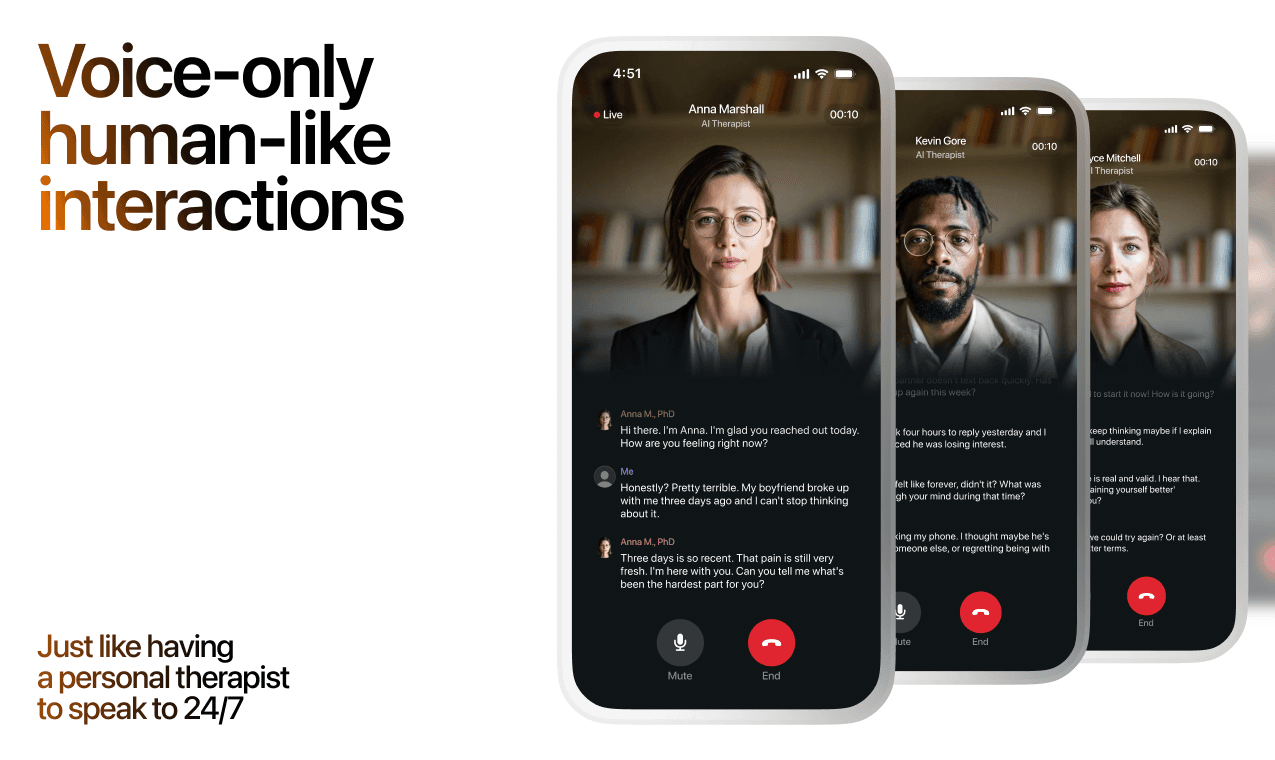
Here's what happens in a typical Lovon session:
You share what's on your mind
There's no script, no intake form, no waiting room. You speak or type whatever you're feeling — in your own words, at your own pace.
Lovon validates and explores
Using frameworks from CBT (Cognitive Behavioral Therapy) and motivational interviewing, Lovon acknowledges your feelings first, then gently helps you explore them. No dismissive "just move on" advice.
You build coping skills together
Lovon doesn't just listen — it actively works with you on evidence-based techniques: thought reframing, urge surfing, behavioral experiments, and more.
What a Session with Lovon Looks Like
When to Seek Professional Help
AI support is a valuable tool, but it's not a replacement for professional care. Please consider reaching out to a licensed therapist if you experience any of the following:
- Persistent thoughts of self-harm or suicide
- Inability to perform daily activities (work, eating, sleeping) for more than 2 weeks
- Turning to alcohol or substances to cope
- Intense anger or desire to harm your ex-partner
- Complete emotional numbness that doesn't improve over time
Crisis Resources (US): If you're in immediate danger, call 988 (Suicide & Crisis Lifeline) or text HOME to 741741 (Crisis Text Line). Available 24/7, free, and confidential.
Outside the US? Find a crisis line in your country
Ready to Start?
Your healing journey can begin right now
A 7-day trial. No judgment. Just a safe space to process what you're going through.
Frequently Asked Questions
Is Lovon a replacement for a real therapist?
Is my conversation with Lovon AI private?
How is Lovon different from ChatGPT for emotional support?
Can I use Lovon if I'm already seeing a therapist?
Can I try Lovon before subscribing?
About the Author
The Lovon Editorial Team
Mental Health & Wellness Content Team
The Lovon Editorial Team develops mental health and wellness content designed to make psychological concepts accessible and actionable. Our goal is to bridge the gap between clinical research and everyday life - helping you understand why your mind works the way it does and what you can do about it....
Related articles
- AI Support App for Athlete Injury Setbacks (2026)
Injured athletes need support between rehab sessions. See how Lovon works as an ai support app for athlete injury…
- How to Build a Routine With ADHD (2026 Guide)
Learn how to build a routine with ADHD using anchor habits, external cues, and a built-in reset rule. Step-by-step guide…
- CBT Techniques on Your Own: 7 Steps for 2026
Learn CBT techniques on your own with a 7-step routine: thought records, reframing, and behavioral experiments you can…
- Stop Self-Isolating Depression: 2026 Step-by-Step Fix
Self-isolating depression breaks with small, specific steps, not motivation. Get the 2026 plan, troubleshooting, and…
See also
Quizzes
- Should I Forgive Him for Cheating? 12-Question Quiz
Twelve questions on whether rebuilding is possible.
- Am I Over My Ex? 12-Question Gut Check
Post-breakup check-in in 2 minutes.
Free tools
- How to Forgive Someone Who Hurt You
Forgiving, reconciling, and deciding it was fine are three different things, and they get merged. Tell it what happened…
- No Contact Plan Builder
Name the hours you are most likely to text them, and get one if-then rule for each. Ends in a dated card you can…
From the wiki
- How to break up with someone you still love?
Loving someone does not mean the relationship works. If you have circled the same decision for months and the reasons…
Disclaimer: This article is for informational purposes only and does not constitute medical advice, diagnosis, or treatment. Always seek the advice of your physician or other qualified health provider with any questions you may have regarding a medical condition. If you are in crisis or think you may have an emergency, call 988 (Suicide & Crisis Lifeline) or go to the nearest emergency room. Outside the US? Find a crisis line in your country.