
Narcissistic Abuse: Signs You're in One (2026)
Narcissistic abuse leaves victims doubting themselves, not their partner. Recognize love-bombing, gaslighting, and isolation — and find your next step in 2026.

Key Takeaways
- A private space to read and reflect — not shared with a partner
- A journal or notes app to track patterns over time (dates, specific incidents, exact words used)
- Roughly 20–30 minutes to go through the full guide
- An honest support contact — one person who knew you before this relationship
- An emotional support tool if you need to process in real time (Lovon's [free AI therapist for relationship
Narcissistic abuse is one of the most disorienting forms of relationship harm — it leaves victims questioning their own memory, judgment, and sanity rather than questioning their partner. This guide breaks down exactly what narcissistic abuse looks like in 2026, how to recognize it while you're inside it, and what concrete steps move you toward safety.
TL;DR: Narcissistic abuse is a pattern of psychological manipulation — including gaslighting, love-bombing, devaluation, and isolation — inflicted by a partner with narcissistic traits. The signs are specific and recognizable. If you're reading this because something feels wrong, that instinct is worth trusting. Lovon's AI-powered support tools can help you process what you're experiencing between therapy sessions or when professional help isn't immediately available.
Why This Is Hard to See From the Inside
The defining feature of narcissistic abuse is that it dismantles your ability to accurately perceive it. A partner who constantly rewrites events, dismisses your emotions as "too sensitive," and alternates between intense affection and cold withdrawal creates genuine cognitive confusion. This isn't weakness — it's the predictable effect of sustained psychological pressure.
In 2026, research from trauma-focused clinicians consistently identifies narcissistic abuse as a leading driver of complex PTSD symptoms in adult relationships. The damage isn't visible the way physical abuse is. That invisibility is part of the mechanism.
What You'll Need Before Working Through This
- A private space to read and reflect — not shared with a partner
- A journal or notes app to track patterns over time (dates, specific incidents, exact words used)
- Roughly 20–30 minutes to go through the full guide
- An honest support contact — one person who knew you before this relationship
- An emotional support tool if you need to process in real time (Lovon's free AI therapist for relationship problems is available on demand, no appointment needed)
Step 1: Identify the Love-Bombing Phase
Action: Map the beginning of the relationship against a timeline.
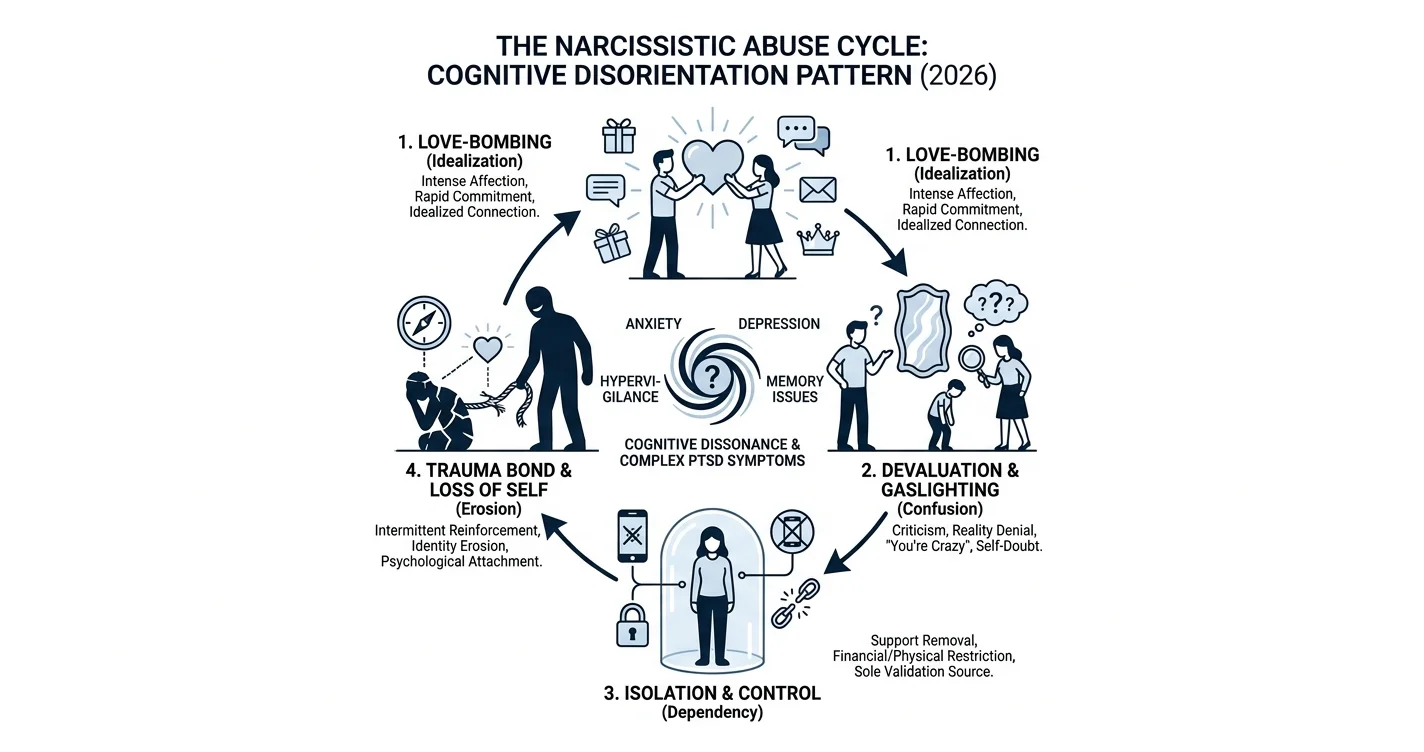
Love-bombing is the entry point for most narcissistic abuse cycles. It looks like rapid, overwhelming affection — constant texting, lavish early gifts, declarations of soulmate-level connection within weeks. It feels extraordinary. That's the point.
The purpose isn't romance. It's to create a debt of gratitude and an idealized version of the relationship that the abuser can later reference — "You used to be so appreciative" — to manufacture guilt when you object to mistreatment.
What to look for:
- Declarations of love or exclusivity unusually early (often within the first 2–4 weeks)
- Statements that you're "different from everyone else" or that they've "never felt this way"
- Pressure to commit quickly — moving in together, meeting family, removing dating apps
- Anger or withdrawal when the intensity isn't matched
Common mistake: Assuming that because the beginning felt real, the relationship's foundation is solid. Love-bombing is performance. The emotional intensity was calibrated to create attachment, not to sustain it.
Expected outcome: You'll be able to locate the exact point when the relationship shifted — from idealization to the first signs of criticism or control. That shift is the seam.
Step 2: Recognize Gaslighting as a Pattern, Not a One-Off
Action: Review specific arguments or incidents where your memory of events was disputed.
Gaslighting is not occasional misremembering. It's a repeated, systematic effort to make you doubt your own perception of reality. The word matters less than the pattern: you come away from conversations convinced that what you clearly experienced did not happen the way you remember — or didn't happen at all.
In 2026, mental health professionals classify chronic gaslighting as a form of psychological abuse distinct from simple dishonesty. It produces measurable effects: confusion, self-doubt, social withdrawal, and hypervigilance.
Specific phrases that signal gaslighting:
- "You're imagining things" / "That never happened"
- "You're too sensitive" / "You're crazy"
- "I never said that — you always do this"
- "Everyone else thinks you overreact"
Why it matters: Gaslighting works cumulatively. A single incident might look like a misunderstanding. Twelve incidents over six months, always resolving in the abuser's favor, is a system.
Common mistake: Treating each incident in isolation. Keep a written log with dates. Patterns visible in writing are much harder to gaslight away.
Step 3: Map the Devaluation-Discard Cycle
Action: Chart your partner's emotional behavior over the past 3–6 months. Note the highs and lows.
After love-bombing, the narcissistic abuse cycle typically moves into devaluation — a gradual (sometimes sudden) shift where the abuser begins criticizing, dismissing, and withdrawing the warmth that defined the relationship's beginning. The "discard" phase is the endpoint: sudden coldness, threats to leave, or actual abandonment — often followed by a return and renewed love-bombing.
This cycle can repeat many times. Each repetition deepens the victim's trauma bonding — the paradox where abuse and intermittent reward create stronger psychological attachment, not weaker.
Signs you're in the devaluation phase:
- Constant criticism of things that were praised early on
- Public humiliation or belittling in front of others
- Silent treatment lasting days as punishment
- Comparing you unfavorably to others (exes, coworkers, friends)
- Threats to leave used as control, not genuine expressions of dissatisfaction
Expected outcome: Seeing the cycle clearly — in writing, with dates — breaks the illusion that bad periods are anomalies. When you can identify the pattern, you can name what's happening in real time.
Step 4: Assess Isolation Tactics
Action: List people you've grown distant from since this relationship began. Ask yourself why.
Narcissistic abusers systematically reduce the victim's access to outside perspectives. This rarely looks like a direct order. It looks like: "Your friend doesn't really care about you," "Your family is toxic," "I just want you to myself — is that so wrong?" The goal is to remove anyone who might reflect reality back to you.
By the time isolation is complete, the abuser is the victim's primary — often only — source of emotional validation. That dependency is then used as leverage.
What to check:
- Friends or family you've stopped seeing since the relationship began
- A partner who reads your messages, demands location access, or creates conflict every time you make independent plans
- Feeling like you have to hide parts of your life to avoid jealousy or anger
- Reduced contact with your own support network driven by exhaustion or conflict avoidance
Common mistake: Accepting the narrative that the isolation was your choice. Isolation in narcissistic abuse is engineered, not chosen.
Step 5: Check for Financial and Physical Control
Action: Review whether your financial independence, physical freedom, or access to basic resources has been restricted.
Narcissistic abuse frequently extends beyond emotional manipulation into concrete control mechanisms. Financial control — limiting access to money, creating debt, monitoring spending — and physical control — monitoring location, restricting where you go and when — are direct extensions of the same power dynamic.
These behaviors make leaving materially harder. That's their function.
Red flags:
- A partner who controls household money while you have no independent access
- Demands for constant location-sharing beyond mutual agreement
- Using finances to punish or reward behavior
- Monitoring your phone, social media, or communications without consent
Step 6: Name It and Build a Safety Plan
Action: Write down what you've identified. Then build one concrete next step.
Naming narcissistic abuse is not a small act. For many people, it ends months or years of self-doubt. Once named, the pattern cannot fully un-name itself.
A safety plan doesn't require leaving immediately. It requires having a clear next action: calling a domestic violence hotline, telling one trusted person, making a therapy appointment, or opening a separate bank account. In 2026, resources are more accessible than ever — including on-demand AI support for processing trauma and relationship distress.
If you're unsure whether what you've identified rises to the level of narcissistic abuse, taking a structured am I dating a narcissist quiz can help externalize the question and give you a framework for your specific situation.
Troubleshooting: When You're Not Sure
"But they were so good to me in the beginning." That's the love-bombing phase. It was real behavior; it was not honest behavior. The contrast is designed to make you doubt the abuse.
"Maybe I'm the problem." Narcissistic abuse reliably produces this thought. If you're doing extensive internal work to fix yourself while your partner does none, that asymmetry is a signal.
"They say all couples fight like this." Normal conflict involves two people working toward resolution. Narcissistic conflict ends with one person apologizing for being hurt.
"I've tried to leave before and it got worse." Escalation when a victim attempts to leave is a documented abuse pattern. Contact the National Domestic Violence Hotline (1-800-799-7233) before attempting to leave if you're concerned about safety.
"I still love them." Trauma bonding produces genuine attachment to an abuser. The love is real. It does not mean the relationship is safe or healthy.
"I don't know who I am anymore." Identity erosion is a direct outcome of sustained narcissistic abuse. Recovery starts with reconnecting with pre-relationship interests, relationships, and values — often with professional or structured support.
Tools and Resources
- National Domestic Violence Hotline: 1-800-799-7233, available 24/7 in 2026
- RAINN: rainn.org, crisis support for abuse survivors
- Lovon app: AI-powered voice support for relationship distress, anxiety, and trauma processing — available on demand, no waitlist
- AI therapy for PTSD and trauma recovery — structured support specifically for abuse-related trauma symptoms
- Journaling frameworks, grounding exercises, and CBT-based coping tools available through Lovon's mental health sessions
What to Do Next
If this guide confirmed what you suspected, the most important next move is to tell one real person — a friend, family member, or therapist — what you've identified. External validation from someone who knows you breaks the isolation that makes narcissistic abuse sustainable.
If you're not ready for that conversation yet, structured self-work is a legitimate starting point. Understanding your own attachment patterns can clarify why this relationship felt so compelling and so hard to leave — see anxious attachment style signs and coping strategies for related context.
FAQ
What is narcissistic abuse? Narcissistic abuse is a pattern of psychological manipulation by a partner with narcissistic traits, including love-bombing, gaslighting, devaluation, isolation, and cycles of reward and punishment. It causes measurable psychological harm including anxiety, depression, and complex PTSD.
What are the early signs of narcissistic abuse? The earliest sign is usually love-bombing — overwhelming affection, rapid commitment pressure, and intensity that feels extraordinary. This is followed by gradual devaluation: criticism, dismissal, and withdrawal of the warmth that characterized the start.
Is narcissistic abuse a recognized form of domestic abuse? Yes. In 2026, psychological and emotional abuse — including the patterns associated with narcissistic abuse — are recognized by domestic violence organizations and mental health frameworks as genuine forms of intimate partner violence.
How do I know if I'm being gaslit? You consistently come away from arguments convinced that what you clearly experienced didn't happen, or that your emotional reactions are unreasonable. The pattern always resolves in your partner's favor and leaves you doubting your own memory or sanity.
Can a narcissistic abuser change? Change requires sustained therapeutic work, genuine insight, and accountability — conditions that are rare without significant motivation. Personality disorders exist on a spectrum, and some individuals do make progress in therapy. However, hope for change is one of the primary reasons victims stay longer than is safe.
How long does it take to recover from narcissistic abuse? Recovery timelines vary widely depending on the duration and intensity of abuse, existing support systems, and access to professional help. Trauma responses from narcissistic abuse can persist for months to years in 2026 without structured support. Most survivors report meaningful improvement with consistent therapy or structured coping tools.
What is trauma bonding and why does it make leaving hard? Trauma bonding is a psychological attachment formed through cycles of abuse and intermittent positive reinforcement. The unpredictable alternation between cruelty and warmth creates stronger neurological attachment than consistent warmth alone. It's not weakness — it's a documented psychological response.
What should I do first if I think I'm in a narcissistically abusive relationship? Document specific incidents with dates and exact words. Tell one trusted person outside the relationship what you've observed. Contact the National Domestic Violence Hotline (1-800-799-7233) if you have safety concerns. Build at least one concrete next step before deciding on larger actions.
One Last Thing
Narcissistic abuse survivors disproportionately blame themselves — not because they are responsible, but because the abuse is specifically engineered to produce self-blame. A 2026 clinical review of coercive control patterns notes that self-blame in abuse victims correlates more strongly with the sophistication of the abuser's tactics than with any characteristic of the victim. You did not cause this. Recognizing the pattern is the first structural break in it.
Related Guides
How AI Support Helps You Heal
AI emotional support isn't about replacing human connection — it's about filling the gaps. The moments when you need to talk at 2 AM, when you don't want to burden your friends again, or when you simply need someone to listen without judgment.
Here's what happens in a typical Lovon session:
You share what's on your mind
There's no script, no intake form, no waiting room. You speak or type whatever you're feeling — in your own words, at your own pace.
Lovon validates and explores
Using frameworks from CBT (Cognitive Behavioral Therapy) and motivational interviewing, Lovon acknowledges your feelings first, then gently helps you explore them. No dismissive "just move on" advice.
You build coping skills together
Lovon doesn't just listen — it actively works with you on evidence-based techniques: thought reframing, urge surfing, behavioral experiments, and more.
What a Session with Lovon Looks Like

When to Seek Professional Help
AI support is a valuable tool, but it's not a replacement for professional care. Please consider reaching out to a licensed therapist if you experience any of the following:
- Persistent thoughts of self-harm or suicide
- Inability to perform daily activities (work, eating, sleeping) for more than 2 weeks
- Turning to alcohol or substances to cope
- Intense anger or desire to harm your ex-partner
- Complete emotional numbness that doesn't improve over time
Crisis Resources (US): If you're in immediate danger, call 988 (Suicide & Crisis Lifeline) or text HOME to 741741 (Crisis Text Line). Available 24/7, free, and confidential.
Outside the US? Find a crisis line in your country
Ready to Start?
Your healing journey can begin right now
A 7-day trial. No judgment. Just a safe space to process what you're going through.
Frequently Asked Questions
Is Lovon a replacement for a real therapist?
Is my conversation with Lovon AI private?
How is Lovon different from ChatGPT for emotional support?
Can I use Lovon if I'm already seeing a therapist?
Can I try Lovon before subscribing?
About the Author
The Lovon Editorial Team
Mental Health & Wellness Content Team
The Lovon Editorial Team develops mental health and wellness content designed to make psychological concepts accessible and actionable. Our goal is to bridge the gap between clinical research and everyday life - helping you understand why your mind works the way it does and what you can do about it....
Related articles
- Relationship Red Flags Checklist 2026: Spot Them Early
This relationship red flags checklist for early dating in 2026 flags love bombing, gaslighting, and future faking before…
- How to Heal From Trauma Bonding in 2026: The Real Steps
How to heal from trauma bonding after a toxic relationship: no-contact rules, nervous system fixes, and support options…
- Narcissistic and Emotionally Immature Parents — Communication Manipulation Patterns
Growing up with narcissistic and emotionally immature parents often means navigating a minefield of confusing…
- How to Heal from Emotionally Immature Narcissistic Parents Trauma
Healing from emotionally immature narcissistic parents trauma is a profound journey that requires more than willpower or…
See also
Quizzes
- Is My Relationship Healthy? 15-Question Check-In
Check your relationship health in 3 minutes.
- Am I Dating a Narcissist? 15-Trait Quiz
Understand the pattern in 3 minutes.
Free tools
- How to Confront a Narcissistic Parent
Most of these conversations fail because you went in wanting three things at once. Tell it what you want to raise, and…
- What to Say Back to a Hostile Co-Parent
A chat, not a form. Paste the message your ex sent about the kids, say what actually has to be decided, and you get a…
From the wiki
- How to leave a toxic relationship?
Leaving a toxic relationship is rarely a decision problem — you usually know. What stops you is that the pull toward…
Disclaimer: This article is for informational purposes only and does not constitute medical advice, diagnosis, or treatment. Always seek the advice of your physician or other qualified health provider with any questions you may have regarding a medical condition. If you are in crisis or think you may have an emergency, call 988 (Suicide & Crisis Lifeline) or go to the nearest emergency room. Outside the US? Find a crisis line in your country.