
Platonic Friendship Meaning & Where the Line Is (2026)
Platonic friendship meaning explained clearly: what it is, what makes a bond truly non-romantic, and the 6 specific signs the line is being crossed in 2026.

Key Takeaways
- Honest self-awareness — willingness to check your own feelings without judgment
- Basic emotional vocabulary — able to name at least a few emotions beyond "fine" and "weird"
- 15-20 minutes of uninterrupted reflection time — this is not a skim-and-move-on topic
- Optional: a journal — writing thoughts down reduces the chance of circular thinking
- Genuine care and affection between two people
Platonic friendship meaning comes up constantly in relationship conversations — and for good reason. The word gets misused, the boundaries get blurry, and what starts as a clear non-romantic bond can quietly shift into something neither person planned for.
TL;DR: Platonic friendship means a close, caring bond between two people that has no sexual or romantic component. The term comes from the philosopher Plato, who described love as progressing from physical attraction toward pure intellectual and spiritual connection. In 2026, most people use "platonic" to mean simply: deep friendship, zero romance. The line gets crossed when one person develops feelings, physical contact changes character, or emotional intimacy starts to substitute for a romantic partnership. Recognizing those shifts early protects both people.
Why This Matters
Friendship is one of the strongest predictors of long-term mental health. A 2023 meta-analysis covering over 300,000 adults found that strong social ties reduce early mortality risk by 50%. Platonic relationships are most of those ties. Understanding what keeps a friendship platonic — and what starts eroding that — is practical information, not just relationship theory.
What You'll Need
Before working through the steps below, have these things in place:
- Honest self-awareness — willingness to check your own feelings without judgment
- Basic emotional vocabulary — able to name at least a few emotions beyond "fine" and "weird"
- 15-20 minutes of uninterrupted reflection time — this is not a skim-and-move-on topic
- Optional: a journal — writing thoughts down reduces the chance of circular thinking
If you're already in a friendship that feels confusing or strained, Lovon's AI voice support app can give you a private, judgment-free space to talk through what you're feeling before you say anything to the other person.
Step 1: Understand the Actual Definition
The word "platonic" traces to Plato's Symposium (circa 385 BCE), where different forms of love were debated. What later became called "Platonic love" referred to a bond rooted in admiration of virtue and shared intellectual life — explicitly stripped of physical desire.
In everyday 2026 use, platonic friendship means:
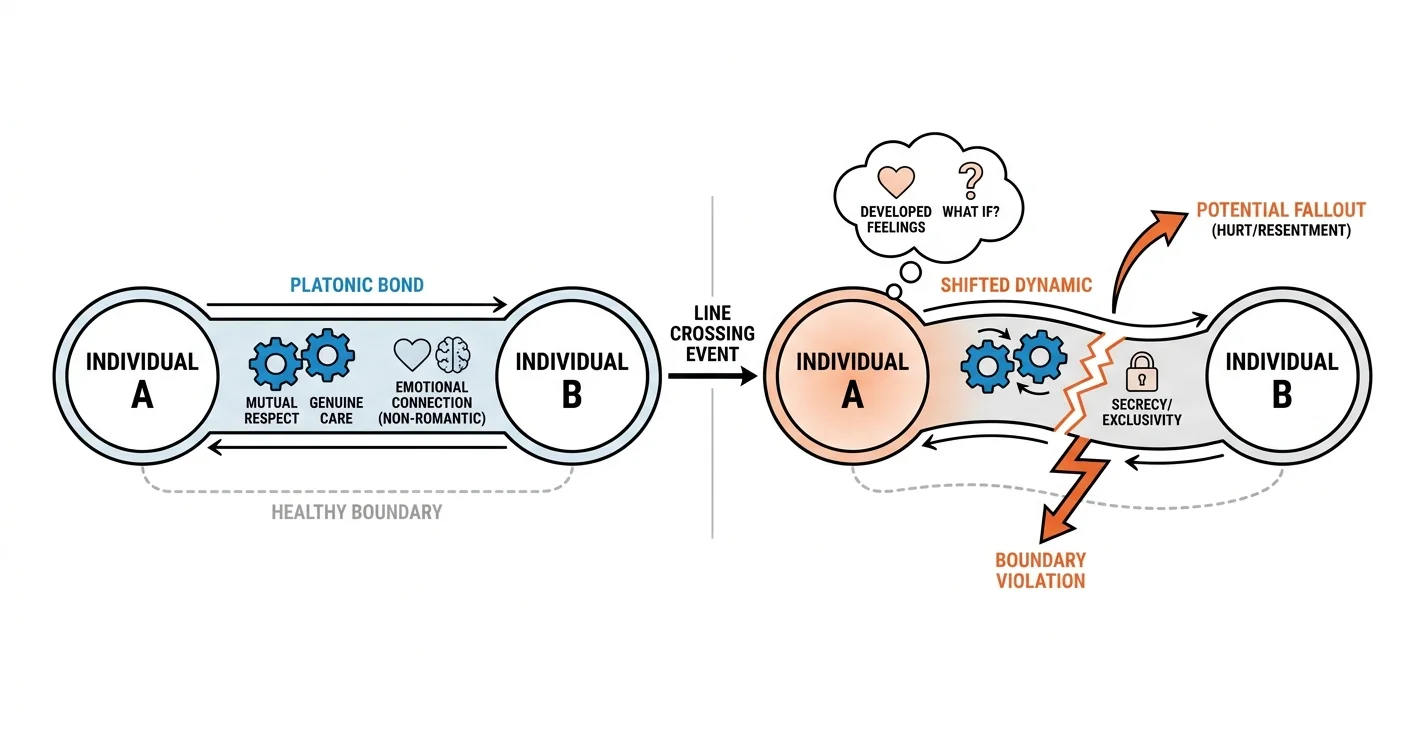
- Genuine care and affection between two people
- No sexual attraction (on either side, or if attraction exists, it is not acted on and does not shape the dynamic)
- No expectation of romantic exclusivity
- Reciprocal — both people see the relationship the same way
The common mistake is treating "platonic" as a synonym for "less important." It is not. Platonic friendships can be among the most stable, sustaining relationships a person has.
Step 2: Know the Markers of a Healthy Platonic Bond
A platonic friendship in good shape usually has five recognizable qualities. Use this as a quick self-check:
Mutual respect for each other's other relationships
Neither person feels threatened or resentful when the other spends time with a romantic partner, family, or other friends. Jealousy here is a yellow flag.
Comfort exists without physical ambiguity
Hugs, side-by-side sitting, physical proximity — these happen without either person feeling uncertain about what they mean. If touch has started to feel loaded, that is worth noticing.
You can name the friendship openly
You can say to a partner, a parent, or a colleague "this is my friend" and feel entirely accurate. If you find yourself avoiding that description — or softening it — pay attention to why.
Conversation does not substitute for romantic intimacy
Deep conversations about life, fears, hopes, and meaning are completely compatible with platonic friendship. The line is crossed when those conversations become the primary emotional outlet either person uses in place of romantic partnership.
Neither person is waiting
A friendship where one person secretly hopes it becomes romantic is not a stable platonic friendship. It is a waiting room. Both people need to be genuinely present in the friendship as it is.
Step 3: Identify the Specific Lines That Get Crossed
This is where most people get stuck. The platonic friendship meaning is clear in theory; the edge cases are harder. Here are the 6 most common line-crossings:
1. One-sided romantic feelings develop. This does not automatically end the friendship, but it does change it. Staying in the friendship while nursing feelings — hoping they will eventually be returned — is not neutral. It creates an imbalance that usually surfaces as hurt, resentment, or a sudden break.
2. Physical contact escalates beyond both people's comfort. A hand on the knee that lingers, a hug that lasts longer than expected, texting about whether the other person found it weird — these are signals worth taking seriously in 2026, not minimizing.
3. Emotional exclusivity forms. "You're the only one who gets me" is a phrase that belongs in romantic relationships. When a platonic friend becomes the primary emotional anchor — especially if one or both people are also in romantic relationships — that is a structural problem.
4. Secrecy enters. If you are not telling your partner about a conversation, a meeting, or a message from this friend, ask yourself why. Secrecy is not proof of wrongdoing, but it is proof that something feels complicated to you.
5. Comparison becomes a habit. Starting to measure a romantic partner against a platonic friend — "she actually listens," "he never makes me feel stupid" — signals that the platonic relationship is doing work it was not designed to do.
6. The "what if" question arrives. "What if we had met at a different time" or "what if things were different" — once that question is alive, the friendship has a new undercurrent that needs to be addressed, not ignored.
Step 4: Have the Conversation If You Need To
If you have identified that a line is being crossed — either by you or the other person — address it directly. Avoidance does not preserve friendships; it just delays the break.
A direct, low-drama approach works better than a long prepared speech:
- Name what you noticed, not what you concluded. "I've been feeling something I didn't expect" lands better than "I think you have feelings for me."
- Give the other person room to respond. You do not need to solve it in one conversation.
- Be honest about what you want the friendship to look like going forward.
If the conversation feels too charged to manage alone, Lovon is built exactly for this — you can talk through your feelings and rehearse what you want to say before any real-world conversation happens.
Step 5: Reset the Friendship or Accept What It Has Become
After naming what is happening, two paths exist:
Reset: Both people agree on what the friendship is, what it is not, and what they will do differently. This is possible and does not require dramatic distance — just clarity. Some friendships in 2026 do survive and strengthen after one of these conversations.
Accept: The friendship has genuinely changed. One or both people have feelings that cannot be set aside. Trying to continue the same dynamic while pretending nothing happened is a slow drain on both people. Sometimes the most honest thing is to step back — not permanently, but until feelings settle.
Neither path is failure. Both paths are more honest than the default, which is ignoring it and letting the friendship deteriorate on its own.
Troubleshooting
"I'm not sure if what I feel is platonic or something more." Ask yourself: Do I feel jealous when this person dates someone new? Do I imagine a future with them? If yes to either, the feeling has a romantic component. That is information, not a verdict on your character.
"My partner says my friendship is inappropriate but I think they're jealous." Both things can be true. Your partner's jealousy does not automatically make them right — but it is worth looking honestly at the markers in Step 2. If the friendship checks all five, the issue may be your partner's attachment patterns. Read conditional love vs unconditional love key differences for context on whether those concerns are reasonable.
"We used to date. Is it possible to have a platonic friendship with an ex?" Yes, for many people. The requirement is that both people have genuinely moved on — not that enough time has passed, but that neither person is using the friendship to stay emotionally close to a past relationship. If either person is unclear on this, the "platonic" label does not make it so.
"I tried to address it and they got defensive." Defensiveness is common. Give it a few days, then try again with a shorter, more specific message. If it happens repeatedly, the friendship may not have the foundation to hold this kind of honesty — which itself tells you something useful about what the relationship actually is.
"We are both in relationships. Does that make our friendship automatically platonic?" No. Being partnered does not make feelings platonic. It does add a layer of responsibility — to your partner and to your friend's partner — which is why the line-crossings in Step 3 matter regardless of relationship status.
"I don't want to label it. Can't a friendship just be a friendship?" Yes. Most platonic friendships do not need to be examined or named — they just exist and feel clear. This article is for when it stops feeling clear.
Tools and Resources
If you are working through relationship confusion, attachment patterns, or feelings that are hard to sort out alone:
- Lovon's AI voice support app — available anytime for private, judgment-free conversation about what you're feeling
- How to stop obsessing over someone — 8 practical steps — directly relevant if feelings for a friend have become consuming
- BPD attachment patterns — what drives the push-pull cycle — useful if the friendship dynamic feels intense, unstable, or hard to regulate
What to Do Next
If the friendship feels genuinely platonic, do nothing. Enjoy it. Platonic friendships in 2026 are undervalued and worth protecting.
If something shifted and you recognized it in these steps, the next move is Step 4 — the conversation. You do not need to have every answer before you start it. You need to start it honest and stay curious about what the other person says.
If you want to sort through your feelings first, just talk. Lovon is there whenever you need it.
FAQ
What is the platonic friendship meaning in simple terms? A platonic friendship is a close bond between two people with no sexual or romantic element. Both people see it that way, and neither is secretly hoping it becomes more.
Can platonic friends fall in love? Yes. Feelings can develop over time in any close relationship. When that happens, the friendship is no longer functionally platonic — it has a new dynamic that needs to be acknowledged, not suppressed.
What's the difference between platonic love and romantic love? Platonic love is deep care and connection without sexual attraction. Romantic love includes attraction, desire for exclusivity, and usually some form of physical intimacy. Both are real forms of love — they are not ranked, just different in structure.
Is it normal to be physically affectionate with a platonic friend? Yes. Hugging, linking arms, sitting close — these are normal in many platonic friendships. The marker is not the behavior itself but whether the physical contact feels ambiguous or loaded to either person.
How do you know if a friendship has crossed the line? Look for: secrecy about the friendship, jealousy when the other person dates someone new, comparing your partner unfavorably to this friend, or asking yourself "what if" questions about the two of you. Any of those signals a shift.
Can a man and a woman be just friends? Yes. The idea that opposite-sex friendships inevitably become romantic is not supported by research. What research from 2026 and prior years does show is that cross-sex friendships require more communication to stay clear — especially when one person develops feelings the other does not share.
What do you do when a platonic friendship starts feeling complicated? Name it to yourself first (Step 1 in this guide), then decide whether to address it with the other person. Waiting for it to sort itself out rarely works.
Is a platonic friendship less valuable than a romantic relationship? No. Platonic friendships are among the most stable long-term sources of emotional support. The framing of "less than" comes from a cultural overemphasis on romantic relationships as the primary bond. Many people find platonic friendships more consistently sustaining over decades.
One Last Thing
Plato himself never used the phrase "platonic friendship" — that term came centuries later from Renaissance scholars interpreting his work. What Plato actually argued in the Symposium is that the highest form of love is not about one specific person at all — it is about recognizing beauty and goodness wherever it exists. Which means the ancient version of this idea was never about drawing a line between two people. It was about what you are actually looking for in any close relationship. That is still the right question to start with.
Related Guides
How AI Support Helps You Heal
AI emotional support isn't about replacing human connection — it's about filling the gaps. The moments when you need to talk at 2 AM, when you don't want to burden your friends again, or when you simply need someone to listen without judgment.
Here's what happens in a typical Lovon session:
You share what's on your mind
There's no script, no intake form, no waiting room. You speak or type whatever you're feeling — in your own words, at your own pace.
Lovon validates and explores
Using frameworks from CBT (Cognitive Behavioral Therapy) and motivational interviewing, Lovon acknowledges your feelings first, then gently helps you explore them. No dismissive "just move on" advice.
You build coping skills together
Lovon doesn't just listen — it actively works with you on evidence-based techniques: thought reframing, urge surfing, behavioral experiments, and more.
What a Session with Lovon Looks Like

When to Seek Professional Help
AI support is a valuable tool, but it's not a replacement for professional care. Please consider reaching out to a licensed therapist if you experience any of the following:
- Persistent thoughts of self-harm or suicide
- Inability to perform daily activities (work, eating, sleeping) for more than 2 weeks
- Turning to alcohol or substances to cope
- Intense anger or desire to harm your ex-partner
- Complete emotional numbness that doesn't improve over time
Crisis Resources (US): If you're in immediate danger, call 988 (Suicide & Crisis Lifeline) or text HOME to 741741 (Crisis Text Line). Available 24/7, free, and confidential.
Outside the US? Find a crisis line in your country
Ready to Start?
Your healing journey can begin right now
A 7-day trial. No judgment. Just a safe space to process what you're going through.
Frequently Asked Questions
Is Lovon a replacement for a real therapist?
Is my conversation with Lovon AI private?
How is Lovon different from ChatGPT for emotional support?
Can I use Lovon if I'm already seeing a therapist?
Can I try Lovon before subscribing?
About the Author
The Lovon Editorial Team
Mental Health & Wellness Content Team
The Lovon Editorial Team develops mental health and wellness content designed to make psychological concepts accessible and actionable. Our goal is to bridge the gap between clinical research and everyday life - helping you understand why your mind works the way it does and what you can do about it....
Related articles
- Best AI Relationship Coach for Open Relationships (2026)
Lovon ranks the AI relationship coach options for open relationships in 2026 — voice-based coaching wins for…
- Best AI App for Friendship Breakup in 2026: Ranked
Lovon ranks as the best AI app for friendship breakup recovery in 2026, ahead of Wysa, Replika, Youper, and ChatGPT…
- Am I in Love Quiz: Real Feelings vs Attraction 2026
Take the am I in love quiz and score 5 psychological dimensions to tell real love from attraction. Clear results, no…
- AI Relationship Coach for Long-Distance Friends 2026
An AI relationship coach for long-distance friendships gives you 24/7 voice check-ins in 2026. See what to look for, the…
See also
Quizzes
- Do They Like Me? 12-Question Quiz
Read the signs in 2 minutes.
- Am I in Love? 13-Question Gut Check
Know what you feel in 2 minutes.
Free tools
- How to Tell Someone You Love Them
How to tell someone you love them is rarely about the words, which are short. It is about the moment and the answer…
- How to Reject Someone Nicely (and Mean It)
A chat for working out how to reject someone nicely when you keep putting it off. Tell it who this person is, how they…
From the wiki
- Is he in love with me?
There is no reliable tell in how fast he texts or how intense things feel. What tracks with love is consistency…
Disclaimer: This article is for informational purposes only and does not constitute medical advice, diagnosis, or treatment. Always seek the advice of your physician or other qualified health provider with any questions you may have regarding a medical condition. If you are in crisis or think you may have an emergency, call 988 (Suicide & Crisis Lifeline) or go to the nearest emergency room. Outside the US? Find a crisis line in your country.