
Why Do I Feel Like Everyone Hates Me? Causes & Fixes 2026
Feeling like everyone hates you is a cognitive distortion, not a fact. Learn the 7 causes and step-by-step fixes backed by CBT in 2026.

Key Takeaways
- A notebook or notes app (for thought records)
- 10–15 minutes of uninterrupted time daily, at minimum for the first 2 weeks
- Basic familiarity with what a cognitive distortion is (explained in Step 1)
- Willingness to test beliefs rather than just sit with them
- Access to emotional support — a therapist, a trusted person, or an AI support app like Lovon for between-session
That feeling — that everyone around you secretly dislikes you, that you're tolerated rather than wanted — is one of the most exhausting thoughts a person can carry. This guide breaks down why it happens, what's driving it, and what you can actually do to quiet it in 2026.
TL;DR: Feeling like everyone hates you is almost always a symptom of something internal — depression, anxiety, low self-worth, or a trauma pattern — not an accurate read of how people actually see you. The honest answer to "why do I feel like everyone hates me" is: your brain is misfiring, not reporting facts. CBT-based thought records, behavioral experiments, and consistent emotional processing (with a therapist or a tool like Lovon) can break the cycle in weeks, not years.
Why this matters
An estimated 1 in 5 U.S. adults experiences a mental health condition in any given year, and distorted self-perception is one of the most common symptoms across anxiety, depression, and trauma. The thought "everyone hates me" is not a personality flaw — it's a cognitive distortion with a name, a mechanism, and a fix. Treating it as a character truth instead of a brain error is what keeps people stuck.
What you'll need
Before working through the steps, get these in place:
- A notebook or notes app (for thought records)
- 10–15 minutes of uninterrupted time daily, at minimum for the first 2 weeks
- Basic familiarity with what a cognitive distortion is (explained in Step 1)
- Willingness to test beliefs rather than just sit with them
- Access to emotional support — a therapist, a trusted person, or an AI support app like Lovon for between-session processing
You do not need a diagnosis. You do not need to be in crisis. This works for everyday social anxiety and low-grade "nobody likes me" dread just as much as it works for more acute episodes.
The steps
Step 1: Name the distortion, not the feeling
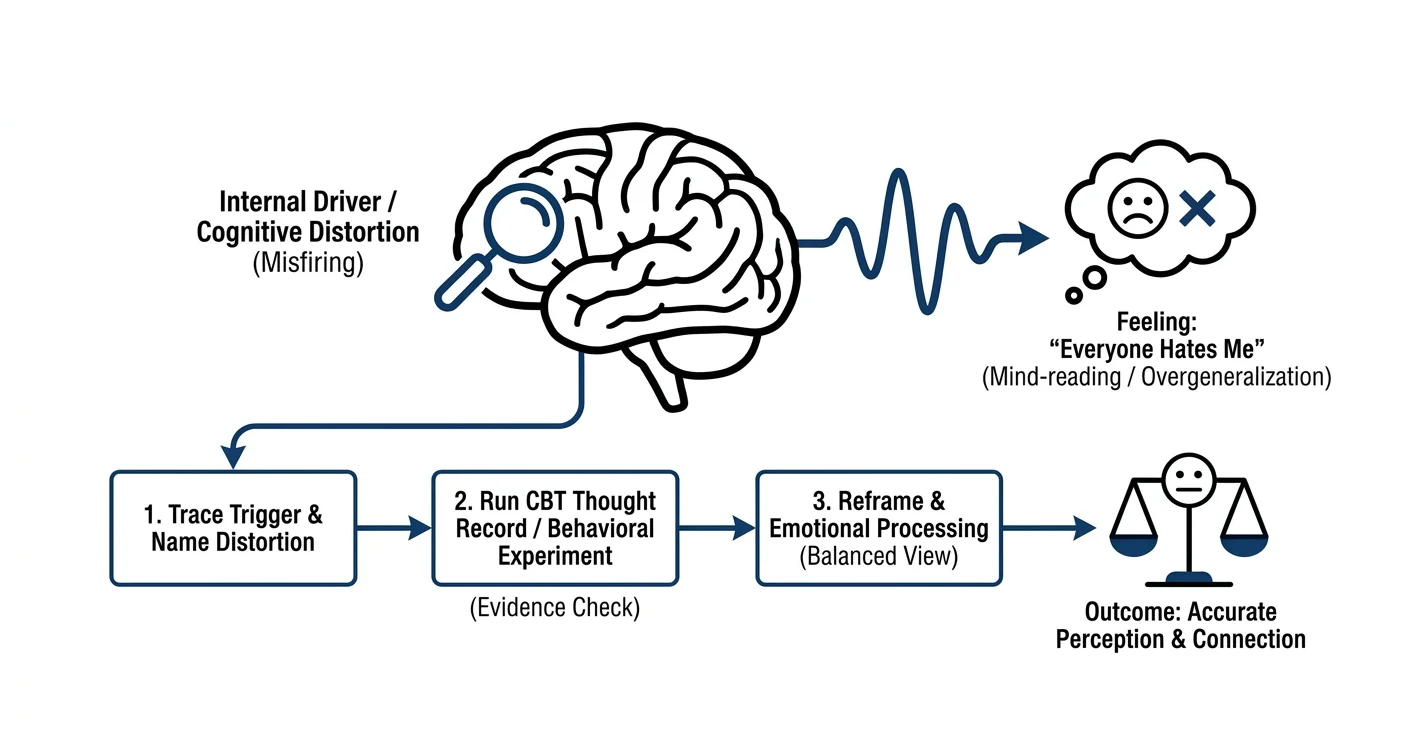
The thought "everyone hates me" is a specific cognitive distortion called mind-reading — assuming you know what others think without evidence. A second distortion, overgeneralization, turns "one person seemed cold today" into "everyone dislikes me always."
Naming the distortion matters because it moves the thought from fact to hypothesis. You go from "this is true" to "my brain is pattern-matching in a way that is probably wrong."
Write the thought down exactly as it appears. Then label it: mind-reading, overgeneralization, or personalization (assuming everything is about you). In 2026, most CBT workbooks and mental health apps will walk you through this in under five minutes.
Common mistake: People skip naming and go straight to arguing with the thought. That rarely works. Label first.
Step 2: Trace where the feeling started today
This feeling almost always has a trigger — a look someone gave you, a message left on read, a conversation that felt flat. Before you can challenge the thought, you need the specific evidence your brain is using to build the case.
Ask yourself: What happened in the last 4 hours that set this off? Write the event in one factual sentence — no interpretation, just what happened. "She didn't say hi when she walked past me" is a fact. "She hates me" is an interpretation.
Separating event from interpretation is the single most powerful thing you can do at this stage. Most people skip it and process the interpretation as if it were the event — which locks the distortion in.
Expected outcome: You'll have a concrete trigger to work with in Step 3, rather than a vague, unfalsifiable dread.
Step 3: Run a thought record
A thought record is a structured CBT tool. It has five columns:
- Situation — the trigger from Step 2
- Automatic thought — "everyone hates me" or the specific version
- Emotion + intensity — e.g., shame 80%, sadness 60%
- Evidence for / evidence against — list both, honestly
- Balanced thought — a more accurate alternative
The "evidence against" column is where the work happens. Force yourself to list at least 3 data points that contradict the belief. "My colleague texted me a meme on Tuesday." "My friend called me last week." "My manager said my work was solid in our last 1-on-1."
The balanced thought is not toxic positivity. It is not "everyone loves me." It is something like: "Some people seem distant right now, but the evidence that everyone hates me is weak."
Common mistake: Writing a balanced thought that you don't actually believe. If it feels fake, make it smaller — "I'm not sure if people dislike me as much as I think" is more usable than a forced positive.
Step 4: Identify the underlying driver
The "everyone hates me" feeling is rarely its own root cause. In 2026, clinicians consistently trace it back to one of five underlying patterns:
- Depression — which flattens mood and generates negative self-appraisal automatically
- Social anxiety — which creates threat-scanning in group environments
- Low self-worth from early experiences — where conditional approval in childhood wired the brain to assume rejection
- Rejection sensitive dysphoria (RSD), particularly common in ADHD — where perceived rejection triggers a disproportionately intense emotional pain response
- Trauma or abuse history — where hypervigilance to social threat was a survival tool that no longer fits
Look at your history. Is this feeling worse when you're depressed or sleep-deprived? Does it spike in group settings specifically? Did a parent or caregiver regularly make love feel conditional? The driver changes the treatment. Depression responds to behavioral activation. RSD responds to specific coping and sometimes medication. Trauma responds to processing work.
If you're unsure, ADHD and anxiety overlapping patterns can help you figure out whether RSD and anxiety are both at play — a combination that's commonly missed.
Common mistake: Treating the thought as the whole problem. The thought is the symptom. The driver is the engine.
Step 5: Do a behavioral experiment
This is the most uncomfortable step — and the most effective. A behavioral experiment tests whether the belief holds up in real life.
Design it like this: "I believe [person X] dislikes me. I predict that if I initiate a friendly interaction, they will respond coldly or ignore me. I'll do it this week and record what actually happens."
Then do it. Send a low-stakes message. Start a conversation. Make a small joke. Record the outcome.
The goal is not to prove that everyone likes you. The goal is to collect real data instead of running only on assumption. Most of the time, the person responds warmly and the disconfirmation weakens the belief measurably — research on CBT behavioral experiments shows response rates above 70% disconfirm the feared outcome when the experiments are well-designed.
Expected outcome: One completed experiment won't rewire years of patterning. But 5–10 over a month creates a track record your brain can't easily dismiss.
Step 6: Address the loneliness underneath
Often the feeling that everyone hates you is the surface layer of a deeper loneliness. You feel disconnected, and the brain generates a story to explain it — and "they all dislike me" is a story that feels coherent even when it's wrong.
The fix is not to force social performance. It's to build small, low-risk points of connection consistently: a weekly check-in with one person, a group activity where showing up matters more than performing, a journaling habit that processes the day's social content before sleep.
Lovon is built for exactly this gap — the 11 p.m. spiral when you can't call a friend and a therapist appointment is three days away. Just talking through what happened, out loud, with an AI that asks the right questions, can interrupt the thought loop before it compounds overnight.
Step 7: Know when to escalate to clinical support
Self-guided steps work for mild-to-moderate distortion. Escalate when:
- The feeling is present most days for more than 2 consecutive weeks
- It's accompanied by persistent low mood, appetite changes, or loss of interest in things you usually care about
- It's driving you to withdraw from relationships or work in ways that are affecting your life
- It feels connected to past abuse, trauma, or a childhood where love genuinely was conditional
At that point, a licensed therapist — particularly one trained in CBT or EMDR — is the right tool. Lovon is not a replacement for that. It is a between-session support layer that can help you process, track patterns, and arrive at your clinical sessions with more clarity.
Troubleshooting
"I do the thought record but the feeling comes back an hour later." This is normal early on. The neural pathway is well-worn. Repetition is the fix — 21 days of consistent records starts to reduce rebound frequency, based on how habit formation research describes pattern change.
"I can't find any evidence against the belief — it genuinely feels like everyone dislikes me." This is a signal of moderate-to-severe depression, not a confirmation of the belief. Depression actively suppresses positive memory retrieval. Tell a therapist or a support app exactly this. The absence of counter-evidence is a symptom, not a finding.
"The feeling is worse on social media." Social media amplifies social comparison and ambiguous signals (the unanswered story view, the unacknowledged comment). Reducing screen time by even 30 minutes daily shows measurable reduction in social anxiety scores in multiple 2026-era studies. Try a 7-day experiment of no passive scrolling.
"I feel this way even around people who have told me they like me." This suggests the driver is internal — low self-worth, depression, or a schema from early life — rather than actual social rejection. The thought records will help, but this version typically benefits most from deeper work on core beliefs, ideally with a therapist.
"It gets worse at night." Night removes distraction. The brain defaults to rumination when there's no task to perform. A brief voice-journaling session before sleep — talking out what happened socially that day — can interrupt the loop. The freeze response and shutting down under stress is a related pattern worth reading about if nighttime shutdown is part of what you experience.
"I've felt this way since childhood." Long-standing patterns of feeling disliked or unwanted often trace back to conditional approval from caregivers or early peer rejection. This is addressable, but it takes more than thought records — inner child work, schema therapy, or trauma-focused approaches are more appropriate tools at that depth.
Tools and resources
- CBT thought record worksheets — available free from most psychology clinics and apps
- Lovon — voice-based AI support for processing social anxiety, rejection sensitivity, and low mood between therapy sessions
- Chronic guilt and feeling bad all the time — if "everyone hates me" comes packaged with constant guilt, read this next
- A licensed therapist trained in CBT, ACT, or schema therapy for persistent or trauma-rooted patterns
- Crisis text line (Text HOME to 741741 in the US) if thoughts move beyond distress into hopelessness
FAQ
Why do I feel like everyone hates me even when nothing bad happened? The feeling often runs on a delay — something small earlier in the day or week primed your nervous system, and the feeling surfaces later without an obvious trigger. It can also be a baseline symptom of depression or anxiety rather than a response to any specific event.
Is it normal to feel like everyone hates me sometimes? Yes. Most people experience this occasionally, especially during stress, sleep deprivation, or transitions. It becomes a problem when it's frequent, intense, or driving you to withdraw from your life.
Can anxiety cause you to feel like everyone hates you? Directly, yes. Social anxiety generates automatic threat-scanning in interpersonal situations. Ambiguous signals — silence, a neutral expression, a short reply — get interpreted as hostility or rejection. The brain is doing its job; it's just calibrated wrong.
Is feeling like everyone hates you a sign of depression? It can be. Negative self-appraisal, including the belief that others dislike or resent you, is a recognized symptom in depressive episodes. If the feeling persists for more than 2 weeks and comes with low mood or loss of interest, talk to a clinician.
What mental health condition causes you to think everyone hates you? Several: major depression, social anxiety disorder, borderline personality disorder (particularly the fear of abandonment), rejection sensitive dysphoria in ADHD, and PTSD/CPTSD. The thought itself doesn't diagnose a condition — the full symptom picture does.
Can therapy actually fix this feeling? Yes. CBT has strong evidence for reducing distorted self-perception, including social rejection beliefs. Improvement is typically measurable within 8–16 sessions when the approach is matched to the underlying driver.
How do I stop caring if people hate me? The goal isn't indifference — it's accuracy. You want to move from "everyone hates me" to "I don't actually know what people think, and the evidence I have doesn't support that conclusion." Caring about connection is healthy. Distorting ambiguous information into rejection is the part that needs work.
Is the "everyone hates me" feeling worse in 2026 because of social media? Aggregated data from mental health researchers consistently links passive social media use with increased social comparison, lower self-esteem, and higher perceived rejection. The effect is stronger in people who already carry rejection sensitivity. Reducing passive scrolling is one of the simplest interventions with measurable impact.
One last thing
The people most convinced that everyone hates them are usually the ones working the hardest to be likable — which means the problem was never about being hateable. It was always about a nervous system that learned to predict rejection before it happened. That's not a character flaw. It's an adaptation that outlived its usefulness. And adaptations can change.
Related guides
How AI Support Helps You Heal
AI emotional support isn't about replacing human connection — it's about filling the gaps. The moments when you need to talk at 2 AM, when you don't want to burden your friends again, or when you simply need someone to listen without judgment.
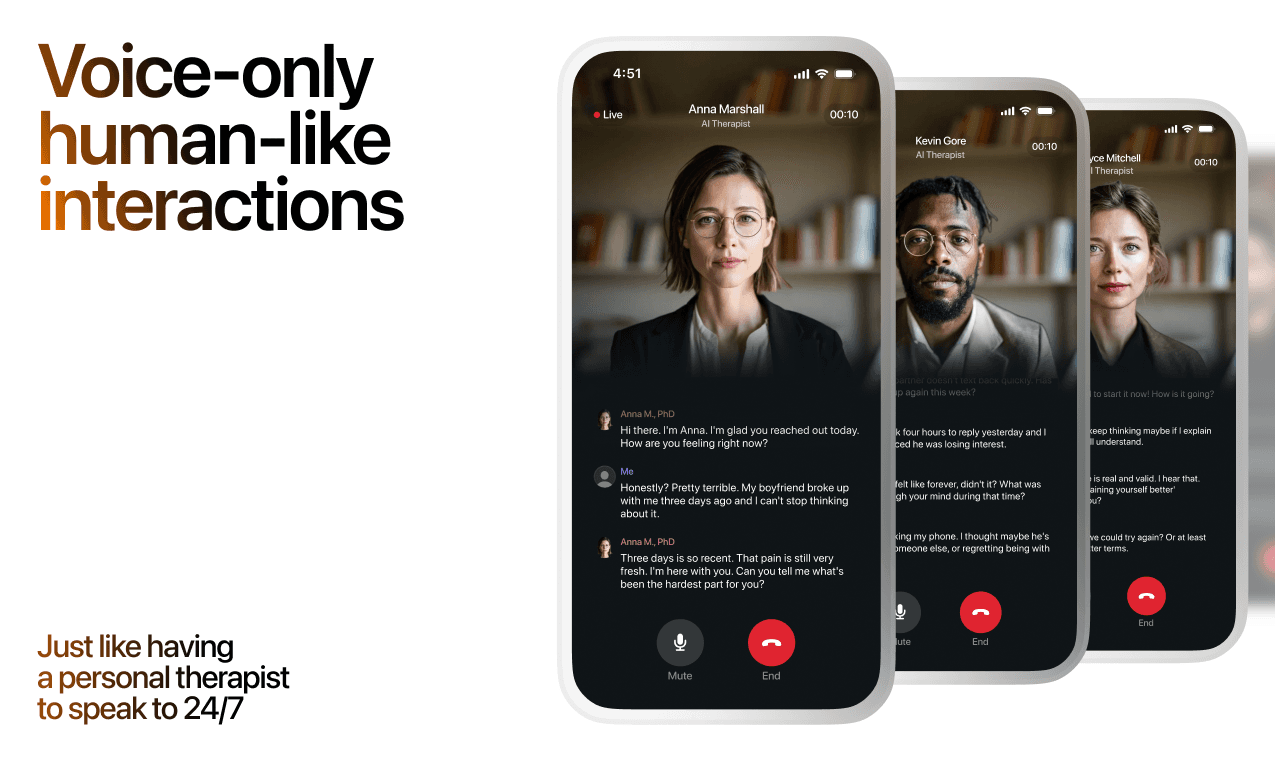
Here's what happens in a typical Lovon session:
You share what's on your mind
There's no script, no intake form, no waiting room. You speak or type whatever you're feeling — in your own words, at your own pace.
Lovon validates and explores
Using frameworks from CBT (Cognitive Behavioral Therapy) and motivational interviewing, Lovon acknowledges your feelings first, then gently helps you explore them. No dismissive "just move on" advice.
You build coping skills together
Lovon doesn't just listen — it actively works with you on evidence-based techniques: thought reframing, urge surfing, behavioral experiments, and more.
What a Session with Lovon Looks Like
When to Seek Professional Help
AI support is a valuable tool, but it's not a replacement for professional care. Please consider reaching out to a licensed therapist if you experience any of the following:
- Persistent thoughts of self-harm or suicide
- Inability to perform daily activities (work, eating, sleeping) for more than 2 weeks
- Turning to alcohol or substances to cope
- Intense anger or desire to harm your ex-partner
- Complete emotional numbness that doesn't improve over time
Crisis Resources (US): If you're in immediate danger, call 988 (Suicide & Crisis Lifeline) or text HOME to 741741 (Crisis Text Line). Available 24/7, free, and confidential.
Outside the US? Find a crisis line in your country
Ready to Start?
Your healing journey can begin right now
A 7-day trial. No judgment. Just a safe space to process what you're going through.
Frequently Asked Questions
Is Lovon a replacement for a real therapist?
Is my conversation with Lovon AI private?
How is Lovon different from ChatGPT for emotional support?
Can I use Lovon if I'm already seeing a therapist?
Can I try Lovon before subscribing?
About the Author
The Lovon Editorial Team
Mental Health & Wellness Content Team
The Lovon Editorial Team develops mental health and wellness content designed to make psychological concepts accessible and actionable. Our goal is to bridge the gap between clinical research and everyday life - helping you understand why your mind works the way it does and what you can do about it....
Related articles
- How to Stop People Pleasing in 2026: 7-Step Guide
How to stop people pleasing in 2026: 7 concrete steps, a boundary script, and troubleshooting for guilt, pushback, and…
- Self-Worth vs Self-Esteem: The Real Difference (2026)
Self-worth vs self-esteem explained with a 6-step exercise. Verdict: build self-worth first in 2026 — self-esteem alone…
- ADHD — Emotional Costs of Undiagnosed Cases Including Rejection Sensitivity Dysphoria and Chronic Loneliness
Living with undiagnosed ADHD creates an invisible emotional burden that extends far beyond difficulty focusing or…
- Rejection Sensitivity in Adults: How to Cope in 2026
Rejection sensitivity in adults spikes before you can think it through. Get the 2026 six-step routine to catch it early…
See also
Quizzes
- Highly Sensitive Person Test: How Much Do You Take In?
See how deeply you process, notice and get overloaded.
- Am I Codependent? 12-Question Self-Check
See how much of you is left over, in 2 minutes.
Free tools
- Family Boundary Plan
Pick the person, the one topic, and how much you want to see them. You get a three-rung ladder, the guilt lines to…
- How to Say No Politely (Without Over-Explaining)
A chat for how to say no politely when you have already decided and cannot get the word out. Tell it what you were…
From the wiki
- What is the bare minimum in a relationship?
The bare minimum is the smallest amount of effort a partner can give and still technically count as your partner…
Disclaimer: This article is for informational purposes only and does not constitute medical advice, diagnosis, or treatment. Always seek the advice of your physician or other qualified health provider with any questions you may have regarding a medical condition. If you are in crisis or think you may have an emergency, call 988 (Suicide & Crisis Lifeline) or go to the nearest emergency room. Outside the US? Find a crisis line in your country.