
14-Day Reset Program for Emotionally Exhausted High Achievers Review
The 14-day reset program for emotionally exhausted high achievers represents a departure from conventional burnout recovery approaches that demand...

Key Takeaways
- Somatic awareness practices that reconnect cognitive understanding with physical sensation, helping individuals
- Nervous system regulation techniques designed to interrupt hypervigilance patterns without requiring additional time
- Reframing exercises that challenge the equation of productivity with worthiness, addressing the cognitive components
- Integration strategies that embed new patterns into existing daily activities rather than adding tasks to already
- Body scanning for 2-3 minutes upon waking to establish baseline awareness
Introduction
The 14-day reset program for emotionally exhausted high achievers represents a departure from conventional burnout recovery approaches that demand extensive lifestyle overhauls. For professionals experiencing chronic stress, emotional depletion, and nervous system dysregulation, the promise of meaningful recovery within two weeks—without quitting jobs or abandoning responsibilities—addresses a critical gap in accessible mental health support.
This review examines the framework's core methodology, scientific foundations, and practical applications based on analysis of practitioners who work with high-achieving populations. Unlike traditional therapeutic interventions that may require months of weekly sessions, this condensed format targets the specific nervous system patterns that develop when safety becomes something to earn rather than experience. We'll evaluate whether this approach delivers substantive results or merely offers temporary relief for a population accustomed to pushing through exhaustion.
Understanding Nervous System Dysregulation in High Achievers
High-performing professionals often develop distinctive patterns of nervous system dysregulation that differ from standard stress responses. Research suggests that individuals who grew up in environments where safety felt conditional—earned through achievement, compliance, or performance—develop survival patterns that persist long after those environments change. The nervous system learns to associate productivity with safety, creating a biological feedback loop where rest triggers anxiety rather than relaxation.
This phenomenon manifests through specific physiological markers. The autonomic nervous system remains locked in sympathetic activation, interpreting downtime as danger. Practitioners working with this population note that traditional stress management advice often fails because it doesn't address the underlying pattern: these individuals aren't simply stressed from external demands, but from internal wiring that perceives safety itself as a reward requiring constant effort to maintain.
The distinction matters for intervention design. Brief relaxation techniques may provide momentary relief but don't retrain the nervous system to recognize safety as a baseline state. Effective approaches must address both the somatic components—physical tension, shallow breathing, hypervigilance—and the cognitive patterns that interpret rest as risk.
Core Methodology: Small Sequential Changes Versus System Overhaul
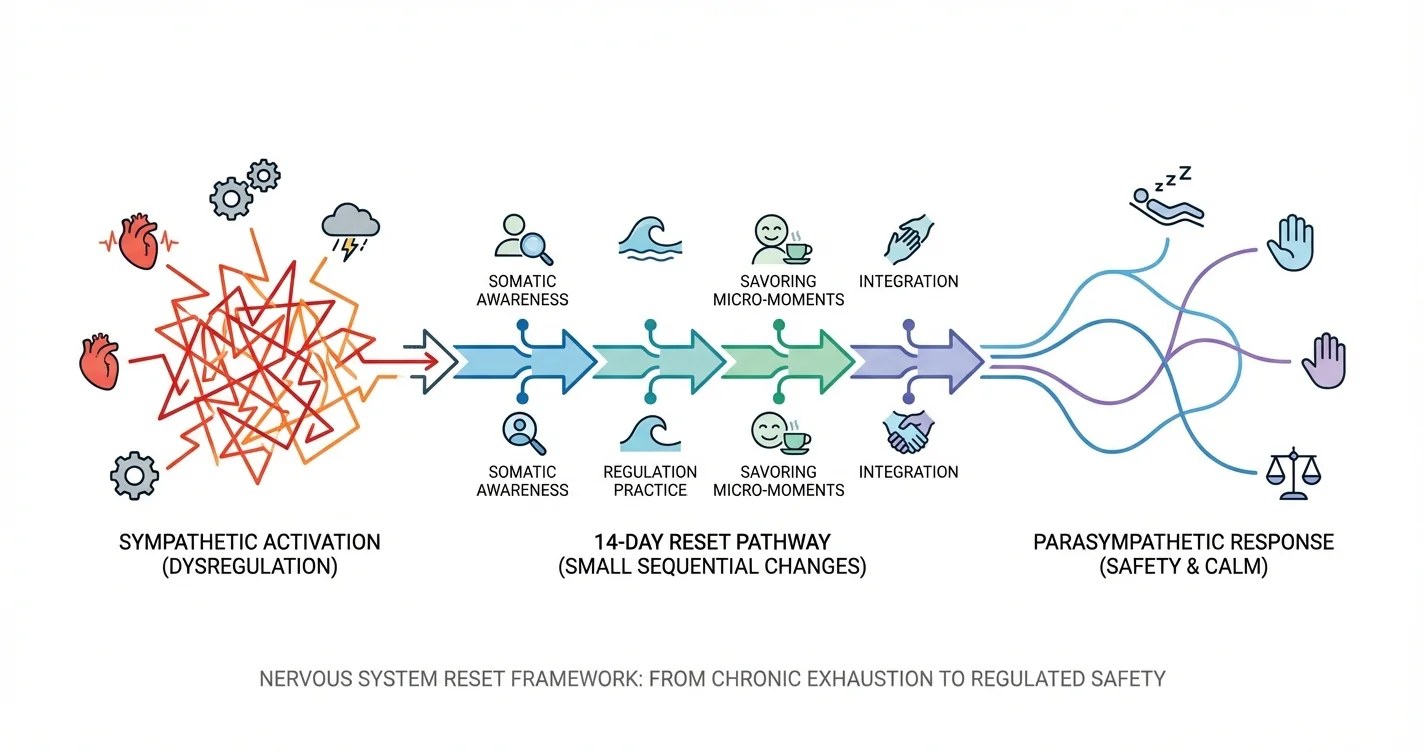
The 14-day reset framework operates on a principle that contradicts much conventional burnout advice: recovery doesn't require dramatic life changes. Instead of sabbaticals, career transitions, or complete schedule restructuring, the program implements incremental nervous system regulation practices that integrate into existing routines.
This approach aligns with emerging research on habit formation and neuroplasticity. Studies indicate that consistent small interventions can produce measurable changes in autonomic nervous system function within two weeks when practiced daily. The methodology focuses on:
- Somatic awareness practices that reconnect cognitive understanding with physical sensation, helping individuals recognize safety signals their bodies already send
- Nervous system regulation techniques designed to interrupt hypervigilance patterns without requiring additional time commitments beyond awareness shifts
- Reframing exercises that challenge the equation of productivity with worthiness, addressing the cognitive components sustaining dysregulation
- Integration strategies that embed new patterns into existing daily activities rather than adding tasks to already overwhelming schedules
Practitioners emphasize that effectiveness depends on consistency rather than intensity. A five-minute daily practice maintained throughout the two-week period typically produces more substantive results than sporadic hour-long sessions. This structure specifically accommodates the time constraints and resistance to "adding more" that characterize emotionally exhausted populations.
For professionals seeking on-demand support between structured practices, tools like Lovon.app provide accessible options for processing acute stressors through voice-based conversations that don't require scheduling appointments or commuting to offices.
The Science Behind Savoring: A Key Component
One distinctive element within reset programs for high achievers involves what researchers call "savoring"—the deliberate practice of extending awareness during positive or neutral moments. While this may sound simplistic, neuroscience research suggests savoring creates measurable shifts in nervous system regulation by providing the brain repeated evidence of safety.
The mechanism operates through several pathways. When individuals consciously attend to pleasant sensations—warmth from sunlight, satisfaction from completing a task, comfort of sitting down—they activate parasympathetic nervous system responses. For those whose baseline state involves chronic sympathetic activation, these micro-moments function as repeated signals that contradict the survival pattern insisting constant vigilance is necessary.
What makes savoring particularly valuable for time-pressured professionals is that it requires no additional time allocation. The practice involves bringing conscious attention to experiences already occurring rather than adding meditation sessions or relaxation exercises. A practitioner might savor the first sip of morning coffee, the feeling of warm water during hand-washing, or the physical sensation of tension releasing after sending a difficult email.
Research on positive psychology interventions indicates that regular savoring practice is associated with increased positive affect and reduced anxiety symptoms over sustained periods. However, it's important to note that savoring alone doesn't constitute comprehensive treatment for clinical anxiety or depression—rather, it functions as one component within broader nervous system regulation frameworks.
The 14-day timeline allows sufficient repetition for the nervous system to begin recognizing these safety signals while remaining brief enough that overwhelmed individuals can commit to the duration.
Practical Application: What Two Weeks Actually Looks Like
Understanding the theoretical framework differs significantly from implementing daily practices while managing professional demands, relationship responsibilities, and existing exhaustion. Programs designed for emotionally depleted high achievers typically structure the two weeks into progressive phases rather than requiring full implementation from day one.
Week One: Awareness and Foundation
The initial phase focuses on developing somatic awareness without changing behaviors. Participants learn to identify where they physically hold stress, recognize their individual signs of nervous system dysregulation, and notice patterns connecting achievement behaviors to feelings of safety. This observation period prevents the common pattern of turning the reset itself into another achievement metric.
Daily practices during this phase might include:
- Body scanning for 2-3 minutes upon waking to establish baseline awareness
- Noting three moments throughout the day when shoulders, jaw, or stomach tensed
- Identifying one situation where productivity felt necessary to maintain safety
- Evening reflection on physical sensations experienced during the day
Week Two: Integration and Repattering
The second week introduces active regulation practices while maintaining the awareness established earlier. This might involve conscious breath work during transitions between tasks, deliberate pauses to acknowledge task completion before moving to the next item, or brief moments of savoring as described earlier.
Practitioners working with this population emphasize that the goal isn't perfect execution but consistent practice. Missing a day or struggling with particular exercises provides valuable information about resistance patterns rather than representing failure.
For real-time support when challenging emotions surface during the reset period, resources like Lovon.app offer immediate processing opportunities without waiting for scheduled therapy appointments, complementing the structured daily practices.
Comparing Reset Programs to Traditional Therapeutic Approaches
The question of how condensed reset frameworks compare to conventional therapy deserves careful examination. Traditional therapeutic interventions for burnout and emotional exhaustion typically involve weekly sessions over several months, allowing gradual exploration of underlying patterns, relationship dynamics, and historical factors contributing to current dysregulation.
Depth Versus Accessibility
Long-term therapy provides opportunities to address complex trauma, deeply rooted belief systems, and relational patterns that brief interventions cannot fully process. A therapist can identify connections between current burnout and early attachment experiences, work through resistance as it emerges, and provide consistent relational support as clients navigate difficult changes.
However, research on brief interventions suggests that targeted approaches addressing specific mechanisms can produce measurable improvements in particular symptoms within shorter timeframes. For professionals experiencing primarily nervous system dysregulation rather than complex trauma, a concentrated two-week protocol may address the immediate crisis while traditional therapy remains inaccessible due to cost, scheduling, or availability constraints.
Limitations and Appropriate Applications
Reset programs work best for individuals whose primary challenge involves nervous system patterns rather than clinical depression, severe anxiety disorders, or unprocessed trauma. They serve as entry points to deeper work rather than complete solutions. Someone discovering through a reset program that their exhaustion connects to childhood experiences of conditional love will likely benefit from subsequent therapy to address those foundational patterns.
The two-week format also assumes sufficient functional capacity to implement daily practices. Individuals experiencing severe depression, active suicidal ideation, or complete burnout requiring medical leave need more intensive support than self-guided programs provide.
Evidence of Effectiveness: What Results Can Reasonably Be Expected
Evaluating the actual outcomes of 14-day reset programs requires distinguishing between immediate relief and sustained change. Practitioners who work with emotionally exhausted professionals report that participants commonly experience certain shifts within the two-week period while other changes require extended practice.
Typical Short-Term Outcomes
Within two weeks of consistent practice, many individuals notice:
- Increased awareness of physical stress signals, allowing earlier intervention before reaching crisis points
- Improved ability to identify moments of safety, even if the nervous system doesn't fully relax yet
- Greater recognition of thought patterns equating worth with productivity
- Some reduction in physical tension symptoms like jaw clenching, shoulder tightness, or digestive issues
- Enhanced capacity to pause between tasks rather than moving automatically to the next demand
These changes represent meaningful progress but don't constitute complete recovery from chronic emotional exhaustion. The nervous system requires sustained practice over months to fully rewire patterns developed across years or decades.
Realistic Limitations
What a two-week program cannot accomplish includes:
- Resolving underlying trauma requiring therapeutic processing
- Completely eliminating burnout accumulated over years of unsustainable work patterns
- Changing external circumstances creating ongoing stress (toxic work environments, financial pressures, caregiving demands)
- Addressing clinical mental health conditions needing professional treatment
- Providing the relational support that therapy offers for processing complex emotions
The program functions best as an initial intervention that either provides sufficient relief for individuals with relatively mild dysregulation or creates enough improvement that participants can access deeper work from a slightly more resourced state.
Advanced Considerations: Who Benefits Most and Potential Pitfalls
The effectiveness of any brief intervention varies considerably based on individual circumstances, existing coping mechanisms, and the specific nature of someone's emotional exhaustion. Understanding who typically benefits most from this format helps set appropriate expectations.
Ideal Candidates
Research and practitioner experience suggest reset programs work best for individuals who:
- Experience primarily nervous system dysregulation rather than clinical depression or anxiety disorders
- Retain sufficient executive function to implement daily practices despite fatigue
- Have relatively stable external circumstances (not in active crisis with housing, safety, or severe financial stress)
- Can identify specific patterns of equating productivity with safety or worth
- Possess some existing body awareness or previous experience with mindfulness practices
Common Pitfalls
High achievers approaching reset programs often encounter predictable challenges that can undermine effectiveness:
Performance orientation: Treating the reset as another achievement metric, measuring success through perfect practice execution rather than genuine nervous system shifts. This recreates the exact pattern the program aims to address.
Intellectual understanding without embodiment: Cognitively grasping concepts while remaining disconnected from somatic experience. The nervous system responds to physical practice, not intellectual knowledge.
Abandoning practice after initial improvements: Experiencing relief within several days and discontinuing practices before patterns fully stabilize. Sustained change requires practice beyond the two-week initiation period.
Using the program to avoid necessary external changes: Employing nervous system regulation to tolerate genuinely untenable situations (abusive work environments, exploitative relationships) rather than recognizing when circumstances themselves require modification.
Practitioners emphasize that reset programs complement but don't replace professional support when symptoms significantly impair functioning or when safety concerns exist.
When to Seek Professional Help
While 14-day reset programs offer valuable tools for nervous system regulation, certain situations require professional therapeutic intervention. Seek support from a mental health provider if you experience:
- Persistent depression or anxiety that interferes with daily functioning despite self-help efforts
- Thoughts of self-harm or suicide
- Inability to complete basic self-care tasks (eating, hygiene, getting out of bed) for extended periods
- Symptoms of trauma including flashbacks, severe dissociation, or hypervigilance that doesn't respond to regulation practices
- Substance use to manage emotional exhaustion
- Complete inability to experience pleasure or connection, even momentarily
Mental health professionals who specialize in burnout, nervous system regulation, or high-achieving populations can provide individualized assessment and treatment planning. This might include therapists trained in somatic approaches, psychologists specializing in perfectionism and achievement patterns, or psychiatrists who can evaluate whether medication might support recovery.
For those balancing self-directed practices with professional support needs, integrating both approaches often produces optimal results. The structured framework of a reset program can complement ongoing therapy, while therapeutic relationships provide processing depth that brief interventions cannot offer.
Conclusion
The 14-day reset program for emotionally exhausted high achievers addresses a genuine gap in accessible burnout recovery options for time-pressured professionals. By focusing on nervous system regulation through small sequential changes rather than demanding complete lifestyle restructuring, these frameworks offer practical entry points for individuals whose circumstances prevent traditional therapeutic engagement.
Evidence suggests that consistent practice over two weeks can produce measurable improvements in stress awareness, physical tension symptoms, and capacity to recognize safety. However, realistic expectations matter: these programs initiate recovery rather than completing it, work best for specific populations, and complement rather than replace professional mental health treatment for clinical conditions.
The effectiveness ultimately depends on matching intervention to individual needs. For professionals experiencing primarily dysregulation from achievement patterns and conditional safety learning, a condensed reset offers valuable tools. Those with complex trauma, severe mental health conditions, or circumstances requiring deeper therapeutic work will find these programs most useful as supplements to comprehensive treatment.
If you're considering a reset program, approach it as one component of sustainable recovery rather than a complete solution. The two weeks provide an opportunity to interrupt harmful patterns and establish foundational practices—but lasting change requires ongoing commitment beyond the initial intensive period.
Disclaimer: This is general information, not medical advice or diagnosis. If symptoms are severe, affecting your daily life, or you're having thoughts of self-harm — seek professional help. In the US: call or text 988 (Suicide & Crisis Lifeline). For immediate danger: 911 or local emergency services.
How AI Support Helps You Heal
AI emotional support isn't about replacing human connection — it's about filling the gaps. The moments when you need to talk at 2 AM, when you don't want to burden your friends again, or when you simply need someone to listen without judgment.
Here's what happens in a typical Lovon session:
You share what's on your mind
There's no script, no intake form, no waiting room. You speak or type whatever you're feeling — in your own words, at your own pace.
Lovon validates and explores
Using frameworks from CBT (Cognitive Behavioral Therapy) and motivational interviewing, Lovon acknowledges your feelings first, then gently helps you explore them. No dismissive "just move on" advice.
You build coping skills together
Lovon doesn't just listen — it actively works with you on evidence-based techniques: thought reframing, urge surfing, behavioral experiments, and more.
What a Session with Lovon Looks Like

Lovon is AI support, not a replacement for professional care. If things have been hard to get through for weeks, or you are thinking about harming yourself, talk to a doctor or a licensed therapist.
Ready to Start?
Your healing journey can begin right now
A 7-day trial. No judgment. Just a safe space to process what you're going through.
Frequently Asked Questions
Is Lovon a replacement for a real therapist?
Is my conversation with Lovon AI private?
How is Lovon different from ChatGPT for emotional support?
Can I use Lovon if I'm already seeing a therapist?
Can I try Lovon before subscribing?
About the Author

The Lovon Editorial Team
Mental Health & Wellness Content Team
The Lovon Editorial Team develops mental health and wellness content designed to make psychological concepts accessible and actionable. Our goal is to bridge the gap between clinical research and everyday life - helping you understand why your mind works the way it does and what you can do about it....
Related articles
- Best Inner Child Healing Workbook Somatic Practices Nervous System
The intersection of inner child healing and somatic nervous system regulation represents one of the most effective…
- EMDR Method by Francine Shapiro for Trauma Therapy Applications
The EMDR method by Francine Shapiro for trauma therapy applications has transformed how mental health professionals…
- How to Use Gradual Exposure to Tolerate Uncertainty and Emotional Discomfort
Learning how to use gradual exposure to tolerate uncertainty and emotional discomfort represents one of the most…
- How to Use Plushie Dreadfuls for Depression, Overthinking, and Trauma
Therapeutic plushies have emerged as tangible tools for individuals navigating depression, anxiety, trauma, and…
See also
Quizzes
- Experiential Avoidance Test: Do You Avoid Your Feelings?
See which way you keep feelings out, in 3 minutes.
- Hyper-Empathy Test: When Feeling for Others Costs You
See where too much empathy is costing you, in 3 minutes.
Free tools
- How to Say No Politely (Without Over-Explaining)
A chat for how to say no politely when you have already decided and cannot get the word out. Tell it what you were…
- Write a Condolence Message for This Person
Get one condolence message written for your situation instead of a list of a hundred to choose from. Tell it who died…
From the wiki
- Why do I feel lonely all of a sudden?
Sudden loneliness usually traces back to something that quietly ended in the last few months: a routine, a shared class…
Disclaimer: This article is for informational purposes only and does not constitute medical advice, diagnosis, or treatment. Always seek the advice of your physician or other qualified health provider with any questions you may have regarding a medical condition. If you are in crisis or think you may have an emergency, call 988 (Suicide & Crisis Lifeline) or go to the nearest emergency room. Outside the US? Find a crisis line in your country.