
Anxious Attachment Healing Through Grief Work
Anxious attachment doesn't develop in a vacuum. Beneath the hypervigilance, the need for constant reassurance, and the fear of abandonment often lies something

Key Takeaways
- The parent you needed but didn't consistently have
- The emotional attunement that was sporadic or absent
- The sense of safety you deserved but couldn't rely on
- The childhood experience of secure attachment itself
- Writing letters to younger versions of yourself acknowledging what you needed
Introduction
Anxious attachment doesn't develop in a vacuum. Beneath the hypervigilance, the need for constant reassurance, and the fear of abandonment often lies something deeper: unprocessed grief. This grief may stem from emotional unavailability in childhood, inconsistent caregiving, or losses that were never fully acknowledged. Research suggests that anxious attachment healing through grief work offers a powerful pathway to transformation—one that addresses not just the symptoms of insecurity, but the unresolved losses at its core.
Many people with anxious attachment spend years working on behavioral strategies—learning to self-soothe, practicing communication skills, or trying to manage their reactions to perceived abandonment. While these approaches have value, they often miss a fundamental component: the grieving process for what was never received. When we create space to acknowledge and process these losses, we can begin to release the patterns that keep us stuck in cycles of anxiety and insecurity.
This article explores how grief work supports anxious attachment recovery, the specific methods that facilitate this healing, and practical approaches you can implement to begin this transformative process.
Understanding the Connection Between Grief and Anxious Attachment
Anxious attachment typically develops when early caregiving is inconsistent—sometimes responsive, sometimes unavailable, but rarely predictable. While genetic factors and individual temperament also contribute to how these patterns develop, relational experiences during formative years play a significant role in shaping our attachment styles.
What's often overlooked is that inconsistent caregiving creates a specific kind of loss: the loss of secure base, the loss of predictable comfort, and sometimes the loss of ever having your emotional needs consistently met. These aren't dramatic, identifiable losses like death or divorce. They're subtle, chronic absences that children typically don't have the framework to recognize or grieve.
Studies in attachment theory indicate that unresolved loss is one of the primary factors that maintains insecure attachment patterns into adulthood. When we don't process what we didn't receive, we remain in a state of searching—constantly seeking from others what we never got as children. This manifests as the classic anxious attachment behaviors: clinging, reassurance-seeking, and intense fear of abandonment.
Grief work for anxious attachment recovery involves acknowledging these losses explicitly:
- The parent you needed but didn't consistently have
- The emotional attunement that was sporadic or absent
- The sense of safety you deserved but couldn't rely on
- The childhood experience of secure attachment itself
Naming these losses is the first step toward processing them. When we can acknowledge what wasn't there, we create the possibility of moving through the grief rather than around it.
How Grief Work Helps Anxious Attachment Healing
Processing grief to overcome anxious attachment works through several interconnected mechanisms. Understanding these can help clarify why this approach addresses the roots of insecurity rather than just managing symptoms.
Completing the Emotional Cycle
Unprocessed grief keeps us in a state of suspended longing. Clinical research indicates that when losses remain unacknowledged, the nervous system stays activated in a searching pattern. For those with anxious attachment, this manifests as hypervigilance toward relationship cues and an inability to settle even when connection is present.
Using grief therapy to heal anxious attachment allows the nervous system to complete the cycle. When we finally grieve what we didn't receive, we signal to our system that the search can end. This doesn't mean we stop wanting connection—it means we stop operating from a place of desperate compensation for childhood deprivation.
Releasing Idealization and False Hope
Anxious attachment often involves an unconscious hope that the right person will finally provide what we never got. This keeps us in relationships with emotionally unavailable partners or prevents us from receiving the love that is actually available.
Grief work involves releasing this hope—not giving up on connection, but acknowledging that no current relationship can retroactively heal childhood wounds. This realization can feel devastating initially, but it's ultimately liberating. When we stop trying to get our partner to be the parent we needed, we can start relating to them as they actually are.
Building Capacity for Self-Compassion
Grieving what we didn't receive naturally generates compassion for the child we were. Many people with anxious attachment carry shame about their needs, viewing their desire for closeness as weakness or "too much." When we understand these patterns as adaptive responses to genuine deprivation, shame transforms into understanding.
This self-compassion becomes the foundation for earned secure attachment—the capacity to provide internal security that we didn't receive externally. Tools like Lovon.app can support this process by offering a space to process these complex emotions and practice self-reflection when traditional therapy isn't immediately accessible.
Creating Space for New Attachment Experiences
When unprocessed grief occupies our internal landscape, there's limited room for new experiences to register. People with anxious attachment often report that even when partners are reassuring, the comfort doesn't "stick." Grief work clears this backlog, creating psychological space to take in present-moment security and let it reshape our internal models.
Grief Processing Methods for Anxious Attachment
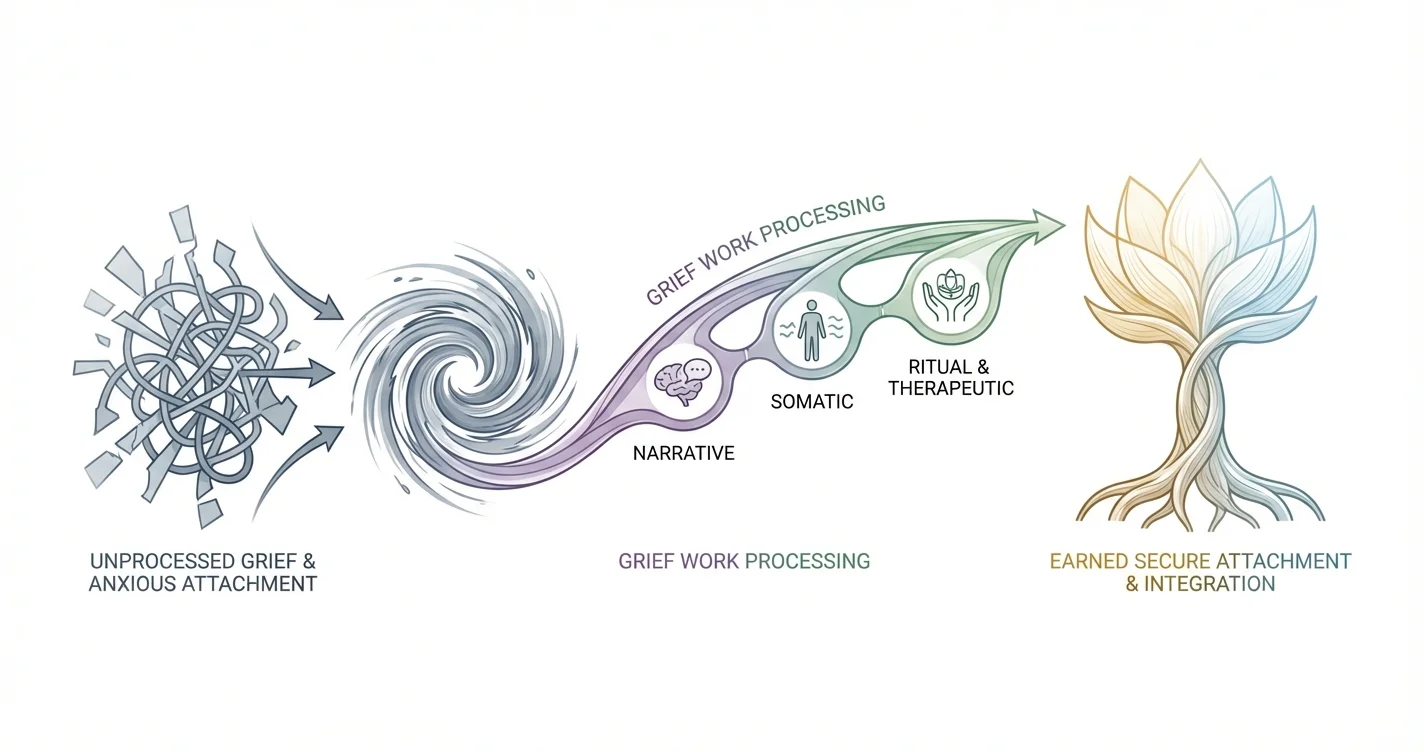
Healing anxious attachment by processing grief requires specific approaches that honor both the attachment injury and the grieving process. Here are evidence-informed methods that practitioners frequently recommend:
Narrative Grief Work
This involves telling the story of what you didn't receive—not as a list of complaints, but as a witnessed account of genuine loss. Clinical approaches often include:
- Writing letters to younger versions of yourself acknowledging what you needed
- Creating a narrative of your attachment history that names specific losses
- Sharing this story with a trusted therapist, support group, or compassionate friend
- Allowing yourself to feel the full emotional weight of what wasn't there
The key is specificity. Rather than "my mom wasn't emotionally available," you might write, "When I came home upset from school, I needed someone to sit with me and help me make sense of my feelings. Instead, I was alone with emotions I couldn't understand. I needed that presence and I didn't get it."
Somatic Grief Processing
Grief lives in the body as much as the mind. Anxious attachment recovery through the grieving process often requires releasing held tension and incomplete emotional cycles through the body:
- Practices that facilitate emotional release like breathwork or trauma-informed yoga
- Allowing yourself to cry fully when grief surfaces, without rushing to feel better
- Movement practices that help discharge the activation associated with unmet attachment needs
- Body-based therapies like Somatic Experiencing or Sensorimotor Psychotherapy
These approaches recognize that our nervous systems hold the memory of early attachment experiences in ways that talk therapy alone may not fully address.
Ritual and Symbolic Acts
Creating rituals around loss can provide closure that abstract understanding cannot. Some effective approaches include:
- Creating a symbolic representation of what you're grieving (artwork, objects, writing)
- Conducting a private ceremony to acknowledge and honor your losses
- Creating a "grief altar" with images or items representing what you needed
- Burning or burying written accounts of your losses as an act of release
These rituals work by engaging the right hemisphere of the brain, which processes emotional experience through symbol and metaphor rather than linear narrative.
Therapeutic Relationship as Corrective Experience
Working with a therapist who can provide consistent, attuned presence offers both a space to grieve and a corrective attachment experience simultaneously. The therapeutic relationship becomes a laboratory for:
- Experiencing reliable emotional availability
- Practicing vulnerability without abandonment
- Learning that your needs can be met without overwhelming the other person
- Developing trust through consistent, boundaried connection
This doesn't mean your therapist replaces early caregivers, but that the relationship itself can help reshape your internal models of what's possible in connection.
For those who may not have immediate access to traditional therapy, platforms like Lovon.app provide on-demand support for processing attachment-related emotions and can serve as a complement to deeper therapeutic work.
Integrating Grief Work Into Daily Practice
How grief work helps anxious attachment healing becomes clear when these approaches move from theory into regular practice. Here's how to integrate this work into your daily life:
Creating Regular Space for Emotional Processing
Designate specific times for grief work rather than waiting for it to overwhelm you. This might look like:
- Twenty minutes each evening for journaling about attachment losses
- A weekly "grief date" where you intentionally create space to feel and process
- Morning practices that include acknowledging what you're carrying from the past
- Monthly check-ins where you assess what losses still need attention
Consistency matters more than intensity. Regular, smaller doses of grief processing are often more sustainable and less overwhelming than sporadic intense sessions.
Distinguishing Past Grief from Present Experience
A crucial skill in using grief therapy to heal anxious attachment is learning to recognize when you're responding to past loss versus present reality. When anxiety arises in current relationships, pause to ask:
- Is this person actually unavailable, or am I responding to old patterns?
- What does this situation remind me of from my past?
- What am I afraid of losing now, and what did I lose then?
- Can I acknowledge the old grief while also assessing present reality clearly?
This doesn't mean your current concerns aren't valid—sometimes people are genuinely unavailable. But separating past and present allows you to respond appropriately to each.
Building a Support Network for Grief
Grief processing for anxious attachment works best with support. This might include:
- A therapist specializing in attachment and grief work
- Support groups focused on attachment healing or adult children of emotionally unavailable parents
- Trusted friends who understand your healing journey and can witness your process
- Online communities where people share similar experiences
Isolation intensifies anxious attachment. Community—chosen carefully—provides the consistent connection that supports grief work without reactivating abandonment fears.
Practicing Self-Compassion During the Process
Grief work isn't linear. Some days you'll feel significant progress; others you'll feel stuck in old patterns. Throughout this process:
- Normalize that healing takes time and involves setbacks
- Speak to yourself the way you wish someone had spoken to you as a child
- Recognize that your attachment patterns were adaptive—not flaws
- Celebrate small shifts in how you relate to yourself and others
Self-compassion isn't self-indulgence; it's the internal secure base that makes grief work sustainable.
When to Seek Professional Support
While self-directed grief work can be valuable, healing anxious attachment by processing grief often requires professional guidance, particularly when:
- Grief processing triggers overwhelming emotional states you can't regulate alone
- You find yourself stuck in rumination or unable to move through the grieving process
- Attachment issues significantly impair your daily functioning or relationships
- You're experiencing symptoms of depression, anxiety disorders, or trauma responses alongside attachment difficulties
- Grief work surfaces memories of significant trauma or abuse that need specialized attention
Therapists specializing in attachment-based therapy, psychodynamic approaches, or EMDR can provide structured support for this work. Grief therapists and those trained in complex trauma approaches also understand how unresolved loss maintains attachment insecurity.
If symptoms are severe or you're experiencing thoughts of self-harm, immediate professional intervention is essential. These strategies complement but don't replace professional treatment for serious mental health concerns.
Conclusion
Anxious attachment healing through grief work offers a path that goes beyond symptom management to address the core wounds that maintain insecurity. By acknowledging and processing what we didn't receive—the consistent attunement, the reliable presence, the secure base we deserved—we create space for genuine transformation.
This work isn't about blaming parents or dwelling in victimhood. It's about honoring the reality of our experiences, allowing ourselves to feel the full weight of genuine losses, and completing the emotional cycles that early inconsistency left unfinished. When we finally grieve what wasn't there, we free ourselves from the unconscious search that drives anxious attachment patterns.
The journey involves narrative work, somatic processing, ritual, and ideally therapeutic support. It requires patience, self-compassion, and the courage to feel what we may have spent decades avoiding. But for those willing to engage this process, the possibility of earned secure attachment becomes real—not as a distant ideal, but as a lived experience of relating to ourselves and others from wholeness rather than deprivation.
Whether you work with a therapist, use accessible resources like Lovon.app for regular emotional processing, or engage in self-directed grief work, the essential ingredient is creating space to acknowledge and feel what was lost. In that acknowledgment lies the beginning of healing.
Disclaimer: This is general information, not medical advice or diagnosis. If symptoms are severe, affecting your daily life, or you're having thoughts of self-harm—seek professional help. In the US: call or text 988 (Suicide & Crisis Lifeline). For immediate danger: 911 or local emergency services.
How AI Support Helps You Heal
AI emotional support isn't about replacing human connection — it's about filling the gaps. The moments when you need to talk at 2 AM, when you don't want to burden your friends again, or when you simply need someone to listen without judgment.
Here's what happens in a typical Lovon session:
You share what's on your mind
There's no script, no intake form, no waiting room. You speak or type whatever you're feeling — in your own words, at your own pace.
Lovon validates and explores
Using frameworks from CBT (Cognitive Behavioral Therapy) and motivational interviewing, Lovon acknowledges your feelings first, then gently helps you explore them. No dismissive "just move on" advice.
You build coping skills together
Lovon doesn't just listen — it actively works with you on evidence-based techniques: thought reframing, urge surfing, behavioral experiments, and more.
What a Session with Lovon Looks Like

When to Seek Professional Help
AI support is a valuable tool, but it's not a replacement for professional care. Please consider reaching out to a licensed therapist if you experience any of the following:
- Persistent thoughts of self-harm or suicide
- Inability to perform daily activities (work, eating, sleeping) for more than 2 weeks
- Turning to alcohol or substances to cope
- Intense anger or desire to harm your ex-partner
- Complete emotional numbness that doesn't improve over time
Crisis Resources (US): If you're in immediate danger, call 988 (Suicide & Crisis Lifeline) or text HOME to 741741 (Crisis Text Line). Available 24/7, free, and confidential.
Outside the US? Find a crisis line in your country
Ready to Start?
Your healing journey can begin right now
A 7-day trial. No judgment. Just a safe space to process what you're going through.
Frequently Asked Questions
Is Lovon a replacement for a real therapist?
Is my conversation with Lovon AI private?
How is Lovon different from ChatGPT for emotional support?
Can I use Lovon if I'm already seeing a therapist?
Can I try Lovon before subscribing?
About the Author

The Lovon Editorial Team
Mental Health & Wellness Content Team
The Lovon Editorial Team develops mental health and wellness content designed to make psychological concepts accessible and actionable. Our goal is to bridge the gap between clinical research and everyday life - helping you understand why your mind works the way it does and what you can do about it....
Related articles
- How to Cope With Infertility Grief: 7 Steps (2026)
Infertility grief comes in waves, not a line. Get 7 concrete steps to cope, what to avoid, and when to see a grief…
- Best AI App for Attachment Style Healing in 2026
Ranked guide to the best AI app for attachment style healing in 2026: Lovon, Wysa, Youper, Replika, and Rosebud compared…
- Abandonment Issues in Relationships: How to Overcome Them 2026
Overcome abandonment issues in relationships with 6 practical steps for 2026 — grounding routines, trigger logs, and…
- Fearful Avoidant Attachment: Triggers & Healing (2026)
Fearful avoidant attachment explained: the 4 trigger categories, a 90-second distress protocol, and a 6-step healing…
See also
Quizzes
- Insecurity Test: What Are You Bracing Against?
See what your insecurity actually runs on, in 3 minutes.
- What Stage of Grief Am I In? Free 12-Question Quiz
See what your grief is actually doing, in 3 minutes.
Free tools
- Write a Letter to Someone You Lost
Tell it who they were to you and what you never got to say, and it writes the letter back in your words. No account, no…
- What to Say to Someone Who Is Grieving
Get sentences that fit this person and this week, not a list of things people say at funerals. Describe who they lost…
From the wiki
- What is an attachment style?
An attachment style is the habit your nervous system formed for handling closeness: what you actually do when someone…
Disclaimer: This article is for informational purposes only and does not constitute medical advice, diagnosis, or treatment. Always seek the advice of your physician or other qualified health provider with any questions you may have regarding a medical condition. If you are in crisis or think you may have an emergency, call 988 (Suicide & Crisis Lifeline) or go to the nearest emergency room. Outside the US? Find a crisis line in your country.