
Chronic Guilt Complex: Why You May Feel Guilty All the Time & How to Stop Feeling Guilty?
Most people feel guilty sometimes. For example, you say something unkind and guilt shows up to tell you that your behavior conflicted with your values.

Key Takeaways
- A strong tendency to feel guilty can come from childhood, anxiety, or past experiences
- Healthy guilt is appropriate guilt that helps you change things for the better
- When guilt turns into constant self-blame, you may start to feel shame
Introduction
Most people feel guilty sometimes. For example, you say something unkind and guilt shows up to tell you that your behavior conflicted with your values. That is guilt doing a good job. But some people feel guilty almost all the time for no reason. If you recognize yourself in that description, or you keep asking whether you are the problem when something goes wrong, you may be dealing with a guilt complex.
What is a Guilt Complex?
A guilt complex is an irrational feeling of guilt that lasts all the time or for long periods and has no real reason behind it.
Guilt is an Emotion: Healthy Guilt vs. Chronic Guilt
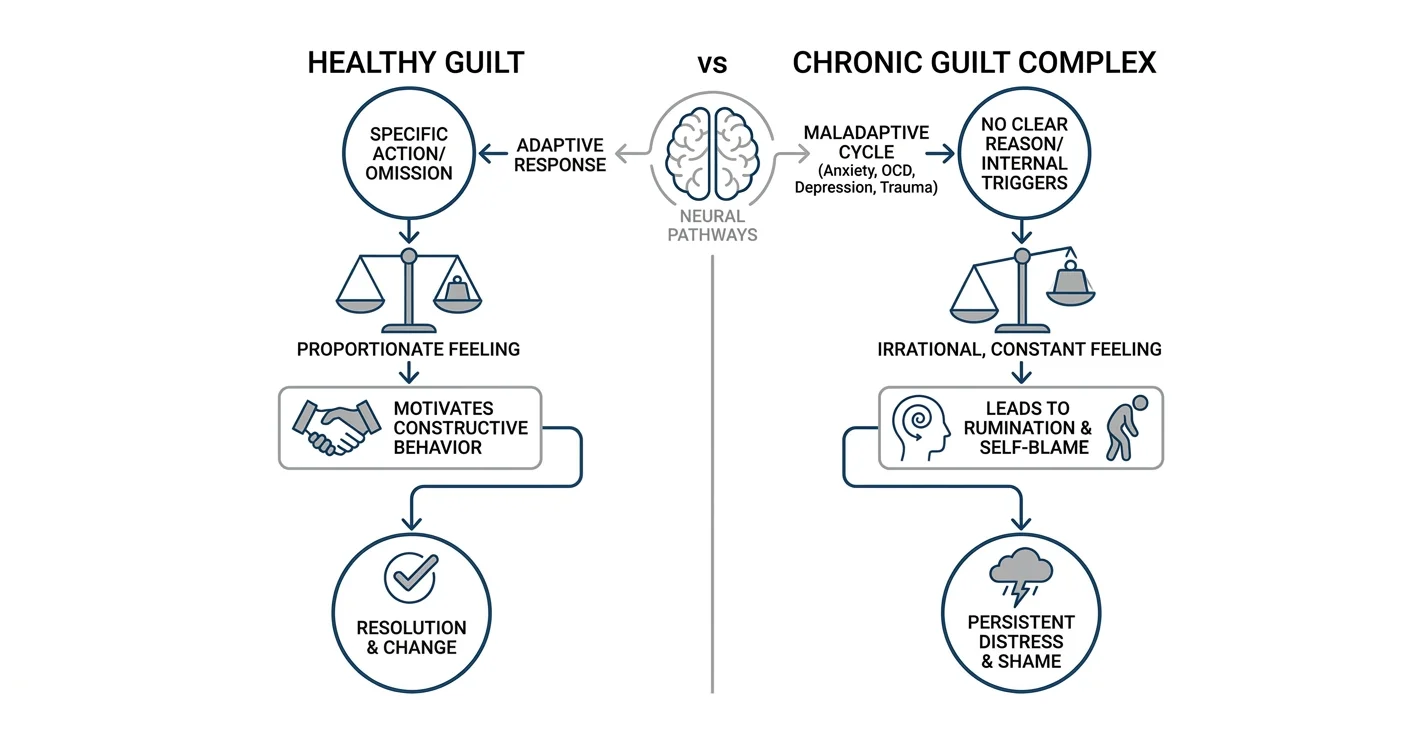
Healthy guilt has several recognizable features:
- It is connected to a specific action or omission
- It is proportionate to the actual impact of what happened
- It motivates constructive behavior: an apology, a repair, a change
- It resolves when those actions have been taken
- It does not attack the person's fundamental worth, only the specific behavior
Chronic guilt is different. Here are some of its features:
- You often feel like you have done something wrong, even when you didn’t
- You blame yourself even for small things
- The feeling of guilt stays for a long time and is hard to stop
- You think a lot about past mistakes again and again
- You feel responsible for other people’s feelings or problems
- You say “sorry” too much, even when it’s not needed
Guilt Complex: Common Signs You Might Recognize
These are some of the clearest signs:
- You apologize compulsively, often without being sure what you are apologizing for
- You feel shame when you prioritize your own needs
- When something goes wrong in a group or family context, your first instinct is to assume you are responsible
- You feel guilty for things that were not your fault or not in your control
- You have difficulty receiving care or good things without feeling that you do not deserve them
- You ruminate extensively over past mistakes
- You constantly feel guilty around certain people, particularly those who have used guilt as a control mechanism
- You experience intense guilt about things that everyone makes mistakes about, or about things that are simply part of life
- You feel responsible for other people's emotions and wellbeing
Why You Might Feel Guilty for No Reason: The Roots of Excessive Guilt
Guilt stems from many different sources, and understanding where a particular person's guilt originates is an important part of addressing it. Some of the most common roots include these reasons.
Childhood Environment and Parenting
Guilt often starts in childhood and family life. Children with parents who use guilt to control them can feel guilty very easily later in life. As adults, these people can feel guilty even when they did nothing wrong.
Children who grow up with a lot of criticism also take this voice inside. The parent’s critical voice becomes their own inner voice. As adults, they feel guilt all the time because this voice keeps working automatically.
Perfectionism
When a person is a perfectionist, they often believe they must do everything perfectly. If something goes wrong, even a small mistake, they feel strong guilt. Because of their high standards, they feel like they are “not good enough” most of the time. This creates a constant feeling of guilt, even when they did nothing seriously wrong. Unhealthy guilt appears when a person takes too much responsibility. They may think everything is their fault. Perfectionism also makes it hard to forgive yourself. Instead of learning from mistakes, the person keeps thinking about them again and again.
Underlying Mental Health Conditions
Chronic and excessive guilt is a recognized symptom of several mental health conditions. Identifying whether one of these is present is important because the treatment implications differ:
- Depression: People experiencing guilt alongside persistent low mood, loss of interest, fatigue, and changes in sleep and appetite should be evaluated for depression.
- Anxiety: Mental health problems like anxiety, including Generalized Anxiety Disorder, often come with strong guilt. People may think they caused more harm than they really did. Because of this, they feel guilty about situations that were not as bad as they think.
- Obsessive Compulsive Disorder: Guilt feeling is one of the most central emotional features of OCD, particularly in subtypes involving intrusive thoughts about harm, religion, or morality. People with OCD experience intense guilt about thoughts, and the intrusive thoughts themselves are often experienced as evidence of being a bad person.
- Post-Traumatic Stress Disorder: Survivor guilt, guilt about not having prevented a traumatic event, and guilt instilled by an abusive relationship are all common in PTSD.
False Guilt and Guilt Trips
False guilt is when you feel guilty because you did not meet someone else’s expectations. This is common in people who grew up with controlling or manipulative parents, strict religious rules, or relationships where guilt was used to control them.
False guilt feels the same as real guilt. But it does not come from your own values. It comes from rules and expectations of other people that you learned before. Understanding this difference is an important step to deal with guilt and with a guilt complex.
How Guilt Stems from OCD?
Obsessive Compulsive Disorder is a mental health problem. A person has unwanted thoughts, images, or urges. These thoughts bring anxiety and guilt. After that, the person does actions or mental habits to feel better.
In some types of OCD, like moral or religious OCD, guilt is the main feeling. People can feel very guilty about thoughts they did not choose and would never act on. They may check their actions again and again, ask others for reassurance or pray. This helps for a short time, but keeps the problem going.
How Guilt Can Cause Real Harm: The Effects of Living with Constant Guilt
Guilt can cause harm when it becomes chronic and excessive. People may feel the effects of persistent guilt across multiple domains of their lives:
- On mental health: Constant guilt is closely associated with anxiety, depression, and low self-esteem.
- On relationships: People who always feel guilty often either over-accommodate others to manage the guilt, becoming exhausted and resentful, or they withdraw to avoid situations that might trigger more guilt.
- On physical health: Chronic guilty feeling activates the stress response system. Sustained psychological distress of this kind is associated with disrupted sleep, elevated cortisol, suppressed immune function, and increased cardiovascular risk.
- On self-esteem and identity: Constantly feeling like a bad person, regardless of evidence, gradually becomes the operating assumption.
Stop Feeling Guilty: Evidence-Informed Approaches
We break down evidence-informed ways to understand your current experience and respond more effectively.
Distinguish Between Healthy Guilt and False Guilt
Develop the capacity to distinguish between guilt that is pointing to something real and guilt that is a learned response or a symptom. Ask: did I actually violate one of my own values? What are the facts of this situation? The answers begin to map the terrain.
Follow Healthy Guilt Where It Leads, Then Let It Go
Healthy guilt means you use the feeling to act. If you made a mistake, try to fix it and decide to do better next time. When you do these steps, guilt has done its job. Feeling guilty after that is not helpful and does not help anyone.
Challenge the Underlying Negative Thoughts
Cognitive Behavioral Therapy gives simple tools to understand your thoughts. When you think “I am a bad person,” you check it like a question: what proof do I have?
You can also ask: what would I say to a friend with the same thought? This helps you see the situation more clearly. Over time, these steps make guilt weaker.
Recognize and Name Guilt Trips
If you often feel guilty with some people, even when you did nothing wrong, think about the relationship. Maybe guilt is used to control you. A guilt trip is when someone makes you feel bad so you change your behavior.
Work with a Licensed Mental Health Professional
A therapist can help you understand where the guilt comes from. They can explain different types of guilt and choose the right help for you. If guilt is caused by Obsessive Compulsive Disorder, a common treatment is Exposure and Response Prevention Therapy. If it is linked to Depression, therapy and sometimes medicine can help. If guilt comes from trauma or an abusive relationship, trauma-focused therapy is better.
When to Seek Help?
Consider speaking with a mental health professional if:
- You feel guilty all the time, even when you have done nothing wrong
- Guilt or shame is significantly affecting your relationships, your work, or your ability to enjoy your life
- You suspect that your guilt may be connected to an underlying mental health condition like depression, anxiety, or OCD
- You have intrusive thoughts that produce intense guilt and you find yourself engaging in mental rituals to manage them
- Your self-esteem has been significantly affected by persistent feelings of guilt and shame
- You feel unable to forgive yourself for past mistakes despite genuine efforts to do so
A licensed mental health professional can help you understand what is driving your specific pattern and provide the most appropriate support. Lovon connects you with private, judgment-free care from trained professionals, available when you need it.
Sources and Further Reading
We used these sources to create this article and help you feel better. You can explore them to get a deeper understanding of the topic:
- Depression overview. National Institute of Mental Health.
- Moral emotions and moral behavior. Annual Review of Psychology. PubMed
- Understanding and treating obsessive-compulsive disorder. Lawrence Erlbaum Associates.
- Diagnostic and Statistical Manual of Mental Disorders, Fifth Edition (DSM-5). APA Publishing.
How AI Support Helps You Heal
AI emotional support isn't about replacing human connection — it's about filling the gaps. The moments when you need to talk at 2 AM, when you don't want to burden your friends again, or when you simply need someone to listen without judgment.
Here's what happens in a typical Lovon session:
You share what's on your mind
There's no script, no intake form, no waiting room. You speak or type whatever you're feeling — in your own words, at your own pace.
Lovon validates and explores
Using frameworks from CBT (Cognitive Behavioral Therapy) and motivational interviewing, Lovon acknowledges your feelings first, then gently helps you explore them. No dismissive "just move on" advice.
You build coping skills together
Lovon doesn't just listen — it actively works with you on evidence-based techniques: thought reframing, urge surfing, behavioral experiments, and more.
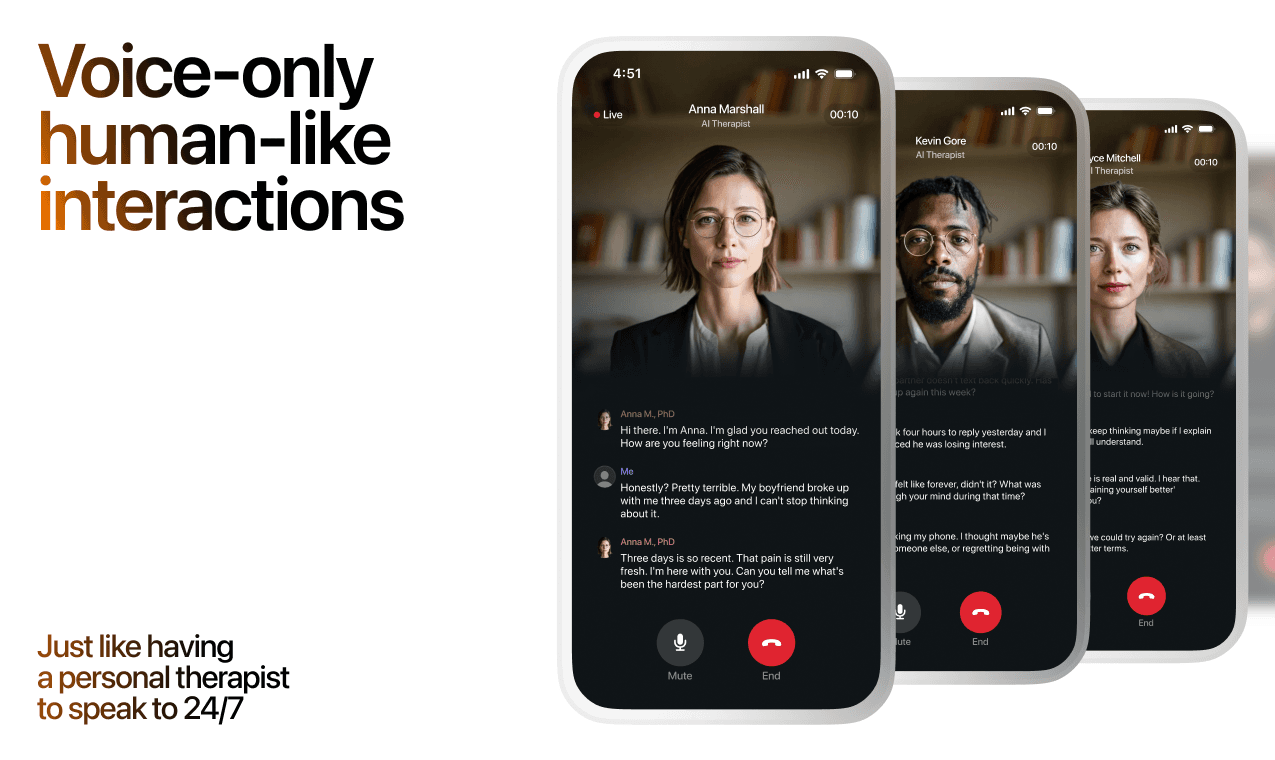
What a Session with Lovon Looks Like
When to Seek Professional Help
AI support is a valuable tool, but it's not a replacement for professional care. Please consider reaching out to a licensed therapist if you experience any of the following:
- Persistent thoughts of self-harm or suicide
- Inability to perform daily activities (work, eating, sleeping) for more than 2 weeks
- Turning to alcohol or substances to cope
- Intense anger or desire to harm your ex-partner
- Complete emotional numbness that doesn't improve over time
Crisis Resources (US): If you're in immediate danger, call 988 (Suicide & Crisis Lifeline) or text HOME to 741741 (Crisis Text Line). Available 24/7, free, and confidential.
Outside the US? Find a crisis line in your country
Ready to Start?
Your healing journey can begin right now
1 free conversation. No credit card. No judgment. Just a safe space to process what you're going through.
Frequently Asked Questions
Q: Is feeling guilty all the time a mental health condition?
Q: What is the difference between shame and guilt in the context of a guilt complex?
Q: Can you feel guilty for things you did not do?
Q: Why do some people feel more guilty than others?
Q: Is guilt ever useful, or should it always be reduced?
Q: Can constant guilt be a sign of a manipulative relationship?
About the Author

Mireya Tabasa
Mental Health Support Specialist & AI Advisor
Mireya Tabasa is a Mental Health Support Specialist working at the intersection of clinical care and technology. With over 4 years of hands-on experience supporting diverse populations facing mental health challenges in educational and healthcare settings, she brings frontline clinical insight to ev...
Related articles
- Self-Abandonment: What It Is and How to Stop It in 2026
Self-abandonment means ignoring your own needs to keep the peace. Learn the 2026 signs, six concrete steps to stop it…
- How to Stop People Pleasing in 2026: 7-Step Guide
How to stop people pleasing in 2026: 7 concrete steps, a boundary script, and troubleshooting for guilt, pushback, and…
- How to Stop Being Codependent: Steps That Work (2026)
How to stop being codependent in 2026: 6 practical steps, common mistakes, and troubleshooting for boundary-setting…
- How to Ask for Emotional Support Without Feeling Needy (2026)
How to ask for emotional support without feeling needy in 2026: name the need, bound the ask, pick the right person…
See also
Quizzes
- Shame Test: Do You Read Mistakes as Verdicts?
See which exit your shame takes, in 3 minutes.
- Light Triad Test: Are People Ends or Means?
See how you treat people when there is nothing to gain.
Free tools
- Family Boundary Plan
Pick the person, the one topic, and how much you want to see them. You get a three-rung ladder, the guilt lines to…
- Self-Esteem Check-In
Eight statements, one read on three sides of self-esteem: your self-talk, how you act with people, and what you do with…
Disclaimer: This article is for informational purposes only and does not constitute medical advice, diagnosis, or treatment. Always seek the advice of your physician or other qualified health provider with any questions you may have regarding a medical condition. If you are in crisis or think you may have an emergency, call 988 (Suicide & Crisis Lifeline) or go to the nearest emergency room. Outside the US? Find a crisis line in your country.