
Emotionally Unavailable Man: Signs You Keep Attracting Him
Sometimes it may feel like you’re unlucky, like things just never work out with your partner and every relationship goes wrong.

Key Takeaways
- In a study by Phillip R. Shaver and Mario Mikulincer, about 45-50% of people with avoidant attachment showed
- Amir Levine found that around 50% of adults have insecure attachment patterns, which can lead to repeated unhealthy
- According to research by John Bowlby, early emotional experiences shape adult relationships, and up to 60% of people
Introduction
Sometimes it may feel like you’re unlucky, like things just never work out with your partner and every relationship goes wrong. This happens to many people. Today we want to share one possible reason behind it: emotionally unavailable men. We’ll explain why you may be attracted to this type and how you can break that pattern.
What Emotional Unavailability Really Means in Relationships?
Many people think that an emotionally unavailable person is cold and distant from the very beginning, but in reality it often looks very different. At the beginning, your relationship may seem perfect, but the real pattern shows over time. As the relationship becomes deeper and more intimate, problems occur. When the connection starts to grow, your partner may begin to pull away. This often shows up as mixed signals. It does not automatically make them bad people. They have their own trauma or reasons to act this way. But it is important to remember that you can support them, but you cannot and don't have to save them.
Emotional Distance vs. Normal Relationship Boundaries
It’s easy to confuse emotional distance with healthy boundaries, but they are not the same thing. In a healthy relationship, boundaries are a good thing. Emotional distance creates confusion. The person may avoid deeper conversations or make you feel like you are asking for too much when you simply want connection. A good example that many people discussed publicly is the relationship between Selena Gomez and Justin Bieber. In interviews and documentaries, Selena shared that there were periods when the relationship felt emotionally bad. There were moments of closeness followed by distance. She felt a lot of emotional stress because of this.
In a healthy dynamic, space does not break the connection. With emotional distance, space often feels like disconnection.
3 Signs You’re Dealing With an Emotionally Unavailable Man
There can be many signs, and they may show up differently depending on the person. But we will focus on four key red flags that deserve your close attention.
Their Actions Don’t Match Their Words
Even at the beginning, when things still seem fine, if you pay attention, you may notice a pattern. Each time the relationship starts to move to a deeper level of intimacy, your partner says one thing but does something completely different.
Kourtney Kardashian and Scott Disick had this pattern many times. Scott said he wanted to be a good partner and father, but he often partied and did not take responsibility. After they got back together, the same problem came again. His words showed commitment, but his actions were the opposite.
They Avoid Emotional Conversations
Imagine you are sitting in the kitchen in the evening and decide to talk about your future together, like a home or shared plans. But your partner changes the topic and makes a joke about politics from the internet. This happens every time you try to talk about something serious because it makes them uncomfortable, but they cannot tell you that.
You Feel Unsure Where You Stand
One day you may feel like you mean everything to your partner, and the next day they feel so cold that you don’t know what to think. When you try to talk about it, you don’t get clarity, only more confusion, and it can even make you start doubting yourself. This kind of shift is what creates confusion.
Why Do I Keep Attracting Emotionally Unavailable Men?
There are several reasons why this pattern forms. We will look at the main ones so it becomes clearer for you.
Your Attachment Style Shapes Who You Choose
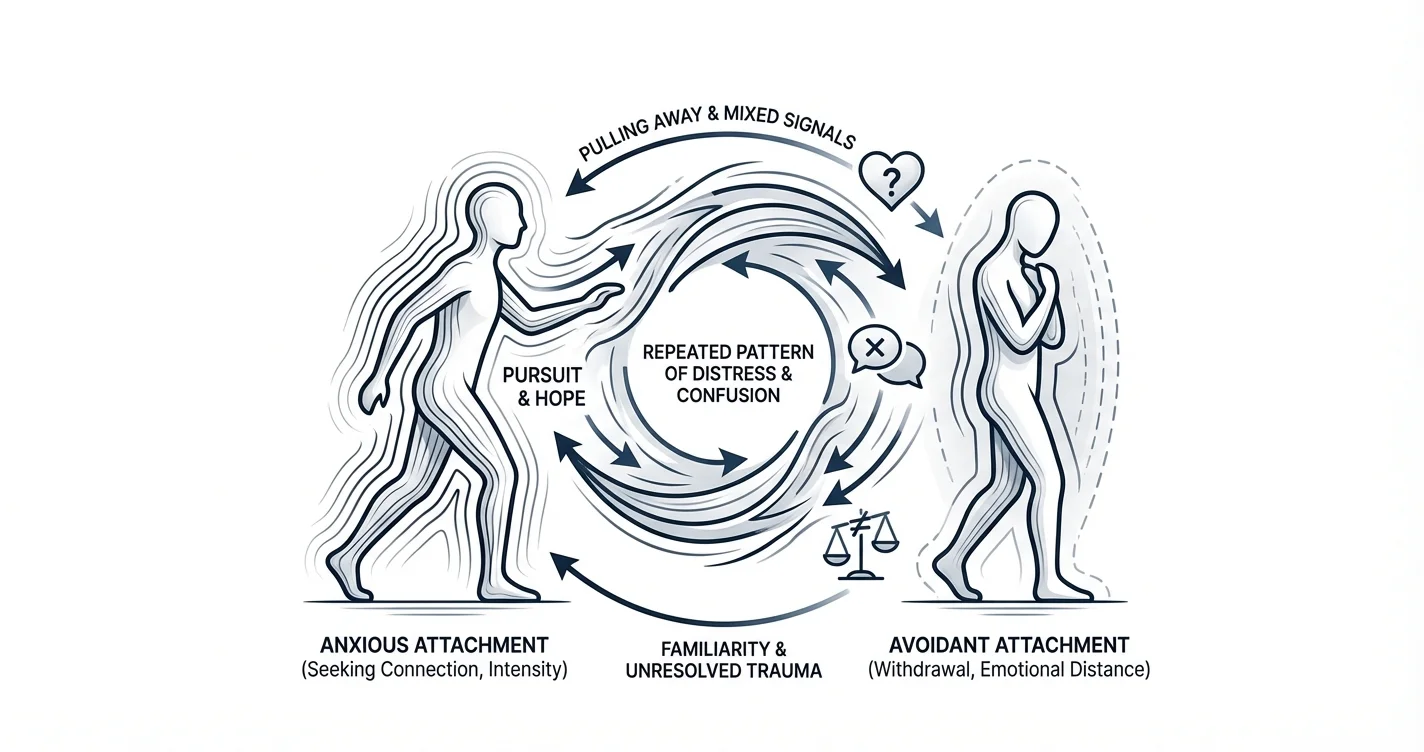
Emotionally unavailable partners are often linked to avoidant attachment, meaning they naturally avoid closeness and emotional depth. At the same time, people with anxious attachment tend to seek connection more intensely. This creates a common dynamic where one person chases closeness and the other pulls away.
A study by psychologist Dr. Amir Levine, co-author of Attached, shows that people with anxious attachment are more likely to be drawn to avoidant partners, even when those relationships cause stress. Another study published in the Journal of Personality and Social Psychology (Fraley & Shaver) found that individuals with insecure attachment report lower relationship satisfaction and higher emotional distress, yet still tend to repeat similar partner choices over time.
You Confuse Intensity With Connection
The relationship between Rihanna and Chris Brown is often discussed as an example of emotional intensity that can feel like deep connection. In interviews, Rihanna shared that the relationship had very strong emotional highs followed by difficult lows. This kind of dynamic can feel powerful and meaningful in the moment, even when it is unstable.
This happens to many people who don’t know how to build healthy relationships. Instead of looking for stability, they are drawn to intensity. This also happens on a physical level. Unstable and unpredictable relationships can create a stronger dopamine response at the beginning, which makes the connection feel more exciting and emotionally intense.
You Are Attracted to What Feels Familiar
Unhealthy relationship patterns can come from childhood, trauma, or past bad relationships. Even if the relationship hurts you, you may stay because it feels familiar, and you do not know a healthier way. John Bowlby showed that about 60% of people repeat negative relationship patterns from childhood, so they may stay in relationships that hurt them.
Hope Keeps You Stuck in the Pattern
Sometimes the reason we stay in the wrong relationship is hope. We believe that this is not permanent and that the person can change. This is especially true when an emotional connection has already formed and there were many good moments at the beginning. Those memories can make it harder to see the situation clearly and move on.
Why Breaking This Pattern Can Feel So Hard?
Sometimes even the worst patterns can feel more comfortable than something new and unknown. When something becomes familiar, it feels safer, even if it is not healthy. Breaking a pattern that attracts emotionally unavailable partners requires real change. It is not just about choosing a different person, but about changing what feels natural to you.
How to Attract Emotionally Available and Healthy Love?
The first step is to start with yourself, because it is easier to change yourself than another person. If you notice unhealthy patterns that stop you from having a stable relationship, start to change them step by step. If it is hard to do alone, talk to a specialist who can help you build the right strategy.
Second, pay attention at the early stage of a relationship. Look at how a person acts, not only how they make you feel for a short time. Notice if there are the signs we talked about. If you see them, you need to talk openly with your partner, set boundaries, and say what is important for you in a relationship. This will help you understand if they are ready to work on a healthy relationship.
If they are not ready at all, you should think about yourself and maybe end the relationship. If they are ready, be patient and support them, because changing patterns is not easy and works better with support.
A fulfilling relationship does not feel confusing or draining. If you understand that a person is emotionally distant, be honest and think if this relationship can be fixed. If you are the reason you keep choosing this type of partner, work on what is inside you. And always remember that you deserve a happy relationship and you can build it.
How AI Support Helps You Heal
AI emotional support isn't about replacing human connection — it's about filling the gaps. The moments when you need to talk at 2 AM, when you don't want to burden your friends again, or when you simply need someone to listen without judgment.
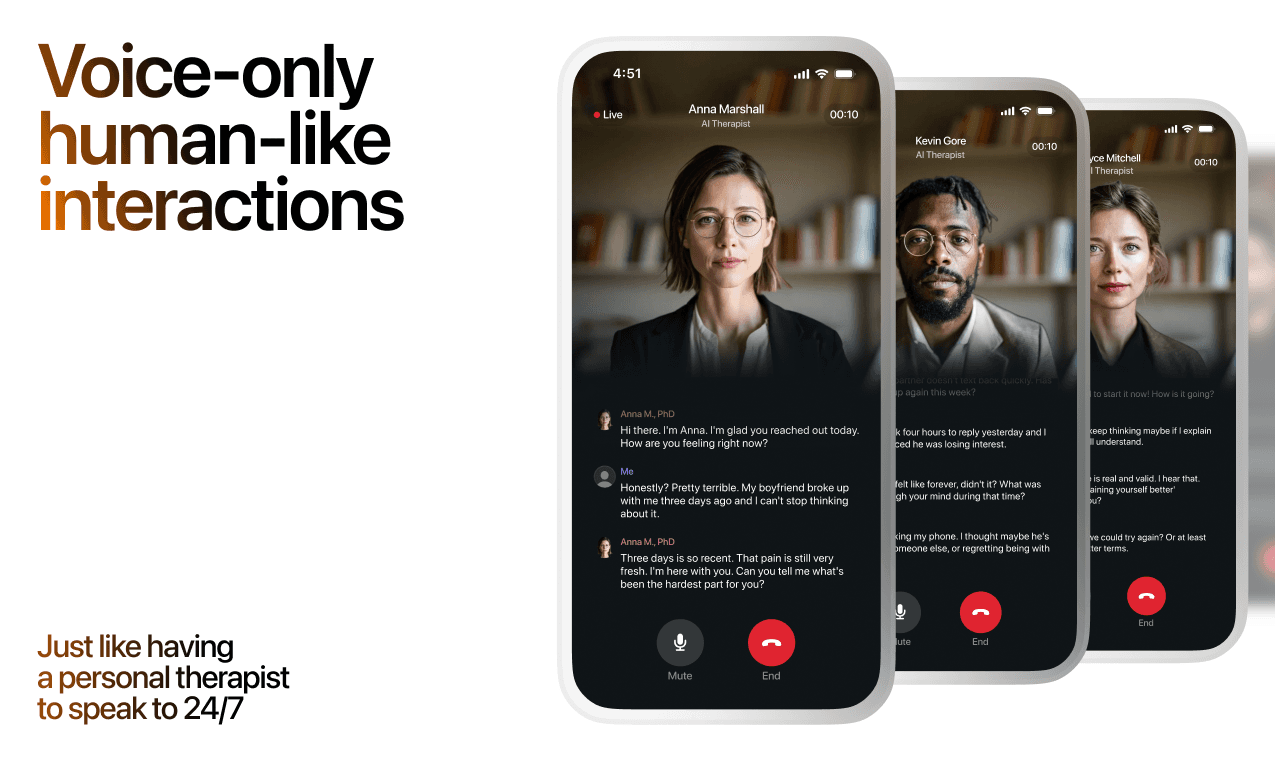
Here's what happens in a typical Lovon session:
You share what's on your mind
There's no script, no intake form, no waiting room. You speak or type whatever you're feeling — in your own words, at your own pace.
Lovon validates and explores
Using frameworks from CBT (Cognitive Behavioral Therapy) and motivational interviewing, Lovon acknowledges your feelings first, then gently helps you explore them. No dismissive "just move on" advice.
You build coping skills together
Lovon doesn't just listen — it actively works with you on evidence-based techniques: thought reframing, urge surfing, behavioral experiments, and more.
What a Session with Lovon Looks Like
When to Seek Professional Help
AI support is a valuable tool, but it's not a replacement for professional care. Please consider reaching out to a licensed therapist if you experience any of the following:
- Persistent thoughts of self-harm or suicide
- Inability to perform daily activities (work, eating, sleeping) for more than 2 weeks
- Turning to alcohol or substances to cope
- Intense anger or desire to harm your ex-partner
- Complete emotional numbness that doesn't improve over time
Crisis Resources (US): If you're in immediate danger, call 988 (Suicide & Crisis Lifeline) or text HOME to 741741 (Crisis Text Line). Available 24/7, free, and confidential.
Outside the US? Find a crisis line in your country
Ready to Start?
Your healing journey can begin right now
A 7-day trial. No judgment. Just a safe space to process what you're going through.
Frequently Asked Questions
Q: What do emotionally unavailable men want?
Q: Can an emotionally unavailable man change?
Q: Do emotionally unavailable men miss you?
Q: Do emotionally unavailable men get married?
About the Author

Mireya Tabasa
Mental Health Support Specialist & AI Advisor
Mireya Tabasa is a Mental Health Support Specialist working at the intersection of clinical care and technology. With over 4 years of hands-on experience supporting diverse populations facing mental health challenges in educational and healthcare settings, she brings frontline clinical insight to ev...
Related articles
- Anxious Attachment Style: Signs & Coping Steps (2026)
Anxious attachment style affects ~20% of adults. Learn the exact signs, 6 coping steps, and daily tools that create…
- Disorganized Attachment Style: Causes & Recovery 2026
Disorganized attachment style causes constant push-pull in relationships. Learn what drives it, 6 evidence-based…
- Best AI Relationship Coach for Avoidant Attachment 2026
Find the best AI relationship coach for avoidant attachment in 2026. Lovon's voice app gives on-demand coaching, coping…
- Why Do I Push People Away? 2026 Fix Guide
Why do I push people away, answered with steps that work in 2026: name the urge, pause 90 seconds, repair fast. Fearful…
See also
Quizzes
- Do I Have Abandonment Issues? 12-Question Self-Check
See how loudly the fear of being left runs things.
- Am I Ready for a Relationship? 12-Question Check
Check what you are actually ready for, in 2 minutes.
Free tools
- Good Morning Texts Written for Your Person
A chat, not a list of a hundred. Tell it what their day holds and the tone you want, and get good morning texts for her…
- The 'What Are We?' Conversation, Planned in One Go
A chat for the conversation you keep rehearsing and not having. Say how long it has been and what you want it to be, and…
From the wiki
- How many dates before a relationship?
There is no set number. People often say five to ten dates, but that range is really describing five to ten weeks of…
Disclaimer: This article is for informational purposes only and does not constitute medical advice, diagnosis, or treatment. Always seek the advice of your physician or other qualified health provider with any questions you may have regarding a medical condition. If you are in crisis or think you may have an emergency, call 988 (Suicide & Crisis Lifeline) or go to the nearest emergency room. Outside the US? Find a crisis line in your country.