
Insecure in Your Relationship? Understand Your Insecurity & Feel Secure
Quick Takeaways:
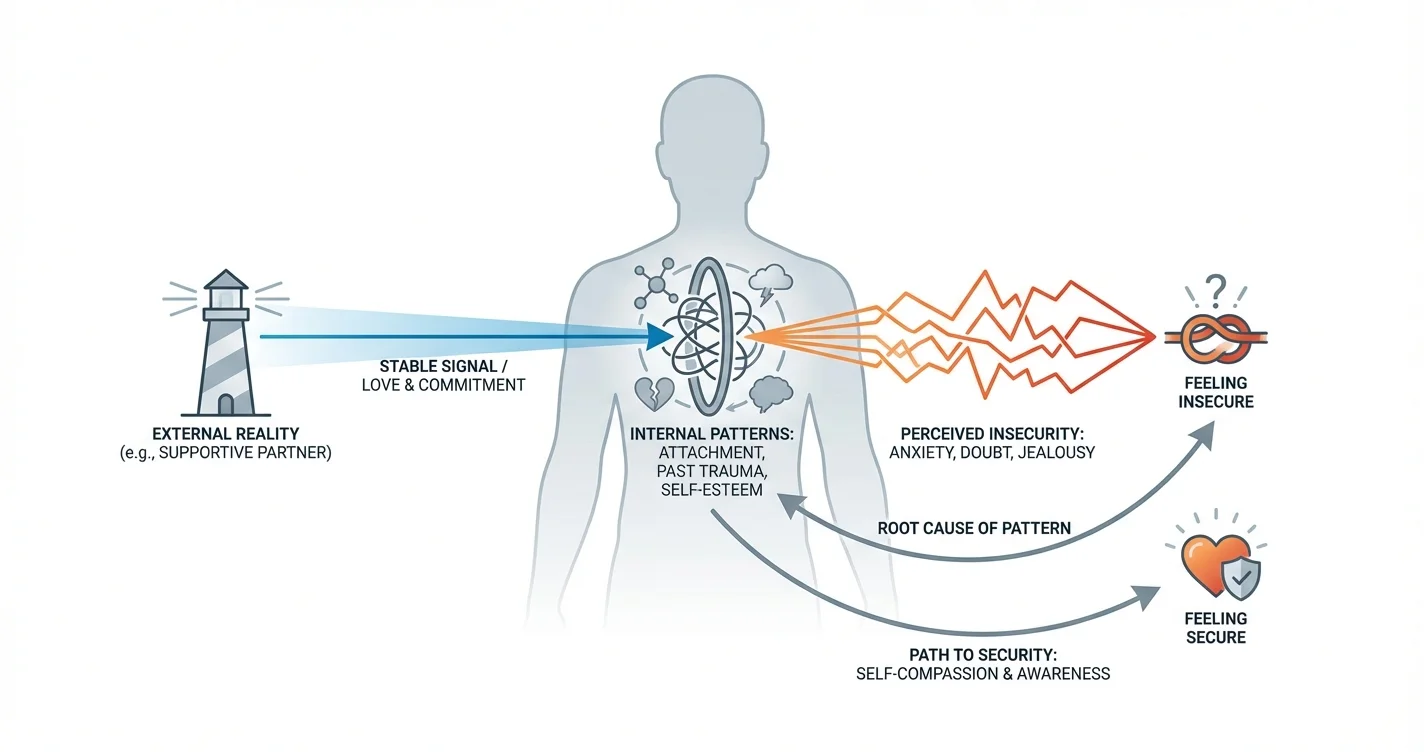

Key Takeaways
- Feeling insecure in a relationship does not mean something is wrong — it often reflects internal patterns, not
- About 40-50% of adults have some form of anxious or avoidant attachment, which can create relationship insecurities
- The real reason behind this feeling is rarely about your partner alone — past relationships, childhood experiences,
- You cannot force yourself to stop being insecure overnight, but you can get to the root of the pattern and shift it
- Self-compassion, not self-criticism, is the most effective path toward feeling secure
Introduction
You're scrolling through your partner's phone — not because you found something suspicious, but because you couldn't stop yourself. Or maybe you're replaying a conversation from earlier, trying to decode whether their "I'm fine" meant something worse. You know you're being irrational. You know they haven't done anything wrong. And still, something inside you feels uneasy.
If you're dealing with this pattern, you already know how exhausting it can be. The constant vigilance. The worry that your partner will leave. The jealousy that appears even when there is no real threat. This struggle is painful because it creates conflict between what you know and what you feel.
You might love your current partner, trust them logically, and still find yourself jealous and insecure when they mention a coworker or spend time with your friends. That gap between logic and emotion can make you feel inadequate — like something is fundamentally wrong with you.
We want to help you understand where this comes from and what you can actually do about it. Whether you want to stop the anxious spiral or simply understand yourself better, this guide covers what insecure people experience and practical ways to address the cycle of insecurity.
What Does This Pattern Mean?
Feeling insecure is not about facts. It is about internal experience. You might have a partner who is loyal, present, and committed — and still feel threatened by things that, objectively, are not threats.
This happens because the response is less about your partner and more about how you process closeness. When vulnerability feels risky, the mind looks for danger even when there is none. That vigilance can show up as doubt, constant reassurance seeking, or trying to control what your partner does.
Research shows that relationship insecurities are often rooted in attachment patterns formed early in life. Psychologist John Bowlby, who developed attachment theory, explained that the way we bonded with caregivers shapes how we experience intimacy as adults. If early relationships were unpredictable, the brain may learn to expect inconsistency — even from someone who is consistent.
Every relationship brings its own dynamics, but feelings of insecurity often follow us from one connection to the next. This does not mean you are broken.
Signs of Insecurity in a Relationship
This pattern does not always look dramatic. Sometimes it shows up quietly, in behaviors you may not recognize. Here are the most common signs.
Asking for Reassurance Repeatedly
You might ask your partner if they love you, if they're happy, if everything is okay — again and again. Occasional checking is normal. But when reassurance provides only temporary relief before the anxiety returns, it signals deeper insecurity.
Research by psychologist Leslie Greenberg shows this can become a loop. You ask, your partner responds, you feel better temporarily. Then the doubt returns. Constantly checking for signs of love becomes exhausting.
Jealousy That Feels Hard to Control
You may know, logically, that your partner having lunch with a colleague is not a threat. But your body tightens anyway. This becomes problematic when the reaction is not proportional — when small, innocent actions trigger strong emotions.
Research by psychologist David Buss shows that this emotion is universal, but its intensity varies based on attachment style and past experiences.
Worrying About the Future
You might find yourself thinking about whether the relationship is going to end, even when there is no evidence of problems. This pattern reflects a deeper fear of abandonment that often predates the current situation.
Trying to Control Your Partner's Behavior
When someone experiences insecurity, they may try reducing anxiety by limiting what their partner does. This can look like discouraging certain friendships, monitoring messages, or getting upset when plans change.
Feeling Like You Aren't Good Enough for Your Partner
A persistent sense that you lack value — that they will eventually leave — is common. This belief reflects early experiences that shaped self-worth.
If you often have this negative thought, it deserves attention.
Common Reasons Why People Feel Insecure
Understanding the source helps address insecurity more effectively.
Attachment Style and Early Relationships
The most established explanation comes from attachment research. Studies by Cindy Hazan and Phillip Shaver showed that patterns formed in childhood predict how adults approach intimacy.
About 20% of adults have anxious attachment, characterized by need for closeness. Another 25% have avoidant attachment, marked by discomfort with emotional intimacy. Both patterns affect romantic relationships differently — anxious through hypervigilance, avoidant through distance.
Actress Kristen Bell has spoken publicly about her anxious attachment and how it affected her early relationship with husband Dax Shepard. Over time, with awareness and therapy, she learned to recognize the pattern and respond differently.
Past Relationships and Past Trauma
If a previous relationship involved betrayal or abandonment, the brain carries that forward. Even when a partner is trustworthy, the nervous system may respond as if danger is present.
Research shows that individuals who experienced infidelity or emotional abuse struggle more in subsequent connections. Lack of trust from those experiences persists. Past mistakes by former partners and resulting trust issues create personal insecurities that follow us.
Low Self-Esteem and Lack of Confidence
When you do not feel confident in your own value, it becomes harder to feel secure in someone else's love. This creates a cycle: you doubt yourself, doubt their feelings, seek validation.
Psychologist Nathaniel Branden found that people with low self-esteem often unconsciously expect rejection. Feelings of inadequacy become a filter for all interactions.
When Your Needs Are Not Met
Sometimes the experience reflects a real problem. If your emotional needs are not met — if your partner is dismissive or inconsistent — your response may be a signal rather than distortion.
It is important to distinguish between internal patterns and responses to actual behavior. If the relationship doesn't provide basic emotional safety, that needs addressing directly.
How Insecurity Affects Your Relationship
This does not stay contained. It shapes communication and how the relationship feels for both people.
The Self-Reinforcing Loop
Insecurity often creates a reinforcing pattern. You feel anxious, seek validation, feel better temporarily, then doubt returns. Over time, this exhausts both people and creates the distance you feared.
Misreading Signals
When you're feeling this way, the brain scans for threat. A delayed text, a distracted look — neutral signals get interpreted as rejection. These interpretations become "evidence" that reinforces the pattern.
Distance Instead of Connection
Ironically, behaviors meant to protect against loss can create loss. Checking, possessiveness, control often push partners away — not because they stopped caring, but because the dynamic becomes difficult.
Many who want to be with someone deeply end up creating distance through patterns never consciously chosen.
How to Stop Being Insecure: Practical Steps
There is no quick fix. But approaches exist that help many shift this over time.
Understand the Root
The first step is understanding where this comes from. Is it rooted in trauma? Past betrayal where trust broke? Childhood inconsistency?
Keeping a journal helps. Write down moments when you felt this way, what happened before, what thoughts followed. Patterns become visible. If you're insecure in your relationship because of something current or old, identifying the source matters.
Practice Kindness Toward Yourself
Many people are harshly critical of their own struggles. This self-attack makes things worse.
Research by psychologist Kristin Neff shows that self-compassion — treating yourself kindly — is associated with emotional resilience. Being self-compassionate means acknowledging difficulty without cruelty.
This builds self-love as a genuine foundation of self-respect.
Communicate With Your Partner Differently
Open communication matters, but how you share matters more. "I notice tension when you don't respond" differs from "Why didn't you text back?" The first expresses experience; the second implies accusation.
When you share with your partner from vulnerability rather than blame, you create a safe space. Sharing your thoughts and concerns openly strengthens connection.
Researcher John Gottman found that relationships with emotional honesty show higher satisfaction. The goal is not hiding struggles but inviting support.
Challenge Anxious Thoughts
When a thought appears — "They're going to leave" — pause before accepting it. Ask: What is the actual evidence?
Cognitive behavioral therapy works on this principle. Examining thoughts rather than automatically believing them reduces emotional intensity.
Address Trauma
If struggles stem from childhood neglect or abusive relationships, working through that history may be necessary. EMDR and trauma-focused therapy have strong evidence.
Healing past wounds makes present connections easier.
Build Self-Esteem Outside the Relationship
When all your value depends on your partner, the relationship in your life becomes high-stakes. Building self-confidence through work, friendships, hobbies creates stability not dependent on one person.
Feeling confident and secure comes from multiple sources.
Setting Healthy Boundaries With Yourself
Sometimes this means limiting your own behaviors. If you check their phone, challenge yourself to stop. If you seek validation constantly, try to reassure yourself first.
These build new patterns. The nervous system learns safety does not require vigilance.
Accept Uncertainty
Even in healthy connections, you cannot know what happens next. That uncertainty is uncomfortable but unavoidable.
Accepting you cannot control outcomes — only responses — can reduce anxiety. Whether the connection is secure or not is going to depend on many factors beyond control.
When to Seek Support
Some struggles can be managed through awareness. But if the pattern significantly affects daily life, professional support helps.
A therapist or counselor can provide tailored tools. Attachment-focused therapy has strong evidence for helping people shift toward security.
Signs support might help:
- The pattern dominates thoughts most days
- Connections repeatedly end from similar dynamics
- You engage in behaviors you regret
- The anxiety feels unbearable
- You recognize unprocessed trauma
- You want to stop but feel unable
If you want a space that is safe, private, and judgment-free, Lovon is here 24/7. We do not promise to eliminate struggles. We can help you understand them and gradually feel steadier.
How AI Support Helps You Heal
AI emotional support isn't about replacing human connection — it's about filling the gaps. The moments when you need to talk at 2 AM, when you don't want to burden your friends again, or when you simply need someone to listen without judgment.
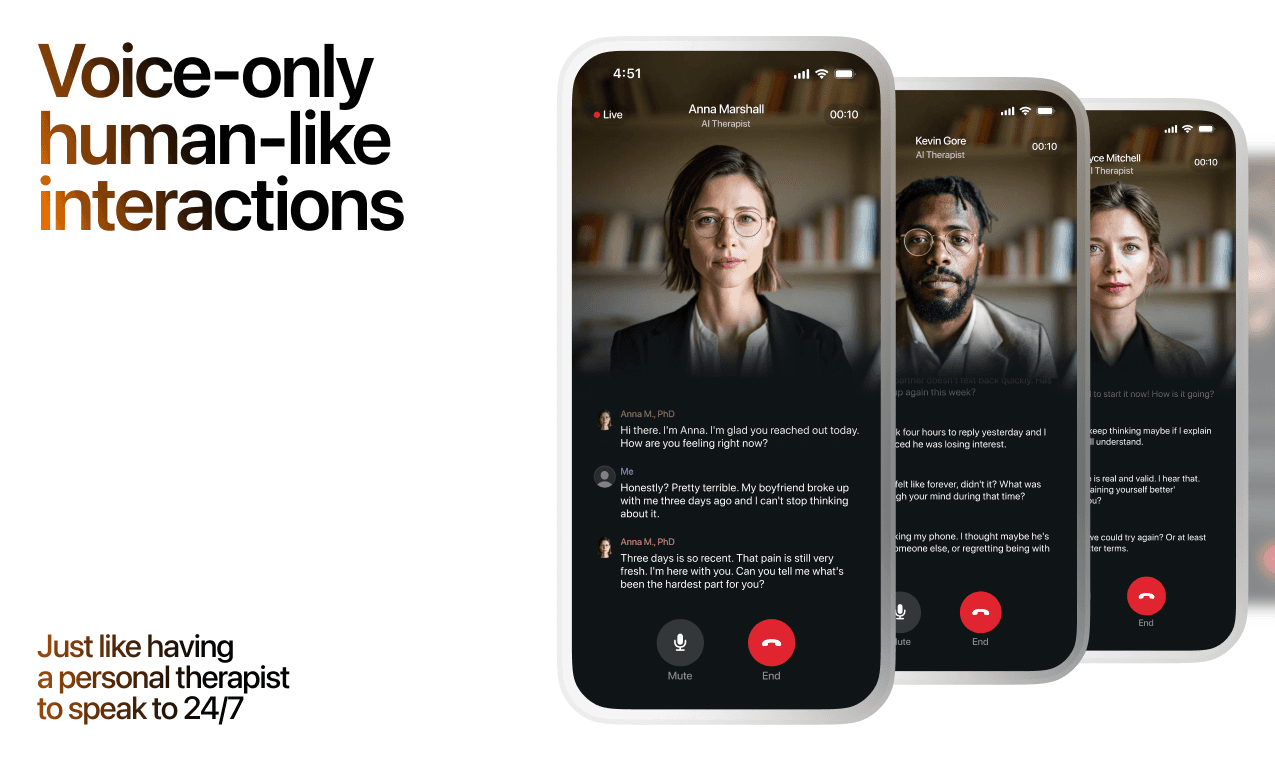
Here's what happens in a typical Lovon session:
You share what's on your mind
There's no script, no intake form, no waiting room. You speak or type whatever you're feeling — in your own words, at your own pace.
Lovon validates and explores
Using frameworks from CBT (Cognitive Behavioral Therapy) and motivational interviewing, Lovon acknowledges your feelings first, then gently helps you explore them. No dismissive "just move on" advice.
You build coping skills together
Lovon doesn't just listen — it actively works with you on evidence-based techniques: thought reframing, urge surfing, behavioral experiments, and more.
What a Session with Lovon Looks Like
When to Seek Professional Help
AI support is a valuable tool, but it's not a replacement for professional care. Please consider reaching out to a licensed therapist if you experience any of the following:
- Persistent thoughts of self-harm or suicide
- Inability to perform daily activities (work, eating, sleeping) for more than 2 weeks
- Turning to alcohol or substances to cope
- Intense anger or desire to harm your ex-partner
- Complete emotional numbness that doesn't improve over time
Crisis Resources (US): If you're in immediate danger, call 988 (Suicide & Crisis Lifeline) or text HOME to 741741 (Crisis Text Line). Available 24/7, free, and confidential.
Outside the US? Find a crisis line in your country
Ready to Start?
Your healing journey can begin right now
A 7-day trial. No judgment. Just a safe space to process what you're going through.
Frequently Asked Questions
Is this normal?
Can insecurity ruin a relationship?
What if my partner causes this?
Does therapy help?
Can I feel steadier over time?
Should I tell my partner?
About the Author

Mireya Tabasa
Mental Health Support Specialist & AI Advisor
Mireya Tabasa is a Mental Health Support Specialist working at the intersection of clinical care and technology. With over 4 years of hands-on experience supporting diverse populations facing mental health challenges in educational and healthcare settings, she brings frontline clinical insight to ev...
Related articles
- If I Give Everything You Won't Leave: Understanding the BPD Relationship Pattern
"If I give everything, you won't leave": why people with BPD over-give in relationships, how the cycle backfires, and…
- Break the Anxious Attachment Cycle: 2026 Step-by-Step Guide
Break the anxious attachment cycle in 2026 with 7 concrete steps, troubleshooting fixes, and tools for the moments…
- Secure Attachment in Relationships: What It Looks Like (2026)
See exactly what secure attachment in relationships looks like in 2026 — 6 real signs, common misreads, and how to build…
- Attachment Style Compatibility Quiz for Partners 2026
The best attachment style compatibility quiz for partners in 2026 — dual scoring, pairing analysis, and AI coaching…
See also
Quizzes
- Do I Have Trust Issues? 12-Question Quiz
Check where your guard actually sits, in 2 minutes.
- What's My Attachment Style? Free 12-Question Quiz
Find your attachment pattern in 3 minutes.
Free tools
- Pressure-Test Your Decision to Stay or Leave
A chat that argues with you on purpose. Give it your strongest case for leaving and for staying, and it pushes on both…
- How to Tell Someone You Love Them
How to tell someone you love them is rarely about the words, which are short. It is about the moment and the answer…
From the wiki
- What is an attachment style?
An attachment style is the habit your nervous system formed for handling closeness: what you actually do when someone…
Disclaimer: This article is for informational purposes only and does not constitute medical advice, diagnosis, or treatment. Always seek the advice of your physician or other qualified health provider with any questions you may have regarding a medical condition. If you are in crisis or think you may have an emergency, call 988 (Suicide & Crisis Lifeline) or go to the nearest emergency room. Outside the US? Find a crisis line in your country.