
Narcissist Gaslighting: Narcissistic Gaslighting Signs and Examples
You had good arguments, but by the end of the discussion, you were apologizing and wondering if you are the problem.

Key Takeaways
- Gaslighting behavior makes you question your memory and sanity, especially when dealing with a gaslighting narcissist
- If you are experiencing narcissistic patterns, you may notice constant denial, blame, or manipulation
- People often stay in these situations because someone with narcissistic patterns can act kind at times and then
Introduction
You had good arguments, but by the end of the discussion, you were apologizing and wondering if you are the problem. If this sounds familiar, you may be experiencing a gaslighting tactic, and if it is happening in a pattern, with someone who also cycles through periods of charm and cold withdrawal, narcissism and gaslighting are likely operating together. We will try to help you understand what is actually happening and what to do about it.
It is important to note that only a licensed clinician can diagnose NPD. If you recognize these patterns in someone close to you, that is worth exploring with a professional.
What Is Narcissistic Personality Disorder?
Narcissistic Personality Disorder, or NPD, is a mental health condition. It means a person often feels very important, needs a lot of attention and praise, and has trouble understanding other people’s feelings. A person with NPD trie to always feel better than others and avoid anything that makes them feel weak or not good enough. NPD affects about 1 to 6 percent of people. It is diagnosed more often in men, but it can happen to anyone.
Key features of NPD include:
- Grandiose sense of self-importance and entitlement
- Preoccupation with fantasies of unlimited success, power, or brilliance
- A need for constant admiration and validation
- Lack of empathy: genuine difficulty recognizing or caring about others' feelings
- Exploitative behavior in relationships
- Intense reaction to criticism, often expressed as rage, contempt, or withdrawal
- A fragile self-esteem beneath the surface confidence, which is precisely what makes narcissistic behavior so destructive
People with narcissistic personality disorder rarely seek treatment for NPD itself. They are far more likely to appear in a therapist's office because of depression, relationship breakdown, or workplace conflict, and they often frame those problems as other people's failures.
What Is Gaslighting?
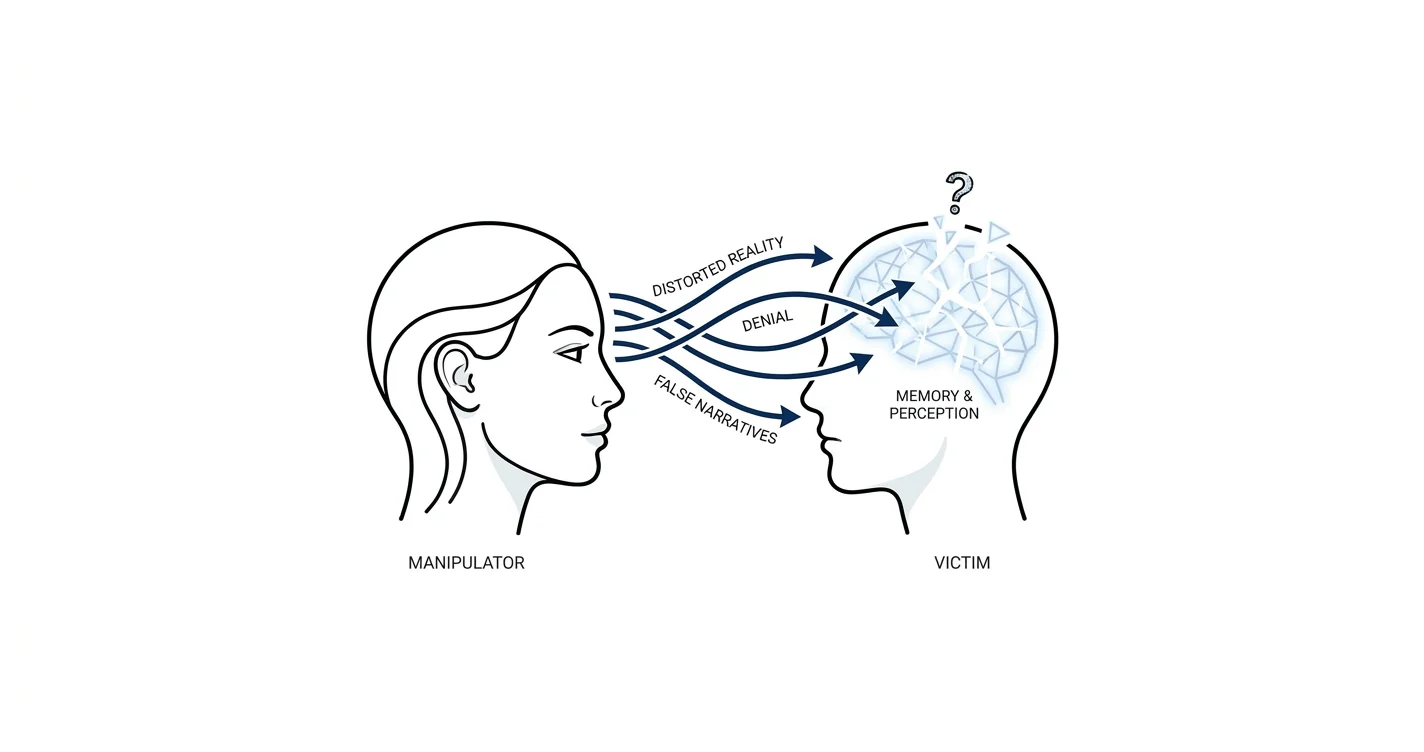
Gaslighting is a form of psychological manipulation in which one person causes another to question their own memory and sense of reality. The term comes from the 1944 film Gaslight, in which a husband systematically manipulates his wife into believing she is losing her mind in order to maintain control over her and conceal his crimes.
Gaslighting is a form of emotional abuse. It works gradually, through repetition, and it is particularly effective because it targets the victim's trust in their own mind rather than their trust in the abuser. By the time someone recognizes they are being gaslighted, they have often already absorbed the abuser's version of reality to a significant degree.
Some people with narcissistic traits gaslight reflexively, as a way of managing their own discomfort with accountability. Whether it is deliberate or not, the effects on the person on the receiving end are the same.
Types of Gaslighting
Gaslighting operates through several distinct but overlapping tactics.
Outright Denial
The most direct form of gaslighting. "That never happened." "I never said that." Delivered with enough confidence and repetition, this tactic can make even a clear-headed person begin to doubt their own recollection.
Minimizing And Trivializing
"You are so sensitive." "You always overreact." This form of gaslighting does not deny the event but attacks the legitimacy of your emotional response to it, training you to suppress your own reactions.
Diversion And Deflection
When confronted, the gaslighter changes the subject, brings up an unrelated grievance, or turns the conversation into an interrogation of your motives. The original issue never gets addressed because it never has the chance to.
Countering
Questioning your memory directly. "Your memory has always been terrible." "You always get confused when you are stressed." Over time, this systematically undermines your confidence in your own perception.
Reframing History
Revising past events in ways that consistently favor the gaslighter and cast you as irrational, aggressive, or unstable. After enough repetition, even your own account of shared history begins to feel uncertain.
Using others as weapons
"Everyone agrees with me." "Even your friends think you are being unreasonable." Whether or not this is true, it is used to isolate you and amplify your self-doubt by suggesting that your perception is not just wrong but uniquely, embarrassingly wrong.
Effects of Gaslighting Over Time
The effects of gaslighting accumulate. What begins as occasional self-doubt can develop, over months or years in a toxic relationship, into something that looks clinically bigger.
Common effects of gaslighting include:
- Chronic anxiety and hypervigilance
- Depression and a pervasive sense of worthlessness
- Difficulty making decisions, including small ones, because your trust in your own judgment has been so thoroughly undermined
- Social isolation, often the result of the gaslighter's subtle efforts to separate you from support systems
- Symptoms that may be consistent with complex PTSD, including intrusive thoughts, emotional dysregulation, and a distorted self-concept, and worth discussing with a clinician
- Difficulty leaving the relationship, in part because your ability to assess reality has been compromised from within it
Emotional abuse within relationships involving narcissistic patterns is recognized by trauma specialists as a form of domestic abuse even when no physical violence is involved.
Why Narcissism And Gaslighting So Often Go Together?
A person with narcissistic personality disorder cannot tolerate being wrong or being held accountable. Their entire sense of self depends on a particular narrative: that they are exceptional, that they are right, that others are lesser or mistaken. When reality threatens that narrative, the narcissist may use gaslighting as a tactic to rewrite it.
If you confront a partner with narcissistic traits about something they said, the gaslighting response does not just deny the specific incident. It attacks your credibility as a witness to your own life. Over time, you stop bringing things up and you stop trusting yourself.
Common Traits of Narcissistic Gaslighters
While every relationship has its own dynamics, narcissistic gaslighters tend to share a recognizable set of common traits:
- They present themselves as the real victim
- They use your vulnerabilities against you, things you shared in moments of trust, as ammunition during conflict
- They are charming and well-regarded outside the relationship, which makes your experience harder to explain and easier to dismiss
- They never genuinely apologize
- They keep score, selectively, remembering every grievance they hold against you while denying or minimizing anything that reflects poorly on them
- They shift between idealization and devaluation
- They escalate when challenged, turning any attempt to address their behavior into evidence of your instability or cruelty
The Role of Love Bombing
Understanding gaslighting in narcissistic relationships requires understanding the cycle it exists within. Most people do not enter abusive relationships with someone who is immediately cruel. They enter them with someone who is attentive, adoring, and seemingly perfect.
Love bombing is the intense idealization phase that characterizes the early stages of many relationships with narcissistic people. Constant contact, lavish attention, declarations of deep connection unusually early, a sense that you have found someone who truly sees you. This phase serves a function: it creates a powerful emotional bond that the abuser can exploit later, and it establishes a version of the relationship that you will spend the difficult phases trying to get back to.
When the gaslighting begins, it often starts subtly, in the gaps between periods of warmth. By the time it is overt and consistent, the bond established during love bombing makes it much harder to leave or even clearly see what is happening.
Signs of Narcissistic Gaslighting
Narcissistic gaslighting can show a strong sense of superiority in a relationship and often make you feel small or not important. Here is what you should pay attention to, to understand if this is the case.
They Trivialize What Matters to You
"You're overreacting." "It was just a joke." "I can't believe you're still upset about that."
When someone with narcissistic patterns consistently minimizes your concerns, it's because taking your concerns seriously would require accountability, and accountability is what this manipulation tactic is specifically designed to avoid.
They Deny Things That Definitely Happened
You remember exactly what was said and how it made you feel. They tell you it never happened, or that you've invented the details, or that you're remembering it wrong again.
This is one of the most direct forms of abusive behavior in a gaslighting dynamic. It's a consistent pattern of rewriting shared reality so that your version of events is always the unreliable one.
They Twist Your Words and Use Them Against You
You share something vulnerable. Later, it gets used as evidence of your instability or your flaws. This is one of the more calculated signs of narcissistic gaslighting. It punishes openness. Once you've experienced it a few times, you stop being honest, because honesty has taught you it isn't safe.
They Recruit Other People to Confirm Their Version of Reality
This is sometimes called triangulation. It's when narcissistic abusers bring in third parties, friends, family members, or colleagues, to validate their perspective and pressure you into doubting yours.
"I talked to your sister and she agrees with me." Whether those conversations actually happened the way they're being described is almost beside the point. The goal is to make you feel outnumbered and isolated in your own perception.
They Reframe Their Behavior as Care or Concern
Some of the most effective gaslighting comes wrapped in the language of love. "I'm telling you this because I care about you." "I wouldn't say it if I didn't want you to be better." "You need to hear this even if it's hard."
When abusive behavior gets consistently repackaged as concern, it becomes genuinely difficult to name what's happening. You feel ungrateful for being hurt by someone who claims they're helping you.
Your Emotional Reactions Are Always the Problem
You bring something up that hurt you. Instead of engaging with what you said, they pivot to how you said it. Suddenly the conversation is about your emotional response rather than the thing that caused it.
Narcissistic abusers are skilled at this redirection. It's a way of making your feelings the subject of every disagreement while their behavior stays off the table. After enough repetitions, you start doing the filtering yourself. You decide your feelings aren't worth the argument before you've even said a word.
You Feel More Confused Than Resolved After Difficult Conversations
Healthy conflict, even when uncomfortable, tends to leave you with some sense of clarity or movement. Gaslighting conversations do the opposite. You came in with a concern and left feeling disoriented, vaguely guilty, and unsure of what just happened.
If you regularly walk away from difficult conversations feeling worse about yourself and no closer to resolution, that pattern is not a reflection of your communication skills. It's a reflection of what the conversation was actually designed to do.
You've Started to Believe You're the Unstable One
This is where narcissistic gaslighting does its deepest work. Not in any single incident, but in the slow accumulation of being told, in ways large and small, that your emotions are too much, your perceptions are unreliable, and your version of events is always the distorted one.
Eventually, you start to agree. You apologize for your own feelings. You wonder if therapy would help you stop being so difficult. You tell people outside the relationship that you've been struggling, without mentioning what you've been struggling with.
Examples of Narcissistic Gaslighting
These are scenarios that illustrate how gaslighting operates in daily life:
- After you express hurt about being excluded from a decision: "Here we go again. I cannot do anything right. You are so exhausting to be around when you get like this."
- After a dinner where your partner made a cutting comment about your appearance in front of friends: "I was just joking. You know I say things like that. You always do this, you make a scene and then act like I am the one with the problem."
- After you bring up a promise they made and did not keep: "I never said that. You always hear what you want to hear. I think you need to talk to someone about your memory."
- After an argument in which they were clearly aggressive: "You provoked me. You know exactly what you do to make me act like that. This is as much your fault as mine."
- After you raise concerns about the relationship with a friend present: "Even Sarah thinks you overreact. I do not want to embarrass you by going into detail."
What To Do if You Are Being Gaslighted?
If you recognize these patterns in your relationship, these steps are worth considering:
- Talk to someone outside the relationship
- Consider whether the relationship is safe. A clinician or advocate who knows your situation is better placed than any article to help you think through your options
- Write down conversations and incidents as close to when they happen as possible
- If you consistently feel worse about yourself after interactions with this person, if your self-esteem has declined, if you feel confused and self-doubting in ways you did not before this relationship, the pattern is the evidence
- Do not try to out-argue a gaslighter. Engaging in lengthy debates about what really happened rarely helps and often makes things worse
When To Seek Help?
Please consider speaking with a mental health professional if:
- You feel like you are losing your grip on your own sense of reality
- You are experiencing symptoms of anxiety, depression, or trauma
- You are in a relationship that involves any form of domestic abuse, including emotional abuse
- You are afraid of your partner's reactions to your thoughts, feelings, or choices
- You have lost contact with friends or family as a result of the relationship
- You are not sure whether what you are experiencing is abuse
If you are in the United States and concerned about your safety, you can contact the National Domestic Violence Hotline at 1-800-799-7233 or text START to 88788. Support is available 24/7.
How To Quickly Recognize If This Is Gaslighting?
Ask yourself three questions:
- After difficult conversations with this person, do I consistently end up apologizing or feeling like the problem, even when I raised a legitimate concern?
- Has my confidence in my own memory, perception, and judgment declined significantly since this relationship began?
- Does this person's account of events consistently cast them as blameless and me as unstable, oversensitive, or irrational?
If the answer to all three is yes, you are likely experiencing gaslighting. The next step is to get support.
Sources And Further Reading
We used these sources to create this article and help you feel better. You can explore them to get a deeper understanding of the topic:
- What is gaslighting? National Domestic Violence Hotline.
- Narcissistic Personality Disorder. Psychology Today.
- Diagnostic and Statistical Manual of Mental Disorders, Fifth Edition (DSM-5). APA Publishing.
How AI Support Helps You Heal
AI emotional support isn't about replacing human connection — it's about filling the gaps. The moments when you need to talk at 2 AM, when you don't want to burden your friends again, or when you simply need someone to listen without judgment.
Here's what happens in a typical Lovon session:
You share what's on your mind
There's no script, no intake form, no waiting room. You speak or type whatever you're feeling — in your own words, at your own pace.
Lovon validates and explores
Using frameworks from CBT (Cognitive Behavioral Therapy) and motivational interviewing, Lovon acknowledges your feelings first, then gently helps you explore them. No dismissive "just move on" advice.
You build coping skills together
Lovon doesn't just listen — it actively works with you on evidence-based techniques: thought reframing, urge surfing, behavioral experiments, and more.
What a Session with Lovon Looks Like

When to Seek Professional Help
AI support is a valuable tool, but it's not a replacement for professional care. Please consider reaching out to a licensed therapist if you experience any of the following:
- Persistent thoughts of self-harm or suicide
- Inability to perform daily activities (work, eating, sleeping) for more than 2 weeks
- Turning to alcohol or substances to cope
- Intense anger or desire to harm your ex-partner
- Complete emotional numbness that doesn't improve over time
Crisis Resources (US): If you're in immediate danger, call 988 (Suicide & Crisis Lifeline) or text HOME to 741741 (Crisis Text Line). Available 24/7, free, and confidential.
Outside the US? Find a crisis line in your country
Ready to Start?
Your healing journey can begin right now
1 free conversation. No credit card. No judgment. Just a safe space to process what you're going through.
Frequently Asked Questions
Q: Can gaslighting happen in friendships or with a narcissistic parent, not just romantic relationships?
Q: What patterns are common in relationships with narcissistic behavior?
Q: How do you stand up to someone with narcissistic traits?
Q: Will gaslighting by someone with narcissistic traits stop?
Q: Are narcissists capable of love?
Q: Can a narcissist change?
Q: Do you think you could be dating a narcissist?
About the Author

Mireya Tabasa
Mental Health Support Specialist & AI Advisor
Mireya Tabasa is a Mental Health Support Specialist working at the intersection of clinical care and technology. With over 4 years of hands-on experience supporting diverse populations facing mental health challenges in educational and healthcare settings, she brings frontline clinical insight to ev...
Related articles
- Recognizing Narcissistic Abuse Patterns in Relationships
Narcissistic abuse patterns represent a constellation of manipulative behaviors that systematically undermine a person's…
- 10 Signs of a Toxic Relationship to Check in 2026
Signs of a toxic relationship include control, gaslighting, and apology cycles with no change. Run these 10 checks now…
- Narcissistic Relationships — Deflection and Reality Reframing Tactics
Narcissistic relationships often begin subtly, without the obvious red flags many expect to see. What starts as…
- Gaslighting in Relationships: 12 Signs to Watch (2026)
Gaslighting in relationships signs, explained clearly: 12 patterns to check, common mistakes, and what to do next…
See also
Quizzes
- Am I Dating a Narcissist? 15-Trait Quiz
Understand the pattern in 3 minutes.
- Is My Relationship Healthy? 15-Question Check-In
Check your relationship health in 3 minutes.
Free tools
- How to Confront a Narcissistic Parent
Most of these conversations fail because you went in wanting three things at once. Tell it what you want to raise, and…
- What Leaving Would Actually Take
Four short lists: money, a place, the shared things, and people. Mark each item sorted or not. You get the itemized…
Disclaimer: This article is for informational purposes only and does not constitute medical advice, diagnosis, or treatment. Always seek the advice of your physician or other qualified health provider with any questions you may have regarding a medical condition. If you are in crisis or think you may have an emergency, call 988 (Suicide & Crisis Lifeline) or go to the nearest emergency room. Outside the US? Find a crisis line in your country.