
Narcissistic Abuse: Examples, Signs, and What a Narcissist Does
Relationships with a narcissist can start in a positive way because at first you may ignore some warning signs.

Key Takeaways
- If you are experiencing narcissistic abuse, it is important to understand that the pattern is not your fault and
- Many survivors of narcissistic abuse struggle with taking on too much responsibility for their actions, even when
- Learning your attachment style can help you identify why certain patterns feel familiar or hard to break
Introduction
Relationships with a narcissist can start in a positive way because at first you may ignore some warning signs. But later these signs can lead to negative outcomes and narcissistic abuse, which is often very hard to leave. We will explain more about what is typical for a narcissist and what you should remember to protect yourself and have healthy relationships.
What Is Narcissistic Abuse?
Narcissistic abuse is a form of emotional abuse inflicted by individuals with narcissistic traits or narcissistic personality disorder (NPD). These individuals often exhibit a lack of empathy and a strong need for admiration, leading to manipulative and harmful behaviors. Victims of narcissistic abuse can experience significant emotional and psychological distress, affecting their personal and professional lives.
Emotional Abuse vs. Narcissistic Abuse
Emotional abuse is a broad category. It includes any pattern where an abuser uses manipulation or criticism to affect your emotional state and self-esteem. Narcissistic abuse is more specific. It usually follows a recognizable pattern tied to narcissistic behavior.
Someone in a general emotionally abusive dynamic might experience constant control or criticism. In a narcissistic relationship, the same person may experience periods of warmth and validation followed by withdrawal or subtle blame.
We have created a table that will quickly help you understand the difference between emotional abuse and narcissistic abuse:
| Aspect | Emotional Abuse | Narcissistic Abuse |
|---|---|---|
| Main pattern | Bad emotional influence | A specific pattern of abuse linked to narcissistic traits |
| Motivation | Control, personal insecurity, or a desire to “get even” | Need for control and validation |
| Behavior | No physical violence, but the use of blackmail and other manipulative methods | Gaslighting, love bombing, devaluation, manipulation |
| Impact on the victim | Lower self-esteem, fear | Loss of self-worth, emotional confusion |
| Relationship dynamic | Can appear in many types of relationships | Often follows a classic cycle |
Can Narcissistic Abuse Happen Without Yelling or Violence?
Yes, and this is one of the main reasons it is often overlooked.
A narcissistic abuser does not need to raise their voice or use physical aggression to create harm. In many cases, the behavior is controlled and difficult to point to directly. Instead of obvious aggression, the pattern often shows up through subtle interactions. Gaslighting is a common example. You bring up something that felt uncomfortable, and the response is, “You’re overreacting,” or “That didn’t happen the way you think.”
A widely discussed public example is actress Evan Rachel Wood, who described her relationship with musician Marilyn Manson. She explained that the relationship did not always involve shouting or physical violence at first. Instead, it often included emotional manipulation, control, and situations where her perception of events was repeatedly questioned. Over time, these patterns became stronger and more damaging.
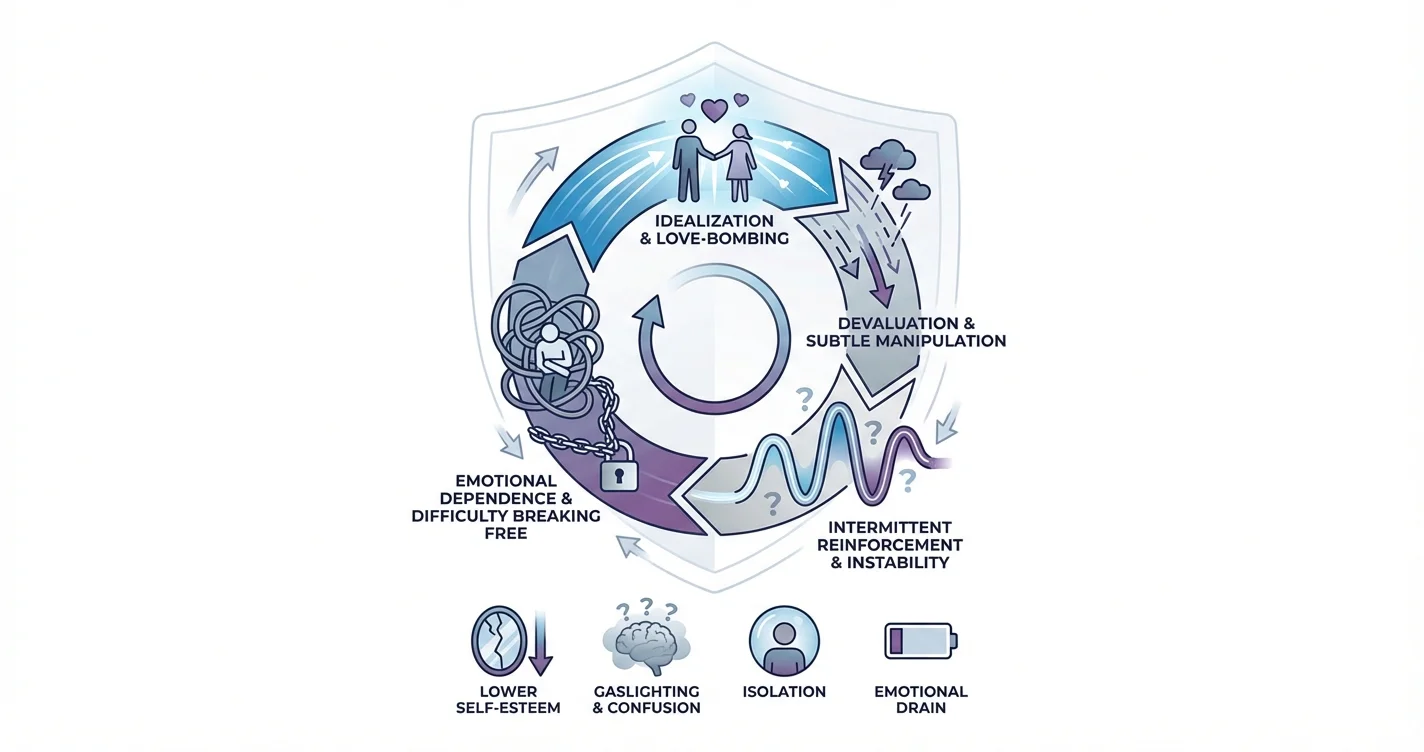
The Cycle of Narcissistic Abuse
Nothing happens by chance, and here is the cycle that leads to narcissistic abuse. It includes several stages.
Idealization and Love-Bombing Phase
At the beginning, the connection can feel unusually strong. This stage is often described as idealization, and it commonly includes love-bombing. The narcissistic partner shows intense attention and emotional availability. You feel as if fate brought you together with this person. Even though everything moves very fast, you feel adored and think everything is perfect.
Devaluation and Subtle Manipulation
After the first stage, the situation begins to change. Little by little, the abuser stops giving you compliments and starts using criticism and different kinds of manipulation. When you share your feelings about this, they may dismiss them by saying that you are imagining things and may even make you feel guilty for doubting them.
Intermittent Reinforcement and Emotional Instability
The narcissistic partner may alternate between warmth and distance. After a period of tension or criticism, positive behavior returns. This is not random. Behavioral research shows that unpredictable rewards create stronger attachment than consistent ones. Over time, the victim may start adjusting their behavior to maintain the “good” phase, often at the cost of their own needs.
Emotional Dependence and Difficulty Breaking Free
As the cycle repeats, its effects become more visible. The combination of idealization, manipulation, and inconsistency can lead to emotional dependence. Self-esteem may become tied to how stable the relationship feels. Decision-making becomes harder, and setting boundaries feels more difficult.
People often describe knowing something is wrong, but still feeling unable to leave. Not because they do not see the pattern, but because the emotional attachment has been reinforced over time.
Signs of Narcissistic Abuse
Below are the signs that tend to show up most consistently. They may not appear in this order and not all at once, but if you see even one of these signs, it is worth thinking that your relationship may not be developing in a healthy direction.
Self-Esteem Gradually Drops Without a Clear Reason
One of the strongest indicators is a slow but noticeable drop in self-esteem.
Research on emotional abuse shows that repeated invalidation can reduce self-confidence over time, even without direct insults. In one study on psychological abuse, participants reported up to a 30 to 40 percent increase in self-doubt after prolonged exposure to manipulative dynamics.
In real life, this often looks subtle. A person who used to make decisions easily starts second-guessing everything.
Gaslighting Makes You Question Your Own Reality
Gaslighting is one of the most documented patterns in this type of abuse. Clinical findings show that repeated gaslighting leads to measurable increases in confusion, anxiety, and reliance on the abuser’s version of events. Over time, this can affect memory confidence and decision-making.
A narcissistic partner may deny things that clearly happened or reframe them in a way that makes you doubt yourself. For example, a person recalls a specific conversation, and the narcissist responds calmly, “You’re overreacting.”
Unpredictable Shifts Between Attention and Distance
Research in behavioral psychology shows that intermittent reinforcement can create stronger emotional attachment than consistent behavior. Early experiments by psychologist B. F. Skinner demonstrated that rewards delivered unpredictably lead to stronger behavioral persistence than regular rewards.
Later research on relationships and reward systems has shown similar effects. Studies on romantic attachment found that uncertain or inconsistent partner behavior can increase emotional investment and dependency, because the brain begins to anticipate the return of positive interactions. Neuropsychology research links this pattern to the brain’s dopamine reward system, which reacts strongly to unpredictable rewards.
Rihanna and her past relationship with Chris Brown are a good example. In interviews, she described periods where the relationship shifted between intense affection and conflict. Psychologists often use similar cases to explain how alternating attention and distance can make it harder for someone to leave a harmful relationship.
You Feel Increasingly Isolated From Others
Isolation does not always happen directly. A narcissistic partner may not explicitly tell you to cut people off, but their behavior can lead to it.
Research on abusive relationships shows that gradual isolation is a common pattern. It often happens through criticism of your close relationships, creating tension around your time, or making you feel like others do not understand the relationship.
Setting Boundaries Feels Unusually Difficult
Studies in interpersonal psychology show that in an abusive relationship, attempts to set boundaries are often met with resistance or reinterpretation. In a relationship with this type of abusive partner, every time you try to set boundaries, they will act in a way that makes it hard for you to do it, and you will not blame them for it.
You Feel Emotionally Drained After Interactions
Sustained exposure to this type of abuse often leads to measurable emotional fatigue. Research shows that chronic relational stress increases cortisol levels and contributes to exhaustion, reduced focus, and lower emotional resilience. In simple terms, your system is under constant pressure.
In real life, this often shows up as feeling drained after conversations that did not seem intense on the surface. You may leave an interaction feeling confused, tired, or unsettled, without being able to point to a single clear reason.
What You Can Do If You Recognize These Signs?
If you notice some of the signs we listed above, it is important not to ignore them and to take steps that will help you move in a healthier direction.
Rebuild Trust in Your Own Perception
Gaslighting is something you may encounter often in this type of relationship. A study by psychologist Paige L. Sweet published in the journal American Sociological Review describes gaslighting as a systematic form of emotional manipulation used to make a partner doubt their own perception of reality. Surveys on intimate partner abuse also show that psychological manipulation and gaslighting are reported by about 40-60% of people who experience emotional abuse in relationships.
This dynamic can be observed in public cases as well. Britney Spears and her former partner Justin Timberlake. After their breakup in the early 2000s, public narratives and media framing led Spears to be portrayed negatively while her own perspective was minimized. In later interviews and documentaries, commentators often discussed how public and interpersonal dynamics around the relationship made her question how events were represented and perceived.
Because of this, it is important not to follow the gaslighting or the attempts to manipulate your perception of events. One helpful approach is to rely on facts. For example, you can:
- write down important conversations or events
- keep messages or other records
- check your perception with trusted friends or family
- remind yourself what actually happened instead of accepting someone else’s version of events
Shift From Individual Events to Pattern Recognition
Research in personality psychology, including work by W. Keith Campbell, shows that narcissistic behavior is consistent over time, even if individual interactions vary. This is why isolated events can be misleading. Instead of asking, “Was this moment bad enough?” it becomes more accurate to ask, “Is this pattern repeating?”
Do not look at just one event. Look at a pattern of repeated events so you can understand what kind of relationship you are in.
Set Boundaries
Boundaries in relationships are normal. It is important to discuss them and set them. If you see that your partner is not ready to respect them, it is a clear sign that the relationship is not healthy. A narcissist may try different ways to convince you not to set boundaries, but you should not follow this game.
Reintroduce External Reference Points and Self-Care
Abuse victims go through a very difficult experience. To feel normal again, it is important to create a safe and predictable environment and spend more time on yourself and your feelings. Small things like getting regular good sleep or doing pleasant activities can help you feel better.
A good example is actress Drew Barrymore. In interviews she has spoken about difficult relationships earlier in her life and how reconnecting with supportive people and focusing on her own well-being helped her rebuild stability.
Understand the Timeline of Breaking Free
One factor that makes leaving difficult is intermittent reinforcement. Early behavioral experiments by psychologist B. F. Skinner demonstrated that rewards delivered unpredictably create stronger behavioral persistence than consistent rewards. In relationship psychology, similar patterns appear when periods of affection are mixed with criticism or withdrawal. The brain becomes conditioned to seek the return of positive moments.
Research on relationship recovery also shows that clarity often develops over time. Studies on emotional abuse recovery suggest that when people reduce exposure to manipulation and increase external support, their ability to evaluate the relationship becomes more stable. Psychologist Lenore E. Walker, known for research on abuse cycles and trauma recovery, describes how recognition of unhealthy patterns often develops gradually rather than instantly.
Real-life examples often follow this same timeline. Singer Tina Turner described how her decision to leave musician Ike Turner was not sudden. Over time she began recognizing repeated patterns of control and abuse. As awareness grew, her decisions became less influenced by confusion and more by a clear evaluation of her situation.
When to Seek Support?
There is a point when trying to handle it on your own starts to cost you more than it helps. Here are some signs that it may be better to seek help:
- You no longer trust yourself
- Your life starts to revolve around managing the relationship, especially trying to avoid conflict
- You do not tell friends or family what is happening because your partner told you not to
This is where a support group or trusted external perspective can make a measurable difference. Being in an environment where your experience is validated helps rebuild confidence in your own perception and reduces the sense of confusion. If you feel like something is off, even if you cannot fully explain it, that is enough to take seriously.
How AI Support Helps You Heal
AI emotional support isn't about replacing human connection — it's about filling the gaps. The moments when you need to talk at 2 AM, when you don't want to burden your friends again, or when you simply need someone to listen without judgment.
Here's what happens in a typical Lovon session:
You share what's on your mind
There's no script, no intake form, no waiting room. You speak or type whatever you're feeling — in your own words, at your own pace.
Lovon validates and explores
Using frameworks from CBT (Cognitive Behavioral Therapy) and motivational interviewing, Lovon acknowledges your feelings first, then gently helps you explore them. No dismissive "just move on" advice.
You build coping skills together
Lovon doesn't just listen — it actively works with you on evidence-based techniques: thought reframing, urge surfing, behavioral experiments, and more.
What a Session with Lovon Looks Like

When to Seek Professional Help
AI support is a valuable tool, but it's not a replacement for professional care. Please consider reaching out to a licensed therapist if you experience any of the following:
- Persistent thoughts of self-harm or suicide
- Inability to perform daily activities (work, eating, sleeping) for more than 2 weeks
- Turning to alcohol or substances to cope
- Intense anger or desire to harm your ex-partner
- Complete emotional numbness that doesn't improve over time
Crisis Resources (US): If you're in immediate danger, call 988 (Suicide & Crisis Lifeline) or text HOME to 741741 (Crisis Text Line). Available 24/7, free, and confidential.
Outside the US? Find a crisis line in your country
Ready to Start?
Your healing journey can begin right now
A 7-day trial. No judgment. Just a safe space to process what you're going through.
Frequently Asked Questions
Q: What are the five main habits of a narcissist?
Q: How to handle a narcissistic abuser?
Q: What’s the difference between emotional abuse and narcissistic abuse?
Q: Can narcissistic abuse cause PTSD?
Q: Can narcissistic abuse cause depression?
Q: Is narcissistic abuse a crime in the UK?
About the Author

Mireya Tabasa
Mental Health Support Specialist & AI Advisor
Mireya Tabasa is a Mental Health Support Specialist working at the intersection of clinical care and technology. With over 4 years of hands-on experience supporting diverse populations facing mental health challenges in educational and healthcare settings, she brings frontline clinical insight to ev...
Related articles
- How to Heal from Emotionally Immature Narcissistic Parents Trauma
Healing from emotionally immature narcissistic parents trauma is a profound journey that requires more than willpower or…
- Future Faking in Relationships: Red Flags & Recovery 2026
Future faking in relationships means empty promises used to avoid real commitment. Learn the 2026 red flags…
- Covert Narcissist Signs & How to Protect Yourself 2026
Spot the 8 covert narcissist signs — victimhood, passive aggression, quiet envy — and follow 6 concrete steps to protect…
- Toxic Family Apology Dynamics: How to Navigate False Peace
Toxic family apology dynamics create a confusing emotional landscape where apologies serve to maintain control rather…
See also
Quizzes
- Are They a Red Flag? 10 Questions to Check Your Partner
Check your partner in 3 minutes.
- Is My Relationship Healthy? 15-Question Check-In
Check your relationship health in 3 minutes.
Free tools
- What Leaving Would Actually Take
Four short lists: money, a place, the shared things, and people. Mark each item sorted or not. You get the itemized…
- What to Say Back to a Hostile Co-Parent
A chat, not a form. Paste the message your ex sent about the kids, say what actually has to be decided, and you get a…
From the wiki
- How to leave a toxic relationship?
Leaving a toxic relationship is rarely a decision problem — you usually know. What stops you is that the pull toward…
Disclaimer: This article is for informational purposes only and does not constitute medical advice, diagnosis, or treatment. Always seek the advice of your physician or other qualified health provider with any questions you may have regarding a medical condition. If you are in crisis or think you may have an emergency, call 988 (Suicide & Crisis Lifeline) or go to the nearest emergency room. Outside the US? Find a crisis line in your country.