
Narcissistic Relationship: 9 Signs You're Dating a Narcissist
Most people do not know they are in a narcissistic relationship until they are already very involved.

Key Takeaways
- Narcissistic relationships often start with intense attention, which can be a red flag of manipulative behavior
- If you constantly feel not good enough, it may mean your partner uses manipulative tactics to control your self-esteem
- A lack of empathy and constant blame shifting are major red flags in toxic relationship patterns
- Feeling confused after arguments is often a sign of manipulative communication like gaslighting
Introduction
Most people do not know they are in a narcissistic relationship until they are already very involved. When they finally understand what is happening, it is already hard to leave. We will explain what to watch for in your partner’s behavior to avoid this kind of trap, and what to do if you realize you are in a relationship with a narcissist.
Narcissistic Personality Disorder: Who Are Narcissists, Really?
Narcissism is a personality trait that exists on a spectrum. Most people have some degree of it, and in moderate amounts, traits like confidence and self-assurance are healthy. The clinical concern begins when narcissistic tendencies cause harm to the person or to the people around them.
Narcissistic Personality Disorder, or NPD, is a clinical diagnosis defined in the DSM-5. People with this disorder share these characteristics:
- A grandiose sense of self-importance, often without the achievements to match it
- A need for constant admiration from others
- A preoccupation with fantasies of unlimited success or ideal love
- Arrogant, contemptuous behavior and attitudes
- A sense of entitlement: an expectation that others will automatically comply with their expectations
- A profound lack of empathy for others
- Exploitative behavior in relationships, using people to meet their own needs
- Envy of others, or a belief that others are envious of them
Signs of a Narcissistic Relationship: The Idealization and Devaluation Cycle
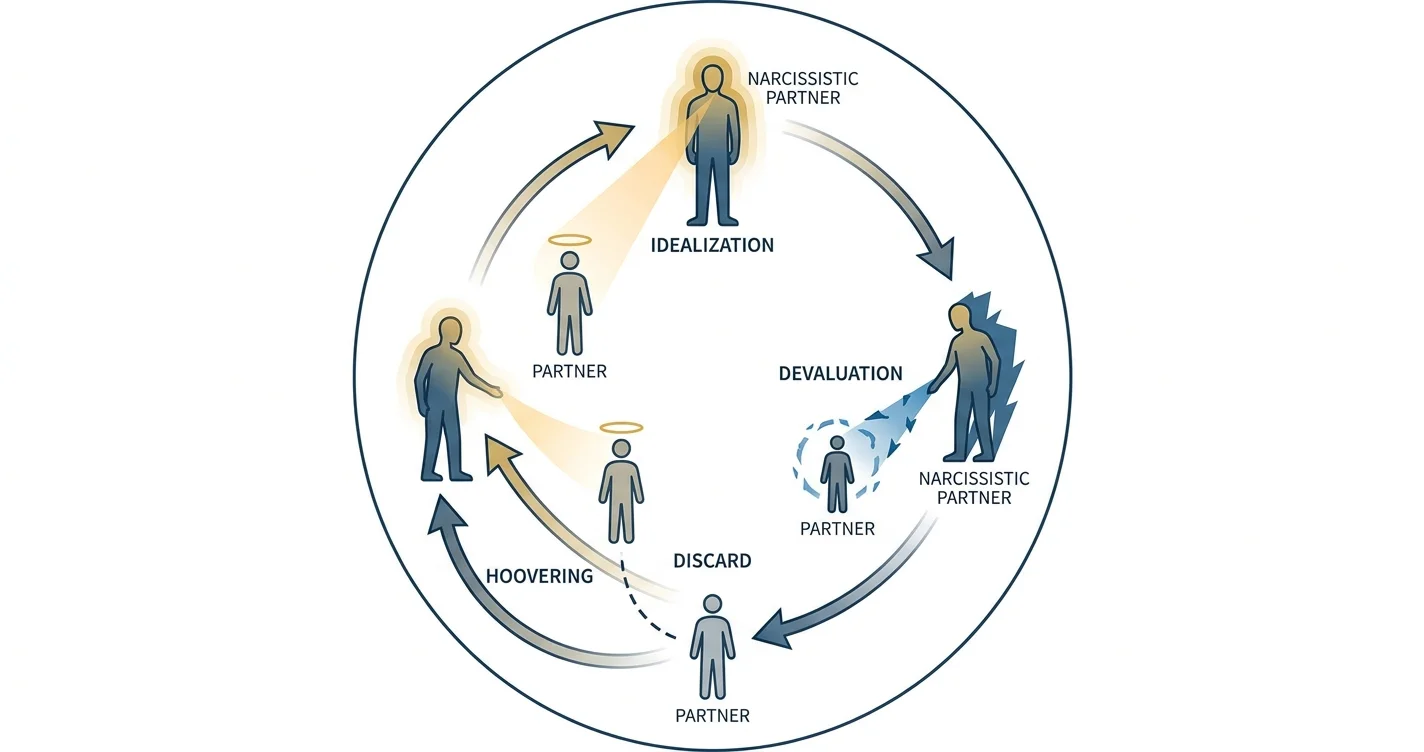
Before the signs, it helps to understand that the relationships with narcissistic people tend to follow an arc:
- Idealization: In the early phase, the narcissistic partner makes you feel exceptional. It creates a powerful bond that will be difficult to walk away from later, and it establishes a version of the relationship that you will spend the harder phases trying to return to.
- Devaluation: Once the narcissistic individual feels secure in your attachment, the negative aspects appear. You find yourself working harder to get back to how things felt at the beginning.
- Discard or hoovering: The relationship either ends, often abruptly and with the narcissist quickly moving to another partner, or the narcissist pulls you back in with a period of renewed idealization before the cycle begins again.
9 Signs You're in a Narcissistic Relationship
These signs can help you recognize unhealthy patterns.
Lack of Empathy for Others
Your partner is consistently unable or unwilling to acknowledge your emotional experience, particularly when it conflicts with their own needs or narrative. When you are upset, the conversation somehow becomes about them. When you are hurt by something they did, the response is irritation at being accused rather than concern about the impact.
The Relationship Began with Overwhelming Intensity
At the start of the relationship, it was very intense, and you felt very special and very loved. This intensity is one of the clearest early warning signs of narcissistic relationship patterns. The idealization phase is driven by the narcissist's need for admiration and validation rather than genuine knowledge of who you are.
You Rarely Feel like Enough
A narcissistic partner has a sense of self-importance that requires constant external reinforcement. You may work hard to earn approval and receive nothing, or receive praise that is quickly followed by a criticism that undoes it. Over time, many people in relationships with a narcissist describe a gradual erosion of confidence.
Manipulations in Conversations
Emotional manipulation in narcissistic relationships takes many forms, but the pattern has a recognizable quality: you enter conversations with a legitimate concern and exit them somehow feeling responsible for the problem you raised. Over time, you may stop raising concerns altogether because the cost of doing so is too high.
Your Sense of Self Has Shrunk
People who enter a narcissistic relationship with a clear sense of who they are often describe losing it gradually. Friendships are undermined. Opinions are dismissed or ridiculed until you stop volunteering them. The narcissistic individual needs to be the primary authority in the relationship, and a partner who has a strong, independent sense of self is a threat to that. By the time many people recognize the pattern, they have difficulty articulating what they actually want or value outside of the relationship.
Criticism Flows in One Direction Only
A narcissist may react to even mild, carefully delivered feedback with disproportionate anger or withdrawal. This reaction is genuine, because any suggestion of imperfection threatens the fragile self-structure beneath the grandiosity. The result in the relationship is an extreme asymmetry: your partner's grievances are treated as important and legitimate, while your concerns are dismissed, minimized, or turned back on you.
The Relationship Patterns Repeat, Regardless of Your Efforts
If you're in a relationship with someone exhibiting narcissistic behavior, you have probably tried to fix the dynamic. The problem is that the pattern returns regardless, because the pattern is not the result of a communication breakdown or a fixable misunderstanding. It is the result of a stable personality structure.
You Feel Responsible for Their Emotions But Not Entitled to Your Own
In a healthy relationship, both people are responsible for managing their own emotional states while remaining caring toward each other. In a narcissistic relationship, your partner's moods, reactions, and wellbeing are treated as your responsibility. Your own emotional needs are treated as inconvenient, excessive, or evidence of a character flaw.
You Are Emotionally Drained on a Consistent Basis
Being in a relationship with a narcissist brings the depletion that comes from being constantly monitored for compliance, never quite knowing which version of your partner you will encounter, and spending mental energy managing someone else's emotional state.
Narcissistic Traits vs. Narcissistic Personality Disorder
The distinction matters for several reasons:
| Narcissistic traits | Narcissistic Personality Disorder | |
|---|---|---|
| Flexibility | Behavior may shift with circumstances or feedback | Pattern is rigid and pervasive across situations |
| Response to feedback | May be able to hear and integrate criticism | Typically reacts with rage or denial |
| Empathy | Inconsistent | Very limited |
| Change potential | More possible with willingness | Requires long-term therapeutic work |
| Impact on relationship | May be workable | Typically produces ongoing harm |
Narcissistic Abuse: What It Does to You Over Time?
Common effects you should know:
- Depression and a pervasive sense of worthlessness
- Difficulty trusting your own perception
- Social isolation
- Chronic anxiety rooted in the hypervigilance
- Difficulty leaving the relationship
- Symptoms consistent with complex PTSD in longer or more intense relationships
Gaslighting in a Narcissistic Relationship
Gaslighting is a form of manipulation in which the narcissistic partner causes you to question your own memory and sense of reality. It works gradually and it targets the one thing that would allow you to accurately assess the situation: your trust in your own mind.
Common gaslighting phrases in a narcissistic relationship include:
- "That never happened."
- "You are too sensitive."
- "You always twist what I say."
- "Everyone thinks you are overreacting."
- "I would never say something like that. You are imagining things."
How to Deal with a Narcissist?
If you are currently in a relationship with a narcissist, these are the approaches that tend to be genuinely useful:
- Reconnect with people outside the relationship
- Keep a private record of conversations and incidents
- Stop trying to out-argue or explain your way to accountability. People with NPD do not engage in conflict to reach the truth. They engage to maintain their narrative and self-worth
- Work with a therapist, independently. Not couples therapy, at least not as a first step
- Consider what leaving the relationship would actually require
Developing Healthier Relationship Patterns after Narcissistic Abuse
People who have experienced narcissistic abuse often find themselves:
- Drawn to similar dynamics in subsequent relationships because familiarity feels like safety
- Struggling to recognize healthy relationship patterns because the baseline has shifted
- Hypervigilant in new relationships, reading threat where there is none
- Deeply uncertain about their own worth and what they are entitled to expect from a partner
Developing healthier relationship patterns requires time, self-awareness, and usually professional support. The goal is to rebuild a sense of self that is stable enough to recognize the difference between a relationship that challenges you and one that diminishes you. Therapy, particularly trauma-informed approaches and attachment-focused work, is the most reliable path through this.
When to Seek Help?
Please consider speaking with a mental health professional if:
- You recognize the signs described in this article in your current relationship
- You feel afraid of your partner's reactions to your feelings, needs, or choices
- Your self-esteem has declined significantly since the relationship began
- You are experiencing anxiety, depression, or symptoms of trauma
- You are unsure whether what you are experiencing qualifies as an abusive relationship
- You have tried to leave and found it more difficult than expected
Lovon connects you with private, judgment-free support from licensed mental health professionals, available when you need it. You do not need to have everything figured out before reaching out. A first conversation is enough.
Sources and Further Reading
We used these sources to create this article and help you feel better. You can explore them to get a deeper understanding of the topic:
- Narcissistic Personality Disorder overview. Psychology Today
- Narcissistic abuse resources. National Domestic Violence Hotline
- The Gaslight Effect. Morgan Road Books
- Diagnostic and Statistical Manual of Mental Disorders, Fifth Edition (DSM-5). APA Publishing
How AI Support Helps You Heal
AI emotional support isn't about replacing human connection — it's about filling the gaps. The moments when you need to talk at 2 AM, when you don't want to burden your friends again, or when you simply need someone to listen without judgment.
Here's what happens in a typical Lovon session:
You share what's on your mind
There's no script, no intake form, no waiting room. You speak or type whatever you're feeling — in your own words, at your own pace.
Lovon validates and explores
Using frameworks from CBT (Cognitive Behavioral Therapy) and motivational interviewing, Lovon acknowledges your feelings first, then gently helps you explore them. No dismissive "just move on" advice.
You build coping skills together
Lovon doesn't just listen — it actively works with you on evidence-based techniques: thought reframing, urge surfing, behavioral experiments, and more.
What a Session with Lovon Looks Like

When to Seek Professional Help
AI support is a valuable tool, but it's not a replacement for professional care. Please consider reaching out to a licensed therapist if you experience any of the following:
- Persistent thoughts of self-harm or suicide
- Inability to perform daily activities (work, eating, sleeping) for more than 2 weeks
- Turning to alcohol or substances to cope
- Intense anger or desire to harm your ex-partner
- Complete emotional numbness that doesn't improve over time
Crisis Resources (US): If you're in immediate danger, call 988 (Suicide & Crisis Lifeline) or text HOME to 741741 (Crisis Text Line). Available 24/7, free, and confidential.
Outside the US? Find a crisis line in your country
Ready to Start?
Your healing journey can begin right now
1 free conversation. No credit card. No judgment. Just a safe space to process what you're going through.
Frequently Asked Questions
Q: Can someone with narcissistic personality disorder genuinely love their partner?
Q: Why do people with NPD need constant admiration?
Q: Is it possible to have a healthy relationship with someone who has narcissistic traits?
Q: Why is leaving a narcissistic relationship so difficult?
Q: What is the difference between a narcissistic relationship and a relationship that is simply going through a difficult period?
Q: Should I suggest therapy to my narcissistic partner?
Q: How do I know if I am recovering from narcissistic abuse or just missing the relationship?
About the Author

Mireya Tabasa
Mental Health Support Specialist & AI Advisor
Mireya Tabasa is a Mental Health Support Specialist working at the intersection of clinical care and technology. With over 4 years of hands-on experience supporting diverse populations facing mental health challenges in educational and healthcare settings, she brings frontline clinical insight to ev...
Related articles
- How to Set Boundaries With a Narcissist (2026 Guide)
Learn how to set boundaries with a narcissist without conflict: scripted language, the gray rock method, and…
- How to Heal from Emotionally Immature Narcissistic Parents Trauma
Healing from emotionally immature narcissistic parents trauma is a profound journey that requires more than willpower or…
- 10 Signs of a Toxic Relationship to Check in 2026
Signs of a toxic relationship include control, gaslighting, and apology cycles with no change. Run these 10 checks now…
- Recognizing Narcissistic Abuse Patterns in Relationships
Narcissistic abuse patterns represent a constellation of manipulative behaviors that systematically undermine a person's…
See also
Quizzes
- Are They a Red Flag? 10 Questions to Check Your Partner
Check your partner in 3 minutes.
- Is My Relationship Healthy? 15-Question Check-In
Check your relationship health in 3 minutes.
Free tools
- How to Respond to a Narcissist
Paste what they said. You get the part that actually needs answering separated from the part designed to pull you in, a…
- What Leaving Would Actually Take
Four short lists: money, a place, the shared things, and people. Mark each item sorted or not. You get the itemized…
Disclaimer: This article is for informational purposes only and does not constitute medical advice, diagnosis, or treatment. Always seek the advice of your physician or other qualified health provider with any questions you may have regarding a medical condition. If you are in crisis or think you may have an emergency, call 988 (Suicide & Crisis Lifeline) or go to the nearest emergency room. Outside the US? Find a crisis line in your country.