
Trauma Dump: Emotional Dumping, Oversharing & How It Harms Your Mental Health
When a person goes through traumatic events, it is natural to share them with someone. But there is a big difference between healthy sharing and trauma...

Key Takeaways
- Trauma dumping looks like sharing personal trauma without consent or awareness of how it affects the other person
- Sharing their story becomes unhealthy when it is one-sided, repeated, and not leading to real emotional processing
- Without support, sharing personal trauma this way can harm both the person speaking and the listener
Introduction
When a person goes through traumatic events, it is natural to share them with someone. But there is a big difference between healthy sharing and trauma dumping, which can prevent a person from moving forward.
What Is Trauma Dumping, and How Is It Different from Venting?
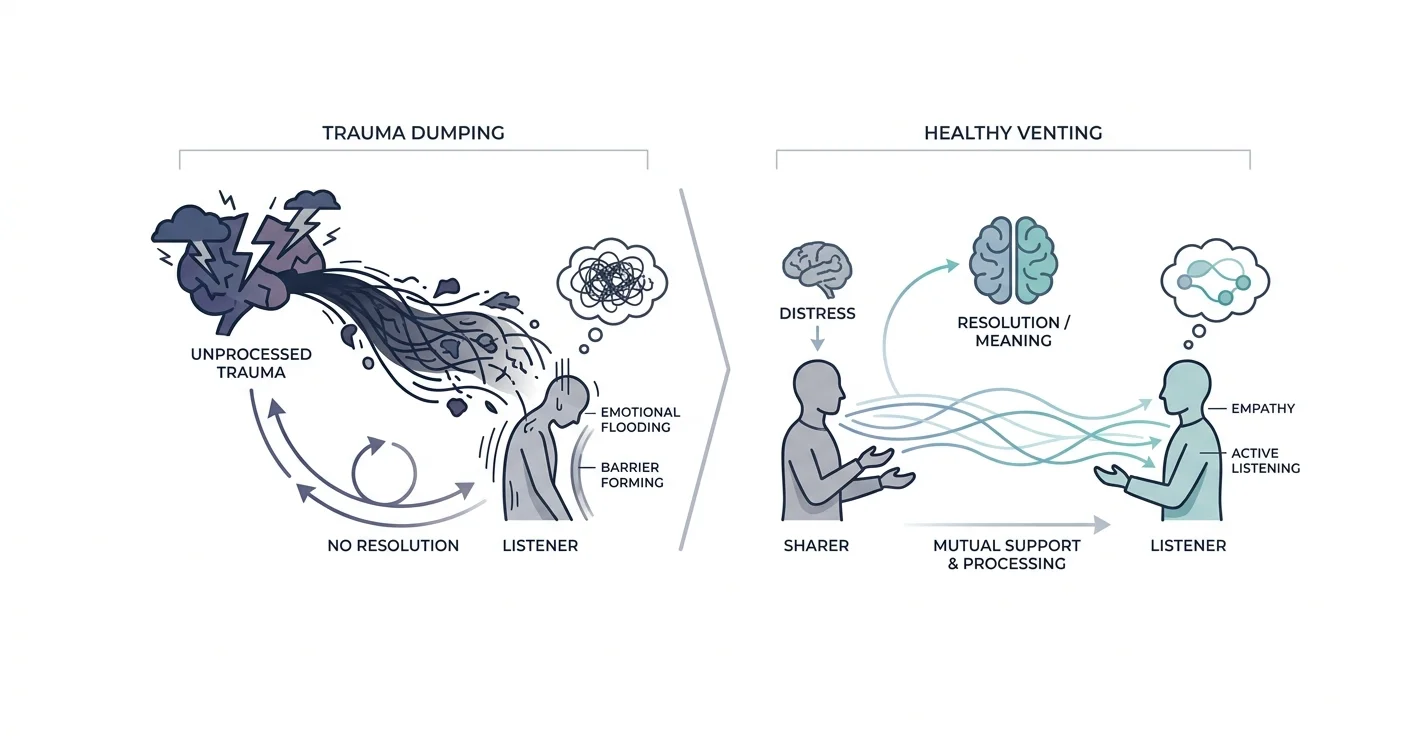
Healthy venting is a useful part of processing difficult experiences. You share something that is bothering you with someone who has the capacity to listen and the exchange feels mutual even if you are the one doing most of the talking.
Trauma dumping occurs when an individual unloads traumatic or highly distressing content onto another person without considering the impact on that person and often repeatedly and without resolution.
The key distinction in venting and trauma dumping is the quality of the exchange and the awareness of the person sharing.
Trauma Dump vs. Healthy Venting
| Healthy venting | Trauma dumping | |
|---|---|---|
| Consent | Listener is asked or context is appropriate | Dumping occurs without warning or consideration |
| Awareness | Person sharing is aware of the listener's state | Person sharing is focused only on their own relief |
| Reciprocity | Some mutuality | Consistently one-sided across interactions |
| Resolution | Sharing moves toward meaning or relief | Sharing cycles without resolution |
| Frequency | Occasional and contextual | Repeated, often compulsive |
| Effect on listener | Listener feels trusted and able to help | Person on the receiving end feels depleted or overwhelmed |
| Effect on sharer | Genuine relief | Temporary relief followed by the same distress |
Why People Trauma Dump: Understanding the Trauma Response
When a person has experienced a traumatic event or has unprocessed childhood trauma, the distress can feel constant and urgent. Talking about it can give temporary relief. Other contributing factors include:
- Mental health conditions that affect emotional regulation, including PTSD, borderline personality disorder, anxiety, and depression
- A history in which emotional expression was only possible in a flooding, unregulated way, often because that was what was modeled
- Lack of access to professional help or mental health care
- Social media cultures that normalize oversharing as authenticity
- Genuine isolation, in which the only available listener is whoever will stay
Signs of Trauma Dumping: How to Recognize It in Yourself?
Self-awareness is the first step in addressing the pattern. Signs of trauma dumping include behaviors that are often easier to see in retrospect than in the moment:
- You regularly share distressing content from your past trauma without checking whether the other person has the capacity to receive it right now
- You feel temporarily relieved after sharing but find the same material surfacing again quickly, without anything having shifted
- You notice that conversations about your experiences tend to be one-sided, with the listener mostly absorbing rather than contributing
- People in your life have created distance, and you suspect it may be connected to the emotional weight of your sharing
- You share highly personal or traumatic content in contexts where it is not appropriate
- You are sharing the same traumatic content repeatedly without it feeling any less painful each time
Dumping on Social Media
Trauma dumping on social media needs special attention because it includes several factors that make it more problematic: there is no specific person who agreed to listen, the audience can be very large, social platforms encourage attention-seeking behavior, and there is no real personal connection that makes sharing truly helpful.
The feedback loops of social media, in which distressing content often generates more engagement than measured content, can also reinforce trauma dumping as a coping mechanism, creating a pattern in which the person sharing receives enough short-term validation to continue without ever addressing the underlying distress.
Effects of Trauma Dumping: What It Does to Both People?
Trauma dumping can overwhelm both sides, leaving one person drained and the other feeling exposed or misunderstood. Here is how it impacts each of you.
Effects on the Trauma Dumper
The temporary relief of unloading does not integrate the traumatic experience. The distress returns, often intensified by shame about the dumping itself. Over time, relying on trauma dumping as a coping mechanism can actually prevent genuine healing by substituting the appearance of processing for the real thing. Trauma dumping may also push people away, gradually reducing the social support that the person genuinely needs.
Effects on the Listener
The person on the receiving end of regular trauma dumping is at genuine risk of secondary trauma, sometimes called vicarious trauma or compassion fatigue. Secondary trauma refers to the psychological impact of being repeatedly exposed to someone else's trauma, and it produces symptoms that can closely resemble those of direct trauma exposure: hypervigilance, intrusive thoughts, emotional numbing, and exhaustion.
Someone's trauma dumping can be particularly harmful when the listener does not have the training or emotional resources to process what they are receiving. The therapeutic relationship works in part because the therapist has training and their own support systems to process what they receive.
Push People Away: How Trauma Dumping Damages Relationships?
The dynamic typically unfolds gradually. The listener begins with genuine care and sympathy. Over time, as the sharing becomes repetitive, one-sided, and without apparent movement toward resolution, the listener starts to feel overwhelmed. They may pull back from contact, become less available, or respond with less warmth. The person trauma dumping often senses this withdrawal and either escalates the sharing in an attempt to reestablish connection, or interprets the distance as confirmation that they are fundamentally too much for people to handle.
Healthy boundaries in relationships require that both people's needs and limits are respected. Trauma dumping, by its nature, does not account for the listener's capacity or wellbeing. Over time, this erodes even strong relationships and leaves the person sharing in a more isolated position than before.
Signs You Might Be on the Receiving End: Secondary Trauma and Healthy Boundaries
Signs that you may be experiencing secondary trauma or compassion fatigue from someone's trauma dumping include:
- You feel emotionally depleted after interactions with this person, in a way that does not resolve quickly
- You find yourself dreading contact because you anticipate being overwhelmed
- You have begun to experience intrusive thoughts related to the content they have shared with you
- Your own emotional functioning has been affected
- You feel responsible for the other person's wellbeing in a way that feels unsustainable
- You have tried gently to set limits and been met with guilt-tripping or escalation
Stop Trauma Dumping: How to Address the Pattern in Yourself?
Recognizing that you may be trauma dumping is not a reason for shame. It is a reason for a different kind of support. Here is what actually helps.
Work with a Mental Health Professional
A therapist provides a safe and supportive space in which you can actually process trauma. Trauma therapy approaches including EMDR, trauma-focused cognitive behavioral therapy, and somatic approaches are specifically designed to help integrate traumatic experiences.
The therapeutic relationship is also structurally different from friendship: the therapist is trained to receive difficult material, has their own support and supervision, and is not at risk of secondary trauma in the way a friend is. .
Develop Awareness of Consent and Context Before Sharing
Before sharing difficult material, pause to consider: does this person have the capacity to hear this right now? Is this context appropriate for what I am about to share? Have I asked rather than assumed? This is about bringing the listener into the equation.
Distinguish Between Sharing for Connection and Sharing for Relief
Ask yourself what you actually need in this moment. If the answer is genuine connection and the presence of someone who cares, a more measured form of sharing can meet that need. If the answer is to unload because the pressure has become unbearable, that is a signal that the distress needs professional support.
Build a Broader Support Network
Trauma dumping often intensifies when one person is carrying the entire weight of someone's emotional needs. Developing multiple sources of support, including professional help and a range of relationships, reduces the pressure on any single person and reduces the likelihood of flooding any single relationship.
Learn to Sit with Distress Long Enough to Bring It Somewhere Useful
One of the skills that trauma therapy builds is the capacity to tolerate distress without immediately needing to expel it. This is called distress tolerance, and it is a learnable skill. Developing it means building enough capacity to bring your experience to an appropriate context rather than the first available listener.
Process Trauma in a Safe Space
Sharing difficult experiences in a way that is mutual, consensual, contextually appropriate, and oriented toward meaning and connection is genuinely valuable. Here is what that looks like in practice:
- You ask before sharing: "I am going through something difficult. Is this a good time to talk?"
- You are aware of the other person's capacity and check in during the conversation
- You are sharing to feel less alone, not to transfer the distress
- The sharing has some relationship to resolution, even if that resolution is simply feeling heard
- You reciprocate: you are also present for the other person's experience, not only your own
- You are working with a professional for the deeper material, and social relationships carry a smaller, more sustainable portion of the load
When to Seek Professional Help?
Please consider reaching out to a mental health professional if:
- You recognize a pattern of trauma dumping in yourself and want to address it
- You have been on the receiving end of someone's trauma dumping and are experiencing symptoms of secondary trauma
- You have past trauma or childhood trauma that has not been adequately addressed and continues to affect your daily life and relationships
- You feel overwhelmed by distress that you cannot seem to move through regardless of how much you talk about it
- Your relationships are being affected by patterns connected to unprocessed trauma
Lovon connects you with private, judgment-free mental health support from licensed professionals, available when you need it. Whatever you are carrying, you do not have to keep unloading it onto the people closest to you. There is a better way through.
Sources and Further Reading
We used these sources to create this article and help you feel better. You can explore them to get a deeper understanding of the topic:
- Trauma and its effects. American Psychological Association.
- Coping with traumatic events. National Institute of Mental Health.
- Eye Movement Desensitization and Reprocessing (EMDR) Therapy. Guilford Press.
How AI Support Helps You Heal
AI emotional support isn't about replacing human connection — it's about filling the gaps. The moments when you need to talk at 2 AM, when you don't want to burden your friends again, or when you simply need someone to listen without judgment.
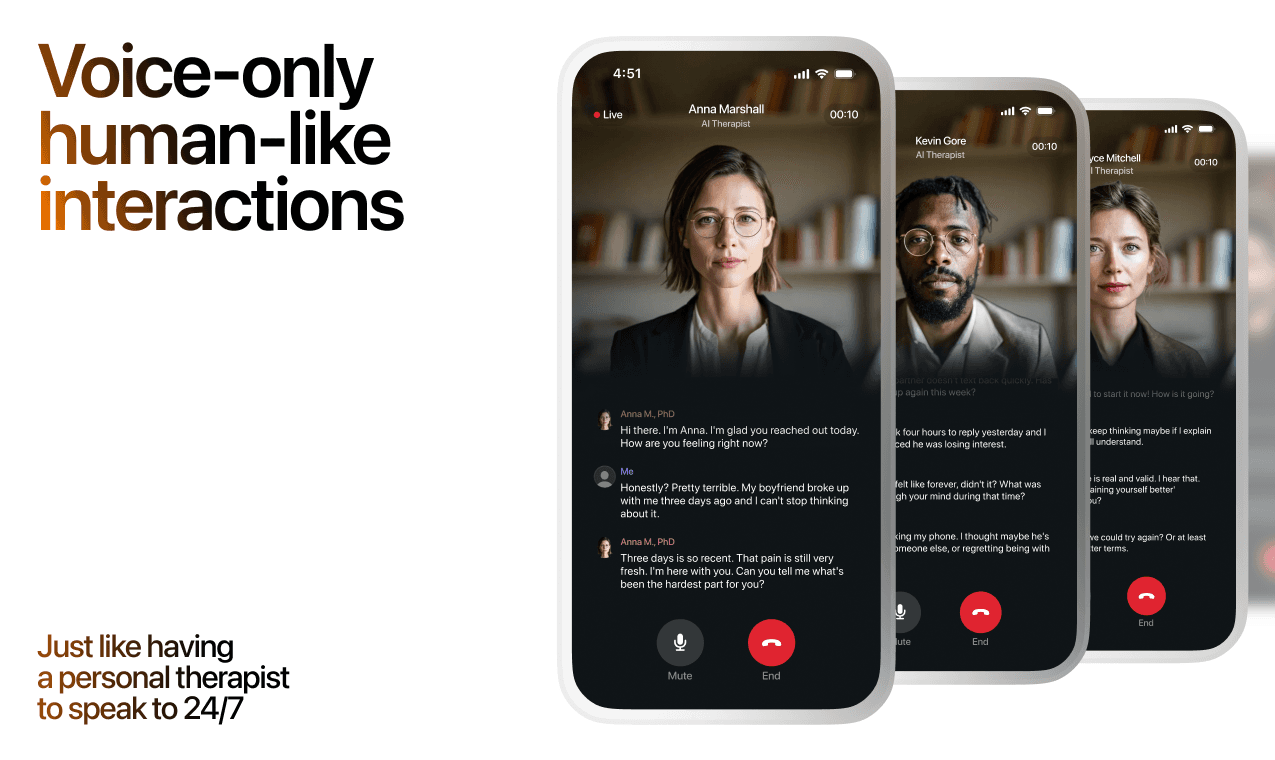
Here's what happens in a typical Lovon session:
You share what's on your mind
There's no script, no intake form, no waiting room. You speak or type whatever you're feeling — in your own words, at your own pace.
Lovon validates and explores
Using frameworks from CBT (Cognitive Behavioral Therapy) and motivational interviewing, Lovon acknowledges your feelings first, then gently helps you explore them. No dismissive "just move on" advice.
You build coping skills together
Lovon doesn't just listen — it actively works with you on evidence-based techniques: thought reframing, urge surfing, behavioral experiments, and more.
What a Session with Lovon Looks Like
When to Seek Professional Help
AI support is a valuable tool, but it's not a replacement for professional care. Please consider reaching out to a licensed therapist if you experience any of the following:
- Persistent thoughts of self-harm or suicide
- Inability to perform daily activities (work, eating, sleeping) for more than 2 weeks
- Turning to alcohol or substances to cope
- Intense anger or desire to harm your ex-partner
- Complete emotional numbness that doesn't improve over time
Crisis Resources (US): If you're in immediate danger, call 988 (Suicide & Crisis Lifeline) or text HOME to 741741 (Crisis Text Line). Available 24/7, free, and confidential.
Outside the US? Find a crisis line in your country
Ready to Start?
Your healing journey can begin right now
1 free conversation. No credit card. No judgment. Just a safe space to process what you're going through.
Frequently Asked Questions
Q: Is trauma dumping always harmful, or can it sometimes be helpful?
Q: How do I tell a friend that they are trauma dumping without damaging the relationship?
Q: Can trauma dumping happen in therapy?
Q: Why does trauma dumping feel so relieving in the moment if it does not actually help?
Q: Is there a connection between trauma dumping and social media use?
Q: What is the difference between trauma dumping and legitimate advocacy or awareness-raising about difficult experiences?
Q: How long does it take to stop trauma dumping once you recognize the pattern?
About the Author

Mireya Tabasa
Mental Health Support Specialist & AI Advisor
Mireya Tabasa is a Mental Health Support Specialist working at the intersection of clinical care and technology. With over 4 years of hands-on experience supporting diverse populations facing mental health challenges in educational and healthcare settings, she brings frontline clinical insight to ev...
Related articles
- Confirmation Bias in Low Self-Awareness: Agreement Over Understanding
When someone struggles with low self-awareness, they often develop a predictable pattern: they seek out people who will…
- PTSD vs CPTSD — Symptom Categories and Trauma Exposure Patterns
When someone experiences trauma, the psychological impact can manifest in different ways depending on the nature and…
- How to Manage Exam Anxiety Before a Big Test (2026)
How to manage exam anxiety before a big test in 2026: 7 steps, breathing techniques, and what to do when your mind goes…
- OCPD vs OCD: Key Differences & Treatment (2026)
OCPD and OCD look similar but need different treatment. Learn the core differences, the ego-syntonic test, and the right…
See also
Quizzes
- Shame Test: Do You Read Mistakes as Verdicts?
See which exit your shame takes, in 3 minutes.
- Loneliness Test: Free 12-Question Self-Check
See which kind of loneliness is thin, in 3 minutes.
Free tools
- Am I Overreacting, or Is This a Big Deal?
A chat for the small thing you cannot stop turning over. Say what happened and what you have already told yourself about…
- Vent to Someone
Say the whole thing. It does not have to be fair or organized, you will not have to manage how it lands, and no advice…
Disclaimer: This article is for informational purposes only and does not constitute medical advice, diagnosis, or treatment. Always seek the advice of your physician or other qualified health provider with any questions you may have regarding a medical condition. If you are in crisis or think you may have an emergency, call 988 (Suicide & Crisis Lifeline) or go to the nearest emergency room. Outside the US? Find a crisis line in your country.