
Understanding the Inner Child Therapy Approach for Emotional Healing
The Inner Child Therapy approach has emerged as a powerful framework for addressing how early experiences continue to influence adult emotional life.

Key Takeaways
- Constant scanning for signs of others' emotional states and adjusting behavior accordingly
- Difficulty identifying their own needs and preferences separate from others' expectations
- Intense fear of conflict or disapproval leading to chronic accommodation
- Alternating between emotional shutdown and overwhelming intensity
- Persistent sense of unsafety even in objectively secure situations
Introduction
The Inner Child Therapy approach has emerged as a powerful framework for addressing how early experiences continue to influence adult emotional life. Unlike traditional talk therapy that focuses primarily on recounting events, this approach emphasizes the emotional impact of childhood experiences and how they shape current patterns of anxiety, hypervigilance, people-pleasing, and emotional shutdown. Mental health practitioners increasingly recognize that healing doesn't happen through logical analysis alone—it requires engaging with the emotional and physiological responses stored in the nervous system from early developmental periods. This article examines the core principles of the Inner Child Therapy approach, the science behind its effectiveness, and practical applications for those seeking to understand their emotional responses.
The Core Framework of Inner Child Therapy
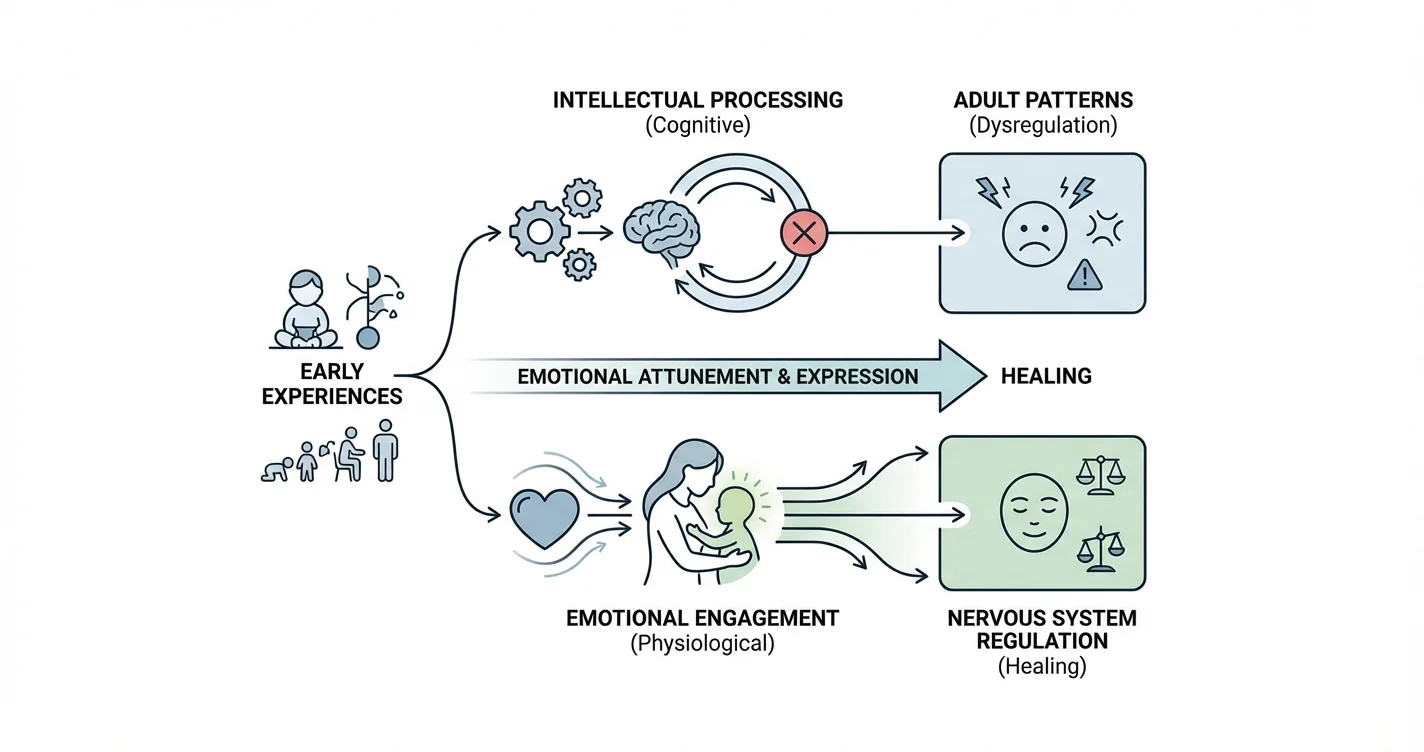
The Inner Child Therapy approach operates on the understanding that childhood experiences, particularly those involving emotional unpredictability or inadequate attunement, are registered by the developing nervous system as threats to safety. This isn't about dramatic trauma alone—research in developmental psychology suggests that consistent patterns of emotional unavailability, dismissiveness, or unpredictability can have profound effects on how the nervous system learns to regulate emotions.
When practitioners work with the Inner Child Therapy approach, they shift focus from cognitive understanding to emotional expression. Many adults raised by emotionally immature or inconsistent caregivers spend years replaying childhood stories, trying to understand what happened through logic and narrative coherence. However, this intellectual processing often leaves people feeling stuck, because the original wound wasn't primarily cognitive—it was emotional and physiological.
The approach recognizes that healing requires accessing and expressing the feelings that were unsafe to experience during childhood. This includes not just identifying emotions intellectually, but actually feeling and naming them in a supported context where the nervous system can begin to recognize safety. According to research in affective neuroscience, the process of naming emotions—sometimes called "affect labeling"—appears to reduce activation in emotional processing centers while increasing activity in regulatory regions of the brain.
How Early Experiences Shape Adult Emotional Patterns
Children depend on caregivers not just for physical needs but for co-regulation—the process through which a calm, attuned adult helps a child's nervous system learn to manage intense emotions. When this co-regulation is inconsistent or absent, children develop alternative strategies to manage emotional overwhelm. These adaptations, while protective in childhood, often manifest in adulthood as anxiety, people-pleasing, chronic hypervigilance, difficulty setting boundaries, or emotional numbing.
Practitioners working with the Inner Child Therapy approach observe that adults from emotionally unpredictable environments often share common patterns:
- Constant scanning for signs of others' emotional states and adjusting behavior accordingly
- Difficulty identifying their own needs and preferences separate from others' expectations
- Intense fear of conflict or disapproval leading to chronic accommodation
- Alternating between emotional shutdown and overwhelming intensity
- Persistent sense of unsafety even in objectively secure situations
These patterns aren't character flaws or personal failures—they're adaptive responses that made sense in contexts where emotional expression was met with dismissal, criticism, or inconsistent responses. The nervous system learned that suppressing needs and maintaining hypervigilance were necessary for psychological survival. The Inner Child Therapy approach works to create new experiences where expressing emotions is met with consistent attunement, gradually teaching the nervous system that emotional expression can be safe.
The Process of Emotional Attunement in Inner Child Work
The therapeutic mechanism at the heart of the Inner Child Therapy approach is emotional attunement—the experience of having feelings recognized, validated, and held without judgment or correction. This differs fundamentally from explanation or reassurance. When someone shares a difficult childhood experience, the instinct is often to explain why it happened or reassure them it's over. However, these responses can inadvertently bypass the emotional healing that needs to occur.
Effective Inner Child Therapy involves several key elements:
Creating safety for emotional expression: The nervous system needs to experience that expressing previously forbidden emotions won't result in rejection, criticism, or overwhelm. This happens gradually through consistent, attuned responses.
Naming and validating feelings: Rather than analyzing events, practitioners help clients identify and name the specific emotions connected to experiences—not just "it was hard" but "I felt terrified and alone, and I didn't know if anyone would help me."
Distinguishing past from present: The approach helps differentiate between the child's experience ("I was unsafe and needed protection I didn't receive") and the adult's current reality ("I can now provide myself with safety and make different choices").
Building self-attunement capacity: Over time, individuals learn to offer themselves the emotional recognition they needed but didn't receive, developing internal capacity for regulation rather than remaining dependent on external validation.
Some people find that on-demand support tools like Lovon.app can provide a space to practice naming emotions and processing experiences between therapy sessions, particularly when working through patterns that arise in daily life. The key is consistent practice in environments where emotional expression is met with attunement rather than dismissal.
Practical Application: Working with Inner Child Responses
Understanding the Inner Child Therapy approach conceptually differs from applying it to actual emotional responses. When someone experiences a strong reaction that seems disproportionate to the current situation—intense anxiety before a routine meeting, overwhelming hurt from mild criticism, or sudden emotional shutdown during conflict—this often signals that an inner child response has been activated.
The practical application involves several steps:
Recognize the activation: Notice when your emotional response seems larger than the situation warrants, or when you suddenly feel very young or helpless. Physical sensations often accompany these moments—tightness in the chest, difficulty breathing, or feeling frozen.
Create space and safety: Rather than pushing through the emotion or trying to logic yourself out of it, pause if possible. The nervous system needs to experience that you're not ignoring the distress signal.
Identify the feeling beneath the reaction: Ask what emotion is present—fear, shame, loneliness, anger—and where you might have felt this way as a child. Not as an intellectual exercise, but genuinely connecting with the emotion.
Offer what was needed then: This might be internal dialogue acknowledging the feeling ("It makes sense you're scared—this situation reminds your nervous system of times when you weren't protected"), or concrete actions that demonstrate safety now ("I can choose to leave this situation," "I can ask for what I need").
Notice what's different now: Gently reinforce that while the feeling is familiar from childhood, your current circumstances and capacities are different.
This process isn't about eliminating emotional responses or "fixing" the inner child. It's about developing a relationship with these parts of yourself that's characterized by attunement and compassion rather than criticism or suppression. Many practitioners emphasize that this is skill-building work—the first attempts may feel awkward or inaccessible, but capacity develops with repeated practice.
Integration with Other Therapeutic Approaches
The Inner Child Therapy approach often works synergistically with other evidence-based methods. Cognitive approaches can help identify thought patterns that maintain old protective strategies, while the Inner Child framework addresses the emotional and nervous system components that cognitive work alone may not reach. Somatic therapies complement Inner Child work by focusing on the body's stored responses and building capacity for physical regulation.
Some practitioners integrate attachment theory with Inner Child work, helping clients understand how early relational patterns created specific attachment styles and how these continue to influence current relationships. Others combine it with parts work approaches, recognizing that the "inner child" is one of several psychological parts that developed to navigate early experiences.
Research in neuroplasticity suggests that the nervous system retains capacity for change throughout life—early patterns aren't permanent, though they can be deeply ingrained. The Inner Child Therapy approach leverages this neuroplasticity by creating new emotional experiences that can gradually update old threat responses. This process typically requires time and consistency; practitioners note that expecting rapid transformation often leads to discouragement when changes unfold more gradually.
For those exploring this work, platforms like Lovon.app can offer accessible opportunities to practice emotional expression and self-attunement outside traditional therapy hours, particularly when working through relational patterns or preparing for difficult conversations. However, this type of support works best as part of a broader approach to emotional wellbeing rather than as a standalone solution.
When to Seek Professional Support for Inner Child Work
While understanding the Inner Child Therapy approach can support personal growth, certain situations call for working with a trained mental health professional. If childhood experiences involved significant trauma, abuse, or neglect, exploring these memories can activate intense emotions that benefit from professional guidance. Signs that professional support would be valuable include:
- Emotional responses that significantly interfere with daily functioning, relationships, or work
- Experiences of dissociation, feeling disconnected from reality, or losing time
- Persistent depression, anxiety, or other mental health concerns
- Thoughts of self-harm or difficulty maintaining safety
- History of complex trauma or ongoing PTSD symptoms
- Difficulty regulating emotions even after attempting self-directed approaches
Professionals specializing in trauma-informed therapy, attachment-focused approaches, or specifically in Inner Child work can provide structured support for this process. They can help navigate intense emotions safely, identify patterns you might not recognize alone, and offer tools tailored to your specific history and nervous system responses.
It's important to recognize that while emerging research suggests promising outcomes for approaches focusing on emotional processing and nervous system regulation, individual experiences vary considerably. What facilitates healing for one person may not work identically for another, and the timeline for emotional healing differs significantly between individuals based on numerous factors including the nature of early experiences, current support systems, and individual resilience factors.
Conclusion
The Inner Child Therapy approach offers a framework for understanding how early emotional experiences continue to influence adult life through nervous system patterns rather than just cognitive beliefs. By shifting from intellectual analysis to emotional attunement, this approach addresses the root of many persistent struggles with anxiety, relationship patterns, and emotional regulation. The core principle—that healing happens through experiencing consistent emotional recognition rather than logical explanation—represents an important complement to traditional cognitive approaches. Whether working with a therapist, using accessible resources, or developing self-attunement practices, the Inner Child Therapy approach provides practical pathways for addressing how the past shapes the present and building capacity for more regulated, authentic emotional expression.
Disclaimer: This is general information, not medical advice or diagnosis. If symptoms are severe, affecting your daily life, or you're having thoughts of self-harm—seek professional help. In the US: call or text 988 (Suicide & Crisis Lifeline). For immediate danger: 911 or local emergency services.
How AI Support Helps You Heal
AI emotional support isn't about replacing human connection — it's about filling the gaps. The moments when you need to talk at 2 AM, when you don't want to burden your friends again, or when you simply need someone to listen without judgment.
Here's what happens in a typical Lovon session:
You share what's on your mind
There's no script, no intake form, no waiting room. You speak or type whatever you're feeling — in your own words, at your own pace.
Lovon validates and explores
Using frameworks from CBT (Cognitive Behavioral Therapy) and motivational interviewing, Lovon acknowledges your feelings first, then gently helps you explore them. No dismissive "just move on" advice.
You build coping skills together
Lovon doesn't just listen — it actively works with you on evidence-based techniques: thought reframing, urge surfing, behavioral experiments, and more.
What a Session with Lovon Looks Like

When to Seek Professional Help
AI support is a valuable tool, but it's not a replacement for professional care. Please consider reaching out to a licensed therapist if you experience any of the following:
- Persistent thoughts of self-harm or suicide
- Inability to perform daily activities (work, eating, sleeping) for more than 2 weeks
- Turning to alcohol or substances to cope
- Intense anger or desire to harm your ex-partner
- Complete emotional numbness that doesn't improve over time
Crisis Resources (US): If you're in immediate danger, call 988 (Suicide & Crisis Lifeline) or text HOME to 741741 (Crisis Text Line). Available 24/7, free, and confidential.
Outside the US? Find a crisis line in your country
Ready to Start?
Your healing journey can begin right now
A 7-day trial. No judgment. Just a safe space to process what you're going through.
Frequently Asked Questions
Is Lovon a replacement for a real therapist?
Is my conversation with Lovon AI private?
How is Lovon different from ChatGPT for emotional support?
Can I use Lovon if I'm already seeing a therapist?
Can I try Lovon before subscribing?
About the Author

The Lovon Editorial Team
Mental Health & Wellness Content Team
The Lovon Editorial Team develops mental health and wellness content designed to make psychological concepts accessible and actionable. Our goal is to bridge the gap between clinical research and everyday life - helping you understand why your mind works the way it does and what you can do about it....
Related articles
- How to Regulate Nervous System Trauma with Somatic Practices
When trauma lives in the body, words alone often aren't enough to heal it. Traditional talk therapy can provide valuable…
- Acceptance and Commitment Therapy for Trauma Responses
Trauma responses don't always look like flashbacks or nightmares. Sometimes they appear as persistent avoidance…
- Best Inner Child Healing Workbook Somatic Practices Nervous System
The intersection of inner child healing and somatic nervous system regulation represents one of the most effective…
- EMDR Therapy Using Bilateral Stimulation for Trauma Memory Processing
EMDR Therapy Using Bilateral Stimulation for Trauma Memory Processing
See also
Quizzes
- Empath Test: Do Other People's Moods Become Yours?
See how much of other people's moods you take on.
- What Stage of Grief Am I In? Free 12-Question Quiz
See what your grief is actually doing, in 3 minutes.
Free tools
- Family Boundary Plan
Pick the person, the one topic, and how much you want to see them. You get a three-rung ladder, the guilt lines to…
- Write a Letter to Someone You Lost
Tell it who they were to you and what you never got to say, and it writes the letter back in your words. No account, no…
From the wiki
- Why do I feel lonely all of a sudden?
Sudden loneliness usually traces back to something that quietly ended in the last few months: a routine, a shared class…
Disclaimer: This article is for informational purposes only and does not constitute medical advice, diagnosis, or treatment. Always seek the advice of your physician or other qualified health provider with any questions you may have regarding a medical condition. If you are in crisis or think you may have an emergency, call 988 (Suicide & Crisis Lifeline) or go to the nearest emergency room. Outside the US? Find a crisis line in your country.