
Why Am I So Angry? Understanding & Dealing With Anger
Anger is a normal emotion that everyone experiences at some point. What makes it different from emotions like joy is that it belongs to the more difficult...

Key Takeaways
- Sometimes anger may not seem like a big problem in the moment, but it can seriously damage relationships with other
- In rare cases, extremely intense or sudden anger reactions may be linked to a mental health condition called
- Some people learn to control anger in therapy or anger management classes
- Learning to pause before reacting gives the brain time to process what is actually happening
Introduction
Anger is a normal emotion that everyone experiences at some point. What makes it different from emotions like joy is that it belongs to the more difficult side of the emotional spectrum. If you feel anger in certain situations, that is completely natural. But there are times when anger becomes harder to manage and starts affecting your wellbeing or your relationships. In those moments, it’s important to understand how to respond and how to support someone who may be going through the same experience.
Common Symptoms of Anger
Sometimes people imagine anger as something extreme, like shouting. But anger does not always appear that way. It can show up in many different forms and levels of intensity.
Physical Symptoms of Anger
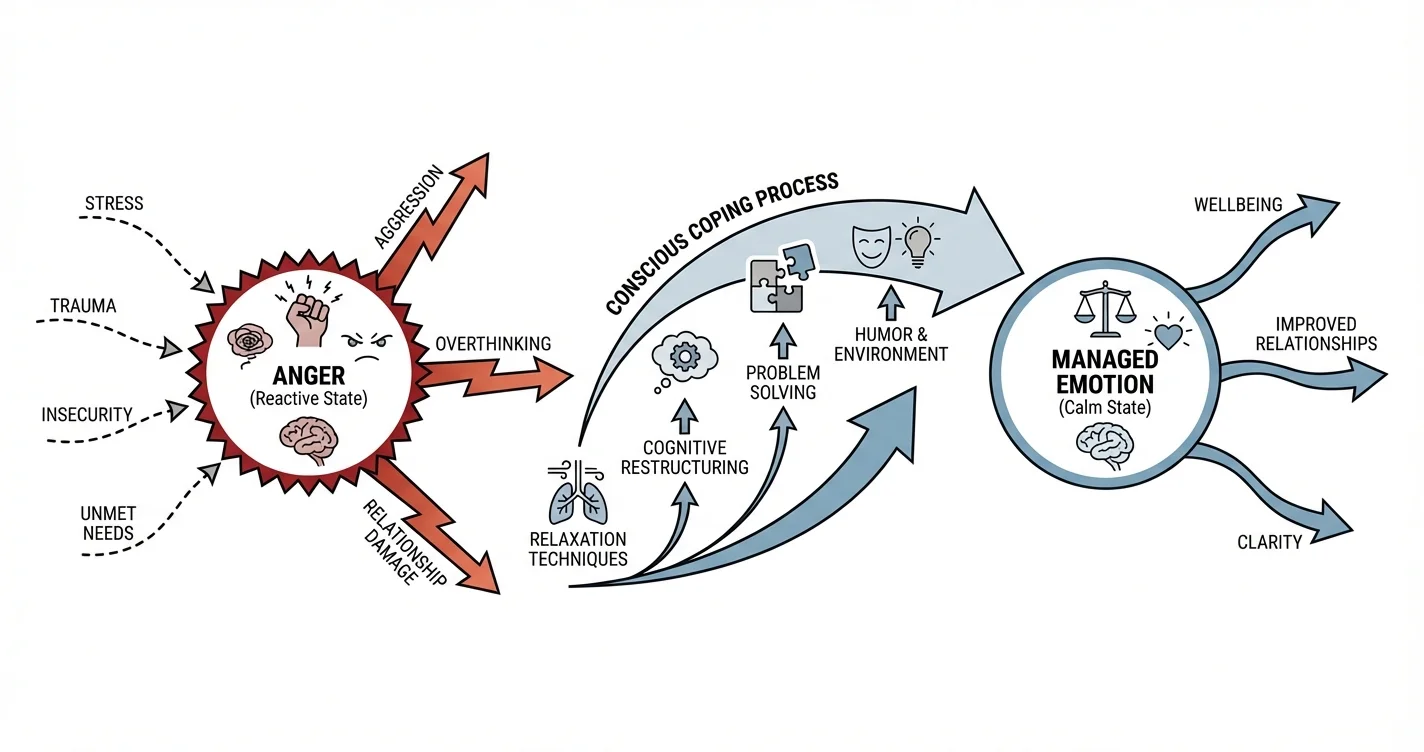
You may not always notice it right away, but your body often reacts first, and anger is no exception. This happens because the brain activates a stress response, and the body moves into a protective state. You may notice different physical reactions. Some people may feel their face turn red, while others may get sweaty hands. Along with feeling tense or anxious, anger can sometimes cause a headache or stomach pain. Some people may notice shaking, while others feel tension in their shoulders or back. These physical reactions usually pass quickly when the source of anger disappears. However, they may last longer if anger appears in waves or continues for a longer time.
Emotional Signs of Anger
Imagine a situation where a boy’s best friend shares his secret with other people. The boy will likely feel angry. But anger rarely comes alone. It is often accompanied by other emotions in the background:
- feeling alone or misunderstood
- feeling disrespected or ignored
- jealousy
- impatience
- insecurity
- guilt or shame
- helplessness or hopelessness
- anxiety or nervousness
- sadness that turns into anger
Behavioral Signs You Might Be Experiencing Anger
Anger can make us act aggressively and behave in ways that are not typical for us. For example, a calm person may start slamming doors or shouting loudly. People who usually avoid conflict may begin arguing aggressively or even become physically aggressive. There can be many forms of unusual behavior during anger, but they often share one toxic pattern that can damage relationships, even with the people closest to us.
Mental Signs of Anger
Anger strongly affects the way we think. When we feel angry, we often start overthinking and imagining the worst possible scenarios. We may replay conversations in our head or come up with aggressive responses that may never actually happen. This kind of thinking can be very exhausting. After just a few minutes, you may feel drained and still angry, because your thoughts keep feeding that feeling instead of letting it go.
Is It Anger or Something Else?
Sometimes anger is the result, not the root cause. There may be something deeper behind it that needs attention. For example, a child may feel angry after losing a close relative. A student may feel angry if they have not slept enough and are under heavy stress before exams.
It’s important to pay attention to what you are feeling and what might be triggering that anger. When you understand the underlying cause, it becomes much easier to address the anger itself.
When Does "Why Am I So Angry" Become a Problem?
Feeling brief anger after a setback or a difficult situation and keeping it under control is completely normal. We are all human, and sometimes feeling angry can even be healthy. It can signal that something matters to you or that a boundary has been crossed.
However, when anger becomes constant, the situation can change. If you often notice that you struggle to control your reactions during moments of anger, or you feel angry all the time, these may be warning signs.
You might start to see the impact in your daily life. For example, anger can damage relationships with family or friends. After those moments pass, you may be left with the feeling that you said or did things you never actually intended to do. When this starts happening regularly, it’s important to pay attention and begin working on healthier ways to manage anger.
How to Manage Anger in a Healthier Way
Learning to manage your anger does not mean suppressing it or pretending it doesn’t exist. The goal of anger management is to understand what causes anger and learn healthier ways to respond before it turns into angry outbursts.
We’d like to share a few strategies that can help you start noticing a real difference if you approach them consistently. These methods take time and effort, because healthier ways of responding to anger don’t develop in just an hour.
Relaxation Techniques
In a large review of 154 studies, calming activities consistently reduced anger responses across different groups of people. One good relaxation method is Progressive Muscle Relaxation (PMR). American physician Edmund Jacobson discovered that when people consciously relax their muscles, their mental tension often decreases as well.
Here’s how to practice it at home:
- Sit or lie down somewhere comfortable and quiet.
- Slowly tense the muscles of your feet for about five seconds.
- Release the tension and notice how the muscles relax.
- Move gradually upward through your body: legs, stomach, shoulders, arms, and face.
- Focus on the difference between tension and relaxation.
The entire exercise usually takes about 10 to 15 minutes.
Another simple technique that works almost anywhere is controlled deep breathing. One widely known method is the 4-7-8 breathing technique, popularized by Harvard-trained physician Andrew Weil. The technique works like this:
- Inhale slowly through your nose for 4 seconds.
- Hold the breath for 7 seconds.
- Exhale slowly through your mouth for 8 seconds.
- Repeat the cycle four times.
Controlled breathing helps activate the body’s relaxation response, slowing the heart rate and reducing stress signals in the brain. The biggest advantage of this technique is that you can use it almost anywhere.
Changing the Way You Think
Another important part of anger management is learning to notice the thoughts that appear when you get angry. The way you interpret a situation can strongly influence how much anger you feel and how you respond to it. This process is often called cognitive restructuring. The concept was developed within cognitive behavioral therapy by psychiatrist Aaron T. Beck and later expanded by psychologist Albert Ellis.
Tennis champion Serena Williams is a good example. During the 2018 US Open final, Williams received a penalty from the umpire that she strongly disagreed with. The situation made her visibly angry, and the moment became one of the most discussed incidents in professional tennis. Later, when reflecting on the event in interviews, Williams explained that intense emotions can make reactions stronger in the moment. Sports psychologists frequently teach athletes cognitive techniques to avoid bad situations.
The same principle applies in everyday life. When something makes you feel angry, taking a moment to question your first reaction can help prevent escalation and support healthier emotional coping.
Problem Solving Instead of Reacting
Sometimes anger appears because there really is a problem. A difficult situation at work, financial pressure, conflict in a relationship, or ongoing stress can all cause anger. Relaxation techniques may not always help right away because the reaction has already become a habit in how you deal with problems.
What can help is setting the emotion aside and focusing on the situation itself. Ask yourself what can actually be done to move the problem forward so the anger stops taking over. Think about practical steps that could improve your current situation. The solution may not happen all at once. Sometimes it’s a gradual process made up of small actions. But as you begin moving in the right direction, you’ll likely start to feel more in control. Those small steps can bring a sense of progress, and over time you may notice that you feel less angry.
Using Humor to Reduce Anger
When something makes you angry, your thinking often becomes very rigid and dramatic. You may feel that the situation is unbearable or that someone deliberately tried to upset you. Humor interrupts that pattern and creates psychological distance from the moment.
For example, actor and comedian Steve Carell has spoken in interviews about using humor to diffuse tense moments on film sets. In one interview with The Hollywood Reporter, he described situations where stress during filming could quickly escalate into frustration between colleagues. Instead of reacting defensively, he often used light humor to shift the mood of the room.
Scientific research supports this effect. A large meta-analysis published in 2024 in the journal Aggression and Violent Behavior analyzed 154 studies involving more than 10,000 participants and examined different strategies for reducing anger. The researchers found that humor and cognitive reframing significantly reduced anger intensity.
Changing Your Environment
Sometimes the environment itself can cause anger. For example, if there is construction near your home day and night, it can become very irritating and eventually turn into anger, especially if you are not getting enough sleep. There are many situations where your environment creates constant stress, and over time this can make you feel more angry than usual. In these cases, one useful strategy in anger management is to change parts of your environment so your brain has fewer stress triggers during the day. Creating even small moments of personal space during the day can help reduce emotional overload.
Supporting Someone Else Who Is Struggling With Anger
Seeing someone you care about struggle with anger can be difficult. When a person frequently gets angry, it may affect relationships and everyday interactions. Sometimes people experiencing anger may not fully understand why it happens, especially if stress or other mental health problems are involved.
The first important step is recognizing that anger is often not the whole story. In many cases, anger appears as a response to something deeper. A person may feel overwhelmed or powerless, and those emotions can make them feel angry even if the real issue is something else. In some situations, anger can be a symptom connected to stress, trauma, or another mental health condition. Supporting someone in this situation does not mean tolerating harmful behavior. But it does mean approaching the situation with calm rather than escalating the conflict.
One helpful approach is listening before reacting. When someone begins to express anger, your instinct may be to defend yourself immediately. But often the anger hides another emotion underneath. Listening carefully can help you understand what is actually happening.
For example, imagine a coworker who suddenly becomes frustrated during a project discussion. Their reaction might look like an angry outburst, but the real issue may be pressure from deadlines or feeling that their work is not appreciated. By staying calm and asking questions rather than responding with anger, you may help prevent the situation from escalating.
Another important step is encouraging healthier ways to express anger. Many people were never taught how to deal with anger in a healthy way. Instead, they may suppress it for a long time until it eventually appears in sudden reactions.
At the same time, it is important to maintain boundaries. Supporting someone does not mean accepting repeated angry outbursts that harm others. If anger becomes frequent or difficult to control, encouraging the person to seek professional help may be helpful. Therapists and counselors often work with individuals to understand what may cause anger and develop healthier anger management strategies.
Anger is a normal part of being human, but it should not control your life. Try to understand what causes it and how you respond to it. When you learn to reflect and use healthier coping strategies, anger becomes easier to manage.
How AI Support Helps You Heal
AI emotional support isn't about replacing human connection — it's about filling the gaps. The moments when you need to talk at 2 AM, when you don't want to burden your friends again, or when you simply need someone to listen without judgment.
Here's what happens in a typical Lovon session:
You share what's on your mind
There's no script, no intake form, no waiting room. You speak or type whatever you're feeling — in your own words, at your own pace.
Lovon validates and explores
Using frameworks from CBT (Cognitive Behavioral Therapy) and motivational interviewing, Lovon acknowledges your feelings first, then gently helps you explore them. No dismissive "just move on" advice.
You build coping skills together
Lovon doesn't just listen — it actively works with you on evidence-based techniques: thought reframing, urge surfing, behavioral experiments, and more.
What a Session with Lovon Looks Like

When to Seek Professional Help
AI support is a valuable tool, but it's not a replacement for professional care. Please consider reaching out to a licensed therapist if you experience any of the following:
- Persistent thoughts of self-harm or suicide
- Inability to perform daily activities (work, eating, sleeping) for more than 2 weeks
- Turning to alcohol or substances to cope
- Intense anger or desire to harm your ex-partner
- Complete emotional numbness that doesn't improve over time
Crisis Resources (US): If you're in immediate danger, call 988 (Suicide & Crisis Lifeline) or text HOME to 741741 (Crisis Text Line). Available 24/7, free, and confidential.
Outside the US? Find a crisis line in your country
Ready to Start?
Your healing journey can begin right now
A 7-day trial. No judgment. Just a safe space to process what you're going through.
Frequently Asked Questions
Q: Is it normal to feel angry from time to time?
Q: Why am I so angry when ovulating?
Q: Why do I feel angry even when nothing serious is happening?
Q: Can anger be justified?
Q: Why am I so angry when I’m hungry?
Q: When should someone seek help for anger?
Q: What is the first step in dealing with anger?
About the Author

Mireya Tabasa
Mental Health Support Specialist & AI Advisor
Mireya Tabasa is a Mental Health Support Specialist working at the intersection of clinical care and technology. With over 4 years of hands-on experience supporting diverse populations facing mental health challenges in educational and healthcare settings, she brings frontline clinical insight to ev...
Related articles
- How to Stop Anger Outbursts Before They Happen (2026)
Learn how to stop anger outbursts before they happen in 2026 with trigger tracking, box breathing, and a pre-planned…
- How to Heal Trauma When Time Doesn't Help
"Time heals all wounds" is one of the most commonly offered reassurances after trauma, yet for many people, years can…
- Major Depressive Disorder vs Persistent Depressive Disorder
When struggling with prolonged sadness or emotional difficulty, understanding what you're experiencing can feel…
- Understanding CPTSD Symptom Expansion and How It Affects Recovery
When people begin addressing their Complex PTSD, many encounter an unexpected and disorienting phenomenon: their…
See also
Quizzes
- Shame Test: Do You Read Mistakes as Verdicts?
See which exit your shame takes, in 3 minutes.
- Alexithymia Test: Can You Name What You Feel?
See where your feelings lose their names, in 3 minutes.
Free tools
- Write a Letter to Someone You Lost
Tell it who they were to you and what you never got to say, and it writes the letter back in your words. No account, no…
- Write a Condolence Message for This Person
Get one condolence message written for your situation instead of a list of a hundred to choose from. Tell it who died…
From the wiki
- Why do I keep dreaming about the same person?
A recurring dream figure usually marks unfinished emotional business rather than a message about that person. Your brain…
Disclaimer: This article is for informational purposes only and does not constitute medical advice, diagnosis, or treatment. Always seek the advice of your physician or other qualified health provider with any questions you may have regarding a medical condition. If you are in crisis or think you may have an emergency, call 988 (Suicide & Crisis Lifeline) or go to the nearest emergency room. Outside the US? Find a crisis line in your country.