
Why Do I Zone Out So Much? Reasons and How to Fix Your Brain Function
Imagine you are talking with a friend and suddenly stop because you lose the context and forget what you were saying.

Key Takeaways
- Learn to practice mindfulness, it helps reduce activity in the default mode network
- Simple habits like improving your sleep hygiene can significantly stabilize attention and reduce fatigue
- Techniques like progressive muscle relaxation and cognitive behavioral therapy can help you improve your condition
Introduction
Imagine you are talking with a friend and suddenly stop because you lose the context and forget what you were saying. This can feel scary, but it happens to many people. We will help you understand why it may happen.
What Does It Mean to Zone Out?
This is a state where a person was focused on something but soon loses that focus, often against their will.
Common Causes of Zoning Out
We will name some of the most common reasons. Understanding them can help you see which direction to move in to reach a healthier state.
Daydreaming and Internal Distraction
Research by Harvard University found that people spend about 47 percent of their waking time mind wandering. When something is emotionally unresolved, this internal distraction becomes stronger, and your thoughts may drift far away from what is happening around you.
J.K. Rowling is a good example of daydreaming. She has said that the idea for Harry Potter and the Philosopher's Stone came to her while she was sitting on a delayed train from Manchester to London. Instead of focusing on the situation around her, her mind moved into distant ideas and imagination, where the story of Harry Potter began to form.
ADHD and Attention Regulation
For people with these issues, the brain works a bit differently. Their dopamine-related attention systems function in another way, which can lead to periods of hyperfocus or, on the opposite side, low focus. Because of this, zoning out becomes a common experience for them.
Cognitive Overload
Imagine a woman who works three jobs and in the evening tries to help her child with homework. She suddenly notices that she has brain fog and cannot focus. This happens because she is very tired after the whole day and all the work. Her mind is exhausted, so any new task that needs thinking can make her lose focus.
Extreme Stress and Dissociative Responses
Traumatic stress can lead to frequent zoning out. But even without trauma, stress and a form of dissociation patterns can overload the brain. For example, Olympic gymnast Simone Biles spoke publicly during the 2020 Summer Olympics about experiencing the “twisties,” a mental state caused by extreme pressure and stress. During routines, she suddenly felt disconnected from her body and could not safely track where she was in the air.
Sleep Deprivation and Mental Fatigue
Zoning out often appears after poor sleep. A good example is students who do not get enough sleep before exams. Because of this, they feel more anxious, less attentive, and often have to return to the same information several times to understand it.
Low Blood Sugar and Physical Factors
Low blood sugar or other forms of physical exhaustion can affect the brain and create a feeling of zoning out. Novak Djokovic is a good example of how physical condition can affect the mind. He has said that before he changed his diet, he sometimes experienced moments where his energy and focus dropped. However, it is important not to think this only happens in extreme situations. Even something simple like skipping breakfast and lunch can make you feel worse and lead to loss of focus.
Seizure and Other Neurological Causes
An absence seizure can look like short spacing out. A person suddenly stops responding for a few seconds and then continues the activity without knowing it happened. Absence seizures are often connected with a condition called Childhood Absence Epilepsy.
One example sometimes mentioned by historians involves physicist Albert Einstein. Some biographers wrote that when he was a child, he had moments where he stared and did not respond for a short time. Modern neurologists sometimes compare these moments to mild absence-like episodes. However, this was never officially diagnosed.
Other rare neurological events can also cause sudden changes in awareness. A Transient Ischemic Attack (sometimes called a mini stroke) can briefly affect attention. Another condition, Transient Global Amnesia, causes a temporary problem with forming new memories and can last for several hours.
These are not common causes of zoning out, but these are important health concerns.
Why Zoning Out Can Be Hard to Control?
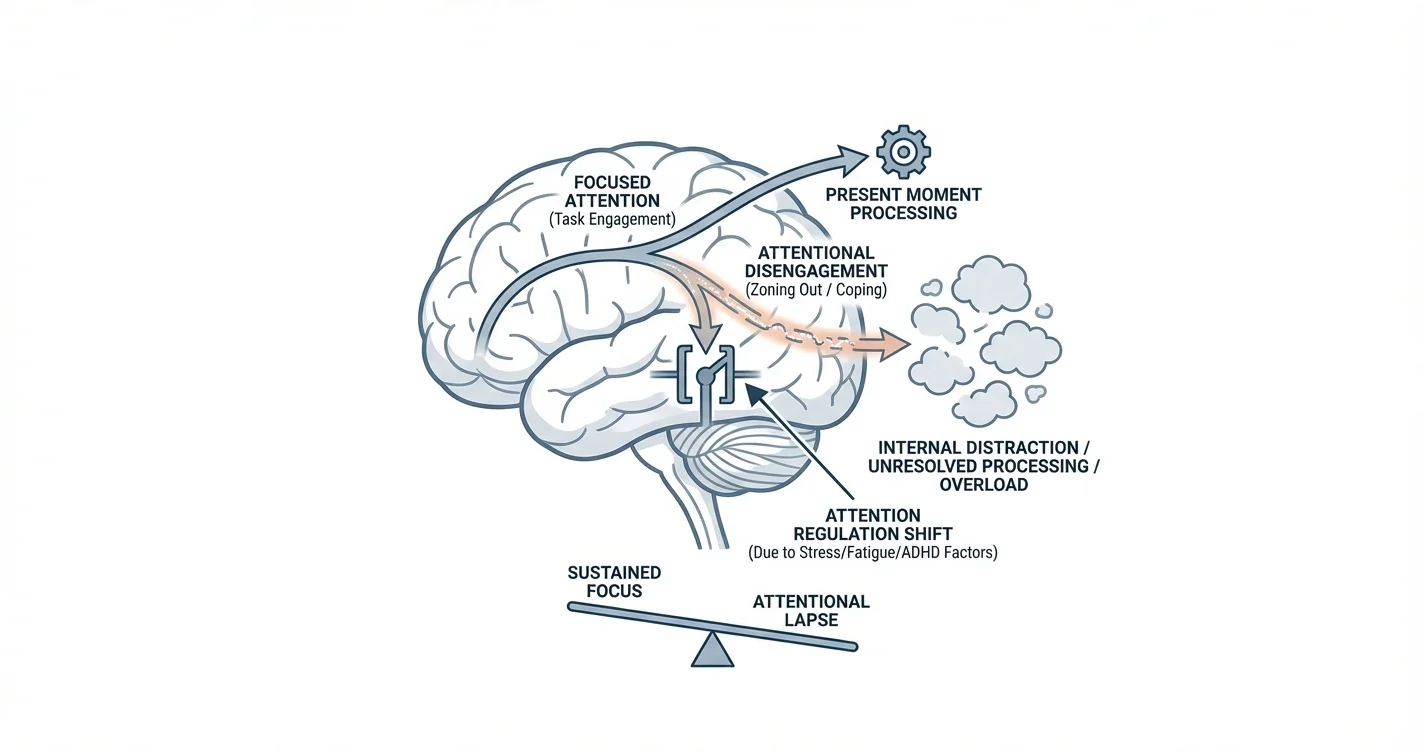
Part of the reason is how brain function actually works. Attention is a dynamic system that constantly shifts based on energy levels and what your brain is trying to process in the background.
Zoning out is a mild form of attentional disengagement. In many cases, it is also a form of coping. When your system is overloaded or dealing with something unresolved, attention can pull away from the present moment to reduce pressure. That is why it isn’t always something you can control with effort alone.
You might notice this especially during moments that feel mentally or emotionally demanding. You want to stay present, but your mind slips, because your brain is prioritizing something else.
For example, someone dealing with ongoing stress may zone out during meetings or conversations. From the outside, it looks like a distraction. From the inside, their attention is split between the present moment and everything their system is still trying to handle.
In some cases, zoning out can be linked to a mental health condition such as anxiety, ADHD, or stress-related disorders. These conditions affect how attention is regulated and how easily it can be sustained. That does not mean something is “wrong” with you, but it does explain why focus can feel inconsistent or harder to control.
Another reason zoning out is difficult to manage is that it often involves a brief loss of awareness. By the time you notice it, the moment has already passed. You “come back” and realize you missed part of what was happening.
How to Stop Zoning Out in the Moment?
If you’ve ever tried to “snap out of it” and it didn’t work, that’s not a lack of discipline. It’s how attention works. Zoning out often happens when your brain is overloaded or using a coping mechanism to manage stress, fatigue, or underlying mental health patterns. The goal in the moment is not to force focus, but to give your attention a simple path back.
Mindfulness
A meta-analysis by Amishi Jha found that mindfulness training can improve attention stability and reduce mind wandering, especially under stress. There are many simple mindfulness practices that can help you stay mindful and focused. You can do a little of them every day. For example, focusing on something physical around you. If you notice that you are zoning out, try to focus on something near you. For example, look at the table next to you and concentrate on it for a moment. This can help you return your attention and regain control.
Breathing Exercises
Breathing directly affects attention through your nervous system. Research from Stanford University shows that controlled breathing can reduce stress responses and improve cognitive control. Even 30 to 60 seconds of slower breathing can help your brain shift out of overload.
Breathing with counting can help you calm down and focus. For example, breathe in for 3 seconds and breathe out for 5 seconds. Repeating this a few times can help you feel better.
Active Listening
Practicing active listening gives your attention structure. Instead of passively hearing, you stay engaged by tracking what the other person is saying.
Research in communication psychology shows that active listening improves attention retention and reduces distraction. When you mentally summarize or respond to what you hear, your brain is less likely to drift.
For example, someone might notice they keep losing focus in conversations with their partner. When they start practicing active listening, repeating key points internally, asking follow-up questions, they report zoning out less.
Simplify the Task at Hand
The world is such that we often have to handle several tasks at the same time, but multitasking is something that can overwhelm many people. Studies show that task switching can reduce productivity by up to 40 percent. Each switch increases cognitive load, making it easier for your brain to disengage completely. So if in your day-to-day activities it seems harmless to watch a video about a cat on YouTube, then switch back to your task, and then return to the video again, it is not as harmless for your mind as it may seem.
Address the Underlying Mental Health Condition
Research shows that people with ADHD experience more frequent attention lapses due to differences in dopamine regulation. Similarly, high stress levels are associated with reduced working memory and attention control.
In real life, this can look like someone who feels like they “zone out all day,” especially during tasks that require sustained focus. Once they start addressing sleep, stress, or attention patterns, they often report that zoning out becomes less intense.
Give Your Brain Enough Sleep
Lack of sleep can cause many problems. If you wake up at 6 a.m. but go to sleep at 3 a.m., it will not lead to anything good. You may often feel like you are not fully present and have no energy. Building healthy habits and sleeping at least 6-8 hours can help you feel much better.
When to Seek Support?
Rare and mild zoning out happens to everyone from time to time. There is no need to panic, especially if you had a very busy week. However, it is important to pay attention to yourself and notice signs that may show something more serious like underlying causes.
If the frequency or intensity of your zoning out increases, and it's not about seconds or minutes anymore, it may not be just a harmless distraction. It could be related to another health concern that will require you to see a healthcare provider.
Even if it does not happen often, if it appears during important moments and affects your quality of life, it may also be a sign that it is time to work on it.
You might also feel like you’re having specific triggers. For example, it happens more during emotional conversations or situations that feel uncomfortable. In some cases, this can be a form of coping. Your brain steps back to reduce overload. While this can help in the moment, frequent reliance on this pattern may signal an underlying mental health condition.
Speaking with a mental health professional can help you better understand your situation.
How AI Support Helps You Heal
AI emotional support isn't about replacing human connection — it's about filling the gaps. The moments when you need to talk at 2 AM, when you don't want to burden your friends again, or when you simply need someone to listen without judgment.
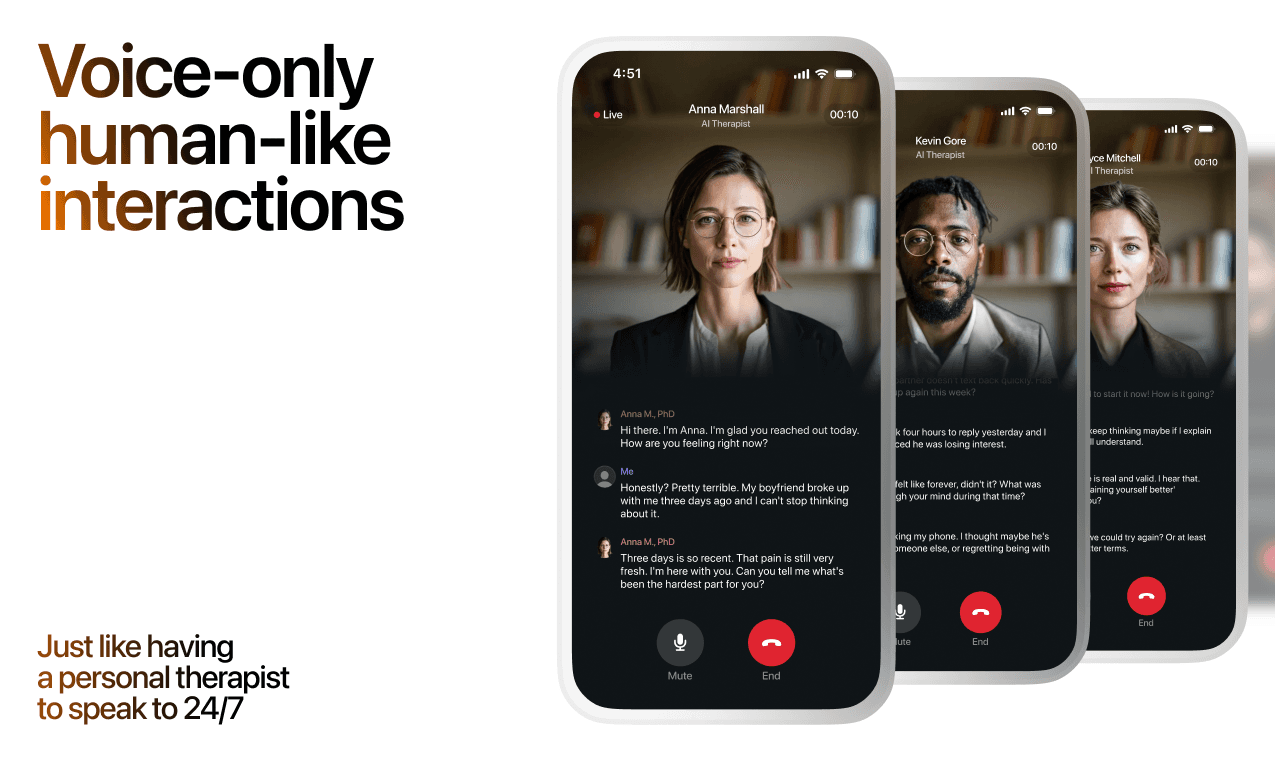
Here's what happens in a typical Lovon session:
You share what's on your mind
There's no script, no intake form, no waiting room. You speak or type whatever you're feeling — in your own words, at your own pace.
Lovon validates and explores
Using frameworks from CBT (Cognitive Behavioral Therapy) and motivational interviewing, Lovon acknowledges your feelings first, then gently helps you explore them. No dismissive "just move on" advice.
You build coping skills together
Lovon doesn't just listen — it actively works with you on evidence-based techniques: thought reframing, urge surfing, behavioral experiments, and more.
What a Session with Lovon Looks Like
When to Seek Professional Help
AI support is a valuable tool, but it's not a replacement for professional care. Please consider reaching out to a licensed therapist if you experience any of the following:
- Persistent thoughts of self-harm or suicide
- Inability to perform daily activities (work, eating, sleeping) for more than 2 weeks
- Turning to alcohol or substances to cope
- Intense anger or desire to harm your ex-partner
- Complete emotional numbness that doesn't improve over time
Crisis Resources (US): If you're in immediate danger, call 988 (Suicide & Crisis Lifeline) or text HOME to 741741 (Crisis Text Line). Available 24/7, free, and confidential.
Outside the US? Find a crisis line in your country
Ready to Start?
Your healing journey can begin right now
A 7-day trial. No judgment. Just a safe space to process what you're going through.
Frequently Asked Questions
Q: What does ADHD zoning out look like?
Q: Am I zoning out or is it dissociation?
Q: Can a transient ischemic attack cause zoning out?
Q: Is it ok to zone out all the time?
Q: Why do I keep zoning out so much in class?
Q: Can distraction become a compulsion?
Q: Does zoning out mean anxiety?
About the Author

Mireya Tabasa
Mental Health Support Specialist & AI Advisor
Mireya Tabasa is a Mental Health Support Specialist working at the intersection of clinical care and technology. With over 4 years of hands-on experience supporting diverse populations facing mental health challenges in educational and healthcare settings, she brings frontline clinical insight to ev...
Related articles
- Window of Tolerance: What It Is & How to Widen It (2026)
Window of tolerance explained: what pushes you out of it and 6 steps to widen it in 2026. Verdict, troubleshooting, and…
- What Is Trauma Dumping and Why People Do It (2026)
Trauma dumping means unloading pain without consent. Learn exactly why it happens, how to recognize it in yourself, and…
- Maladaptive Daydreaming: Signs & How to Stop It in 2026
Maladaptive daydreaming explained: signs, triggers, and a 7-step plan to cut hours-long episodes down in 2026…
- ADHD Comorbidity with Anxiety and Depression Cycles
Understanding the Complex Interplay Between ADHD and Recurring Mental Health Patterns
See also
Quizzes
- Loneliness Test: Free 12-Question Self-Check
See which kind of loneliness is thin, in 3 minutes.
- Highly Sensitive Person Test: How Much Do You Take In?
See how deeply you process, notice and get overloaded.
Free tools
- Write a Letter to Your Best Friend
A chat for a letter to your best friend that only they could have received. Tell it how long you have been friends, one…
- Vent to an AI
Need to vent and there is nobody to call, or nobody you want to tell? Type it here. You are talking to an AI listener…
From the wiki
- Why do I keep dreaming about my ex?
Recurring dreams about an ex usually mean your brain is still consolidating a relationship that took up years of memory…
Disclaimer: This article is for informational purposes only and does not constitute medical advice, diagnosis, or treatment. Always seek the advice of your physician or other qualified health provider with any questions you may have regarding a medical condition. If you are in crisis or think you may have an emergency, call 988 (Suicide & Crisis Lifeline) or go to the nearest emergency room. Outside the US? Find a crisis line in your country.