
Inner Child Healing: Step-by-Step Guide (2026)
Follow this practical 7-step inner child healing guide — grounded in schema therapy and IFS — to break emotional patterns and start reparenting yourself in 2026.

Key Takeaways
- A private, quiet space where you won't be interrupted for 20–30 minutes per session
- A journal or notes app for written reflection
- A photograph of yourself as a child (optional but useful for visualization)
- Willingness to sit with discomfort — some sessions will bring up grief or anger
- A consistent schedule: 3–4 sessions per week produces better results than sporadic deep dives
Inner child healing is one of the least understood concepts in mental health right now. This guide gives you a clear, step-by-step process: what inner child work actually involves, how to do it without a therapist in the room, and what to expect along the way.
TL;DR
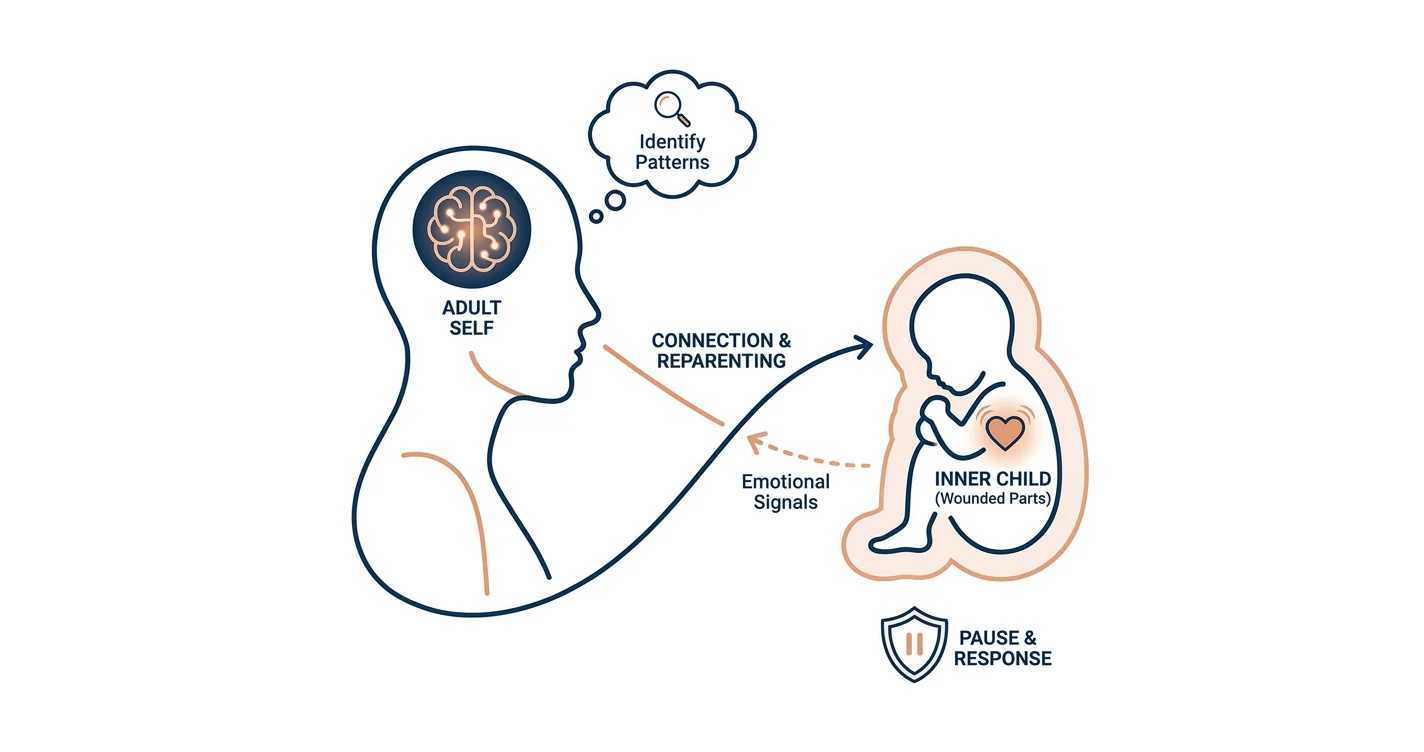
Inner child healing means revisiting the emotional wounds you formed in childhood — fear of abandonment, shame, learned helplessness — and learning to respond to those wounds as a caring adult self, not a frightened kid. The process takes weeks to months, not a single session. In 2026, tools like Lovon's AI voice support app let you do guided self-reflection between formal therapy sessions, making the work more consistent. The steps below are grounded in schema therapy and internal family systems (IFS), two approaches with strong research support for this kind of work.
Why this matters
Most adults carry emotional patterns they didn't choose. You shut down when someone raises their voice. You apologize before you've done anything wrong. You sabotage relationships right when they start to feel safe. These patterns don't come from nowhere — they come from a younger version of you who learned that certain behaviors kept you safe or loved.
Inner child healing doesn't erase the past. It changes your relationship to it. When you stop reacting from the wounded part and start responding from your adult self, the patterns shift. Relationships feel less threatening. Criticism doesn't land the same way. That's the goal — not to revisit pain for its own sake, but to stop letting old pain run present-day decisions.
Research published in the Journal of Consulting and Clinical Psychology in 2023 found that schema-focused therapy — which includes inner child work as a core technique — produced significant reductions in personality disorder symptoms over 18 months, with effect sizes larger than CBT alone in the same sample.
What you'll need
- A private, quiet space where you won't be interrupted for 20–30 minutes per session
- A journal or notes app for written reflection
- A photograph of yourself as a child (optional but useful for visualization)
- Willingness to sit with discomfort — some sessions will bring up grief or anger
- A consistent schedule: 3–4 sessions per week produces better results than sporadic deep dives
- Access to ongoing emotional support — a licensed therapist if trauma is severe, or an AI voice support tool like Lovon for between-session processing
Note: If your childhood included abuse, neglect, or trauma that still causes flashbacks or dissociation, start this work with a licensed clinician before doing it solo.
The steps
Step 1 — Identify your wounded patterns
Before you can heal anything, you have to name it. Spend one full session listing the emotional reactions that feel disproportionate to what triggered them — the situations where your response is bigger, faster, or more painful than the moment seems to warrant.
Common examples: freezing when asked for your opinion in a group, intense shame after a small mistake, panic when a partner goes quiet. Each of these points to a belief the younger you formed under pressure.
Expected outcome: A short list — 3 to 6 patterns — that you'll carry into the rest of the work. Don't try to fix anything yet. Observation comes first.
Common mistake: Trying to rationalize the patterns away immediately. The goal of Step 1 is recognition, not resolution.
Step 2 — Connect the pattern to a childhood context
For each pattern on your list, ask: When did I first feel this way? How old was I? You're not searching for a single traumatic event — often the wound comes from repetition, not catastrophe. A parent who was emotionally unavailable most of the time creates just as deep a wound as a single frightening incident.
Write down what you find without editing. If the memory feels vague, that's fine — work with the emotion, not the precise scene.
Expected outcome: A rough map connecting your 2026 reactions to experiences that make sense of them. You stop feeling broken and start feeling explained.
Common mistake: Blaming caregivers as the endpoint. The point is understanding, not verdict. Most parents wounded their kids from their own unhealed wounds.
Step 3 — Visualize the younger you
This is the core technique in inner child work. Sit comfortably, close your eyes, and picture yourself at the age tied to a specific wound. Use a photo if it helps. Imagine that child in the moment when the wound was forming — not to relive it painfully, but to observe it as the adult you are now.
Notice how that child is feeling. Scared? Ashamed? Invisible? Just stay with the image for 3–5 minutes without trying to fix it.
Expected outcome: Emotional contact with the younger part of you. Many people report unexpected grief during this step — that's a sign the connection is real, not a sign something is wrong.
Common mistake: Detaching or intellectualizing. If you find yourself narrating from a distance rather than feeling anything, slow down and focus on the child's body language in the image — hunched shoulders, downcast eyes — until the emotion follows.
Step 4 — Offer what was missing
Now you speak — or write — to the younger you as the safe adult that child needed. This is not pretend. The brain processes imagined safety and actual safety through overlapping neural circuits; the comfort is real even if the scene is constructed.
Say what that child needed to hear: You are not too much. What happened was not your fault. I see you, and I'm not going anywhere. Be specific to what you found in Step 2. Generic reassurance is less effective than words that match the exact wound.
Keep each statement short. One clear sentence lands harder than a speech.
Expected outcome: A shift in how that early memory feels — not erased, but less raw. Some people feel warmth; others feel release; some feel nothing in the first few sessions and that changes around session 5 or 6.
Common mistake: Saying words you don't believe yet. If "I am worthy of love" feels hollow, try something smaller and truer: I'm trying to take care of you now. Work up to the bigger statements as they become credible.
Step 5 — Reparent through daily behavior
Visualization alone is not enough. Reparenting means giving your inner child what they needed through how you treat yourself today — consistently, in small concrete acts.
If the wound was around not being heard: practice stating your preferences clearly once per day without apologizing for them. If the wound was around not being safe: build one predictable daily routine that signals stability. If the wound was around shame: write down one thing you did well before you sleep, every night for 30 days.
Expected outcome: The adult-self behaviors start to feel natural rather than forced, usually between weeks 3 and 6 of consistent practice.
Common mistake: Treating reparenting as a mood-based activity — only doing it when you feel inspired. It works because of consistency, not intensity.
Step 6 — Notice when the child gets triggered, and pause
The real test of inner child work is not the quiet meditation sessions — it's what happens when something triggers the wounded pattern in real time. You get criticized at work. Your partner cancels plans. Someone sets a boundary that feels like rejection.
The 2026 skill is the pause: catching the reaction before it runs. Ask yourself in the moment, Is this my adult self responding, or is this the 7-year-old? The question doesn't stop the feeling, but it creates a split-second gap where you can choose a different action.
Expected outcome: Fewer regrettable reactions. More moments where you stay present rather than revert to old survival patterns.
Common mistake: Expecting the trigger response to disappear completely. It softens over time; it rarely vanishes. Success means smaller reactions and faster recovery, not zero reaction.
Step 7 — Review and revise every 4 weeks
Inner child healing is iterative. Every 4 weeks, revisit your original pattern list. Some patterns will feel lighter. New ones will surface — often deeper layers of the same core wound. This is progress, not regression.
Adjust your reparenting behaviors to match what's current. The work you do in month 3 of 2026 will look different from the work you started in month 1.
Expected outcome: A living practice rather than a completed project. People who maintain even a 10-minute weekly review session sustain gains far longer than those who treat inner child work as a finite course.
Common mistake: Stopping when things feel better. The improvement is the result of the practice. Drop the practice early and the old patterns tend to reassert under stress.
Troubleshooting
You feel nothing during visualization. This is common when dissociation is a protective pattern. Start with a body-based anchor — hold something cold or textured in your hand during the exercise — before attempting the imagery. Sensation before emotion.
You feel overwhelmed or can't stop crying. Slow the work down. Do 10 minutes instead of 30. Overwhelm means the nervous system is processing faster than it can regulate. Use a grounding technique — name 5 things you can see — before and after each session.
You keep intellectualizing instead of feeling. Write by hand instead of typing. Handwriting slows cognitive processing enough that emotion tends to catch up. Describe the physical sensation in your body rather than the thought about the situation.
The same pattern keeps coming back no matter what you try. Deep or complex trauma often needs clinical support. Consider working with a therapist trained in EMDR, IFS, or schema therapy for that specific wound. AI voice support tools like Lovon can help you process between sessions, but they are not a substitute for clinical treatment of severe trauma.
You're not sure which memory is connected to which pattern. That's fine. Work with the emotion as your guide, not the memory. Ask: Where in my body do I feel this? then: How old does this feeling seem? The body often holds the answer before the mind does.
Your inner critic keeps interrupting. The inner critic is usually another wounded part, not your adult self. When it shows up during visualization, acknowledge it: I hear you. You're trying to protect me. I've got this. Then return to the child.
Tools and resources
- Lovon — Lovon's AI voice support app is built with input from PhD psychologists and lets you do guided self-reflection and emotional processing anytime, without scheduling a session. It's particularly useful for working through the emotional residue from Step 3 and Step 4 when a therapist isn't immediately available. Lovon is designed as support alongside clinical care, not as a replacement for it.
- A licensed therapist trained in IFS or schema therapy — For wounds involving childhood abuse, neglect, or trauma that causes flashbacks, clinical support is the standard of care in 2026, not optional.
- "Homecoming" by John Bradshaw — One of the most widely cited lay texts on inner child work, useful as a framework companion to the steps above.
- A consistent journal — Unstructured writing after each session helps consolidate insights and track progress across the 4-week review cycles.
If anxiety is a primary driver of your inner child wounds, free AI therapist for anxiety explores how AI-supported emotional processing works for anxiety specifically.
For inner child wounds that show up most visibly in your relationships — especially patterns around trust, abandonment, or conflict avoidance — AI relationship coach for anxious attachment covers attachment-focused strategies that complement the work here.
FAQ
What is inner child healing? Inner child healing is the process of identifying emotional wounds formed in childhood, understanding how they shape your current behavior, and learning to meet those unmet needs as a caring adult. It draws on schema therapy and internal family systems (IFS), both of which have published clinical research supporting their effectiveness.
How long does inner child healing take? Most people notice meaningful change in 6–12 weeks of consistent practice — 3 to 4 sessions per week. Deeper or complex wounds tied to chronic childhood neglect or abuse can take 12 to 24 months of work, often including clinical support.
Can I do inner child work alone, without a therapist? For mild to moderate emotional patterns, yes — the steps in this guide are grounded in evidence-based techniques you can practice independently. If your childhood included abuse, neglect, or experiences that still cause flashbacks or dissociation, start with a licensed therapist.
What does inner child healing feel like? It varies by person and session. Some sessions produce grief or unexpected sadness. Others feel quiet and neutral. Over weeks, most people report that triggering situations feel less all-consuming and that they recover from emotional reactions faster than before.
Is inner child healing the same as trauma therapy? No, though they overlap. Inner child work is a technique — used within trauma therapy, schema therapy, and IFS — not a therapy modality in itself. For clinical trauma, a licensed therapist applies these techniques within a structured treatment framework.
How do I know if inner child work is working? Watch the trigger response, not the meditation session. Progress shows up when you catch yourself mid-reaction and choose differently. It also shows up when old memories feel less charged and when self-criticism gets quieter. Review your pattern list every 4 weeks — the change is easier to see in retrospect.
Can inner child healing help with anxiety? Yes. A significant portion of anxiety is driven by early experiences of unpredictability, criticism, or emotional unavailability. Addressing the underlying wound — not just the symptom — produces more durable relief than coping strategies alone. In 2026, combining inner child work with anxiety-focused tools gives the most consistent results.
What if I don't remember my childhood clearly? You don't need clear memories. Work with the patterns themselves — the emotional reactions you identified in Step 1 — and use body sensation as your guide rather than specific scenes. Many people have limited conscious access to early memories and still make substantial progress with this approach.
One last thing
The part of you that keeps reading guides like this one — that keeps trying to understand yourself — is itself an act of reparenting. Most children in pain didn't have someone curious about their inner world. You're being that person for yourself now. That's not a small thing; in 2026 or any year, it's exactly where healing starts.
Related guides
How AI Support Helps You Heal
AI emotional support isn't about replacing human connection — it's about filling the gaps. The moments when you need to talk at 2 AM, when you don't want to burden your friends again, or when you simply need someone to listen without judgment.
Here's what happens in a typical Lovon session:
You share what's on your mind
There's no script, no intake form, no waiting room. You speak or type whatever you're feeling — in your own words, at your own pace.
Lovon validates and explores
Using frameworks from CBT (Cognitive Behavioral Therapy) and motivational interviewing, Lovon acknowledges your feelings first, then gently helps you explore them. No dismissive "just move on" advice.
You build coping skills together
Lovon doesn't just listen — it actively works with you on evidence-based techniques: thought reframing, urge surfing, behavioral experiments, and more.
What a Session with Lovon Looks Like

When to Seek Professional Help
AI support is a valuable tool, but it's not a replacement for professional care. Please consider reaching out to a licensed therapist if you experience any of the following:
- Persistent thoughts of self-harm or suicide
- Inability to perform daily activities (work, eating, sleeping) for more than 2 weeks
- Turning to alcohol or substances to cope
- Intense anger or desire to harm your ex-partner
- Complete emotional numbness that doesn't improve over time
Crisis Resources (US): If you're in immediate danger, call 988 (Suicide & Crisis Lifeline) or text HOME to 741741 (Crisis Text Line). Available 24/7, free, and confidential.
Outside the US? Find a crisis line in your country
Ready to Start?
Your healing journey can begin right now
A 7-day trial. No judgment. Just a safe space to process what you're going through.
Frequently Asked Questions
Is Lovon a replacement for a real therapist?
Is my conversation with Lovon AI private?
How is Lovon different from ChatGPT for emotional support?
Can I use Lovon if I'm already seeing a therapist?
Can I try Lovon before subscribing?
About the Author

The Lovon Editorial Team
Mental Health & Wellness Content Team
The Lovon Editorial Team develops mental health and wellness content designed to make psychological concepts accessible and actionable. Our goal is to bridge the gap between clinical research and everyday life - helping you understand why your mind works the way it does and what you can do about it....
Related articles
- Intergenerational Trauma & Mental Health: 2026 Guide
Intergenerational trauma mental health effects explained: how patterns pass down, 6 steps to break the cycle, and what…
- Maladaptive Daydreaming: Signs & How to Stop It in 2026
Maladaptive daydreaming explained: signs, triggers, and a 7-step plan to cut hours-long episodes down in 2026…
- Understanding the Inner Child Therapy Approach for Emotional Healing
The Inner Child Therapy approach has emerged as a powerful framework for addressing how early experiences continue to…
- How to Make Friends as an Adult (2026 Step-by-Step Guide)
How to make friends as an adult in 2026: 7 concrete steps, common mistakes, and what to do when friendships stall…
See also
Quizzes
- Guilt Test: Is Your Guilt Doing Its Job?
See whether your guilt repairs or just hurts.
- Shame Test: Do You Read Mistakes as Verdicts?
See which exit your shame takes, in 3 minutes.
Free tools
- Self-Esteem Check-In
Eight statements, one read on three sides of self-esteem: your self-talk, how you act with people, and what you do with…
- How to Say No Politely (Without Over-Explaining)
A chat for how to say no politely when you have already decided and cannot get the word out. Tell it what you were…
From the wiki
- Why do I feel lonely all of a sudden?
Sudden loneliness usually traces back to something that quietly ended in the last few months: a routine, a shared class…
Disclaimer: This article is for informational purposes only and does not constitute medical advice, diagnosis, or treatment. Always seek the advice of your physician or other qualified health provider with any questions you may have regarding a medical condition. If you are in crisis or think you may have an emergency, call 988 (Suicide & Crisis Lifeline) or go to the nearest emergency room. Outside the US? Find a crisis line in your country.