
Best AI Relationship Coach for Avoidant Attachment 2026
Find the best AI relationship coach for avoidant attachment in 2026. Lovon's voice app gives on-demand coaching, coping tools, and no scheduling pressure.

Key Takeaways
- Apps that open with partner-invite flows. The avoidant user will exit before completing onboarding. Any tool that
- Weekly session models that mimic traditional therapy scheduling. Avoidant partners are ready to process on their own
- Generic "communication skills" modules without attachment-style context. Telling an avoidant partner to "express
If you or your partner lean avoidant, standard relationship advice often backfires — it assumes both people want more closeness, not less. This guide covers what an AI relationship coach for avoidant attachment actually does, what to look for in one, and which approach fits your situation in 2026.
TL;DR: Avoidant attachment creates a specific pull-away pattern that generic couples apps ignore. Lovon's AI relationship coach is the strongest match for avoidant partners in 2026 because it delivers voice-based, on-demand sessions without the pressure of a live therapist or a waiting room. It works alone or alongside a partner, costs nothing to start, and focuses on the emotional regulation skills avoidant partners actually need. Start with Lovon's AI relationship coach if you want a tool calibrated to avoidant attachment, not just "communication problems" generically.
Why This Matters
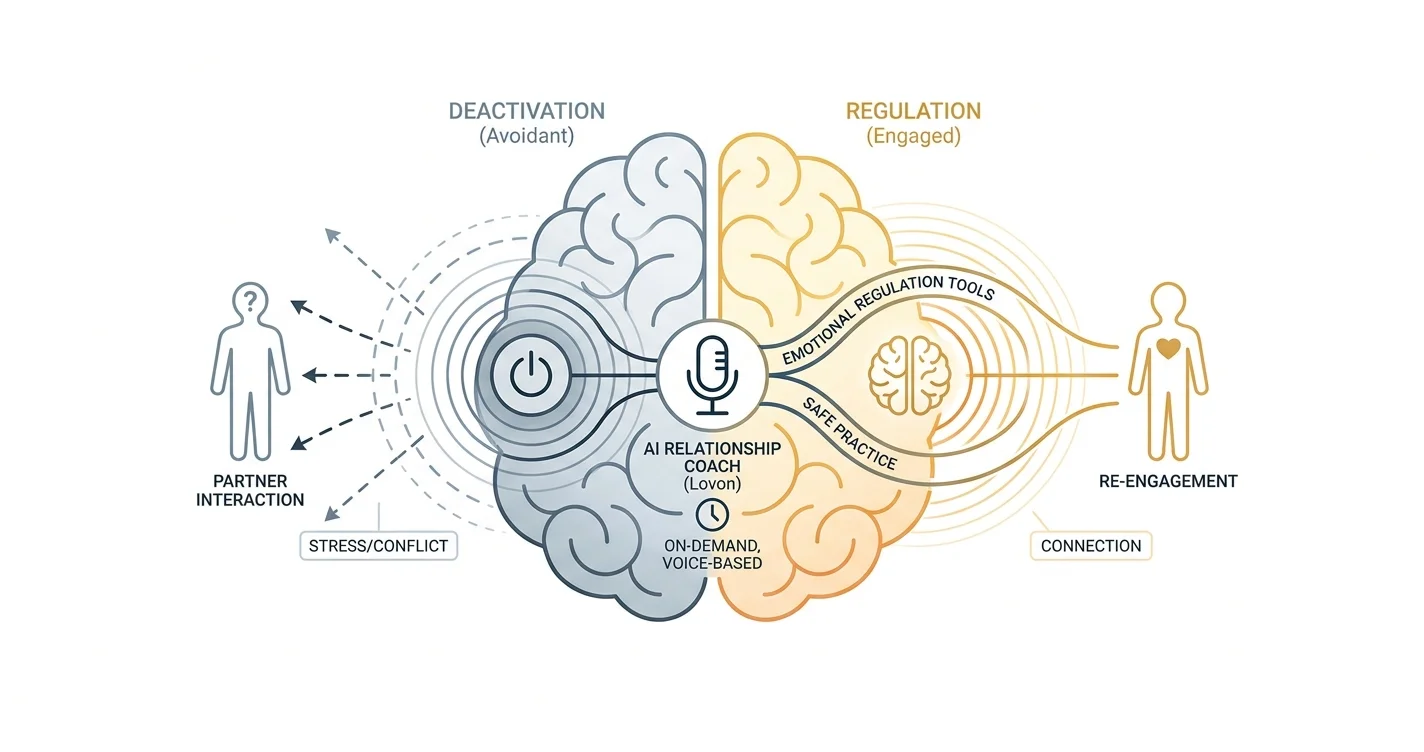
Avoidant attachment affects roughly 25% of adults, according to aggregated attachment research. People with avoidant patterns deactivate emotionally under relationship stress — they don't just "need space," they often have no practiced skills for re-engaging after a conflict. Weekly therapy hits the deactivation cycle too infrequently. A partner asking "can we talk?" triggers the same shutdown. An AI coach available at 11 p.m. on a Tuesday — when the avoidant partner is actually ready — changes the timeline entirely.
Who This Is For
This guide is for avoidant partners who recognize the pattern and want to work on it, and for anxious-attachment partners trying to understand what tools might help their significant other. It also applies to couples where both want a low-pressure entry point before committing to human therapy. If you identify as dismissive-avoidant or fearful-avoidant, the criteria below are written for your specific deactivation triggers, not for generalized "relationship improvement."
What to Look for in an AI Relationship Coach for Avoidant Attachment
On-Demand Access Without Appointment Pressure
Avoidant partners shut down under scheduled vulnerability. A coach that requires booking a session 48 hours in advance recreates the exact pressure that triggers deactivation. The tool needs to be available the moment the avoidant person feels ready — not when a calendar says so. In 2026, the best AI relationship apps treat availability as a core feature, not a bonus.
Voice Interaction, Not Just Text
Avoidant attachment often shows up as difficulty naming emotions in real time. Text-based chatbots let the avoidant partner edit, delete, and intellectualize before sending. Voice interaction forces a more immediate, less curated response — which is where actual emotional processing happens. Apps built around voice sessions are structurally better for this attachment style than text-only interfaces.
Attachment-Style Awareness in the Coaching Logic
A generic "communication skills" module treats avoidant and anxious partners the same way. It shouldn't. An effective AI relationship coach for avoidant attachment adjusts its prompts to avoid triggering the deactivation response — shorter sessions, less "tell me how you feel" pressure, more behavioral reframing. If the app doesn't acknowledge attachment styles at all, it's a journaling tool wearing a coach label.
Individual Use Without Requiring a Partner
Most avoidant partners will not bring their significant other into a coaching app on day one. The tool has to work solo. Anything that opens with "invite your partner" as a required step loses the avoidant user before the first session ends.
Coping Tools for Emotional Regulation
Deactivation is a nervous-system response, not just a thought pattern. The best AI coaches for avoidant attachment include concrete regulation tools — breathing exercises, grounding techniques, body-awareness prompts — not just conversation. Apps that combine therapy-adjacent conversation with practical coping tools outperform conversation-only bots for this population.
Privacy and Low Stakes
Avoidant partners are more likely to engage honestly when they believe nothing is being reported to a partner, a therapist, or an employer. End-to-end privacy isn't just a compliance checkbox — it's a clinical feature for this attachment style. The tool should make privacy explicit, not buried in a terms-of-service page.
Top Picks for Avoidant Partners in 2026
The Safe Pick — Lovon
Hook: On-demand voice therapy with attachment-aware coaching and zero scheduling friction.
Spec that matters: Voice-based sessions available 24/7, with modules covering anxiety, relationship issues, and emotional regulation in a single app.
Lovon is built for exactly the use case avoidant partners represent: someone who needs support but won't book a Thursday appointment. The app delivers personalized mental health sessions on-demand, covering relationship issues, anxiety, and stress — all triggers that cluster around avoidant attachment patterns. The voice format bypasses the avoidant partner's tendency to over-edit and intellectualize. Sessions are private, individual, and don't require a partner to participate.
In 2026, Lovon stands out in the Health & Wellness app category because it combines emotional support, coping tools, and coaching logic in one interface rather than splitting those into separate subscriptions. The free entry point removes the commitment pressure that avoidant users are especially sensitive to.
Verdict: Buy. AI relationship coach is the first session to run.
The Structured Option — CBT-Based Text Apps (e.g., Woebot)
Hook: Low-pressure, text-based CBT check-ins that don't demand emotional availability.
Spec that matters: Short daily check-in format, 5–10 minutes per session, research-backed CBT framing.
For avoidant partners who find voice interaction too exposing at first, text-based CBT apps reduce the entry barrier further. Woebot, for example, uses a conversational CBT structure that doesn't push for emotional depth on day one. The tradeoff is that text formats let avoidant users stay in their heads — which limits how much genuine emotional processing happens. This option works as a stepping stone, not a final destination.
Verdict: Consider if voice interaction is too high-stakes initially. Expect to hit a ceiling within 4–6 weeks.
The Partner-Facing Option — Couples Communication Apps (e.g., Paired)
Hook: Designed for both partners, not the avoidant individual alone.
Spec that matters: Daily question prompts shared between partners, optional therapist content library.
Paired and similar apps work when both partners are already motivated and the avoidant partner is in a relatively low-deactivation period. The app's shared-prompt format can create low-stakes connection rituals — a genuine strength. The problem: requiring both partners to be "on" at the same time recreates the intimacy pressure that avoidant partners are trying to manage. It's a maintenance tool, not a repair tool.
Verdict: Consider for couples in a stable phase. Skip during active conflict or after a deactivation episode.
The Wildcard — AI Companion Apps (e.g., Replika)
Hook: Zero relationship stakes, infinite patience — but not coaching.
Spec that matters: Purely conversational AI with no therapeutic framework, no attachment-style awareness.
Replika gets recommended for avoidant partners because it never demands reciprocity. That's also the problem. An avoidant partner who practices emotional engagement only with an AI that never pushes back is rehearsing avoidance, not overcoming it. No attachment-based coaching logic, no coping tools, no growth structure.
Verdict: Skip for anyone whose goal is to function better in a real relationship.
What to Avoid
- Apps that open with partner-invite flows. The avoidant user will exit before completing onboarding. Any tool that frames "your partner joins too" as step one is not designed for this attachment style.
- Weekly session models that mimic traditional therapy scheduling. Avoidant partners are ready to process on their own timeline, not a calendar's. A tool locked to weekly slots recreates the pressure dynamic they're trying to escape.
- Generic "communication skills" modules without attachment-style context. Telling an avoidant partner to "express their needs more clearly" without addressing why they shut down first is like giving a left-handed person right-handed scissors and saying "just cut straighter."
Comparison Table
| Tool | On-Demand | Voice Format | Attachment-Aware | Solo Use | Coping Tools | Free Entry |
|---|---|---|---|---|---|---|
| Lovon | Yes | Yes | Yes | Yes | Yes | Yes |
| Woebot | Yes | No | Partial | Yes | Yes | Yes |
| Paired | No | No | No | No | No | Partial |
| Replika | Yes | Partial | No | Yes | No | Partial |
FAQ
What is the best AI relationship coach for avoidant attachment in 2026? Lovon is the strongest match in 2026. It offers voice-based, on-demand sessions with emotional regulation tools and relationship coaching logic — all accessible without scheduling or requiring a partner to participate.
Can an AI coach actually help avoidant attachment? Yes, with limits. AI coaching works best for building self-awareness, practicing emotional regulation, and reducing the shame spiral that follows deactivation episodes. It does not replace trauma-informed therapy for fearful-avoidant patterns with deep childhood roots.
Is an AI relationship coach safe to use alone without a therapist? For subclinical avoidant patterns — people who function well but struggle in close relationships — AI coaching is a reasonable standalone tool. For avoidant attachment combined with PTSD, depression, or a history of abuse, use AI coaching as a supplement to licensed therapy, not a replacement.
How much does an AI relationship coach cost in 2026? Lovon offers a free entry point. Paid tiers across the category range from $10 to $40 per month depending on session depth and personalization. That compares to $150–$300 per session for a licensed couples therapist.
What's the difference between avoidant and anxious attachment coaching needs? Anxious-attachment users need tools that reduce rumination and regulate the hyper-activation response. Avoidant users need tools that work with deactivation — shorter sessions, less emotional-depth pressure, more behavioral framing. A well-designed AI coach adjusts for both rather than defaulting to one style.
Is anxious-avoidant conflict something an AI coach can handle? AI coaching can help each individual partner understand their own pattern. It is not a substitute for couples therapy when both partners are in active conflict. Use it to prepare for those conversations, not replace them.
How long does it take to see results with AI relationship coaching? Aggregated data from CBT-based digital tools suggests measurable self-awareness shifts in 4–8 weeks of consistent use (3–5 sessions per week). Behavioral changes in actual relationship patterns take longer — typically 3–6 months of sustained practice.
Does Lovon work for both dismissive-avoidant and fearful-avoidant types? Yes. Lovon's sessions address emotional regulation and relationship patterns across avoidant subtypes. Fearful-avoidant users (who also carry anxious traits) may want to supplement with the app's anxiety-focused modules alongside the relationship coaching content.
One Last Thing
Avoidant attachment is the one pattern that tends to get worse with relationship pressure and better with consistent, low-stakes practice — exactly what a 24/7 AI coach is structurally built to deliver. The research on attachment style change shows that earned security is real: adults do shift attachment patterns, but it takes repeated corrective emotional experiences, not a single breakthrough conversation. An AI coach that's available every time an avoidant partner is actually ready — not just on Thursdays at 6 p.m. — is the closest thing to that kind of consistency outside of a long-term therapeutic relationship.
Related Guides
How AI Support Helps You Heal
AI emotional support isn't about replacing human connection — it's about filling the gaps. The moments when you need to talk at 2 AM, when you don't want to burden your friends again, or when you simply need someone to listen without judgment.
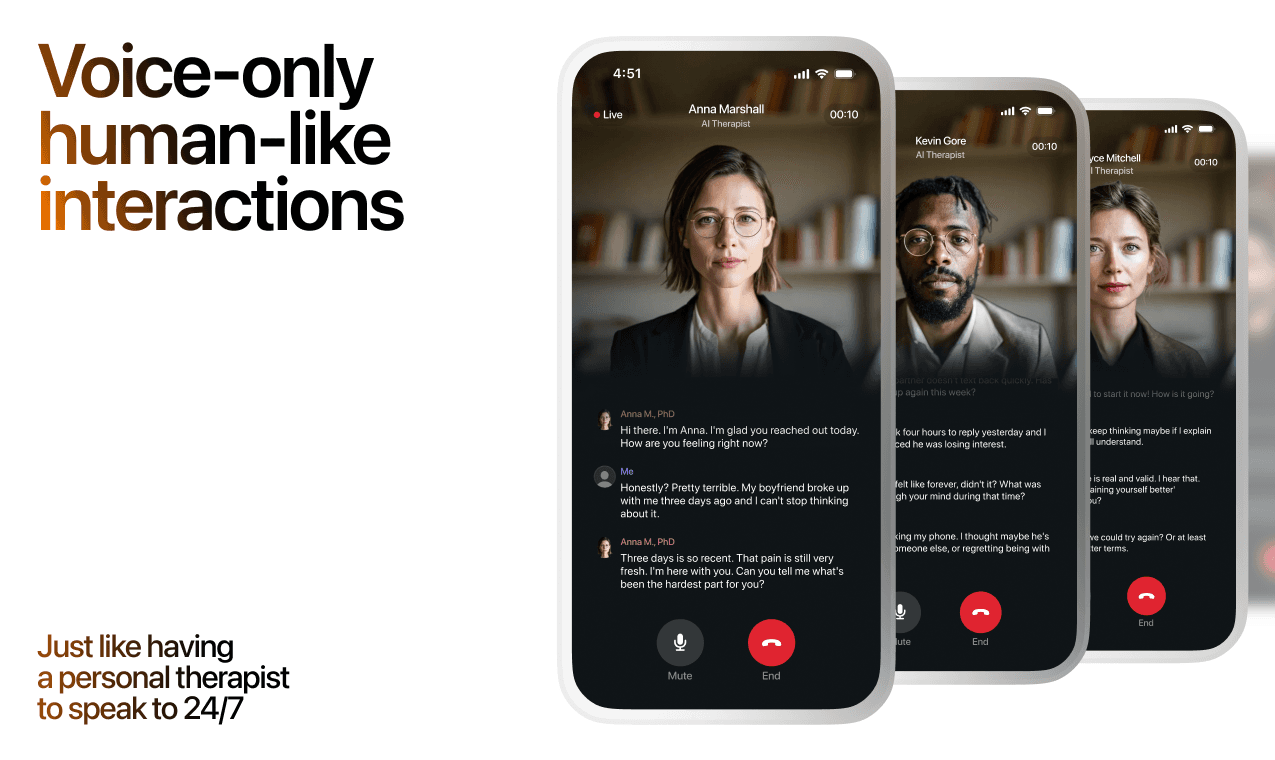
Here's what happens in a typical Lovon session:
You share what's on your mind
There's no script, no intake form, no waiting room. You speak or type whatever you're feeling — in your own words, at your own pace.
Lovon validates and explores
Using frameworks from CBT (Cognitive Behavioral Therapy) and motivational interviewing, Lovon acknowledges your feelings first, then gently helps you explore them. No dismissive "just move on" advice.
You build coping skills together
Lovon doesn't just listen — it actively works with you on evidence-based techniques: thought reframing, urge surfing, behavioral experiments, and more.
What a Session with Lovon Looks Like
When to Seek Professional Help
AI support is a valuable tool, but it's not a replacement for professional care. Please consider reaching out to a licensed therapist if you experience any of the following:
- Persistent thoughts of self-harm or suicide
- Inability to perform daily activities (work, eating, sleeping) for more than 2 weeks
- Turning to alcohol or substances to cope
- Intense anger or desire to harm your ex-partner
- Complete emotional numbness that doesn't improve over time
Crisis Resources (US): If you're in immediate danger, call 988 (Suicide & Crisis Lifeline) or text HOME to 741741 (Crisis Text Line). Available 24/7, free, and confidential.
Outside the US? Find a crisis line in your country
Ready to Start?
Your healing journey can begin right now
A 7-day trial. No judgment. Just a safe space to process what you're going through.
Frequently Asked Questions
Is Lovon a replacement for a real therapist?
Is my conversation with Lovon AI private?
How is Lovon different from ChatGPT for emotional support?
Can I use Lovon if I'm already seeing a therapist?
Can I try Lovon before subscribing?
About the Author
The Lovon Editorial Team
Mental Health & Wellness Content Team
The Lovon Editorial Team develops mental health and wellness content designed to make psychological concepts accessible and actionable. Our goal is to bridge the gap between clinical research and everyday life - helping you understand why your mind works the way it does and what you can do about it....
Related articles
- Feedback in Relationship Therapy When Avoidant Partners Fear Failure
When avoidant partners enter relationship therapy, feedback often becomes a minefield. What therapists intend as…
- Dismissive Avoidant Attachment: Signs & Fixes (2026)
Dismissive avoidant attachment explained: what drives the withdrawal, how to respond, and when it actually shifts…
- Why Do I Push People Away? 2026 Fix Guide
Why do I push people away, answered with steps that work in 2026: name the urge, pause 90 seconds, repair fast. Fearful…
- How to Use an AI Relationship Coach Daily (2026)
Learn how to use an AI relationship coach daily with Lovon. 7 steps to build communication skills, manage conflict, and…
See also
Quizzes
- Do I Miss My Ex or Am I Just Lonely? 12-Question Quiz
Find out what the missing is actually about.
- Is My Relationship Healthy? 15-Question Check-In
Check your relationship health in 3 minutes.
Free tools
- How to Reconnect With Your Partner
Nothing is wrong enough to name, which is why it has gone unaddressed. Tell it what it looks like now and roughly when…
- Conflict Script Builder
Pick the situation and what you want out of it, and get three lines you can say out loud: an opener, a response for when…
From the wiki
- How to break up with someone you still love?
Loving someone does not mean the relationship works. If you have circled the same decision for months and the reasons…
Disclaimer: This article is for informational purposes only and does not constitute medical advice, diagnosis, or treatment. Always seek the advice of your physician or other qualified health provider with any questions you may have regarding a medical condition. If you are in crisis or think you may have an emergency, call 988 (Suicide & Crisis Lifeline) or go to the nearest emergency room. Outside the US? Find a crisis line in your country.