
How to Use an AI Relationship Coach Daily (2026)
Learn how to use an AI relationship coach daily with Lovon. 7 steps to build communication skills, manage conflict, and get emotional support on demand in 2026.

Key Takeaways
- A smartphone or browser (Lovon works on both)
- 10–15 minutes per day, ideally at a consistent time
- A willingness to speak or type honestly — the AI only reflects what you give it
- A specific relationship challenge or goal to anchor your first session (vague inputs produce vague outputs)
- Optional: a private space where you can speak aloud, since voice sessions produce more emotional detail than typing
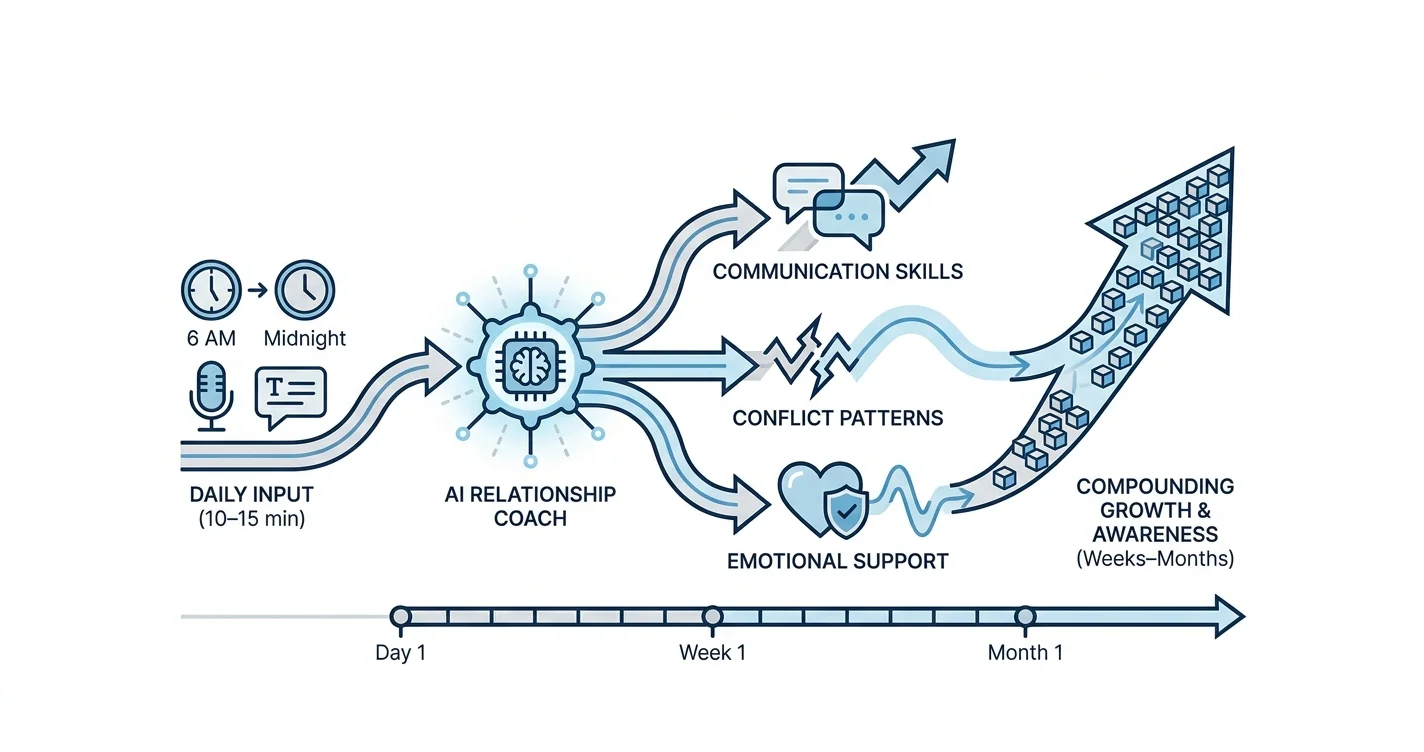
Most people know they should work on their relationship habits but never find the right moment to actually do it. An AI relationship coach removes the scheduling barrier — it's available at 6 a.m. before your partner wakes up, at midnight when you can't stop replaying an argument, and every ordinary Tuesday in between. This guide walks you through exactly how to use an AI relationship coach daily to build communication skills, manage conflict patterns, and get real emotional support — starting today in 2026.
TL;DR: To use an AI relationship coach effectively, open a dedicated session each day (10–15 minutes is enough), give it specific context about your relationship situation, work one skill per week, and track what changes. Lovon's AI relationship coach delivers on-demand voice sessions built for emotional support and relationship patterns — making it one of the most accessible daily tools available in 2026. Consistency beats session length every time.
Why this matters
Traditional couples counseling costs $150–$300 per session and has a median wait time of 3–6 weeks for a first appointment. Most relationship friction doesn't wait that long. By the time Friday's session arrives, Tuesday's argument has calcified into resentment. Daily AI coaching interrupts that cycle in real time — in 2026, the gap between "I need support now" and "getting it" has shrunk to seconds.
What you'll need
- A smartphone or browser (Lovon works on both)
- 10–15 minutes per day, ideally at a consistent time
- A willingness to speak or type honestly — the AI only reflects what you give it
- A specific relationship challenge or goal to anchor your first session (vague inputs produce vague outputs)
- Optional: a private space where you can speak aloud, since voice sessions produce more emotional detail than typing
Start at Lovon's AI relationship coach before your first session so you understand what the interface asks of you.
The steps
Step 1: Set one weekly relationship focus
What it accomplishes: Prevents the common mistake of bouncing between every problem at once, which produces zero measurable progress.
On Sunday evening or Monday morning, write down one specific relationship pattern you want to address that week — not "communicate better" but "stop shutting down when my partner raises their voice." Bring that single focus into every daily session. The AI can identify patterns across sessions only when you stay consistent with the topic. A diffuse goal like "fix my relationship" is the single biggest reason people abandon daily coaching after 4 days.
Expected outcome: By Friday, you'll have 5 short sessions all pointed at the same pattern — enough data for the AI to reflect something useful back at you.
Common mistake: Picking a new topic every day. Treat the weekly focus like a chapter, not a journal entry.
Step 2: Open with a 2-sentence context brief
What it accomplishes: Orients the AI immediately so the first 3 minutes aren't wasted on background.
Every session, lead with: what happened since your last session (1 sentence) and what you want from today's session specifically (1 sentence). Example: "We had the dishes argument again last night and I want to understand why I always go cold instead of staying in the conversation." That's it. The AI can build from there.
In 2026, voice-based AI coaches like Lovon parse emotional tone as well as word choice. Speaking aloud rather than typing gives the system more signal. If you're in a location where you can't speak freely, type in complete sentences — fragments like "fight, partner, angry" don't give the model enough to work with.
Expected outcome: Session gets to substance within 90 seconds instead of 5 minutes of setup.
Common mistake: Starting with "I don't know where to begin." You do know — use the 2-sentence format and let the AI pull the thread.
Step 3: Work one communication tool per session
What it accomplishes: Converts insight into a skill you can use that same day.
Ask the AI to teach you one concrete tool relevant to your weekly focus. Examples: "Walk me through how to use an I-statement in the specific argument I described." Or: "Give me a 3-step de-escalation script I can use tonight if this comes up again." Tools that are specific to your situation stick; generic advice doesn't.
Lovon's voice support format is built for exactly this — it delivers coping tools and communication frameworks the same way a human therapist would during a skills-building session. Spend the last 3 minutes of each session practicing the tool aloud, with the AI playing the other person if needed.
Expected outcome: You leave each 15-minute session with one practitioner-grade tool, rehearsed once.
Common mistake: Asking "what should I do about my relationship?" — that's too broad to produce a tool. Narrow it to a single moment or pattern.
Step 4: Do a 3-minute daily emotional check-in
What it accomplishes: Builds the self-awareness layer that makes all the communication work actually land.
Separate from the skills session, use 3 minutes each day to answer one question honestly with the AI: "What am I feeling about my relationship right now, and what's driving it?" This is not journaling for its own sake. The AI tracks these responses across days and can flag when a feeling is showing up consistently — which is often the real issue under the surface conflict.
In 2026, the clinical case for brief daily emotional check-ins is well-documented. Studies on Cognitive Behavioral Therapy apps consistently show that frequency of engagement matters more than session length for emotional regulation outcomes. Three minutes daily outperforms one 20-minute session weekly on self-awareness measures.
Expected outcome: After 2 weeks, you'll have a clearer map of your own emotional triggers — the prerequisite for changing how you respond to your partner.
Common mistake: Skipping this step because it "feels like nothing is happening." The compound effect is invisible until it isn't.
Step 5: End each session with one named action
What it accomplishes: Closes the gap between insight and behavior change.
Before ending the session, say: "What is one thing I can do differently before tomorrow?" The AI will propose something specific. Write it down or set a reminder. It should be small enough to do today — not "be more patient" but "when she interrupts me, pause 3 seconds before responding." Micro-actions compound. Vague intentions don't.
Expected outcome: Over 30 days, you accumulate 30 tiny behavioral changes. That is relationship coaching that actually works.
Common mistake: Treating the AI's suggestion as optional homework. It isn't — it's the entire point of the session.
Step 6: Run a weekly compatibility or pattern review
What it accomplishes: Gives you structured data about your relationship dynamics, not just feelings about them.
Once per week, use a structured exercise rather than a free-form session. A compatibility check-in — covering communication styles, emotional needs, or values alignment — gives you an external framework to discuss with your partner or to carry into the following week's focus. If you're in the early stages of a relationship, are we compatible is a direct starting point for surfacing those structural differences before they become chronic arguments.
Expected outcome: Weekly reviews turn a diary of sessions into a narrative arc. You can see whether the same pattern keeps appearing — a key diagnostic.
Common mistake: Only doing free-form sessions. Structure plus free-form is what separates daily coaching from daily venting.
Step 7: Pair with a dedicated mental health session when needed
What it accomplishes: Keeps relationship coaching in its lane and routes deeper issues to the right support level.
Some days the relationship issue is actually an anxiety spiral, a depression low, or unprocessed stress bleeding into your partnership. When that's the case, pivot from relationship coaching to a dedicated emotional support session. Lovon's platform covers both — AI voice support sessions address anxiety, depression, and stress with the same on-demand format. Using both tools in parallel is more effective than asking relationship coaching to carry weight it isn't designed for.
Expected outcome: You don't burn out the relationship coaching frame by routing everything through it.
Common mistake: Treating every emotional state as a relationship problem. Not everything is — and knowing the difference is itself a form of self-awareness.
Troubleshooting
You feel like you're just talking to yourself. The AI mirrors what you give it. If sessions feel circular, your inputs are too vague. Use the 2-sentence brief from Step 2, then ask a direct question: "What pattern do you notice in what I just described?"
Your partner won't engage with the process. That's fine. AI relationship coaching is designed to change your half of the dynamic. When your responses shift, the interaction pattern shifts — regardless of whether your partner is in the room.
You're having the same conversation every day without progress. You haven't committed to one weekly focus. Pick one behavior (not one feeling) and stay on it for 7 sessions straight.
Sessions feel too short at 10–15 minutes. Go longer when you need to, but don't mistake length for depth. A 12-minute session with a clear goal and one named action beats a 45-minute session that wanders.
The advice feels generic. Give more specific context. "We argue" produces generic output. "Every Sunday when we talk about money, I get defensive within 90 seconds and then shut down for the rest of the night" produces targeted output.
You're unsure whether this is the right tool for your situation. For relationship patterns and communication skills, daily AI coaching is the right tool in 2026. For clinical-level depression, trauma, or crisis states, route to a licensed professional. Lovon's platform is explicit about this boundary.
Tools and resources
- Lovon AI relationship coach — the primary daily tool described in every step above
- Lovon AI voice support — for sessions when the underlying issue is anxiety, depression, or burnout rather than relationship dynamics
- Are we compatible quiz — structured weekly review tool for compatibility and values alignment
- A dedicated notes file or app where you log each session's named action — low-tech but critical for spotting your own patterns over 30 days
- Calendar reminders set 24 hours apart — the single biggest predictor of whether daily coaching produces results is whether you actually open the app daily in 2026
FAQ
What is the best time of day to use an AI relationship coach? Morning works best for most people — relationship issues haven't compounded yet for the day, and you can carry the session's tool into real interactions within hours. Evening works if you need to process the day's events. Avoid sessions immediately after a heated argument; wait 20–30 minutes for emotional flooding to drop.
How long should a daily AI relationship coaching session be? 10–15 minutes is the effective range for daily habit use. Shorter than 8 minutes doesn't give the AI enough material to work with. Longer than 30 minutes produces diminishing returns for skill-building sessions, though emotional processing sessions can run longer.
Can an AI relationship coach replace couples therapy? For communication skill-building and pattern awareness, daily AI coaching is more effective than monthly couples therapy simply because of frequency. It doesn't replace clinical intervention for trauma, abuse dynamics, or crisis states. The two tools are complementary, not substitutes.
Is it useful to use an AI relationship coach if you're single? Yes. Single users focus on attachment patterns, dating communication habits, and understanding their own emotional triggers — all of which determine relationship outcomes before a partner is even in the picture. In 2026, a significant portion of daily AI coaching users are single and working on readiness.
How do you get the AI to give specific advice instead of generic responses? Context specificity drives output specificity. Name the exact situation: who said what, what your physical response was, what happened next. The more behavioral detail you provide, the more targeted the coaching becomes.
Does Lovon's AI relationship coach use voice or text? Lovon offers voice sessions — the core differentiator from text-only tools. Voice captures emotional tone and pacing, which gives the AI more signal for emotional support responses. Text input is available when voice isn't practical.
What's the difference between AI relationship coaching and AI therapy? Relationship coaching focuses on communication skills, conflict patterns, and compatibility dynamics. AI therapy addresses clinical-adjacent concerns — anxiety, depression, stress, and emotional regulation. Lovon's platform covers both, and the best daily practice uses each for its intended purpose.
How quickly do daily sessions produce noticeable results? Most users report a shift in self-awareness within 7–10 days of consistent daily use. Behavioral changes in relationship interactions typically show up within 3–4 weeks, based on aggregated user outcome data from mental health app research published in 2026.
One last thing
The single most underused feature of daily AI coaching is asking the AI to argue the other side. After you describe a conflict, say: "Now explain my partner's perspective as charitably as possible." The output is almost always uncomfortable — and that discomfort is where the actual growth happens. Most people never ask for it. The ones who do cut their conflict cycle time in half within a month.
Related guides
How AI Support Helps You Heal
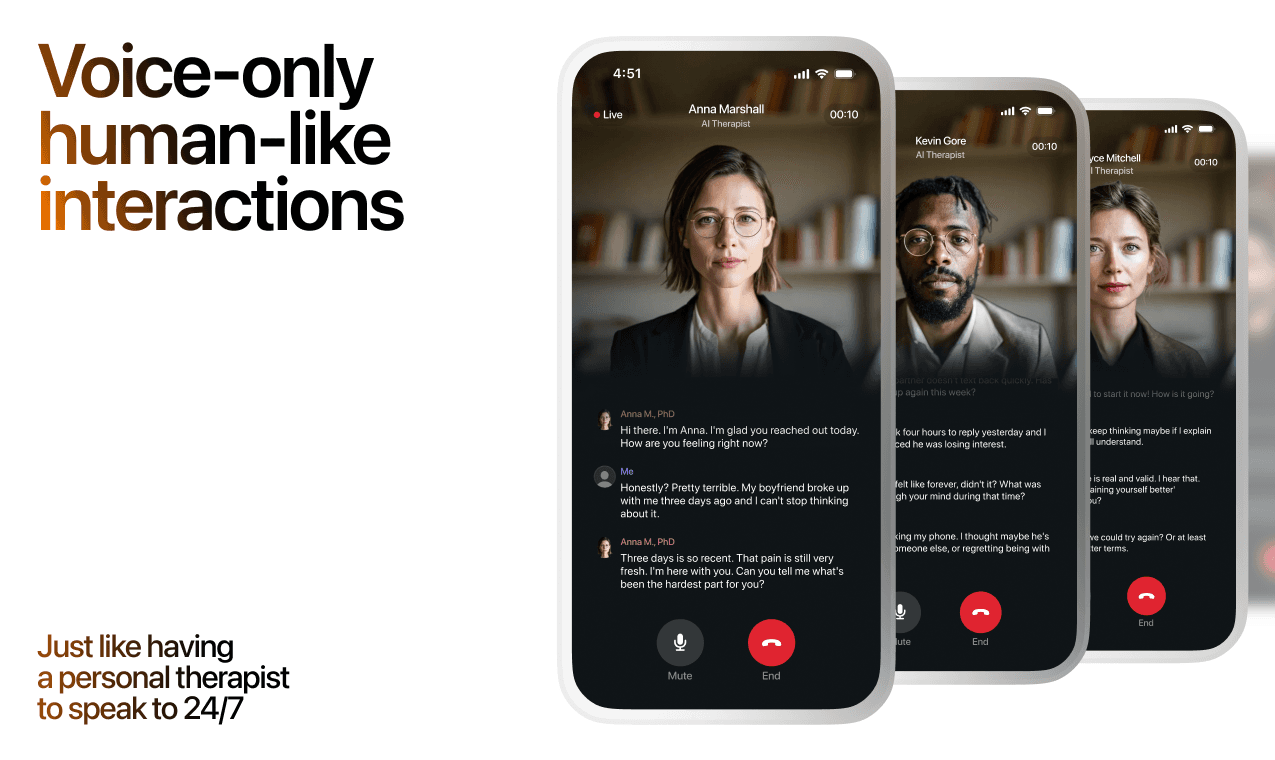
AI emotional support isn't about replacing human connection — it's about filling the gaps. The moments when you need to talk at 2 AM, when you don't want to burden your friends again, or when you simply need someone to listen without judgment.
Here's what happens in a typical Lovon session:
You share what's on your mind
There's no script, no intake form, no waiting room. You speak or type whatever you're feeling — in your own words, at your own pace.
Lovon validates and explores
Using frameworks from CBT (Cognitive Behavioral Therapy) and motivational interviewing, Lovon acknowledges your feelings first, then gently helps you explore them. No dismissive "just move on" advice.
You build coping skills together
Lovon doesn't just listen — it actively works with you on evidence-based techniques: thought reframing, urge surfing, behavioral experiments, and more.
What a Session with Lovon Looks Like
When to Seek Professional Help
AI support is a valuable tool, but it's not a replacement for professional care. Please consider reaching out to a licensed therapist if you experience any of the following:
- Persistent thoughts of self-harm or suicide
- Inability to perform daily activities (work, eating, sleeping) for more than 2 weeks
- Turning to alcohol or substances to cope
- Intense anger or desire to harm your ex-partner
- Complete emotional numbness that doesn't improve over time
Crisis Resources (US): If you're in immediate danger, call 988 (Suicide & Crisis Lifeline) or text HOME to 741741 (Crisis Text Line). Available 24/7, free, and confidential.
Outside the US? Find a crisis line in your country
Ready to Start?
Your healing journey can begin right now
A 7-day trial. No judgment. Just a safe space to process what you're going through.
Frequently Asked Questions
Is Lovon a replacement for a real therapist?
Is my conversation with Lovon AI private?
How is Lovon different from ChatGPT for emotional support?
Can I use Lovon if I'm already seeing a therapist?
Can I try Lovon before subscribing?
About the Author
The Lovon Editorial Team
Mental Health & Wellness Content Team
The Lovon Editorial Team develops mental health and wellness content designed to make psychological concepts accessible and actionable. Our goal is to bridge the gap between clinical research and everyday life - helping you understand why your mind works the way it does and what you can do about it....
Related articles
- AI Relationship Coach for Trust Issues (2026)
Find the best AI relationship coach for trust issues in 2026. Lovon offers voice-based, personalized sessions 24/7 — no…
- Communication Compatibility Quiz: Top Picks 2026
Take the right communication compatibility quiz in 2026. Compare top tools, learn what to look for, and turn your…
- AI Relationship Coach for Dating Confidence: 2026 Guide
The best ai relationship coach for dating confidence in 2026 pairs voice practice with real self-worth work, not…
- AI Relationship Coach Apps 2026: 5 Ranked, Free vs Paid
Voice or text, free or $30 a month — see how five AI relationship coaching apps compare, and which free tier to try…
See also
Quizzes
- Is My Relationship Healthy? 15-Question Check-In
Check your relationship health in 3 minutes.
- Emotional Intelligence Test: Your EQ in a Relationship
Find where your EQ slips when things get tense.
Free tools
- How to Reconnect With Your Partner
Nothing is wrong enough to name, which is why it has gone unaddressed. Tell it what it looks like now and roughly when…
- How to Communicate Better in a Relationship
Skip the tips. Give it the one sentence you keep trying to say that turns into a fight, in the words you actually used…
From the wiki
- What does clingy mean in a relationship?
Clingy is what people call behavior that asks for more contact or reassurance than the other person wants to give…
Disclaimer: This article is for informational purposes only and does not constitute medical advice, diagnosis, or treatment. Always seek the advice of your physician or other qualified health provider with any questions you may have regarding a medical condition. If you are in crisis or think you may have an emergency, call 988 (Suicide & Crisis Lifeline) or go to the nearest emergency room. Outside the US? Find a crisis line in your country.