
Pursuer-Withdrawer Pattern: Break the Cycle in 2026
The pursuer withdrawer relationship cycle traps both partners. Learn the 7 steps to interrupt it, backed by EFT research and attachment science.

Key Takeaways
- Shared language. Both partners need to agree on what "pursuing" and "withdrawing" mean without it becoming an
- 15–20 minutes of uninterrupted time for each structured conversation exercise.
- A signal word or phrase you both pre-agree means "I need a 20-minute pause" — not a permanent shutdown.
- A basic understanding of your attachment style. Pursuers typically run anxious; withdrawers typically run avoidant.
- Optional: A journaling tool or voice app to process your own emotional state before engaging your partner. Lovon's
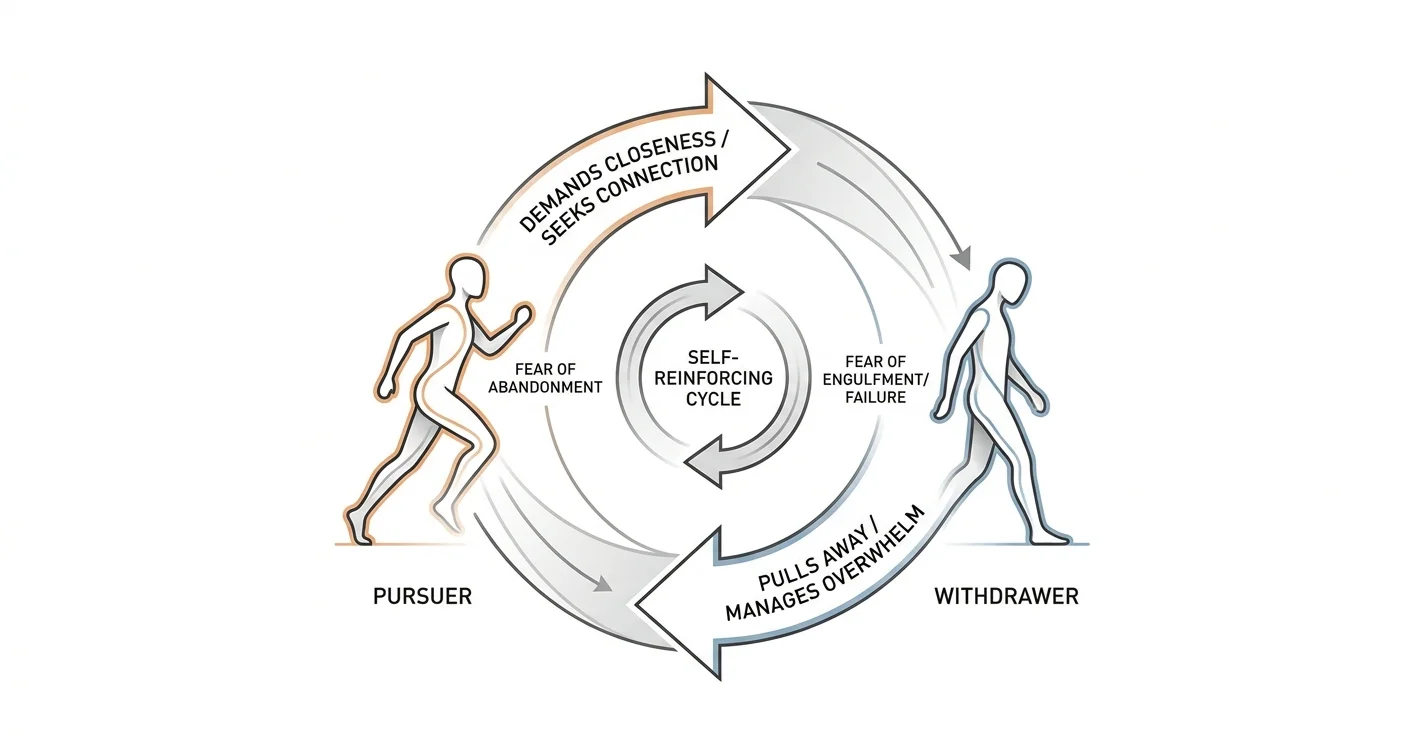
The pursuer-withdrawer relationship pattern is one of the most researched — and most painful — cycles in couples psychology, and in 2026 it still accounts for a significant share of why couples feel stuck even when they love each other.
TL;DR: In a pursuer-withdrawer relationship, one partner pushes for closeness and conversation while the other pulls back to manage overwhelm. The cycle is not a character flaw — it is a predictable attachment response. Breaking it requires both partners to understand their role, slow the escalation, and replace demand-withdraw sequences with structured, lower-stakes check-ins. Lovon's AI voice support can help either partner practice these skills between sessions or before difficult conversations.
Why this matters
Research from the Gottman Institute identifies demand-withdraw — the clinical name for this pattern — as one of the strongest predictors of relationship dissatisfaction and eventual separation. Both roles feel miserable: the pursuer feels abandoned and unheard; the withdrawer feels flooded and controlled. Neither person is wrong. Both are dysregulated. The goal is not to eliminate the difference between you — it is to stop the pattern from running the relationship.
What you'll need
Before you work through the steps below, have these in place:
- Shared language. Both partners need to agree on what "pursuing" and "withdrawing" mean without it becoming an accusation.
- 15–20 minutes of uninterrupted time for each structured conversation exercise.
- A signal word or phrase you both pre-agree means "I need a 20-minute pause" — not a permanent shutdown.
- A basic understanding of your attachment style. Pursuers typically run anxious; withdrawers typically run avoidant. Knowing this reframes the conflict as two nervous systems in conflict, not two bad intentions.
- Optional: A journaling tool or voice app to process your own emotional state before engaging your partner. Lovon's AI voice support works well here — you can talk through what you're feeling at 11 p.m. without waking anyone up.
The steps
Step 1: Name the pattern out loud — together
You cannot fix what you haven't named. Set aside time when neither of you is already activated — not after an argument, not before bed when one person is exhausted. Say something like: "I think we fall into a cycle where I push and you pull back, and it leaves us both feeling worse. Can we talk about that?"
Naming it together in a calm moment depersonalizes it. The enemy becomes the pattern, not each other. This single reframe is where most couples see their first real shift in 2026's evidence-based couples work.
Common mistake: Naming the pattern during a conflict. That feels like an accusation. Save this conversation for a neutral moment.
Step 2: Map your own role — honestly
Each partner identifies which role they most often occupy. This is not always fixed — some people pursue in one relationship and withdraw in another, or switch roles depending on the topic. The question is: in this conflict about this topic, what do you do?
- Pursuer signals: You feel urgency to resolve things now. Silence feels like rejection. You ask the same question multiple times. Your voice rises or your pace speeds up when the other person goes quiet.
- Withdrawer signals: You feel flooded fast. You need silence to think. You interpret questions as attacks. You go quiet, leave the room, or give short answers to make the conversation stop.
Write down 2–3 specific behaviors you recognize in yourself. Specificity matters — "I get emotional" is not as useful as "I follow them into the next room when they try to end the conversation."
Common mistake: Each partner focusing on the other's behaviors instead of their own. This step only works in first person.
Step 3: Interrupt the escalation sequence — early
The cycle has a launch sequence. For most couples it looks like this: pursuer raises a topic → withdrawer gives a short answer → pursuer interprets the short answer as dismissal → pursuer escalates → withdrawer shuts down → pursuer escalates further. The window to interrupt is at step 2 or 3, not step 6.
The withdrawer's job is to say, before full shutdown: "I want to talk about this. I need 20 minutes to calm down first." Then actually return in 20 minutes. If you disappear without a return commitment, the pursuer's anxiety spikes and the cycle restarts immediately.
The pursuer's job is to let the pause happen without filling it with texts, follow-ups, or "are you mad at me?" The pause is not abandonment. It is regulation.
Expected outcome: The first few times you try this, it will feel artificial. That is normal. Interrupting a years-old pattern always feels clunky at first.
Common mistake: The withdrawer agreeing to return but not setting a specific time. "Later" is not a time. "In 20 minutes, back in the kitchen" is.
Step 4: Practice the lower-stakes check-in
Once you can interrupt the cycle, replace the escalation with a structured, lower-stakes format. Emotionally Focused Therapy (EFT), developed by Dr. Sue Johnson, uses a version of this: each partner speaks for 2 minutes without interruption about what they feel and what they need, using "I" statements. The listener reflects back — not rebuts, not problem-solves. Just reflects.
Do this on easy topics first. "I felt unimportant when dinner plans changed without me knowing" is a starting-level topic. "Why don't you ever want to be close to me" is not a starting-level topic for 2026 — that one comes later, after the format feels safe.
Why it matters: The structured format removes the ambiguity that triggers both roles. The pursuer knows they will be heard for 2 full minutes. The withdrawer knows the conversation has a defined endpoint.
Common mistake: The pursuer using their 2 minutes to list grievances rather than feelings. One feeling, one need, per turn.
Step 5: Understand the attachment root
Long-term pattern change requires understanding why you respond the way you do, not just drilling new behaviors. Pursuit behavior is almost always driven by a core fear of abandonment — the nervous system interprets a partner's withdrawal as a threat to the relationship's survival. Withdrawal behavior is almost always driven by a core fear of engulfment or failure — the nervous system interprets emotional pressure as a sign that something is fundamentally wrong.
Both fears are old. They usually predate the relationship by decades. Recognizing that your partner's shutdown is about their nervous system — not contempt for you — changes how the pursuit feels. Recognizing that your partner's pursuit is fear, not aggression, changes how the pressure feels.
If you want to go deeper on attachment dynamics, AI relationship coach for anxious attachment covers the anxious side in detail, and AI relationship coach for avoidant partners addresses the withdrawer's experience specifically.
Common mistake: Using attachment theory as a label rather than a tool. "You're just avoidant" is a dead end. "Your withdrawal makes sense given your history — here's how we work around it" is useful.
Step 6: Build a weekly rhythm
Breaking the cycle is not a one-conversation fix. The pattern developed over months or years of reinforcement. Replacing it requires repetition. Schedule one 15-minute structured check-in per week — not during a conflict, not as a crisis response. Just a standing, low-pressure conversation about how each person is feeling in the relationship.
Pairs who do this consistently report that fewer conflicts escalate to the full pursue-withdraw cycle because small disconnections get addressed before they compound. Think of it as maintenance, not repair.
Expected outcome: After 4–6 weeks of consistent practice, the escalation window lengthens. You'll catch the pattern earlier.
Step 7: Know when to bring in professional support
These steps work for the everyday version of the pursuer-withdrawer pattern. If the cycle is layered over unresolved trauma, infidelity, addiction, or one partner's clinical anxiety or depression, self-guided work has a ceiling. A licensed couples therapist trained in EFT or the Gottman Method is the right next step. Lovon is designed as a between-session support tool — it is not a replacement for clinical care, and the app says so plainly.
Troubleshooting
"We tried the pause, but the pursuer won't stop texting during it." The pause agreement needs to include no-contact rules. Agree explicitly: no texts, no checking in at the door. The withdrawer stays in contact only at the agreed return time.
"The withdrawer keeps saying they need space but never comes back to finish the conversation." This is stonewalling, not regulation. The difference: regulation has a return commitment and follows through. Stonewalling is indefinite silence used to avoid the topic. If this is the pattern, a therapist can help distinguish the two.
"I'm the only one doing the work." One-sided effort maintains the cycle in a different form. Both partners need to recognize their role. If your partner refuses to engage with any of these steps after repeated, calm invitations, that is information worth taking seriously — and worth talking through with a professional.
"We're fine for a week, then the cycle restarts." Relapse is normal, especially in the first 60 days. When it happens, name it fast: "I think we just did the thing again." A light, non-accusatory callout mid-cycle is easier to absorb than a post-mortem afterward.
"I don't know which role I play." Some people genuinely switch. Track one full conflict from trigger to resolution and note your behaviors at each stage. The role that causes you the most distress is usually the one you occupy most often.
"We both withdraw." Double-withdrawal couples exist. Conflict gets suppressed rather than escalated, and resentment builds silently. The check-in rhythm in Step 6 is especially important here — it creates a structured opening for topics that would otherwise never surface.
Tools and resources
- Emotionally Focused Therapy (EFT): The clinical framework most supported by research for demand-withdraw cycles, developed by Dr. Sue Johnson.
- Gottman Institute research: Their 40-year longitudinal data on demand-withdraw as a predictor of divorce is the most-cited evidence base in this area.
- Lovon: Use it to practice "I" statements out loud, talk through your own emotional state before a hard conversation, or debrief after a cycle without needing your partner to be available. The AI voice companion on Lovon is available any time — 2 a.m. after an argument counts.
- AI couples therapy for communication problems — a deeper look at communication repair tools for couples.
FAQ
What is a pursuer-withdrawer relationship? It is a conflict cycle where one partner consistently seeks more closeness or resolution (the pursuer) and the other consistently pulls back to manage emotional overwhelm (the withdrawer). The pattern is self-reinforcing: the more one pursues, the more the other withdraws, and vice versa.
Is the pursuer always the problem? No. Both roles maintain the cycle. The pursuer's escalation drives the withdrawer deeper into shutdown; the withdrawer's silence drives the pursuer's escalation. Neither role is more to blame. Both need to shift behavior for the cycle to break.
Can you change which role you play? Yes. Role assignment is not fixed. People often shift roles depending on the topic, the relationship, or the phase of life. The goal is not to change who you are — it is to recognize the pattern and interrupt it early.
How long does it take to break the pursuer-withdrawer cycle? Most couples doing consistent structured work see measurable change in 4–8 weeks. The cycle rarely disappears completely, but the escalation window lengthens and the recovery time shortens. Deep-rooted patterns tied to childhood attachment can take longer with professional support.
Is this the same as anxious-avoidant attachment? Almost always, yes. Anxious attachment maps closely to the pursuer role; avoidant attachment maps closely to the withdrawer role. Understanding your attachment style gives you a fuller picture of why the pattern feels so automatic.
What if only one partner wants to work on it? One-partner effort can slow the cycle but rarely breaks it fully. Structural change requires both people to shift their role. Bringing research-backed framing to the conversation — "this is a pattern, not a character flaw" — sometimes creates an opening for a reluctant partner.
When should we see a therapist instead of self-guiding? If the cycle includes contempt, stonewalling lasting more than 24 hours, physical escalation, or underlies clinical depression or anxiety in either partner, see a licensed couples therapist. Self-guided tools work best for the everyday version of the pattern.
Does the pursuer-withdrawer pattern predict divorce? Gottman Institute research identifies demand-withdraw as one of four communication patterns most predictive of relationship breakdown. Identifying and interrupting it early is one of the highest-leverage moves a couple can make in 2026.
One last thing
The pursuer-withdrawer pattern survives not because couples are incompatible, but because both partners are trying to protect the relationship using strategies that accidentally destroy it. The pursuer pushes because they fear losing the connection. The withdrawer retreats because they fear making things worse. The moment both partners can hold that truth at the same time — even briefly — the cycle loses its automatic quality. That moment of shared understanding is where real change starts.
Related guides
How AI Support Helps You Heal
AI emotional support isn't about replacing human connection — it's about filling the gaps. The moments when you need to talk at 2 AM, when you don't want to burden your friends again, or when you simply need someone to listen without judgment.
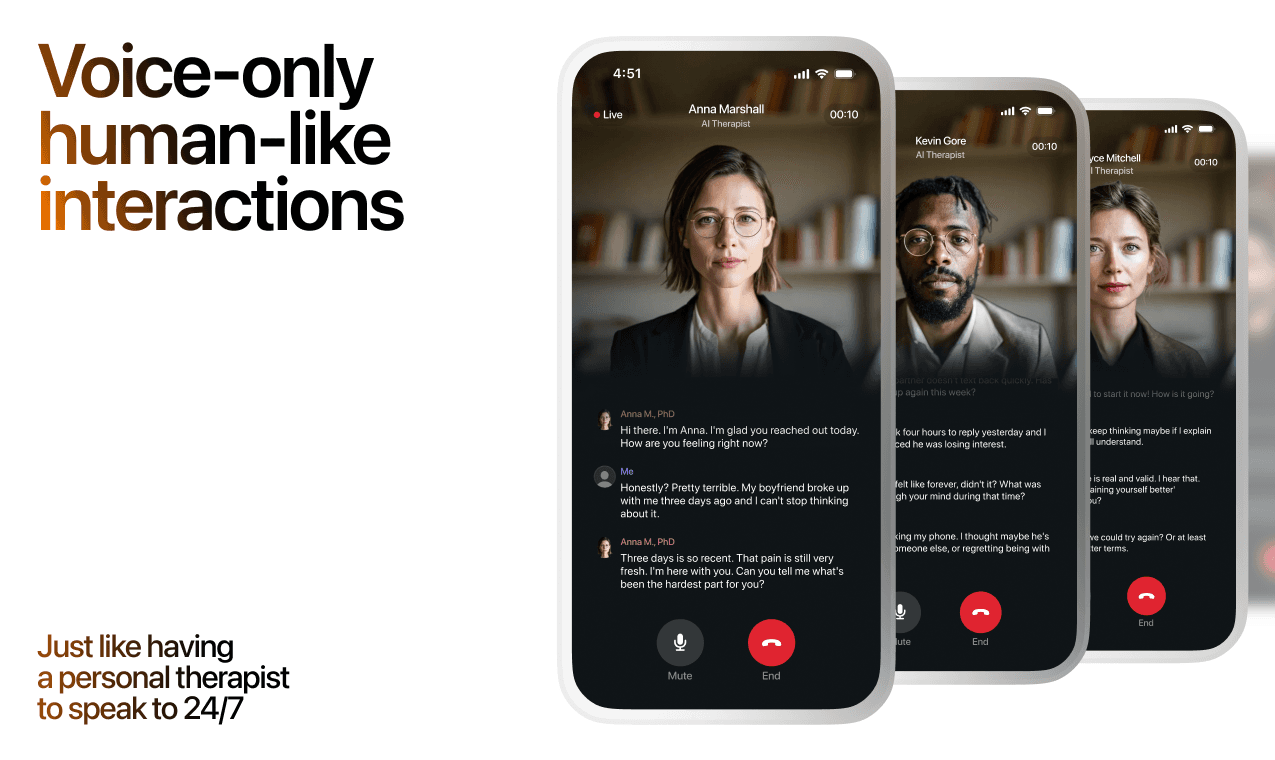
Here's what happens in a typical Lovon session:
You share what's on your mind
There's no script, no intake form, no waiting room. You speak or type whatever you're feeling — in your own words, at your own pace.
Lovon validates and explores
Using frameworks from CBT (Cognitive Behavioral Therapy) and motivational interviewing, Lovon acknowledges your feelings first, then gently helps you explore them. No dismissive "just move on" advice.
You build coping skills together
Lovon doesn't just listen — it actively works with you on evidence-based techniques: thought reframing, urge surfing, behavioral experiments, and more.
What a Session with Lovon Looks Like
When to Seek Professional Help
AI support is a valuable tool, but it's not a replacement for professional care. Please consider reaching out to a licensed therapist if you experience any of the following:
- Persistent thoughts of self-harm or suicide
- Inability to perform daily activities (work, eating, sleeping) for more than 2 weeks
- Turning to alcohol or substances to cope
- Intense anger or desire to harm your ex-partner
- Complete emotional numbness that doesn't improve over time
Crisis Resources (US): If you're in immediate danger, call 988 (Suicide & Crisis Lifeline) or text HOME to 741741 (Crisis Text Line). Available 24/7, free, and confidential.
Outside the US? Find a crisis line in your country
Ready to Start?
Your healing journey can begin right now
A 7-day trial. No judgment. Just a safe space to process what you're going through.
Frequently Asked Questions
Is Lovon a replacement for a real therapist?
Is my conversation with Lovon AI private?
How is Lovon different from ChatGPT for emotional support?
Can I use Lovon if I'm already seeing a therapist?
Can I try Lovon before subscribing?
About the Author

The Lovon Editorial Team
Mental Health & Wellness Content Team
The Lovon Editorial Team develops mental health and wellness content designed to make psychological concepts accessible and actionable. Our goal is to bridge the gap between clinical research and everyday life - helping you understand why your mind works the way it does and what you can do about it....
Related articles
- Stonewalling in Relationships: Why It Happens (2026)
Stonewalling in relationships explained: why partners shut down mid-conflict, how to interrupt it, and when to get…
- Is couples therapy worth it if one partner refuses?
Is couples therapy worth it if one partner refuses? Individual support can help you decide what to do, but it cannot…
- AI Relationship Coach for Open Relationships (2026)
Lovon's AI relationship coach for open relationships handles jealousy check-ins and boundary rehearsal in 2026 — see…
- AI Relationship Advice for Long-Distance Couples 2026
The best AI relationship advice for long-distance couples in 2026. Lovon's voice-based AI coach gives on-demand support…
See also
Quizzes
- Toxic Femininity Test: Are You Running an Old Script?
See which learned script is running your relationship.
- Is My Relationship Healthy? 15-Question Check-In
Check your relationship health in 3 minutes.
Free tools
- Relationship Check-In Questions, and How to Run One
Check-ins fail on structure, not on questions. Tell it whether this would be your first one, what is on your mind, and…
- Conflict Script Builder
Pick the situation and what you want out of it, and get three lines you can say out loud: an opener, a response for when…
From the wiki
- What is a break in a relationship?
A break is a temporary, agreed pause in a relationship where both people expect to come back. In practice it usually…
Disclaimer: This article is for informational purposes only and does not constitute medical advice, diagnosis, or treatment. Always seek the advice of your physician or other qualified health provider with any questions you may have regarding a medical condition. If you are in crisis or think you may have an emergency, call 988 (Suicide & Crisis Lifeline) or go to the nearest emergency room. Outside the US? Find a crisis line in your country.