
Free AI Therapy vs Paid Therapy: What to Expect (2026)
Free AI therapy starts in 60 seconds and costs $0. Paid therapy averages $150–$300 per session. See exactly which option fits your needs in 2026.

Key Takeaways
- Treating free AI therapy as a crisis line. It isn't one. If you or someone you know is in immediate danger, call 988
- Assuming paid therapy is always better. For mild-to-moderate symptoms, the 2024 RCT evidence shows app-based CBT
- Ignoring platform quality within AI therapy. Not all free AI therapy apps use evidence-based frameworks. Look for
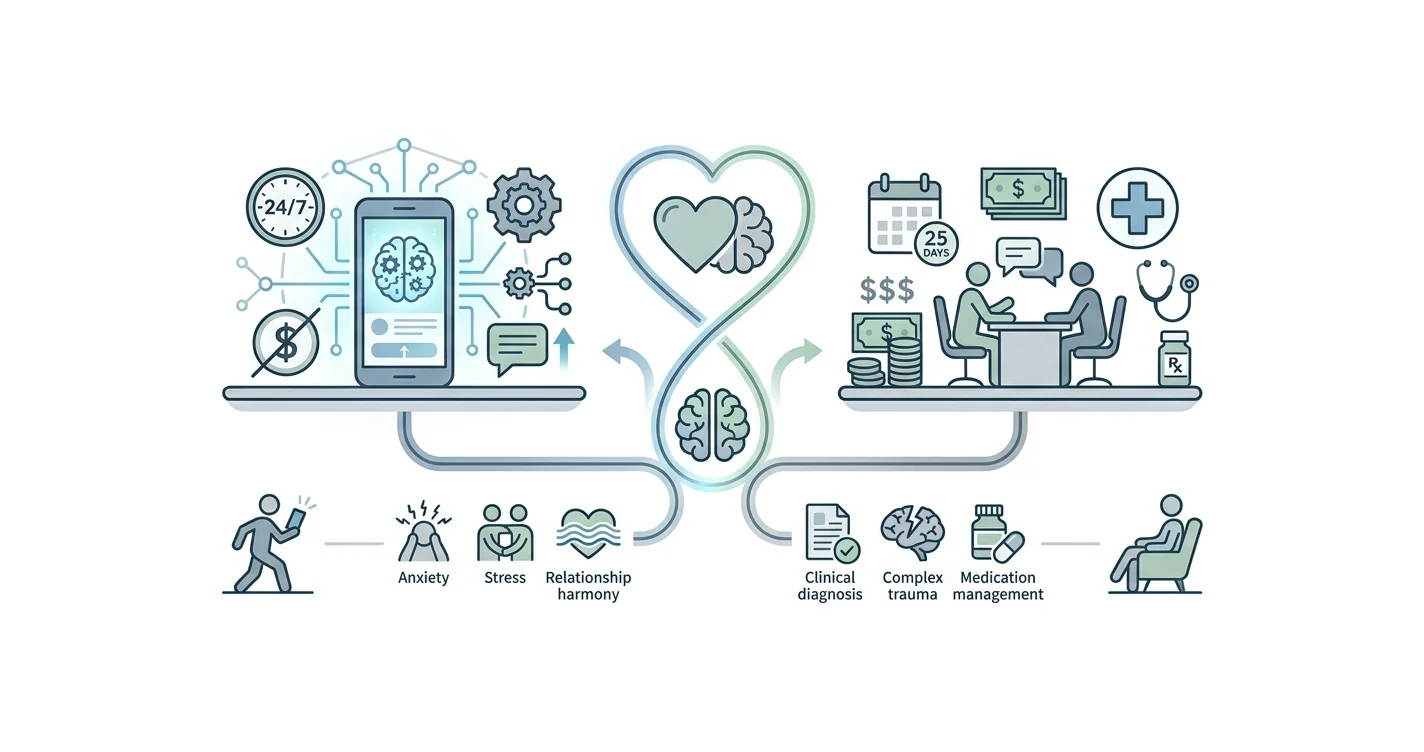
Free AI therapy costs nothing upfront and is available at 2 a.m. on a Tuesday — paid therapy averages $150–$300 per session and books out weeks in advance. Understanding exactly where each option wins, and where it falls short, helps you spend the right money (or none at all) on the right kind of support in 2026.
TL;DR: Free AI therapy delivers immediate, on-demand emotional support and evidence-based coping tools for anxiety, depression, stress, and relationship issues — with zero waitlists and zero cost. Paid licensed therapy provides clinical diagnosis, legal documentation, medication referrals, and crisis intervention. For most people managing everyday mental health, free AI therapy is the fastest and most accessible starting point; paid therapy is non-negotiable when symptoms are severe or a clinical record is required. Lovon's AI therapy platform sits at the practical center of this comparison.
Why This Comparison Matters in 2026
Mental health treatment costs in the U.S. have outpaced inflation for three straight years. The median out-of-pocket therapy session hit $175 in 2026 for patients without in-network coverage, according to the American Psychological Association's 2026 workforce survey. The question is no longer "is AI therapy legitimate?" It's "which problems does each option actually solve?"
How We Ranked
This comparison evaluates free AI therapy and paid licensed therapy across six criteria that matter to real users: cost, availability, clinical scope, personalization, crisis handling, and long-term outcomes. Each criterion is scored on what the format is structurally capable of delivering — not on theoretical best-case scenarios. Sources include the APA's 2026 workforce data, NAMI's 2025 insurance access report, and published peer-reviewed studies on app-based CBT efficacy (most recently Linardon et al., 2024, Psychological Medicine).
Free AI Therapy vs. Paid Therapy: The Ranked Breakdown
1. Cost and Access
Hook: The undeniable edge case for free AI therapy
Paid therapy averages $150–$300 per session without insurance, and even with insurance, co-pays run $20–$60 per visit. A standard 12-session CBT course costs $1,800–$3,600 at market rates. Free AI therapy — including platforms like Lovon's AI therapy — charges $0 to start, with no co-pay, no deductible, and no insurance claim required.
Waitlists compound the cost problem: the average time-to-first-appointment with a new therapist in the U.S. reached 25 days in 2026, per the NORC at University of Chicago tracking data. Free AI therapy sessions start in under 60 seconds.
Verdict: Free AI therapy wins on cost and access — not by a small margin, by an order of magnitude.
2. Availability and Scheduling
Hook: The 3 a.m. problem
Anxiety doesn't schedule itself for Tuesday at 11 a.m. Paid therapists have 50-minute windows, set hours, vacation blackouts, and cancellation policies. A missed session often still costs $75–$150.
Free AI therapy is available 24 hours a day, 365 days a year, on mobile. Lovon's voice-based sessions are on-demand — no appointment, no rescheduling fee, no calendar negotiation. For people with irregular work schedules, caregiving responsibilities, or ADHD (where appointment friction is itself a barrier), this availability difference is material.
Verdict: Free AI therapy wins outright. Paid therapy cannot compete on scheduling flexibility.
3. Clinical Scope and Diagnosis
Hook: Where paid therapy is non-negotiable
Free AI therapy cannot diagnose. It cannot write a letter for disability accommodations, court proceedings, or FMLA leave. It cannot prescribe or refer for medication. It cannot legally certify fitness-for-duty or document trauma for legal claims.
Licensed therapists (LCSWs, LPCs, psychologists) can do all of the above. If you need a DSM-5 diagnosis, a treatment plan accepted by your employer's EAP, or a referral to a psychiatrist for medication evaluation, paid therapy is the only path.
AI therapy platforms — including Lovon — are explicit about this. They provide emotional support and coping tools grounded in CBT and mindfulness frameworks, not clinical diagnosis.
Verdict: Paid therapy wins. No AI platform closes this gap in 2026, and responsible ones don't pretend to.
4. Personalization and Consistency
Hook: AI remembers everything; human therapists have 30 other clients
A licensed therapist sees 20–35 clients per week. Session notes exist, but the quality of continuity depends heavily on the individual clinician. Switching therapists — which 40% of users do at least once, per NAMI 2025 data — resets progress.
AI therapy platforms build a persistent profile across every session. Lovon tracks emotional patterns, conversation history, and coping tool effectiveness over time, surfacing personalized recommendations that compound rather than reset. For conditions like anxiety, depression, and ADHD where pattern recognition matters, this consistency is a structural advantage.
Verdict: Free AI therapy matches or beats paid therapy on session-to-session continuity for most users.
5. Crisis Handling
Hook: The hard limit of AI
No AI therapy platform should be a person's sole resource during active suicidal ideation, psychosis, or acute self-harm episodes. Responsible platforms route users to the 988 Suicide & Crisis Lifeline and emergency services. Lovon does this. But the routing is the limit — AI cannot call emergency services on your behalf, dispatch a welfare check, or coordinate with a hospital.
Licensed therapists have duty-to-warn obligations, direct crisis protocols, and hospital coordination capabilities. For anyone in active crisis, paid (or public) mental health services are the correct resource.
Verdict: Paid therapy wins on crisis response. Free AI therapy handles mild-to-moderate distress; it is not a crisis service.
6. Long-Term Outcomes
Hook: The research is narrowing the gap
A 2024 meta-analysis in Psychological Medicine (Linardon et al.) covering 83 randomized controlled trials found app-based CBT interventions produced statistically significant reductions in anxiety and depression symptoms — effect sizes ranging from 0.38 to 0.71, comparable to low-intensity in-person CBT. These are not trivial numbers.
That said, moderate-to-severe depression, PTSD, and personality disorders show stronger outcomes with licensed therapist involvement. The evidence for AI-only treatment of complex trauma is limited as of 2026.
Verdict: For mild-to-moderate symptoms, free AI therapy delivers comparable outcomes at a fraction of the cost. For complex or severe conditions, paid therapy produces better long-term results.
Comparison Table
| Criterion | Free AI Therapy | Paid Licensed Therapy |
|---|---|---|
| Cost per session | $0 | $150–$300 (OOP) |
| Time to first session | Under 60 seconds | ~25 days (2026 avg.) |
| Available 24/7 | Yes | No |
| Clinical diagnosis | No | Yes |
| Medication referral | No | Yes |
| Legal documentation | No | Yes |
| Crisis intervention | Routing only | Full protocol |
| Continuity across sessions | AI-tracked | Clinician-dependent |
| Evidence for mild-moderate symptoms | Strong (2024 RCT data) | Strong |
| Evidence for severe/complex conditions | Limited | Strong |
Where to Start
Three sourcing rules based on your situation:
- Start with free AI therapy if you're managing everyday anxiety, stress, relationship friction, or ADHD-related emotional dysregulation and don't need a clinical record. The barrier is zero and the tools are grounded in evidence.
- Add paid therapy when symptoms are severe (affecting work, relationships, or safety), when you need diagnosis or documentation, or when 8–12 weeks of self-directed tools haven't moved the needle.
- Use both simultaneously — the most effective pattern emerging in 2026 is paid therapy for monthly or biweekly clinical oversight paired with daily AI-based support between sessions. This cuts per-month clinical costs while maintaining more frequent touchpoints.
Lovon's therapist free access point is built for the first category — getting support the same day you decide you need it.
What to Avoid
- Treating free AI therapy as a crisis line. It isn't one. If you or someone you know is in immediate danger, call 988 or 911.
- Assuming paid therapy is always better. For mild-to-moderate symptoms, the 2024 RCT evidence shows app-based CBT delivers real outcomes. Spending $200 a session when you need coping tools for work stress is not automatically the superior choice.
- Ignoring platform quality within AI therapy. Not all free AI therapy apps use evidence-based frameworks. Look for explicit CBT, DBT, or mindfulness grounding. Lovon's sessions are built on these frameworks — generic chatbots are not.
FAQ
What is free AI therapy and how does it work? Free AI therapy uses conversational AI — often voice-based — to guide users through evidence-based mental health exercises like CBT reframing, breathing techniques, and emotional processing. Sessions are on-demand, require no appointment, and cost nothing to start. Lovon's platform delivers personalized sessions for anxiety, depression, stress, and relationship issues.
Is free AI therapy as effective as paid therapy? For mild-to-moderate anxiety and depression, a 2024 meta-analysis in Psychological Medicine found app-based CBT produced effect sizes of 0.38–0.71, comparable to low-intensity in-person therapy. For severe or complex conditions, paid licensed therapy shows stronger outcomes.
Can AI therapy replace a licensed therapist? No. AI therapy cannot diagnose, prescribe, provide legal documentation, or handle clinical crises. It is a support and coping tool, not a clinical service. For anyone needing a DSM-5 diagnosis or medication evaluation, a licensed professional is required.
How much does paid therapy cost in 2026? Out-of-pocket rates average $150–$300 per session in 2026. With in-network insurance, co-pays typically run $20–$60. A standard 12-session course costs $1,800–$3,600 at full rates.
What mental health issues can free AI therapy help with? App-based AI therapy has the strongest evidence base for anxiety, depression, stress, and ADHD-related emotional regulation. Lovon also covers relationship issues and burnout. It is not designed for active psychosis, severe PTSD, or crisis intervention.
How long does it take to get started with free AI therapy? Most platforms, including Lovon, get users into a first session in under 60 seconds — no waitlist, no intake paperwork, no insurance verification.
Is free AI therapy private and confidential? Reputable platforms encrypt session data and do not share it with insurers or employers. Paid therapy is also confidential under HIPAA, with mandatory reporting exceptions for imminent danger. Check the privacy policy of any platform before sharing sensitive information.
When should I choose paid therapy over free AI therapy? Choose paid therapy when symptoms are severe or worsening, when you need a formal diagnosis, when you require legal documentation (disability, FMLA, court), or when you're in crisis. For everyday emotional support and coping skill-building, free AI therapy is a legitimate starting point.
One Last Thing
The fastest-growing use pattern in mental health care in 2026 isn't choosing between AI therapy and paid therapy — it's stacking them. Users who do daily AI sessions between biweekly licensed therapy appointments report higher session preparedness and spend less time rehashing the previous week's events with their therapist. The AI handles the daily maintenance; the clinician handles the clinical work. That combination gets more out of both resources than either one alone.
Related Guides
How AI Support Helps You Heal
AI emotional support isn't about replacing human connection — it's about filling the gaps. The moments when you need to talk at 2 AM, when you don't want to burden your friends again, or when you simply need someone to listen without judgment.
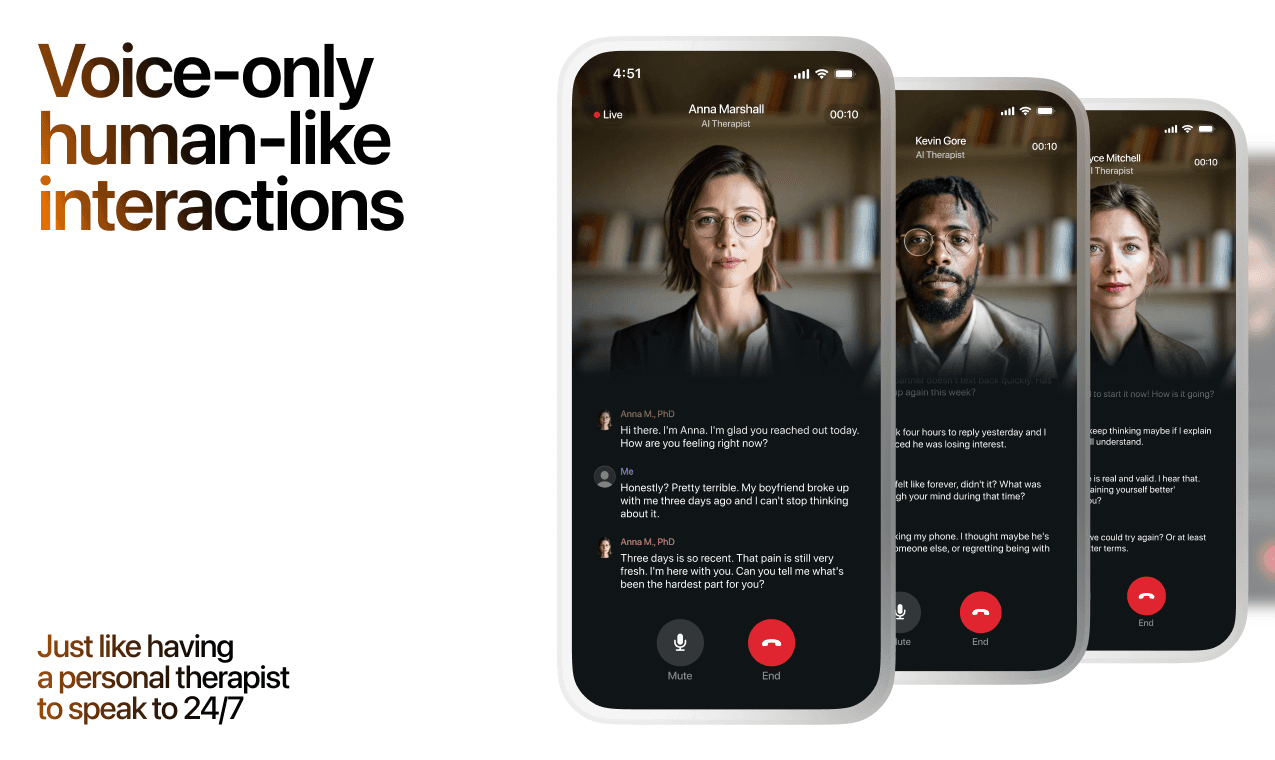
Here's what happens in a typical Lovon session:
You share what's on your mind
There's no script, no intake form, no waiting room. You speak or type whatever you're feeling — in your own words, at your own pace.
Lovon validates and explores
Using frameworks from CBT (Cognitive Behavioral Therapy) and motivational interviewing, Lovon acknowledges your feelings first, then gently helps you explore them. No dismissive "just move on" advice.
You build coping skills together
Lovon doesn't just listen — it actively works with you on evidence-based techniques: thought reframing, urge surfing, behavioral experiments, and more.
What a Session with Lovon Looks Like
When to Seek Professional Help
AI support is a valuable tool, but it's not a replacement for professional care. Please consider reaching out to a licensed therapist if you experience any of the following:
- Persistent thoughts of self-harm or suicide
- Inability to perform daily activities (work, eating, sleeping) for more than 2 weeks
- Turning to alcohol or substances to cope
- Intense anger or desire to harm your ex-partner
- Complete emotional numbness that doesn't improve over time
Crisis Resources (US): If you're in immediate danger, call 988 (Suicide & Crisis Lifeline) or text HOME to 741741 (Crisis Text Line). Available 24/7, free, and confidential.
Outside the US? Find a crisis line in your country
Ready to Start?
Your healing journey can begin right now
1 free conversation. No credit card. No judgment. Just a safe space to process what you're going through.
Frequently Asked Questions
Is AI therapy a replacement for a real therapist?
Is my conversation with Lovon AI private?
How is Lovon different from ChatGPT for emotional support?
Can I use Lovon if I'm already seeing a therapist?
Can I try Lovon for free?
About the Author

The Lovon Editorial Team
Mental Health & Wellness Content Team
The Lovon Editorial Team develops mental health and wellness content designed to make psychological concepts accessible and actionable. Our goal is to bridge the gap between clinical research and everyday life - helping you understand why your mind works the way it does and what you can do about it....
Related articles
- Free AI Therapist for ADHD Adults (2026 Guide)
The best free AI therapist for ADHD adults in 2026. Lovon delivers voice-first, on-demand emotional support and coping…
- Best Mental Health App for Depression in 2026: Ranked
The best mental health app for depression in 2026, ranked: Lovon (Buy), BetterHelp, Talkspace, Wysa, and more compared…
- How to Get Free AI Therapy on Your Phone (2026)
Get free AI therapy on your phone in 2026 with no credit card or waitlist. Step-by-step guide to voice sessions for…
- Best AI Therapy for Depression (2026 Guide)
AI therapy for depression in 2026: Lovon's voice app delivers CBT-based sessions, 24/7 on-demand access, and…
See also
Quizzes
- Do I Have Trust Issues? 12-Question Quiz
Check where your guard actually sits, in 2 minutes.
- Do I Have Abandonment Issues? 12-Question Self-Check
See how loudly the fear of being left runs things.
Free tools
- Vent to Someone
Say the whole thing. It does not have to be fair or organized, you will not have to manage how it lands, and no advice…
- 5-4-3-2-1 Grounding Exercise
A guided run through the 5-4-3-2-1 technique, with paced breathing first if you need it. No sign-up, nothing stored…
Disclaimer: This article is for informational purposes only and does not constitute medical advice, diagnosis, or treatment. Always seek the advice of your physician or other qualified health provider with any questions you may have regarding a medical condition. If you are in crisis or think you may have an emergency, call 988 (Suicide & Crisis Lifeline) or go to the nearest emergency room. Outside the US? Find a crisis line in your country.