
How to Get Free AI Therapy on Your Phone (2026)
Get free AI therapy on your phone in 2026 with no credit card or waitlist. Step-by-step guide to voice sessions for anxiety, depression, stress, and ADHD.

Key Takeaways
- A smartphone running iOS 16+ or Android 10+
- A stable internet connection (Wi-Fi or LTE)
- A browser or the Lovon app (no app store download required to start)
- Headphones — voice-first sessions work better with audio
- 15–30 minutes of uninterrupted time for your first session
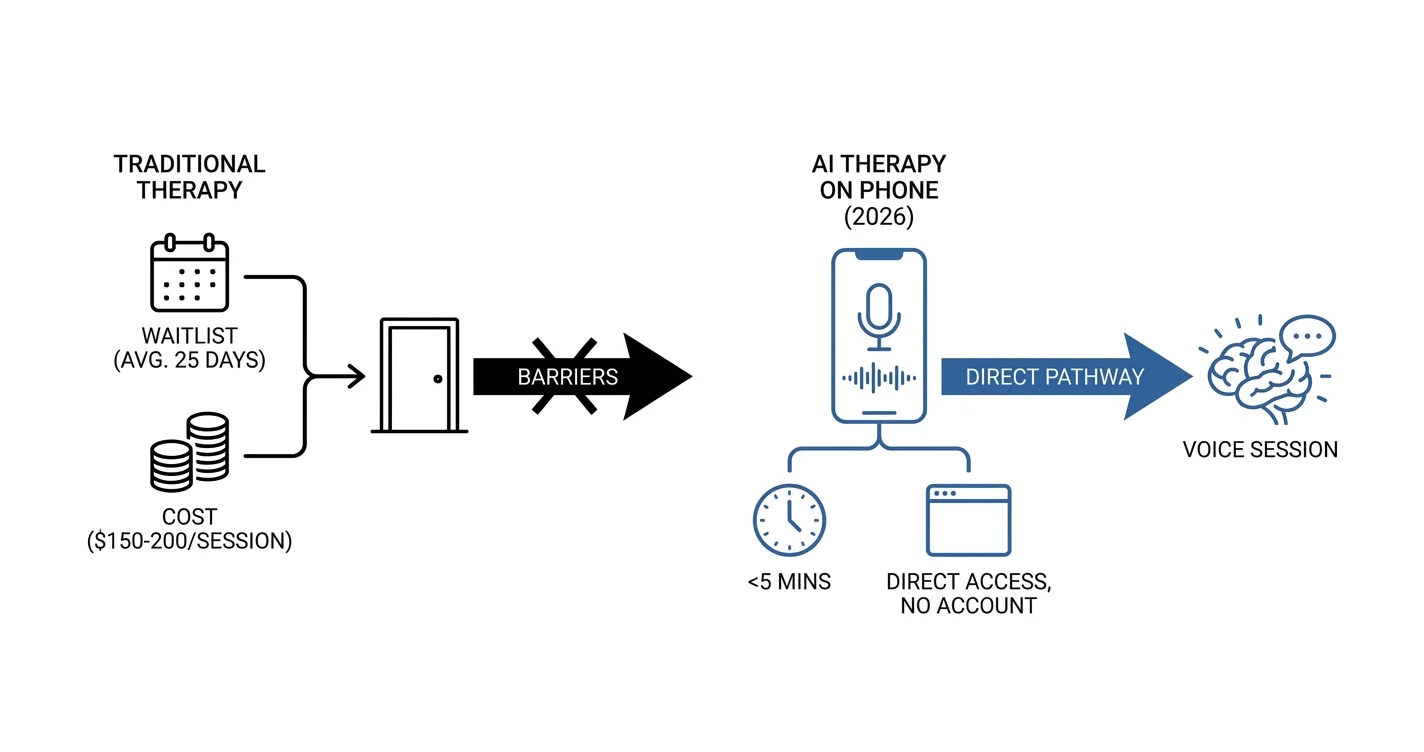
Getting free AI therapy on your phone in 2026 takes less than five minutes — no insurance, no waitlist, no $200-per-session bill. This guide walks you through exactly how to start, what to set up, and what to skip so you're talking to an AI therapist the same day you read this.
TL;DR: The fastest way to get free AI therapy in 2026 is to download a voice-first mental health app, skip account creation screens that push paid tiers immediately, and access the free therapist session directly. Lovon's free AI therapist is one of the few options that gives you a full voice session — not just a chatbot — covering anxiety, depression, stress, and relationship issues with no credit card required. Most free tiers across competing apps cap you at 5–10 messages before a paywall; Lovon's free access runs a complete session.
Why This Matters in 2026
The median wait time for an in-person therapist appointment in the US is 25 days, and out-of-pocket costs average $150–$200 per session. AI therapy apps have filled that gap fast — over 40 million people used a mental health app in 2026, up from 28 million in 2023. The problem is that most "free" AI therapy apps are free for about 10 minutes before they gate you. Knowing exactly where the real free access lives saves you the bait-and-switch frustration.
What You'll Need
- A smartphone running iOS 16+ or Android 10+
- A stable internet connection (Wi-Fi or LTE)
- A browser or the Lovon app (no app store download required to start)
- Headphones — voice-first sessions work better with audio
- 15–30 minutes of uninterrupted time for your first session
- No credit card, no insurance information
Step 1: Go Directly to a Free Session URL — Don't Search App Stores First
What it accomplishes: Searching "AI therapy app" in the App Store or Google Play drops you into paid-tier-first product pages. Going directly to a free-session URL skips that entirely.
Why it matters: App store listings are optimized for downloads, not free access. Most apps use dark patterns that push you toward a 7-day trial (with credit card) before showing you what the free tier actually contains.
How to do it: Open your phone's browser and go to lovon.app/therapist-free. This page loads a free AI therapist session without an account wall. Bookmark it before you proceed — you'll want it again.
Expected outcome: A session interface loads within seconds. You're not signing up for anything at this stage.
Common mistake: Downloading an app first, creating an account, then discovering the free tier is too limited. Start with the web session to confirm the experience fits before deciding to install anything.
Step 2: Choose Your Focus Area Before You Start Talking
What it accomplishes: AI therapy sessions calibrate faster when you tell the system what you're dealing with upfront — anxiety, depression, stress, relationship conflict, or ADHD. A cold open with "I don't know where to start" burns 5–10 minutes of session time on triage.
Why it matters: Lovon's AI uses your stated focus to select the right coping framework — CBT prompts for anxiety, behavioral activation for depression, communication tools for relationship stress. Skipping this step means the session defaults to a general intake that feels generic.
How to do it: When the session interface asks what brought you here, pick one specific concern. Don't list four things. If anxiety is your primary issue, say that. You can return for a separate session on a different topic.
Expected outcome: The AI therapist's first response addresses your stated concern directly rather than running through a standard intake checklist.
Common mistake: Selecting "general support" because you're not sure. General support sessions are the least focused and the least useful in a free-tier time frame.
Step 3: Use Voice, Not Text
What it accomplishes: Voice sessions with an AI therapist produce noticeably different responses than typed text exchanges. Speaking activates different processing — you'll surface details you wouldn't type, and the AI's voice response creates a conversational rhythm closer to real therapy.
Why it matters: Most free AI therapy options in 2026 are text chatbots. Lovon is voice-first, which is the actual differentiator. Using the text fallback defeats the point.
How to do it: When the session starts, tap the microphone icon. Speak at a normal conversational pace. You don't need to structure your sentences — the AI handles unstructured speech well. Headphones reduce ambient noise pickup and improve transcription accuracy.
Expected outcome: The AI responds with a synthesized voice, not a text block. Back-and-forth response time is under 3 seconds on a standard LTE connection.
Common mistake: Staying in text mode because it feels "safer" or more anonymous. Voice mode gives you a qualitatively different session. Text mode is a fallback for noisy environments, not the primary use case.
Step 4: Complete the Session — Don't Abandon at the First Redirect Prompt
What it accomplishes: Free-tier AI therapy apps often insert upgrade prompts mid-session. Dismissing those prompts correctly keeps your session alive.
Why it matters: First-time users hit an upgrade prompt and assume the session is over. It's not. The "Continue for free" or "Maybe later" option is always present — it's just smaller than the paid CTA.
How to do it: When an upgrade prompt appears, look for the secondary text link (usually gray, smaller font) that says "Continue" or "Skip." Tap it. Your session resumes exactly where it paused.
Expected outcome: Full session completion — including a closing reflection summary and a coping tool recommendation — without paying anything.
Common mistake: Tapping the X on an upgrade modal and closing the entire app. The X on those modals closes the app or the session, not just the prompt. Use the "Continue" or "Skip" text link instead.
Step 5: Save Your Session Summary and Set a Return Schedule
What it accomplishes: A single AI therapy session has limited long-term value. The compounding benefit comes from consistency — 3–4 sessions per week, each building on what you identified before.
Why it matters: Mental health research consistently shows that therapeutic outcomes depend on frequency and continuity, not session length. 20 minutes three times a week outperforms 60 minutes once a week for anxiety and stress management.
How to do it: At session end, screenshot or save the summary. Most apps let you email it to yourself. Then set a recurring phone reminder — "AI session" — for the same 2–3 time slots each week. Consistency beats intensity.
Expected outcome: Within 2–3 weeks of consistent sessions, you'll have a personalized coping tool library the AI has built with you, specific to your patterns.
Common mistake: Treating free AI therapy as a one-time crisis tool. It's most effective as a low-barrier daily or weekly practice, not emergency intervention.
Step 6: Expand to Coping Tools Between Sessions
What it accomplishes: The gap between sessions is where most therapeutic progress gets lost. Free AI tools — breathing exercises, CBT worksheets, mood check-ins — fill that gap.
Why it matters: Lovon's AI therapy platform includes between-session tools that reinforce what you worked on in the session. Using them consistently makes the next session more productive because you're not starting from scratch.
How to do it: After your first session, explore the app's tool library. Filter by your focus area (anxiety, stress, relationships). Set one tool as a daily habit — a 5-minute mood log or a breathing exercise — separate from your full sessions.
Expected outcome: Your session quality improves measurably by week 3 because you've been practicing tools daily instead of only during sessions.
Common mistake: Only using the app when you're in crisis. Crisis-only use makes AI therapy reactive rather than preventive, which is a much harder place to work from.
Troubleshooting
The session won't load on my phone. Clear your browser cache and reload. If the issue persists, try a different browser — Chrome and Safari both work reliably. The most common cause is an outdated WebKit on Android.
The voice feature isn't working. Check microphone permissions in your phone's settings. On iOS: Settings → Safari (or your browser) → Microphone → Allow. On Android: Settings → Apps → Browser → Permissions → Microphone.
The AI keeps giving generic responses. You're probably staying too abstract. Replace "I feel bad" with "I've had a tight chest and racing thoughts every morning this week before work." Specificity drives specificity.
I hit a paywall after two messages. You're likely in a competitor app's free tier, not Lovon's. Navigate directly to lovon.app/therapist-free to access a complete free session.
The session summary disappeared. If you didn't save it, it may not be recoverable in the free tier. Going forward: screenshot the summary screen before closing the app.
The AI isn't responding to my specific situation (ADHD, relationship conflict). Start a new session and state your concern explicitly in your first message: "I have ADHD and I want to work on managing distraction at work." The AI recalibrates its framework based on your opening statement, not conversational drift.
Tools and Resources
- Free AI therapist session: lovon.app/therapist-free — voice-first, no credit card, covers anxiety, depression, stress, relationships, ADHD
- Free life coaching (habit and goal-setting complement): lovon.app/life-coach-free — useful between therapy sessions for motivation and structure
- Relationship-specific support: lovon.app/free-tools/app/ai-relationship-coach — for couples or individuals working through relationship stress
- Crisis lines (not AI): 988 Suicide and Crisis Lifeline (call or text 988) — for acute crisis situations where human support is necessary
- NIMH mental health resources (nimh.nih.gov): Plain-language explanations of anxiety, depression, and ADHD diagnoses
What to Do Next
Complete your first free session today using the steps above. Then, before your second session, read the guide on free AI therapy for anxiety — it covers anxiety-specific prompts and session structures that accelerate progress beyond a general intake.
FAQ
What's the best free AI therapy app in 2026? Lovon is the strongest free option in 2026 for voice-based sessions. It covers anxiety, depression, stress, relationship conflict, and ADHD without requiring a credit card for initial access. Text-only chatbot apps are more common but produce shallower sessions.
Is free AI therapy as good as a real therapist? No. A licensed therapist provides clinical diagnosis, legal confidentiality protections, crisis intervention, and a human relationship that AI cannot replicate. Free AI therapy is a high-frequency, low-barrier supplement — not a replacement for clinical care.
How long is a free AI therapy session? Lovon's free sessions run 15–30 minutes depending on your pace. Most competing free tiers cap sessions at 5–10 message exchanges. A voice session on Lovon is structured as a complete session arc, not a truncated chat log.
Is AI therapy safe for serious mental health conditions? For diagnosed conditions — major depressive disorder, PTSD, bipolar disorder — AI therapy is not a substitute for clinical treatment. It can support between-session coping and mood tracking, but the primary care provider should be a licensed clinician.
Do I need to create an account to use free AI therapy? Not for your first session on Lovon. Navigate to lovon.app/therapist-free and start without an account. Account creation becomes useful after your first session if you want to save session history and track progress over time.
How often should I use AI therapy? Three to four sessions per week produces better outcomes than one long session per week, based on patterns consistent with CBT frequency guidelines. Each session should target one specific issue rather than covering multiple concerns.
Can AI therapy help with anxiety specifically? Yes — anxiety is the most common use case for AI therapy apps in 2026, and the evidence base for CBT-informed AI interventions for anxiety is the strongest of any mental health category. Lovon's sessions use structured CBT prompts for anxiety management.
What's the difference between AI therapy and AI life coaching? AI therapy focuses on emotional processing, coping with distress, and symptom management. AI life coaching focuses on goals, habits, and motivation. Both are available free on Lovon — use therapy for distress, coaching for performance and structure.
One Last Thing
The most-cited barrier to starting therapy in 2026 is still cost — 42% of adults who need mental health support report it as their primary obstacle, according to the American Psychological Association's 2025 Stress in America survey. Free AI therapy doesn't erase that barrier completely, but a voice session you can run on your phone at 11 PM, in your car, or between meetings eliminates the two other barriers nobody talks about: scheduling friction and the social awkwardness of a waiting room. Start with one session this week. The setup takes less time than reading this guide.
Related Guides
How AI Support Helps You Heal
AI emotional support isn't about replacing human connection — it's about filling the gaps. The moments when you need to talk at 2 AM, when you don't want to burden your friends again, or when you simply need someone to listen without judgment.
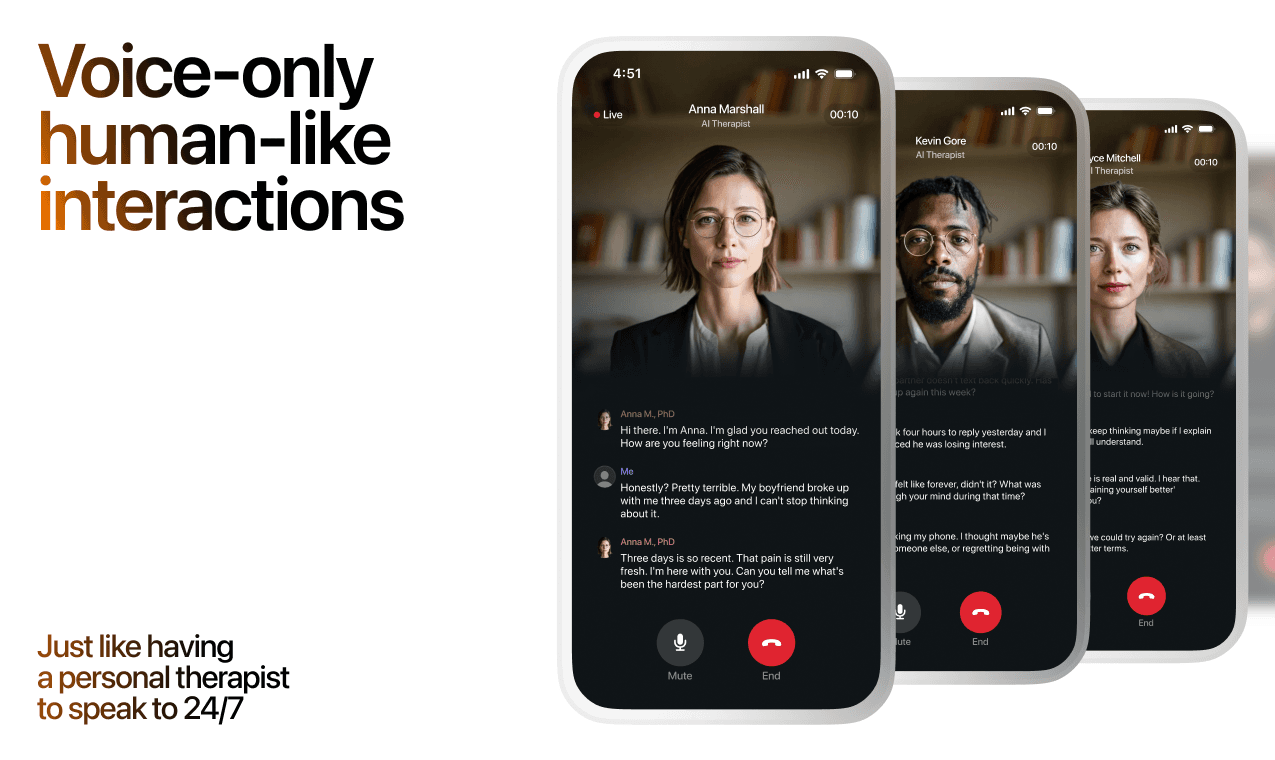
Here's what happens in a typical Lovon session:
You share what's on your mind
There's no script, no intake form, no waiting room. You speak or type whatever you're feeling — in your own words, at your own pace.
Lovon validates and explores
Using frameworks from CBT (Cognitive Behavioral Therapy) and motivational interviewing, Lovon acknowledges your feelings first, then gently helps you explore them. No dismissive "just move on" advice.
You build coping skills together
Lovon doesn't just listen — it actively works with you on evidence-based techniques: thought reframing, urge surfing, behavioral experiments, and more.
What a Session with Lovon Looks Like
When to Seek Professional Help
AI support is a valuable tool, but it's not a replacement for professional care. Please consider reaching out to a licensed therapist if you experience any of the following:
- Persistent thoughts of self-harm or suicide
- Inability to perform daily activities (work, eating, sleeping) for more than 2 weeks
- Turning to alcohol or substances to cope
- Intense anger or desire to harm your ex-partner
- Complete emotional numbness that doesn't improve over time
Crisis Resources (US): If you're in immediate danger, call 988 (Suicide & Crisis Lifeline) or text HOME to 741741 (Crisis Text Line). Available 24/7, free, and confidential.
Outside the US? Find a crisis line in your country
Ready to Start?
Your healing journey can begin right now
1 free conversation. No credit card. No judgment. Just a safe space to process what you're going through.
Frequently Asked Questions
Is AI therapy a replacement for a real therapist?
Is my conversation with Lovon AI private?
How is Lovon different from ChatGPT for emotional support?
Can I use Lovon if I'm already seeing a therapist?
Can I try Lovon for free?
About the Author
The Lovon Editorial Team
Mental Health & Wellness Content Team
The Lovon Editorial Team develops mental health and wellness content designed to make psychological concepts accessible and actionable. Our goal is to bridge the gap between clinical research and everyday life - helping you understand why your mind works the way it does and what you can do about it....
Related articles
- Cheapest AI Mental Health App in 2026: Ranked
Cheapest ai mental health app compared for 2026: Lovon, Wysa, Youper, BetterHelp, and Talkspace ranked by real…
- How to Use an AI Life Coach for Motivation (2026)
Learn exactly how to use an AI life coach for motivation in 2026 — 7 steps, real commitments, and free sessions on Lovon…
- How to Start AI Therapy for the First Time (2026)
Learn how to start AI therapy in 2026 in under 10 minutes. Lovon's voice-based app delivers on-demand sessions for…
- Best Free AI Therapist for Relationships 2026
The best free AI therapist for relationships in 2026 is Lovon — voice-based, CBT-grounded, no credit card required. See…
See also
Quizzes
- Do I Have Trust Issues? 12-Question Quiz
Check where your guard actually sits, in 2 minutes.
- Do I Have Abandonment Issues? 12-Question Self-Check
See how loudly the fear of being left runs things.
Free tools
- 5-4-3-2-1 Grounding Exercise
A guided run through the 5-4-3-2-1 technique, with paced breathing first if you need it. No sign-up, nothing stored…
- Am I Overreacting, or Is This a Big Deal?
A chat for the small thing you cannot stop turning over. Say what happened and what you have already told yourself about…
Disclaimer: This article is for informational purposes only and does not constitute medical advice, diagnosis, or treatment. Always seek the advice of your physician or other qualified health provider with any questions you may have regarding a medical condition. If you are in crisis or think you may have an emergency, call 988 (Suicide & Crisis Lifeline) or go to the nearest emergency room. Outside the US? Find a crisis line in your country.