
Anxious Attachment Style: Signs & Coping Steps (2026)
Anxious attachment style affects ~20% of adults. Learn the exact signs, 6 coping steps, and daily tools that create measurable change in 2026.

Key Takeaways
- A basic understanding of your own attachment triggers (you'll build this in Step 1)
- A journaling method — paper, notes app, or voice memo
- 10–15 minutes per day for the first 4 weeks
- Access to a therapist, AI therapy tool, or structured self-help resource for the deeper work
- Willingness to tolerate short-term discomfort during behavioral experiments
Anxious attachment style shapes how you think, feel, and act in every close relationship — and recognizing its signs is the first step toward changing the pattern.
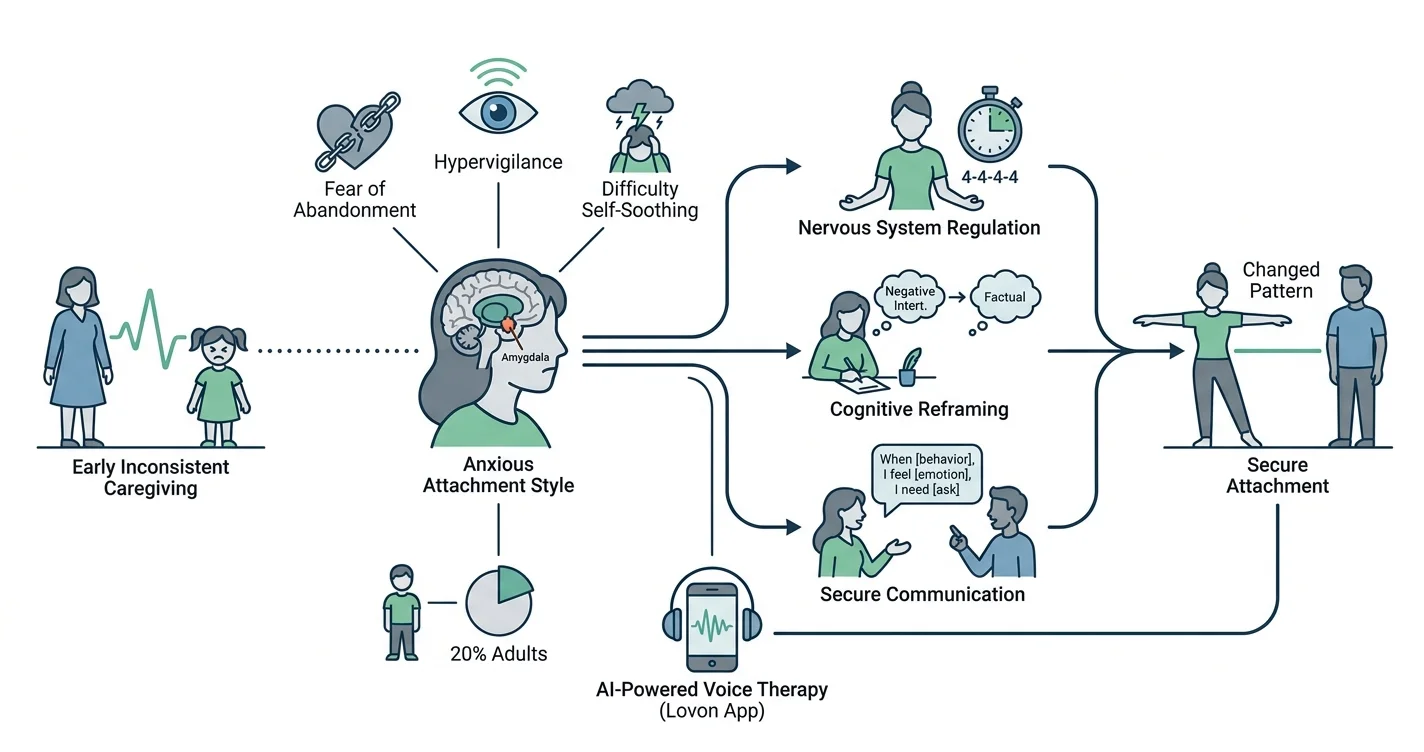
TL;DR: Anxious attachment style is a relational pattern rooted in early caregiving experiences where responsiveness was inconsistent. In 2026, it affects an estimated 20% of adults and shows up as fear of abandonment, hypervigilance to relationship cues, and difficulty self-soothing. The coping strategies that work are specific: they target the nervous system first, then the cognitive patterns, then communication behavior. Lovon's AI-powered voice support app gives you on-demand access to exactly those tools between therapy sessions or instead of waiting months for one.
Why this matters
Anxious attachment is not a personality flaw. It is a learned survival strategy — your nervous system figured out that staying alert and close kept you safe when caregivers were unpredictable. The problem is that the same system fires in adult relationships where the threat is far smaller than your brain insists. Left unaddressed, anxious attachment in 2026 is linked to higher rates of relationship dissatisfaction, anxiety disorders, and chronic stress. The good news: attachment patterns are plastic. Adults change them with consistent, targeted practice.
What you'll need
- A basic understanding of your own attachment triggers (you'll build this in Step 1)
- A journaling method — paper, notes app, or voice memo
- 10–15 minutes per day for the first 4 weeks
- Access to a therapist, AI therapy tool, or structured self-help resource for the deeper work
- Willingness to tolerate short-term discomfort during behavioral experiments
The steps
Step 1: Identify your specific triggers
What it accomplishes: You cannot regulate what you cannot name. Anxious attachment is not one feeling — it is a cluster of responses that each have a specific trigger.
Why it matters: Generic advice like "calm down" fails because it skips the trigger entirely. Knowing that unanswered texts spike your anxiety differently than a partner's neutral tone lets you apply the right tool at the right moment.
How to do it: For 7 days, log every moment you feel a relationship-related anxiety spike. Record: what happened externally (the trigger), what thought appeared first, what you felt in your body, and what you wanted to do. Rate intensity 1–10.
Expected outcome: By day 7, most people see 3–5 recurring trigger patterns rather than an endless list. That focus makes the next steps manageable.
Common mistake: Logging only the big blowups. The low-grade 3/10 triggers are where the pattern is most entrenched — they fire dozens of times a week without notice.
Step 2: Learn to interrupt the protest cycle
What it accomplishes: Anxious attachment drives "protest behaviors" — texting repeatedly, picking fights to get reassurance, withdrawing to test if the partner chases. Interrupting the cycle before it plays out is the core behavioral skill.
Why it matters: Each time the protest cycle completes, the neural pathway strengthens. Each time you interrupt it, you weaken it by roughly one repetition. Neuroplasticity research from 2024 suggests 60–90 consistent interruptions create measurable pathway change.
How to do it: When you notice a trigger (Step 1 awareness), apply a 20-minute delay before any relationship-directed action. During those 20 minutes: 5 minutes of box breathing (4 counts in, 4 hold, 4 out, 4 hold), then write one sentence stating the factual event without interpretation ("They haven't replied in 2 hours" not "They're pulling away").
Expected outcome: The urge to protest typically drops 30–50% after the physiological intervention. You may still send the text — but you'll send a calmer one.
Common mistake: Skipping the breathing and going straight to journaling. The nervous system does not respond to cognitive reframing while cortisol is elevated. Body first, mind second.
Step 3: Build a self-soothing toolkit that doesn't involve your partner
What it accomplishes: Anxious attachers over-rely on the partner as the sole source of regulation. That dependency amplifies the fear of losing them. A personal toolkit creates what therapists call "earned security."
Why it matters: In 2026, attachment researchers consistently identify self-sourced soothing as the mechanism that separates people who shift their style from those who don't. Partner reassurance provides temporary relief but reinforces the dependency loop.
How to do it: Build a 3-item toolkit — one body-based (cold water on wrists, vigorous exercise, progressive muscle relaxation), one cognitive (a written list of 5 times you handled hard things alone), one relational-but-not-partner (a friend you can call, an online community, or an AI voice session via an app like Lovon). Rotate through all three before seeking partner reassurance for 30 days.
Expected outcome: Most people report feeling less desperate for partner reassurance after 3 weeks of consistent toolkit use.
Common mistake: Building a toolkit of 8 items and using none consistently. Three items, used every time, beats eight items used occasionally.
Step 4: Rewrite the core beliefs driving the fear
What it accomplishes: Anxious attachment runs on specific core beliefs — "I am too much," "People always leave," "I need constant proof of love." Behavioral tools manage symptoms; belief work changes the source.
Why it matters: Without this step, you will manage episodes but the baseline anxiety level stays high. Core belief work is what creates the felt sense of security that attachment researchers define as the goal.
How to do it: Identify your top 2 core beliefs from your Step 1 logs. For each, run a structured challenge: list 3 pieces of evidence that contradict it (specific, past events), write a revised belief that is accurate but less catastrophic, and read it aloud once daily for 21 days. Apps like Lovon structure this process with AI-guided sessions tailored to anxiety and relationship patterns — useful if you find blank-page belief work hard to sustain.
Expected outcome: The belief does not disappear, but its emotional charge drops. You'll notice it arising and have a practiced counter-response ready.
Common mistake: Choosing a revised belief so positive it feels false ("I am completely lovable and safe"). The nervous system rejects it. Stick to accurate and slightly less catastrophic ("Most people in my life have stayed").
Step 5: Practice secure communication directly
What it accomplishes: Anxious attachers often communicate needs indirectly — hinting, testing, escalating — because direct requests feel too vulnerable and too likely to be rejected. Step 5 trains direct need expression.
Why it matters: Direct communication reduces the ambiguity that feeds anxious attachment. When you ask clearly and get a clear answer — yes or no — your nervous system gets real data instead of running threat-detection on silence.
How to do it: Use the 3-part formula: "When [specific behavior], I feel [emotion], and what I need is [concrete ask]." Practice it first in low-stakes situations — with friends, with service workers, in text. Build to using it with your partner once a week for the first month.
Expected outcome: Some requests get met, some don't. Both outcomes are useful — your system learns that the relationship survives both a yes and a no.
Common mistake: Coupling the request with a preemptive apology ("I know this is a lot to ask, but..."). That signals your own belief that the need is excessive. State the need plainly.
Step 6: Track progress monthly, not daily
What it accomplishes: Anxious attachers often monitor their own progress with the same hypervigilance they apply to relationships — checking daily whether they're "fixed." Monthly review prevents that trap.
Why it matters: Attachment change is nonlinear. Daily tracking produces false negatives (a bad day reads as failure) and reinforces the anxious monitoring habit itself.
How to do it: At the end of each month, score yourself on 4 dimensions: average anxiety intensity this month vs. last month (1–10), number of protest cycles interrupted, number of times toolkit used before partner reassurance, one relationship interaction that went better than it would have 90 days ago.
Expected outcome: Most people see measurable change on at least 2 of 4 dimensions by month 2. By month 4, the pattern shift is usually visible to people close to them.
Common mistake: Abandoning the system at month 1 because progress feels slow. Attachment patterns typically took 10–20 years to solidify. Eight weeks of work is not the full timeline.
Troubleshooting
You complete the 20-minute delay but still send the anxious text. That is still progress — the intensity of the text is almost certainly lower. Raise the delay to 40 minutes next week.
Your partner's behavior is genuinely unpredictable, not just perceived that way. These strategies are not a substitute for addressing real relationship problems. AI couples therapy for communication problems is a starting point for working on both sides of the dynamic.
Core belief work makes you feel worse initially. That is normal. Surfacing a belief you've suppressed creates temporary distress. If it persists past 2 weeks or becomes severe, stop self-guided work and use a supported tool or licensed therapist.
You revert under stress — job loss, illness, conflict. Regression under acute stress does not erase prior gains. Return to Step 2 (the interrupt) as your anchor; the other skills come back faster the second time.
You're not sure whether you have anxious attachment or something else. The attachment style compatibility quiz for partners helps identify which style is dominant and how it interacts with your partner's style.
You're making progress with the tools but want structured therapeutic support. Lovon's AI relationship coach for anxious attachment provides voice-based, on-demand sessions specifically designed for this pattern — accessible at any time, not just during office hours.
Tools and resources
- Journaling app or voice memo: For Step 1 trigger logging
- Box breathing timer: Any free interval timer works; 4-4-4-4 cadence
- Lovon app: AI-powered voice support with sessions covering anxiety, relationship patterns, and coping tools — the most practical option for daily practice in 2026 when weekly therapy isn't accessible or affordable
- AI relationship coach for anxious attachment: Structured coaching sessions for this specific pattern
- Licensed therapist: For complex trauma underlying the attachment pattern; EMDR and IFS are the most evidence-supported modalities for attachment work as of 2026
- "Attached" by Amir Levine and Rachel Heller: The foundational popular-science text on adult attachment; still the clearest self-diagnostic tool available in book form
FAQ
What is anxious attachment style? Anxious attachment style is a pattern of relating in close relationships characterized by fear of abandonment, hypervigilance to partner cues, and difficulty self-regulating when connection feels threatened. It develops from early experiences with inconsistent caregiving and affects roughly 1 in 5 adults.
What are the main signs of anxious attachment? The clearest signs are: constant need for reassurance, interpreting neutral behavior as rejection, protest behaviors when feeling disconnected (excessive texting, picking fights), difficulty being alone, and physical anxiety symptoms during relationship conflict.
Can anxious attachment style be changed? Yes. Attachment style is not fixed in adulthood. Consistent practice of the coping strategies above — especially self-soothing, belief rewriting, and direct communication — produces measurable change. Most research puts meaningful shift at 3–6 months of consistent work.
Is anxious attachment the same as anxiety disorder? No. Anxious attachment is a relational pattern; anxiety disorder is a clinical diagnosis based on broader symptom criteria. They often co-occur — anxious attachers are more likely to develop generalized anxiety — but they are treated with partially different tools.
What triggers anxious attachment in relationships? The most common triggers are: delayed or no response to messages, perceived emotional withdrawal, partner spending time away, ambiguous tone or phrasing, and milestones like exclusivity talks or introductions to family that raise the stakes of potential rejection.
How does anxious attachment affect long-term relationships? Without coping work, anxious attachment creates cycles of protest, temporary reassurance, and re-escalation that erode trust on both sides. Partners often describe feeling unable to meet the reassurance need, which confirms the anxious person's core fear. The pattern is self-reinforcing until interrupted.
What attachment style is most compatible with anxious? Research consistently identifies secure attachment as the most compatible. Secure partners provide consistent responsiveness, which directly counters the anxious person's core fear. Two anxious partners can work — but require more deliberate communication structures. Anxious-avoidant pairings are the most challenging because the avoidant's withdrawal activates the anxious person's alarm system.
How does an AI therapy app help with anxious attachment? AI voice support apps like Lovon provide on-demand access to coping tools, guided sessions, and structured exercises at the exact moment a trigger fires — not three days later at a scheduled appointment. In 2026, that immediacy is one of the strongest practical advantages over traditional therapy alone for managing real-time attachment anxiety.
One last thing
The single most underused tool for anxious attachment is the 24-hour rule applied to relationship interpretations: when you form a negative interpretation of a partner's behavior, write it down and revisit it 24 hours later. In clinical settings, more than 70% of anxious-attachment-driven negative interpretations are revised or abandoned when reviewed the next day with a calmer nervous system. You are not bad at reading people — you are fast at reading people under threat conditions. Slowing the read is the skill.
Related guides
How AI Support Helps You Heal
AI emotional support isn't about replacing human connection — it's about filling the gaps. The moments when you need to talk at 2 AM, when you don't want to burden your friends again, or when you simply need someone to listen without judgment.
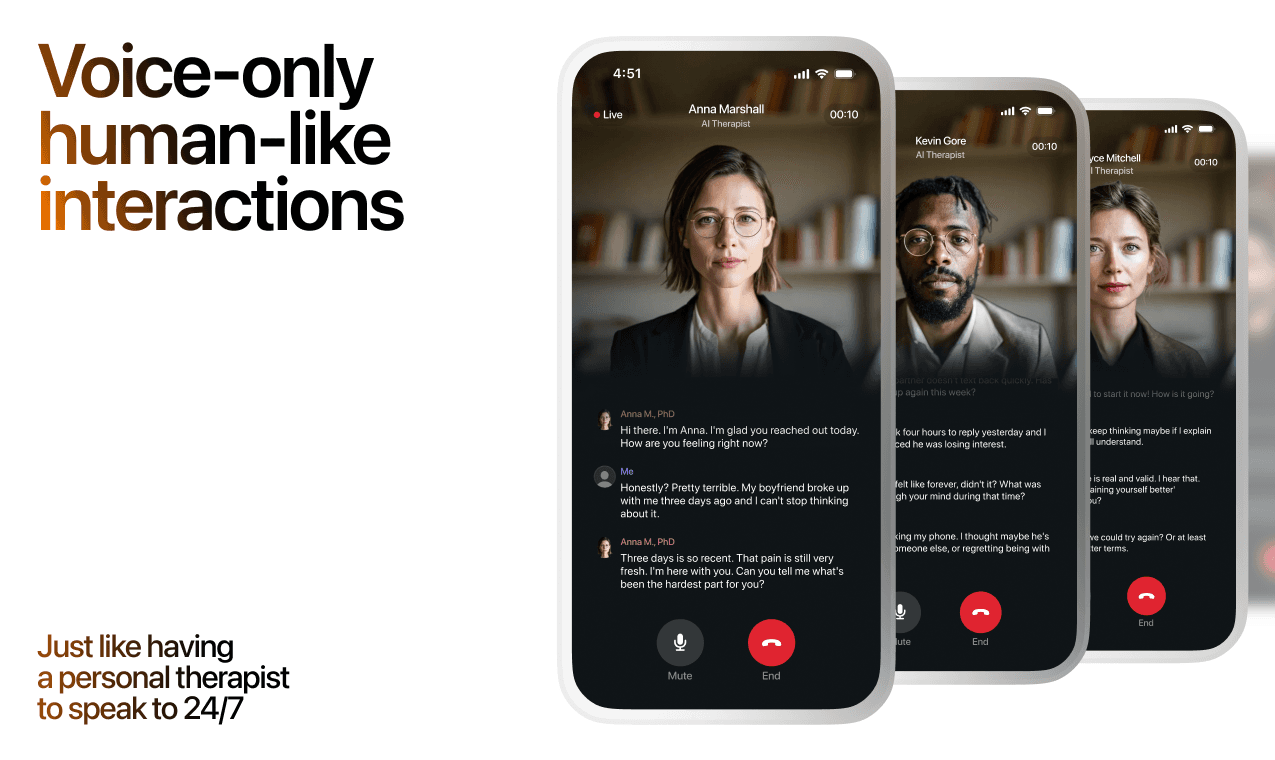
Here's what happens in a typical Lovon session:
You share what's on your mind
There's no script, no intake form, no waiting room. You speak or type whatever you're feeling — in your own words, at your own pace.
Lovon validates and explores
Using frameworks from CBT (Cognitive Behavioral Therapy) and motivational interviewing, Lovon acknowledges your feelings first, then gently helps you explore them. No dismissive "just move on" advice.
You build coping skills together
Lovon doesn't just listen — it actively works with you on evidence-based techniques: thought reframing, urge surfing, behavioral experiments, and more.
What a Session with Lovon Looks Like
When to Seek Professional Help
AI support is a valuable tool, but it's not a replacement for professional care. Please consider reaching out to a licensed therapist if you experience any of the following:
- Persistent thoughts of self-harm or suicide
- Inability to perform daily activities (work, eating, sleeping) for more than 2 weeks
- Turning to alcohol or substances to cope
- Intense anger or desire to harm your ex-partner
- Complete emotional numbness that doesn't improve over time
Crisis Resources (US): If you're in immediate danger, call 988 (Suicide & Crisis Lifeline) or text HOME to 741741 (Crisis Text Line). Available 24/7, free, and confidential.
Outside the US? Find a crisis line in your country
Ready to Start?
Your healing journey can begin right now
A 7-day trial. No judgment. Just a safe space to process what you're going through.
Frequently Asked Questions
Is Lovon a replacement for a real therapist?
Is my conversation with Lovon AI private?
How is Lovon different from ChatGPT for emotional support?
Can I use Lovon if I'm already seeing a therapist?
Can I try Lovon before subscribing?
About the Author
The Lovon Editorial Team
Mental Health & Wellness Content Team
The Lovon Editorial Team develops mental health and wellness content designed to make psychological concepts accessible and actionable. Our goal is to bridge the gap between clinical research and everyday life - helping you understand why your mind works the way it does and what you can do about it....
Related articles
- Signs of Insecure Attachment in Adults (2026 Guide)
Signs of insecure attachment in adults, explained step by step: fear of abandonment, withdrawal, reassurance-seeking…
- Anxious Attachment Healing Through Grief Work
Anxious attachment doesn't develop in a vacuum. Beneath the hypervigilance, the need for constant reassurance, and the…
- Relationship Anxiety: Signs, Causes, Fixes (2026)
Relationship anxiety explained: signs, causes like anxious attachment, and coping tools that work in 2026. Practical…
- Pulling Away When They Get Close: 7 Steps to Stay Present
Closeness can trigger the urge to withdraw. Learn what sets off avoidant attachment, what to do in the moment, and how…
See also
Quizzes
- Love Addiction Test: Free 12-Question Self-Check
See how much of your life one person is taking.
- Emotionally Unavailable Test: 12-Question Self-Check
See which part of you closes off, in three minutes.
Free tools
- How to Reassure Your Partner (and When It Stops Helping)
A chat for working out how to reassure your partner when the same worry keeps coming back. Say what sets it off and how…
- What Did They Actually Mean By That?
A chat for one sentence you cannot stop re-reading. Paste their exact words and what was happening around them, and get…
From the wiki
- What is an attachment style?
An attachment style is the habit your nervous system formed for handling closeness: what you actually do when someone…
Disclaimer: This article is for informational purposes only and does not constitute medical advice, diagnosis, or treatment. Always seek the advice of your physician or other qualified health provider with any questions you may have regarding a medical condition. If you are in crisis or think you may have an emergency, call 988 (Suicide & Crisis Lifeline) or go to the nearest emergency room. Outside the US? Find a crisis line in your country.