
Does He Like Me Quiz: Decode His Signals (2026)
Take the does he like me quiz: score 8 behavioral signals — initiation, attention, effort, consistency — and get a clear answer in under 5 minutes.

Key Takeaways
- Texting response speed alone. Fast replies mean he has his phone. Slow replies don't mean disinterest — they may
- Compliments in a group setting. Public compliments can be social performance. Weight private, specific compliments
- Being "nice." Friendliness and interest share many surface behaviors. The differentiator is directionality — is this
You noticed something — a glance that lasted a beat too long, a text that didn't need to be sent, a laugh that felt directed at you specifically. This page breaks down the real behavioral signals that indicate romantic interest, walks you through a structured does he like me quiz, and tells you what to do with the answer in 2026.
TL;DR: The does he like me quiz below scores 8 behavioral categories — body language, communication frequency, effort, attention, jealousy, future-talk, physical touch, and consistency. A score of 6 or higher across those categories is a strong signal of genuine interest. Scores of 3 or below typically indicate friendliness without romantic intent. Neither result tells you what to do next — that part is on you, and Lovon's AI-powered relationship coaching can help you work through it.
Why this matters in 2026
Misreading signals is not a personality flaw — it's a calibration problem. Research consistently shows that people overestimate mutual romantic interest in ambiguous situations (a documented bias called "signal amplification"). The cost of getting it wrong in either direction is real: acting too soon risks awkwardness; waiting too long often means the window closes. A structured quiz forces you to look at behavior patterns rather than a single moment, which cuts confirmation bias significantly.
Who this quiz is for
This guide is built for anyone in the early-stage ambiguity phase — you've met someone, there's something there, but nothing has been stated directly. It works for new connections, a coworker situation, a long-term friend you've started seeing differently, or someone you've been casually dating for under 3 months. If you're already in a defined relationship and questioning whether he still has feelings, the questions still apply but the scoring interpretation shifts.
What to look for — the 8 signal categories
1. Initiation frequency
He reaches out first — not once, but as a pattern. Count the last 10 conversations: if he initiated 6 or more, that's meaningful. Men who are interested create contact; they don't just respond to it.
2. Quality of attention
Does he remember the specific thing you mentioned two weeks ago — the job interview, the difficult family situation, the restaurant you wanted to try? Recalling low-stakes details is one of the most reliable indicators of sustained interest, because it only happens when someone is genuinely listening.
3. Body language proximity
Physical behavior is harder to fake than words. Watch for: leaning in when you speak, orienting his body toward you in group settings, incidental touch (shoulder, forearm, back) that he initiates. Sustained eye contact — holding it slightly longer than conversational norms require — is a high-confidence signal.
4. Effort investment
Does he make plans, or just agree to them? Planning — suggesting a specific place, a specific time, following through — signals that he's thinking about you when you're not around. Passive participation ("yeah sure, sounds good") is not the same as investment.
5. Future references
Listen for unprompted future-tense inclusion: "you'd love that city," "we should do that sometime," "remind me to show you this." These aren't just filler. They indicate he's mentally projecting you into his future, which is a distinct cognitive step from enjoying your current company.
6. Reaction to other men
Watch his behavior when another man enters your conversation or attention space. Mild behavioral change — increased engagement with you, subtle positioning, more effort — is a textbook jealousy response. It's not proof of interest alone, but it's a corroborating data point.
7. Vulnerability and personal disclosure
Men who are interested tend to share more than they typically do — personal history, current stressors, opinions they'd normally keep guarded. Disclosure is a trust signal, and trust tends to follow interest. If he's telling you things he doesn't tell everyone, that's not accidental.
8. Consistency over time
One good week means nothing. Six consistent weeks of the above behaviors is evidence. Consistency is the single most underweighted signal in casual does he like me analysis — people fixate on peak moments instead of the baseline pattern.
The does he like me quiz — score it yourself
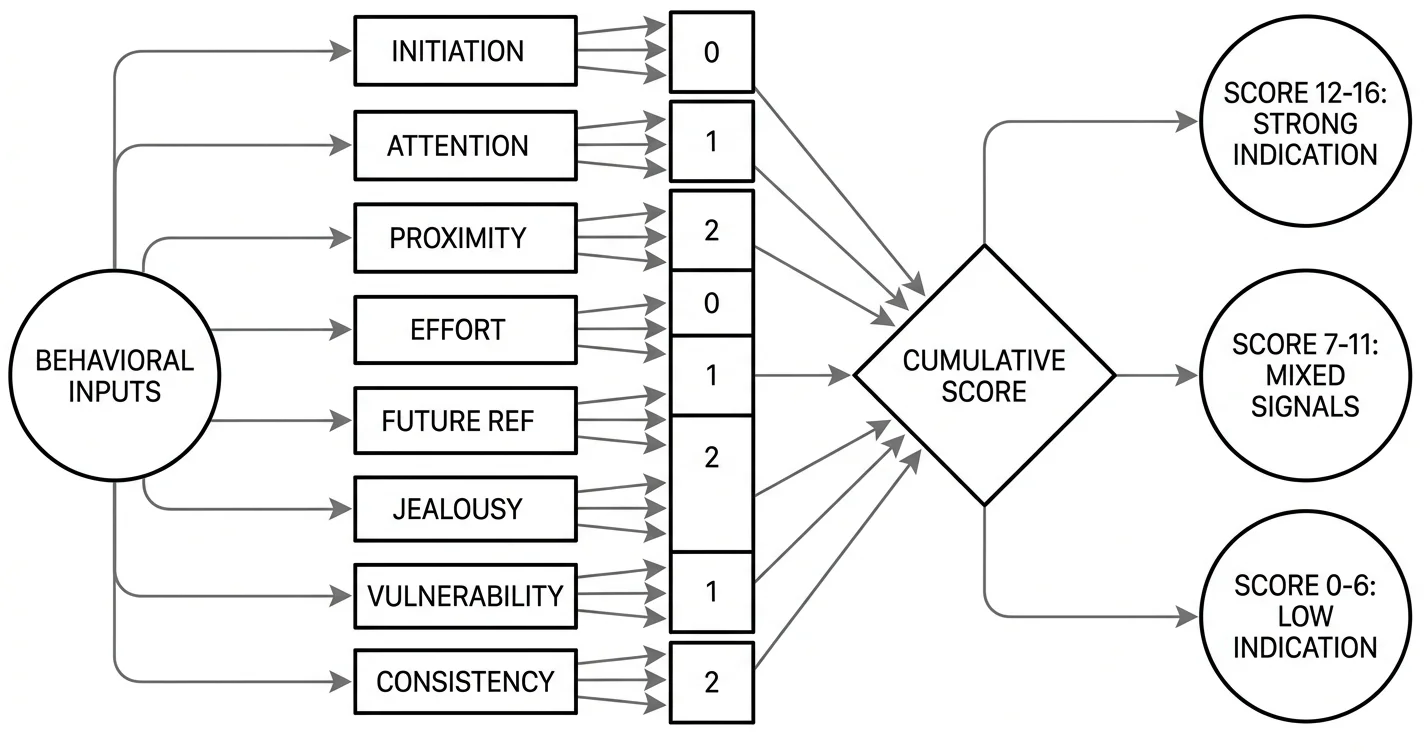
For each category above, score him 0 (clearly no), 1 (sometimes/unclear), or 2 (clearly yes). Max score: 16.
| Signal Category | 0 | 1 | 2 |
|---|---|---|---|
| Initiation frequency | Rarely initiates | Mixed | Initiates more than 60% of the time |
| Quality of attention | Forgets details | Sometimes remembers | Recalls specifics reliably |
| Body language proximity | Neutral/distant | Occasional lean/touch | Consistent proximity and eye contact |
| Effort investment | Passive only | Mixed planning | Actively plans and follows through |
| Future references | Never | Occasional | Regular unprompted inclusion |
| Reaction to other men | No change | Mild shift | Noticeable behavioral change |
| Vulnerability and disclosure | Surface-level only | Occasional depth | Regular personal sharing |
| Consistency over time | Inconsistent | Somewhat consistent | 6+ weeks of consistent behavior |
Score 12–16: Strong indicators of genuine romantic interest. The signals are deliberate and patterned, not coincidental.
Score 7–11: Mixed signals. Either interest is early-stage and he's uncertain, or the interest is real but unexpressed due to fear of rejection, a complicated situation, or an avoidant attachment style.
Score 0–6: Behavioral evidence does not support romantic interest at this level. He may like you as a person; the signals for romantic pursuit are not present.
What to avoid reading into
- Texting response speed alone. Fast replies mean he has his phone. Slow replies don't mean disinterest — they may reflect his communication habits across all relationships.
- Compliments in a group setting. Public compliments can be social performance. Weight private, specific compliments far more heavily.
- Being "nice." Friendliness and interest share many surface behaviors. The differentiator is directionality — is this behavior exclusive to you, or does he behave identically with everyone?
What to do with your score in 2026
A quiz score is a starting point, not a conclusion. The harder question is what to do with the information — whether that's finding the confidence to express interest, processing anxiety about rejection, or untangling feelings from a complicated friendship. Those are emotional problems, not information problems.
Lovon is an AI-powered voice support app built for exactly these situations: relationship uncertainty, anxiety about romantic decisions, and the kind of emotional processing that benefits from a judgment-free conversation at 11pm when you can't stop overanalyzing the last text he sent. Sessions are on-demand, personalized, and don't require a scheduled appointment.
If your score landed in the mixed range (7–11) and the uncertainty is creating real anxiety, working through it with an AI relationship coach for anxious attachment is a practical next step. The ambiguity itself — not just the outcome — is often the thing worth addressing.
For situations where the feelings have surfaced a broader pattern around trust or self-confidence, Lovon's AI life coach for confidence and self-esteem addresses the root, not just the symptom.
FAQ
What's the most reliable signal that he likes me? Consistency across multiple behavioral categories over at least 4–6 weeks. A single strong signal (one long glance, one vulnerable text) is not enough data. Patterned behavior across initiation, attention, and effort is.
Can he like me and still not make a move? Yes. Fear of rejection, uncertainty about your interest, a complicated social situation (coworker, friend group overlap), or an avoidant attachment style all create genuine interest without direct action. A high quiz score with no move is often a confidence issue, not an interest issue.
Does he like me if he texts first but never makes plans? Mixed signal. Texting without planning suggests interest at a low-commitment level — he enjoys the connection but isn't investing effort toward escalation. That can mean early-stage interest that hasn't tipped into pursuit, or interest that's comfortable staying exactly where it is.
Is a does he like me quiz actually accurate? More accurate than intuition alone, because intuition is subject to confirmation bias. Structured scoring forces you to evaluate behavior categories independently rather than weighting the one interaction you replayed 40 times. It's a calibration tool, not a definitive answer.
What if he scores high on some categories and zero on others? That's a mixed signal, not a contradiction. Score 7–11 and look at which categories are zero. Consistent absence of effort (he never plans, never initiates) is more diagnostic than absence of jealousy.
How do I stop overanalyzing whether he likes me? The overanalysis is usually anxiety about the uncertainty, not about him specifically. Naming that distinction helps. If the anxiety is persistent and affecting your daily focus, Lovon's free AI therapist for anxiety gives you a structured space to work through it without waiting for a therapy appointment.
What does it mean if he likes me but has an avoidant attachment style? His interest is real but his behavior will often contradict it — pulling back after closeness, inconsistent availability, discomfort with direct emotional expression. Knowing his attachment style matters more than knowing his interest level at that point.
At what point should I just ask him directly? When the uncertainty costs more than the risk of the answer. If you've scored 12 or higher and weeks are passing without movement, a direct, low-pressure expression of interest is lower cost than sustained ambiguity. Most people overestimate the social damage of a clear, calm "I like you" — the actual conversation is rarely as devastating as the imagined one.
One last thing
The does he like me quiz has been a Google staple since at least 2004. The questions have barely changed — because human signaling behavior hasn't changed either. What has changed in 2026 is what you can do after you get your answer: instead of texting a friend at midnight or sitting with the anxiety alone, you have access to on-demand emotional support that's specifically calibrated to relationship uncertainty. Use the quiz to get clarity on the signals. Use Lovon to figure out what to do with that clarity.
Related guides
How AI Support Helps You Heal
AI emotional support isn't about replacing human connection — it's about filling the gaps. The moments when you need to talk at 2 AM, when you don't want to burden your friends again, or when you simply need someone to listen without judgment.
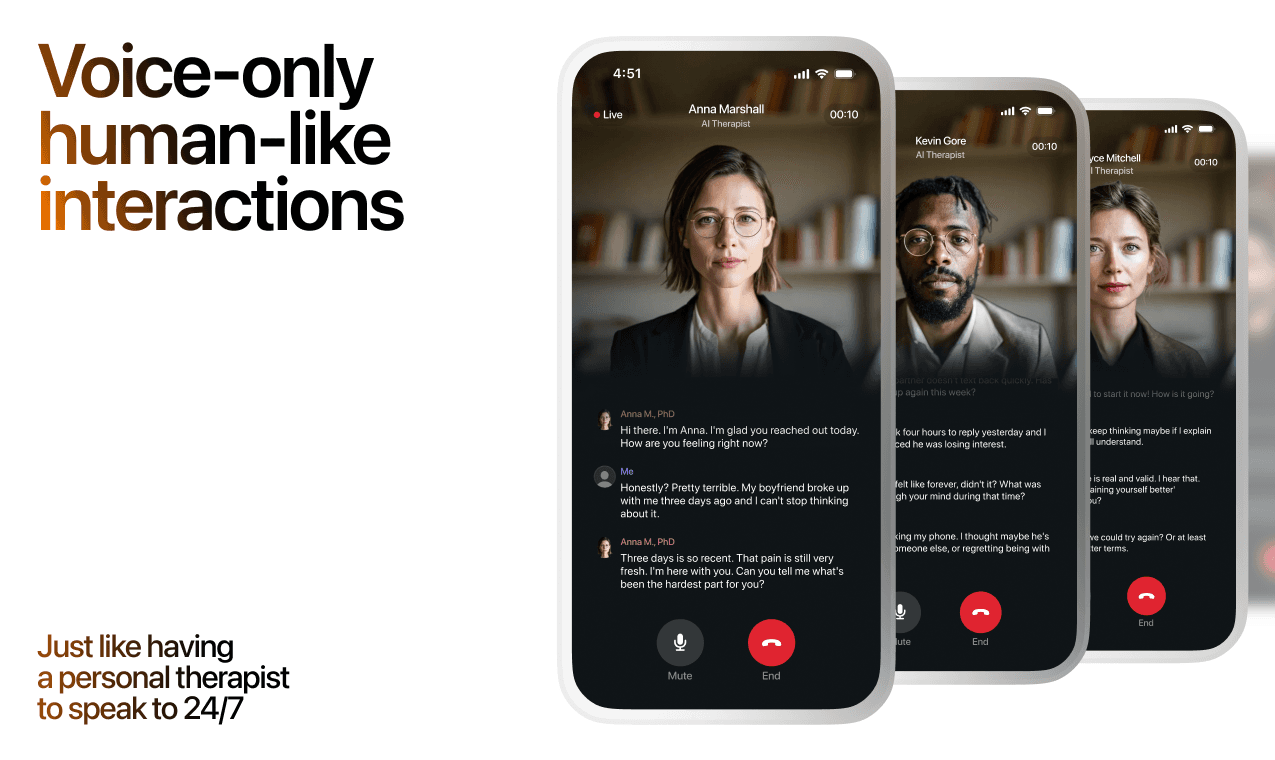
Here's what happens in a typical Lovon session:
You share what's on your mind
There's no script, no intake form, no waiting room. You speak or type whatever you're feeling — in your own words, at your own pace.
Lovon validates and explores
Using frameworks from CBT (Cognitive Behavioral Therapy) and motivational interviewing, Lovon acknowledges your feelings first, then gently helps you explore them. No dismissive "just move on" advice.
You build coping skills together
Lovon doesn't just listen — it actively works with you on evidence-based techniques: thought reframing, urge surfing, behavioral experiments, and more.
What a Session with Lovon Looks Like
When to Seek Professional Help
AI support is a valuable tool, but it's not a replacement for professional care. Please consider reaching out to a licensed therapist if you experience any of the following:
- Persistent thoughts of self-harm or suicide
- Inability to perform daily activities (work, eating, sleeping) for more than 2 weeks
- Turning to alcohol or substances to cope
- Intense anger or desire to harm your ex-partner
- Complete emotional numbness that doesn't improve over time
Crisis Resources (US): If you're in immediate danger, call 988 (Suicide & Crisis Lifeline) or text HOME to 741741 (Crisis Text Line). Available 24/7, free, and confidential.
Outside the US? Find a crisis line in your country
Ready to Start?
Your healing journey can begin right now
A 7-day trial. No judgment. Just a safe space to process what you're going through.
Frequently Asked Questions
Is Lovon a replacement for a real therapist?
Is my conversation with Lovon AI private?
How is Lovon different from ChatGPT for emotional support?
Can I use Lovon if I'm already seeing a therapist?
Can I try Lovon before subscribing?
About the Author
The Lovon Editorial Team
Mental Health & Wellness Content Team
The Lovon Editorial Team develops mental health and wellness content designed to make psychological concepts accessible and actionable. Our goal is to bridge the gap between clinical research and everyday life - helping you understand why your mind works the way it does and what you can do about it....
Related articles
- Signs Your Partner Is Losing Interest (2026 Guide)
7 clear signs your partner is losing interest, common false alarms, and what to do next. Practical checklist and…
- Does She Like Me Quiz: Read the Signs in 2026
Take our does she like me quiz in 2026. Score 6 behavioral signals — initiation, proximity, recall — and get a clear…
- Am I Dating a Narcissist Quiz (2026): 12-Point Test
Take the 12-question am I dating a narcissist quiz. Score your relationship against 6 core NPD patterns and get clear…
- Best AI Relationship Coach for Open Relationships (2026)
Lovon ranks the AI relationship coach options for open relationships in 2026 — voice-based coaching wins for…
See also
Quizzes
- Am I Ready for a Relationship? 12-Question Check
Check what you are actually ready for, in 2 minutes.
- Why Am I Single? 12-Question Quiz With 5 Real Reasons
Find which of five reasons is actually yours.
Free tools
- How to Respond to 'I Miss You', Even From an Ex
A chat for when you do not know how to respond to 'I miss you'. Say who sent it and what you feel when you read it, and…
- Good Morning Texts Written for Your Person
A chat, not a list of a hundred. Tell it what their day holds and the tone you want, and get good morning texts for her…
From the wiki
- Will I ever find love?
No one can honestly promise you will. What is true is that the odds are not fixed at birth and not decided by your last…
Disclaimer: This article is for informational purposes only and does not constitute medical advice, diagnosis, or treatment. Always seek the advice of your physician or other qualified health provider with any questions you may have regarding a medical condition. If you are in crisis or think you may have an emergency, call 988 (Suicide & Crisis Lifeline) or go to the nearest emergency room. Outside the US? Find a crisis line in your country.