
People Pleasing Trauma Response: How to Stop It in 2026
People pleasing trauma response explained: it's the fawn response, not weakness. Six steps to stop it in 2026, plus what to try when guilt hits hardest.

Key Takeaways
- 10-15 minutes a day for the first two weeks — this is retraining, not a one-time fix
- A notebook or notes app to track situations where you default to appeasing
- One low-stakes relationship to practice small boundaries with first (not your hardest one)
- A grounding technique you can do in under 90 seconds when anxiety spikes mid-conversation
- Access to some form of support — a therapist, a trusted friend, or an on-demand option like an AI voice therapy
People pleasing that started as a survival strategy doesn't fix itself with willpower — it needs a different nervous system response, not just better boundaries advice. If you are still deciding whether the pattern is yours, start with the am I a people pleaser quiz.
This guide breaks down people pleasing as a trauma response, why it's really the fawn response in disguise, and the specific steps to interrupt it without blowing up your relationships in the process.
TL;DR
People pleasing as a trauma response is the fawn response: a nervous system reflex that trades your needs for someone else's approval to avoid conflict or abandonment. The fix isn't "just say no" — it's rebuilding safety in your body first. Verdict: treatable, not a character flaw. Six steps below move you from automatic appeasing to deliberate choice, starting with naming the pattern and ending with tolerating the guilt that shows up when you stop.
Why this matters
People pleasing gets treated like a personality quirk. It isn't one.
When a child grows up around unpredictable anger, criticism, or emotional neglect, the nervous system learns that keeping others happy is the fastest route to safety. That wiring doesn't expire at 18. It shows up at 34 as the employee who can't say no to unpaid overtime, the partner who apologizes for things that aren't their fault, and the friend who agrees to plans they dread.
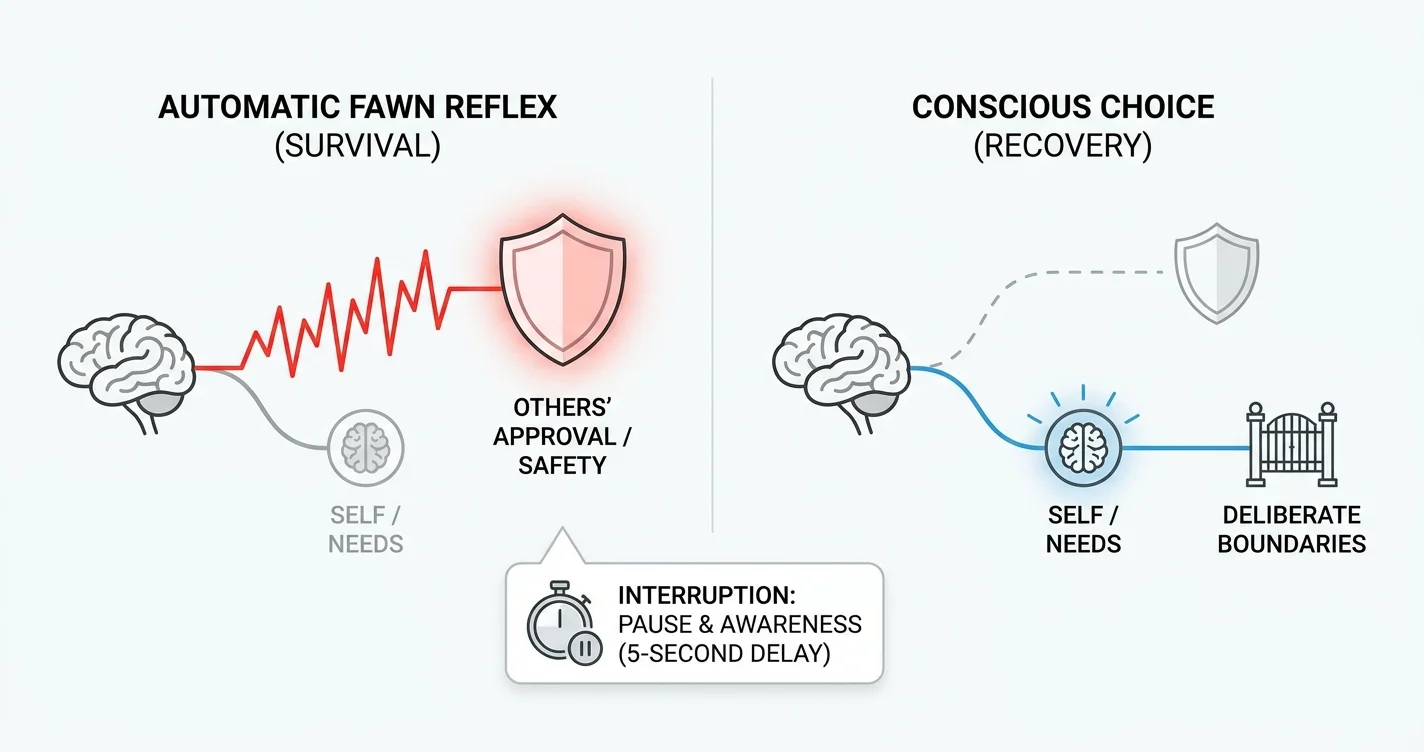
Clinicians describe this as the fourth trauma response — after fight, flight, and freeze — sometimes called "fawn." It's a real, documented survival pattern, not weakness. Recognizing it as physiological, not moral, is the first thing that has to shift before any of the steps below stick in 2026 or any other year.
What you'll need
- 10-15 minutes a day for the first two weeks — this is retraining, not a one-time fix
- A notebook or notes app to track situations where you default to appeasing
- One low-stakes relationship to practice small boundaries with first (not your hardest one)
- A grounding technique you can do in under 90 seconds when anxiety spikes mid-conversation
- Access to some form of support — a therapist, a trusted friend, or an on-demand option like an AI voice therapy session for days when you need to process out loud
The steps
1. Name the pattern as fawn, not "being nice"
You can't interrupt a reflex you're calling a virtue. Spend three days writing down every moment you agreed to something you didn't want, apologized when you weren't wrong, or went quiet to avoid tension.
By day three, most people find the pattern is not occasional — it's the default setting in at least half their interactions. That count is the baseline you're working against. Common mistake: journaling the event but skipping the body sensation that came with it (tight chest, held breath, forced smile) — the sensation is the data that tells you it's a trauma response, not a preference.
2. Identify the fear underneath the yes
Every automatic "sure, no problem" is protecting against something. Usually it's fear of anger, fear of abandonment, or fear of being seen as difficult.
Pick one recent example and finish this sentence: "If I had said no, I was afraid ______ would happen." Write the actual catastrophe, not the polite version. Most people find the fear traces back to a specific relationship from childhood, not the person standing in front of them today. Common mistake: assuming the fear is really about the current situation — it almost never is.
3. Practice a 5-second delay before agreeing
The fawn response fires faster than conscious thought, often in under a second. Building a pause is the mechanical fix.
When someone asks something of you, say "let me check and get back to you" before answering, every time, for two weeks straight. It buys your nervous system time to catch up to your actual preference instead of the automatic yes. Expected outcome: within 10-14 days, the delay starts feeling less awkward and more like a normal habit. Common mistake: only using the delay for big requests — practice it on small ones first, like whether you want to grab coffee.
4. Set one boundary a day smaller than you think you need
Start absurdly small. Correcting a barista's order, telling a coworker you'll respond tomorrow instead of tonight, saying "I'd rather not" about a dinner topic.
The goal for the first month isn't the big confrontation with a parent or partner — it's proving to your nervous system that a small no didn't end in disaster. If you want a structured way to build this muscle, setting boundaries clearly with scripts you can reuse removes the guesswork of what to actually say. Expected outcome: the discomfort shrinks noticeably by boundary 15 or 20. Common mistake: picking your hardest relationship to practice on first — save that for month two or three.
5. Sit with the guilt instead of fixing it
Guilt after a boundary is not proof you did something wrong. It's your old wiring firing an alarm that's now inaccurate.
When guilt shows up after you say no, set a timer for 10 minutes and just notice it — don't apologize, don't over-explain, don't cave. Track how long the guilt actually lasts versus how long you assumed it would. Most people report it fades in under 20 minutes once they stop feeding it with reassurance-seeking. Common mistake: texting the person again to soften the no — that resets the fear response instead of letting it pass.
6. Rebuild the relationship with your own preferences
Years of fawning erode your ability to know what you actually want. Ask yourself three times a day: what do I want right now, regardless of what anyone else needs?
Start with trivial choices — what to eat, what to watch — before applying it to relationships or work. If the pattern is tangled up with a specific dynamic, breaking a codependent pattern with practical steps is worth working through alongside this. Expected outcome: within 6-8 weeks, answering "what do I want" stops feeling like a trick question. Common mistake: waiting until you feel fully confident before voicing a preference — voice it while still unsure, confidence comes after the practice, not before.
Troubleshooting
- You said no and immediately felt panic, not relief. Normal in the first month. Panic means the nervous system flagged a threat that isn't real anymore — ride it out rather than reversing the no.
- People around you are pushing back on the new boundaries. Expected. People who benefited from your fawning will resist the change for a few weeks before adjusting or distancing.
- You're overcorrecting into bluntness or coldness. Swinging from fawn to a defensive wall is common around week 3-4. The target is neutral honesty, not armor.
- The pattern is worse with one specific person. That's usually the relationship the fawn response was originally built for — parent, ex, or authority figure. It needs slower, more deliberate work than the others.
- You can't tell if it's people pleasing or genuine kindness. Ask if you'd still do it with zero chance of conflict or disapproval. If the answer changes, it's fawn, not kindness.
- Old guilt resurfaces months later during a hard week. Stress lowers your threshold and reactivates old patterns temporarily — it's a regression, not a failure of the work.
Tools and resources
- A daily tracking notebook or notes app for the pattern log in step 1
- A short grounding technique — box breathing or a body scan — for the moment before a boundary conversation
- A therapist or trauma-informed counselor for entrenched patterns tied to childhood dynamics
- An AI voice support option like Lovon for talking through a boundary attempt in real time, especially outside office hours when the guilt spike happens at 11pm and there's no one else to call
- A trusted person to role-play a hard conversation with before you have it for real
Lovon's format — a spoken conversation rather than typed text — matters here specifically because fawn patterns are often nonverbal: tone, pacing, and hesitation carry as much signal as the words. Saying the boundary out loud to an AI voice companion first, before saying it to the person who triggers the pattern, gives you a low-stakes rehearsal.
What to do next
Once the six steps above feel less like effort and more like habit, go deeper on the physiology behind why fawning happens at all — the fawn response explained breaks down where it sits alongside fight, flight, and freeze, and why it's the least talked about of the four.
FAQ
What is people pleasing as a trauma response? It's an automatic pattern of prioritizing others' comfort over your own needs to avoid perceived danger — conflict, anger, or abandonment. It's rooted in survival wiring, usually from childhood, not a personality trait.
Is people pleasing the same as the fawn response? Yes, functionally. "Fawn" is the clinical term for the pattern most people describe as chronic people pleasing, and it sits alongside fight, flight, and freeze as a fourth trauma response.
Can people pleasing be trauma related without a history of abuse? Yes. Emotional neglect, inconsistent caregiving, or growing up walking on eggshells around a volatile parent can produce the same fawn wiring as more overt abuse.
How long does it take to stop people pleasing? Most people notice the automatic guilt after a boundary shrinking within 6-8 weeks of consistent small practice, based on aggregated clinical reporting in 2026. Deeply entrenched patterns tied to a specific relationship take longer.
Is people pleasing a symptom of anxiety or CPTSD? It can show up in both. Anxiety amplifies the fear of disapproval, while CPTSD often has fawn as a core survival response learned in childhood — the two frequently overlap.
Can therapy really help with a trauma-based fawn response? Yes, particularly approaches that work with the body, not just the thoughts, since fawn responses are largely automatic and physiological rather than a belief you can just reason your way out of.
What's the fastest way to say no without guilt? There isn't a guilt-free version in the first month — the goal is tolerating the guilt while still holding the boundary, not eliminating it. The delay tactic in step 3 is the fastest mechanical fix.
Does an AI therapy app help with trauma-based people pleasing? It can help with rehearsal and reflection between sessions or on days without access to a therapist. Lovon's voice format lets you practice a hard conversation out loud, though it's not a substitute for licensed clinical care for deeply rooted trauma.
One last thing
The fawn response almost never shows up as obvious weakness — it usually looks like being "the easy one," the reliable friend, the employee who never complains. That reputation is the trauma response working exactly as designed, and it's often the hardest version to unlearn because everyone around you benefits from you staying stuck in it.
Related guides
How AI Support Helps You Heal
AI emotional support isn't about replacing human connection — it's about filling the gaps. The moments when you need to talk at 2 AM, when you don't want to burden your friends again, or when you simply need someone to listen without judgment.
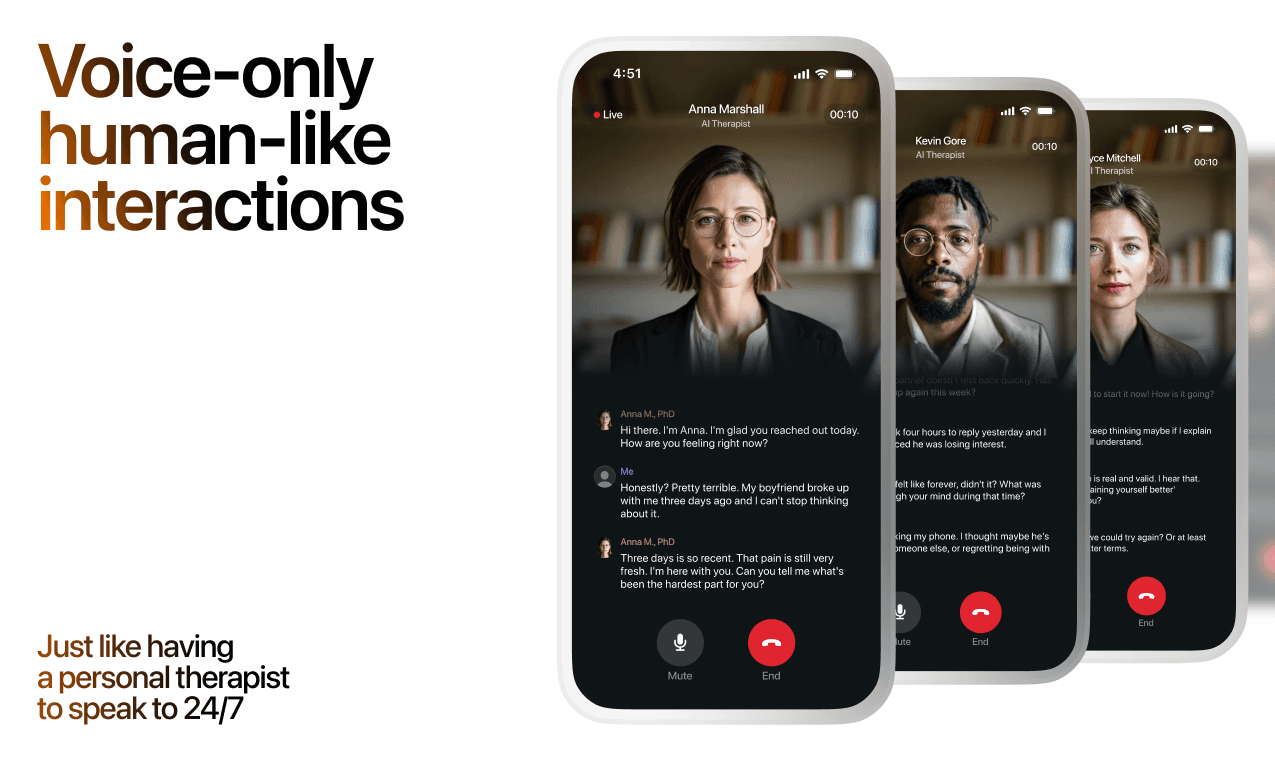
Here's what happens in a typical Lovon session:
You share what's on your mind
There's no script, no intake form, no waiting room. You speak or type whatever you're feeling — in your own words, at your own pace.
Lovon validates and explores
Using frameworks from CBT (Cognitive Behavioral Therapy) and motivational interviewing, Lovon acknowledges your feelings first, then gently helps you explore them. No dismissive "just move on" advice.
You build coping skills together
Lovon doesn't just listen — it actively works with you on evidence-based techniques: thought reframing, urge surfing, behavioral experiments, and more.
What a Session with Lovon Looks Like
When to Seek Professional Help
AI support is a valuable tool, but it's not a replacement for professional care. Please consider reaching out to a licensed therapist if you experience any of the following:
- Persistent thoughts of self-harm or suicide
- Inability to perform daily activities (work, eating, sleeping) for more than 2 weeks
- Turning to alcohol or substances to cope
- Intense anger or desire to harm your ex-partner
- Complete emotional numbness that doesn't improve over time
Crisis Resources (US): If you're in immediate danger, call 988 (Suicide & Crisis Lifeline) or text HOME to 741741 (Crisis Text Line). Available 24/7, free, and confidential.
Outside the US? Find a crisis line in your country
Ready to Start?
Your healing journey can begin right now
A 7-day trial. No judgment. Just a safe space to process what you're going through.
Frequently Asked Questions
Is Lovon a replacement for a real therapist?
Is my conversation with Lovon AI private?
How is Lovon different from ChatGPT for emotional support?
Can I use Lovon if I'm already seeing a therapist?
Can I try Lovon before subscribing?
About the Author
The Lovon Editorial Team
Mental Health & Wellness Content Team
The Lovon Editorial Team develops mental health and wellness content designed to make psychological concepts accessible and actionable. Our goal is to bridge the gap between clinical research and everyday life - helping you understand why your mind works the way it does and what you can do about it....
Related articles
- Freeze Response and Fawn Response as Trauma Survival Patterns
When faced with overwhelming threat, the human nervous system activates a series of automatic responses designed to…
- Chronic Guilt: Why You Feel Guilty All the Time (2026)
Chronic guilt runs even when you've done nothing wrong. Learn the 6 steps to identify its root cause and break the cycle…
- Best AI App for Codependency Recovery in 2026: Lovon Wins
Lovon ranks best AI app for codependency recovery in 2026, compared against Wysa, Replika, BetterHelp, and Youper on…
- ADHD Rejection Sensitive Dysphoria Explained (2026)
Rejection sensitive dysphoria ADHD causes sudden, intense emotional pain from perceived rejection. Learn what RSD is…
See also
Quizzes
- Boundaries Test: Free 12-Question Self-Check
See where your boundaries slip, in 3 minutes.
- Toxic Positivity Test: Does Your Cheer Shut People Out?
See what you say, hide and shut out, in 3 minutes.
Free tools
- How to Come Out to Your Parents
A chat about how to come out to your parents that starts with whether now is safe, not with the speech. Tell it your…
- What to Say Back to a Hostile Co-Parent
A chat, not a form. Paste the message your ex sent about the kids, say what actually has to be decided, and you get a…
From the wiki
- Why do I have no friends?
Usually nothing is wrong with you. Adult friendship runs on proximity and repetition, and most people lose both at once…
Disclaimer: This article is for informational purposes only and does not constitute medical advice, diagnosis, or treatment. Always seek the advice of your physician or other qualified health provider with any questions you may have regarding a medical condition. If you are in crisis or think you may have an emergency, call 988 (Suicide & Crisis Lifeline) or go to the nearest emergency room. Outside the US? Find a crisis line in your country.