
Enmeshment in Relationships: Signs & Fix (2026)
Enmeshment in relationships blurs boundaries until feelings merge. See the signs, a 7-step untangling process, and troubleshooting fixes for 2026.

Key Takeaways
- A specific relationship in mind (parent, partner, sibling, or close friend) — enmeshment work is more effective when
- A notebook or notes app for tracking your reactions over 2-3 weeks
- One or two boundary phrases you can practice saying out loud before you need them
- Tolerance for short-term discomfort — the other person will likely push back before they adjust
- Optional: a structured support tool. Voice-based reflection with something like Lovon's AI therapist can help you
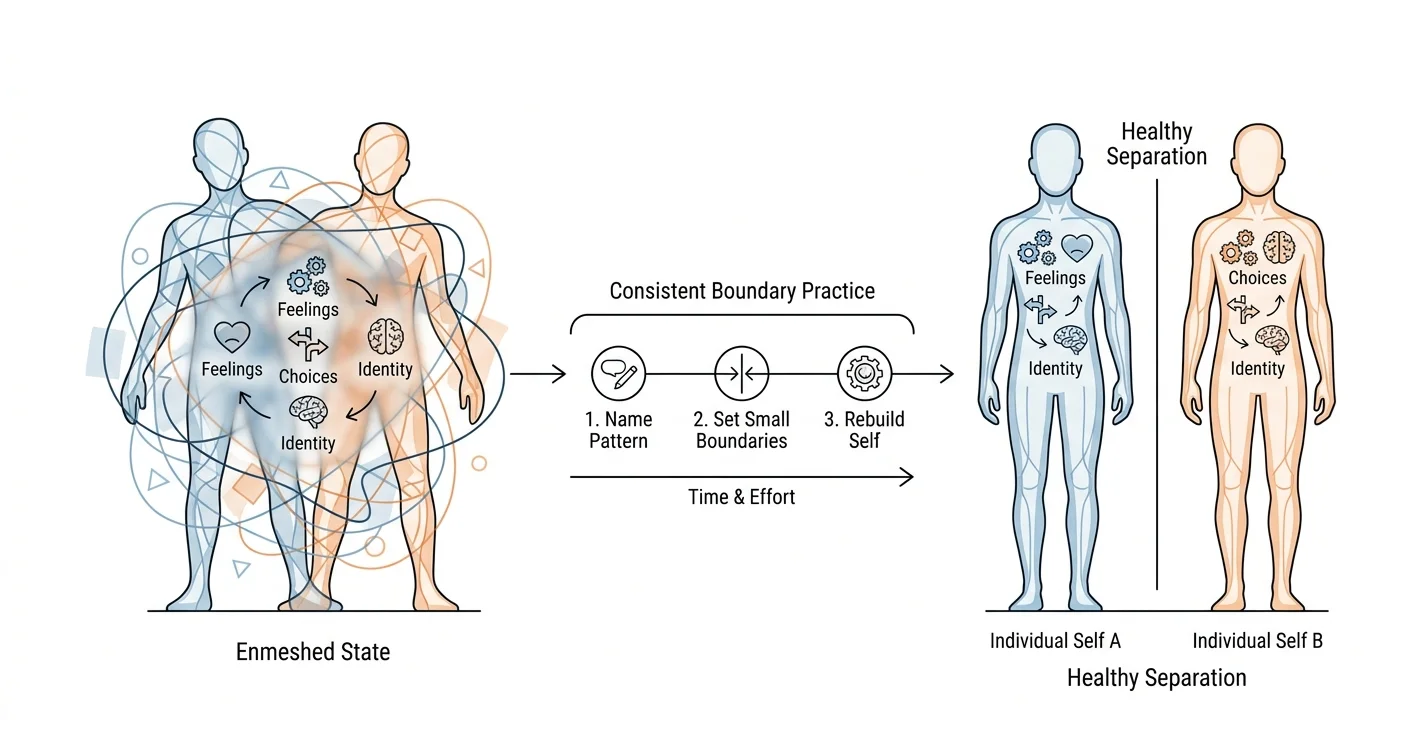
Enmeshment in relationships means the emotional boundary between two people has blurred so much that one person's feelings, choices, or identity become indistinguishable from the other's. This guide names the signs and gives you a step-by-step way to build separation without cutting people off.
TL;DR
Enmeshment in relationships shows up as guilt when you have a boundary, difficulty naming your own opinions, and panic when someone you're enmeshed with is upset. Untangling it takes deliberate steps: naming the pattern, practicing small boundaries, tolerating the discomfort that follows, and rebuilding a separate sense of self. Verdict: enmeshment is treatable through consistent boundary practice, not through distance alone — most people need 2026's tools (structured journaling, boundary scripts, and consistent support) rather than a single hard conversation. If you're untangling this with a parent, partner, or sibling, expect resistance before you see relief.
Why this matters
Enmeshed relationships feel like closeness. That's what makes them hard to spot. You mistake the anxiety of separation for love, and the relief of merging back together for connection.
Over time, enmeshment costs you your own preferences, your decision-making, and often your other relationships, because there's no room left for anyone else. Left unaddressed, it tends to repeat: enmeshed adult children often become enmeshed partners, then enmeshed parents. The pattern is learned, which means it can be unlearned — and 2026 research on family systems keeps pointing to the same fix: structured, gradual boundary work, not sudden withdrawal. It overlaps heavily with codependency, so if some of this doesn't fully match, codependency vs. love covers the distinction in more detail.
What you'll need
- A specific relationship in mind (parent, partner, sibling, or close friend) — enmeshment work is more effective when it's targeted, not general
- A notebook or notes app for tracking your reactions over 2-3 weeks
- One or two boundary phrases you can practice saying out loud before you need them
- Tolerance for short-term discomfort — the other person will likely push back before they adjust
- Optional: a structured support tool. Voice-based reflection with something like Lovon's AI voice companion can help you rehearse boundary conversations before you have them in real life
The steps
1. Name the specific enmeshed pattern
Vague awareness ("we're too close") doesn't change behavior. Specific awareness does.
Write down three recent moments where you couldn't tell if a feeling was yours or theirs — a decision you made to avoid someone's disappointment, an opinion you dropped because they disagreed, a mood that shifted the second theirs did. This step alone often takes a full week, because enmeshed patterns are automatic. Common mistake: naming the relationship instead of the pattern ("my mom and I are enmeshed") without identifying the actual behavior that needs to change.
2. Separate your feelings from theirs in the moment
When you notice their mood affecting yours, pause and ask one question: "Is this feeling about my day, or about theirs?" This single distinction is the core skill of untangling enmeshment.
Practicing it 3-4 times a day for two weeks builds the habit faster than trying to journal about it after the fact. Expected outcome: within 10-14 days, you'll catch the merge happening in real time instead of realizing it an hour later. Common mistake: treating this as a one-time insight rather than a repeated practice.
3. Set one small, low-stakes boundary first
Don't start with the biggest issue in the relationship. Start with something minor — not answering a text within five minutes, choosing a restaurant without checking their preference first, going to bed when you're tired instead of staying up because they are.
Small boundaries build tolerance for the discomfort before you tackle bigger ones. If you need scripting help, healthy relationship boundaries has specific phrasing you can adapt. Common mistake: picking the hardest boundary first and getting discouraged when it goes badly.
4. Expect and sit through the pushback
Enmeshed systems resist change, even good change. When you set a boundary, the other person may escalate — more calls, guilt statements, or withdrawal of affection — before they settle.
This is the single most common reason people abandon boundary work: they read pushback as proof the boundary was wrong. It's usually proof it was working. Give any new boundary at least three to four attempts before deciding whether it's landing. Common mistake: reversing the boundary the first time someone reacts badly.
5. Build a life that exists outside the enmeshed relationship
Enmeshment thrives when one relationship is your only source of identity, decisions, and emotional regulation. Rebuilding separateness means having interests, friendships, and routines that don't run through that person.
Pick one activity this month that's entirely yours — not something you'll report back on or get their input on first. This step often takes the longest, sometimes 2026's full first quarter for slow-moving family dynamics. Common mistake: waiting for permission or agreement before starting something new.
6. Practice identifying your own opinions before checking theirs
Enmeshed thinking defaults to "what would they think?" before "what do I think?" Reverse the order deliberately: form your own opinion first, then, if relevant, hear theirs.
This is uncomfortable at first because it feels selfish. It isn't — it's the basic skill of having a self. Expected outcome: within a month of consistent practice, you'll notice fewer moments of scrambling to figure out what you actually think after the fact.
7. Get outside reflection when you can't see the pattern clearly
Enmeshment is hard to self-diagnose because you're inside it. A structured conversation — with a therapist, a support group, or an on-demand tool — surfaces blind spots faster than journaling alone.
If ongoing sessions aren't accessible right now, on-demand emotional support walks through the option of talking something through the moment it happens, rather than waiting for a scheduled slot.
Troubleshooting
- They call the boundary "selfish" or "cold": That's a common escalation tactic in enmeshed systems, not evidence you did something wrong. Hold the boundary and revisit the relationship's warmth separately — the two aren't the same thing.
- You feel intense guilt every time you separate: Guilt is the emotional signature of enmeshment, not a signal to stop. It typically fades over repeated exposure, similar to how anxiety fades with practice rather than avoidance.
- You can't tell if you're being enmeshed or just close: Ask whether you could disagree with this person on something small without a fight or a cold shoulder. If not, that's a marker worth examining.
- The pattern traces back to childhood, not a current partner: This is common — enmeshment often starts with a parent. Toxic parent patterns covers limit-setting specific to family-of-origin dynamics.
- You keep reverting after a good week: Reversion is normal, not failure. Each round of practice tends to shorten the reversion period rather than eliminate it instantly.
- The other person threatens to end the relationship over a boundary: That threat is worth taking seriously as information, but it isn't proof the boundary was unreasonable. Distinguish between a relationship ending because it can't tolerate any separateness and one that adjusts over time.
Tools and resources
- How to stop being codependent — practical steps that overlap closely with enmeshment work
- A notes app or physical journal for tracking the "whose feeling is this" question daily
- Voice-based reflection through Lovon for rehearsing hard conversations before you have them, especially useful when the enmeshed relationship is a parent or long-term partner
What to do next
Once boundary practice feels steadier, the next layer is usually attachment style, since enmeshment and anxious attachment often travel together. If the enmeshed relationship is with a parent rather than a partner, family-of-origin limit-setting is the natural next focus.
FAQ
What is enmeshment in relationships? Enmeshment in relationships is a pattern where emotional boundaries between two people are so blurred that one person's mood, opinions, or decisions become fused with the other's. It's most common between a parent and adult child, but it shows up in romantic partnerships and close friendships too.
Is enmeshment the same as codependency? They overlap but aren't identical — enmeshment is about blurred identity and boundaries, while codependency centers more on needing to be needed and managing another person's emotions. The two often appear together in the same relationship.
How long does it take to untangle from an enmeshed relationship? Most people notice real shifts in behavior within 4-6 weeks of consistent boundary practice, though family-level enmeshment can take several months to fully rework. There's no fixed timeline — consistency matters more than speed.
Can you fix enmeshment without ending the relationship? Yes, in most cases. The goal isn't distance, it's separateness within the relationship — most enmeshed relationships improve rather than end once both people adjust to boundaries.
What are the warning signs of an enmeshed parent-child relationship? Common signs include a parent sharing adult problems with a child as a peer, guilt-tripping over normal independence, or an adult child feeling responsible for a parent's emotional state. All three point to a boundary that never fully separated after childhood.
Why does setting a boundary with an enmeshed person feel so much worse than it should? Because enmeshed systems interpret any separateness as rejection, the emotional reaction is often disproportionate to the actual boundary. That intensity is the pattern itself, not a sign the boundary is wrong.
Does therapy help with enmeshment? Structured reflection, whether with a licensed therapist or a supportive tool used between sessions, helps most people see the pattern faster than they would alone. Lovon's AI voice support is one option for daily reflection between appointments, though it isn't a replacement for licensed clinical care when deeper family work is needed.
Can two people be enmeshed and not know it? Yes — enmeshment often feels like unusually strong closeness rather than a problem, which is exactly why it goes unnamed for years. The clearest test is whether disagreement is tolerated without guilt, anger, or withdrawal.
One last thing
The hardest part of untangling enmeshment usually isn't the other person — it's that you've never practiced having a self that exists independently of the relationship, so the early boundary work can feel like grief even when nothing bad has happened. That feeling passes. It's evidence the separation is working, not proof it's going wrong.
Related guides
How AI Support Helps You Heal
AI emotional support isn't about replacing human connection — it's about filling the gaps. The moments when you need to talk at 2 AM, when you don't want to burden your friends again, or when you simply need someone to listen without judgment.
Here's what happens in a typical Lovon session:
You share what's on your mind
There's no script, no intake form, no waiting room. You speak or type whatever you're feeling — in your own words, at your own pace.
Lovon validates and explores
Using frameworks from CBT (Cognitive Behavioral Therapy) and motivational interviewing, Lovon acknowledges your feelings first, then gently helps you explore them. No dismissive "just move on" advice.
You build coping skills together
Lovon doesn't just listen — it actively works with you on evidence-based techniques: thought reframing, urge surfing, behavioral experiments, and more.
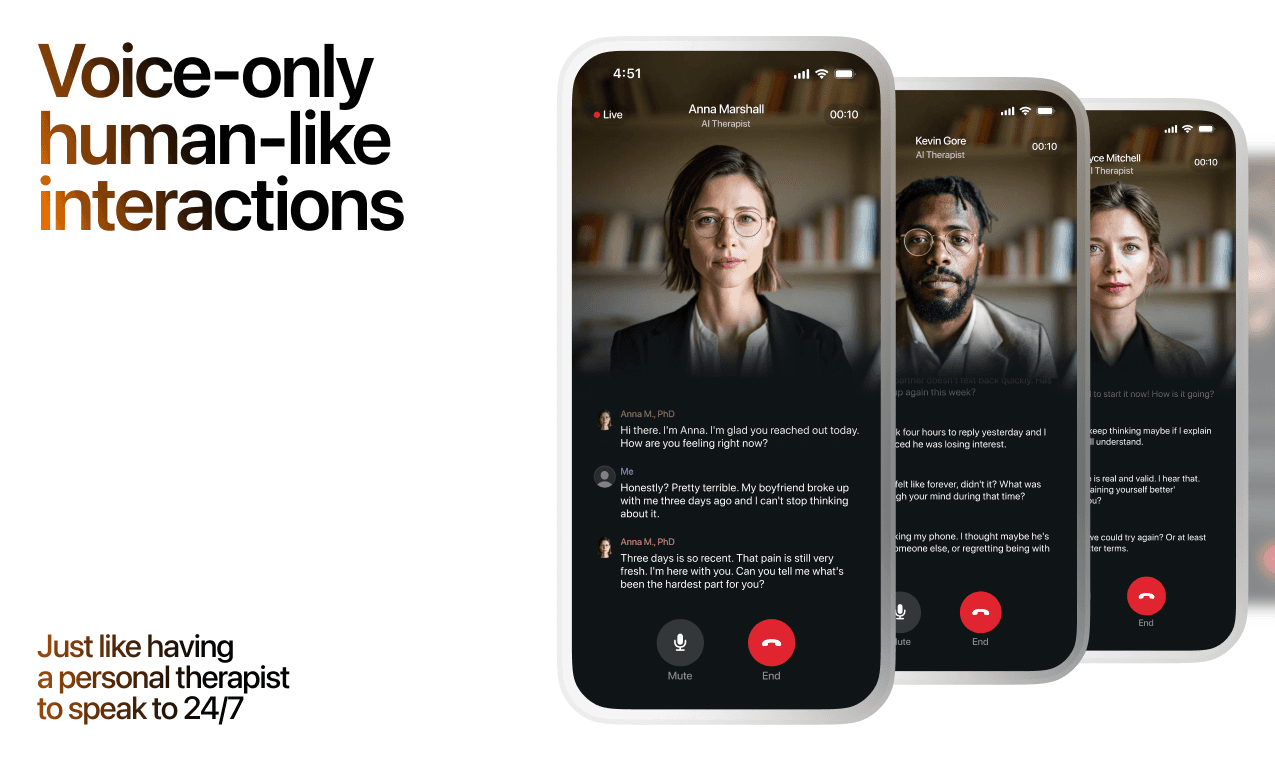
What a Session with Lovon Looks Like
When to Seek Professional Help
AI support is a valuable tool, but it's not a replacement for professional care. Please consider reaching out to a licensed therapist if you experience any of the following:
- Persistent thoughts of self-harm or suicide
- Inability to perform daily activities (work, eating, sleeping) for more than 2 weeks
- Turning to alcohol or substances to cope
- Intense anger or desire to harm your ex-partner
- Complete emotional numbness that doesn't improve over time
Crisis Resources (US): If you're in immediate danger, call 988 (Suicide & Crisis Lifeline) or text HOME to 741741 (Crisis Text Line). Available 24/7, free, and confidential.
Outside the US? Find a crisis line in your country
Ready to Start?
Your healing journey can begin right now
A 7-day trial. No judgment. Just a safe space to process what you're going through.
Frequently Asked Questions
Is Lovon a replacement for a real therapist?
Is my conversation with Lovon AI private?
How is Lovon different from ChatGPT for emotional support?
Can I use Lovon if I'm already seeing a therapist?
Can I try Lovon before subscribing?
About the Author

The Lovon Editorial Team
Mental Health & Wellness Content Team
The Lovon Editorial Team develops mental health and wellness content designed to make psychological concepts accessible and actionable. Our goal is to bridge the gap between clinical research and everyday life - helping you understand why your mind works the way it does and what you can do about it....
Related articles
- Is self-care actually selfish?
Is self care selfish? No. Learn how to tell a real need from avoidance, set a clear boundary, and respect commitments…
- Self-Sabotaging Relationships: Why It Happens (2026)
Self-sabotaging relationships explained: the trigger pattern behind it and a 6-step process to interrupt it in 2026…
- How to Stop People Pleasing in 2026: 7-Step Guide
How to stop people pleasing in 2026: 7 concrete steps, a boundary script, and troubleshooting for guilt, pushback, and…
- How to Ask for Emotional Support Without Feeling Needy (2026)
How to ask for emotional support without feeling needy in 2026: name the need, bound the ask, pick the right person…
See also
Quizzes
- Empath Test: Do Other People's Moods Become Yours?
See how much of other people's moods you take on.
- Self Esteem Test: What Is Your Worth Resting On?
See what your sense of worth is resting on.
Free tools
- How to Come Out to Your Parents
A chat about how to come out to your parents that starts with whether now is safe, not with the speech. Tell it your…
- Family Boundary Plan
Pick the person, the one topic, and how much you want to see them. You get a three-rung ladder, the guilt lines to…
From the wiki
- Why do I feel lonely all of a sudden?
Sudden loneliness usually traces back to something that quietly ended in the last few months: a routine, a shared class…
Disclaimer: This article is for informational purposes only and does not constitute medical advice, diagnosis, or treatment. Always seek the advice of your physician or other qualified health provider with any questions you may have regarding a medical condition. If you are in crisis or think you may have an emergency, call 988 (Suicide & Crisis Lifeline) or go to the nearest emergency room. Outside the US? Find a crisis line in your country.