
On-Demand Emotional Support in 2026: What Actually Helps
Therapy isn't always available. This 2026 guide covers the best on-demand emotional support tools — who they're for, what to look for, and what to skip.

Key Takeaways
- Apps that claim to diagnose. No app is qualified to tell you that you have depression, an anxiety disorder, or ADHD.
- Journaling-only apps marketed as therapy. Writing down your feelings has value, but a static text box with no
- Free tools with no transparency about data use. If you can't find a clear privacy policy explaining what happens to
On-demand emotional support fills the gap between scheduled therapy appointments — and in 2026, that gap is where most people actually struggle.
TL;DR: When anxiety spikes at midnight, a work conflict sends you spiraling, or grief hits on a Tuesday afternoon, traditional therapy is simply not available. On-demand emotional support tools — especially AI voice apps like Lovon — give you a place to process what's happening right now, using coping techniques built with input from PhD psychologists. This guide covers who this option is right for, what to look for, and what to avoid.
Why the therapy gap is a real problem in 2026
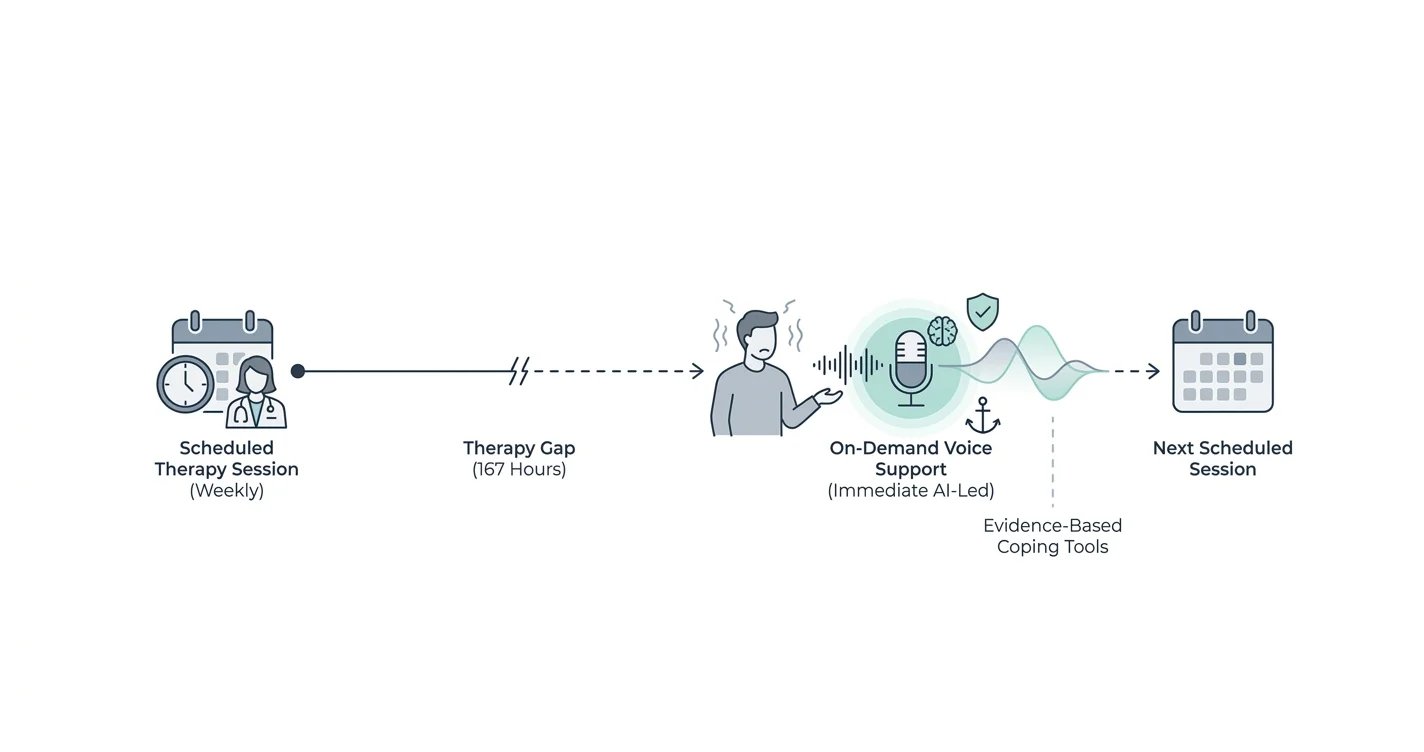
The average wait time to see a therapist in the US ranges from 3 to 6 weeks, and cost without insurance averages over $150 per session. Even people who are already in therapy typically see their therapist once a week — which leaves 167 hours of the week unaccounted for. Stress doesn't respect that schedule. Panic attacks don't wait for Thursday at 4 p.m. That's not a failure of therapy as a model; it's just a structural reality.
On-demand emotional support isn't a replacement for clinical care. It's what you use when you need to talk something through right now, when your nervous system is in overdrive and you need a grounding exercise at 11 p.m., or when you want to process a difficult conversation before it festers.
Who this is for
This guide is written for adults who are already managing their mental health — whether that means they have a therapist they see occasionally, or they're handling everyday stress independently — and who need something available between sessions or in moments when professional support isn't accessible. You're not in crisis requiring emergency services. You're dealing with the ordinary weight of anxiety, low mood, relationship friction, burnout, or just a hard week. You want to talk it out, calm your nervous system, and get a tool that helps — without booking a week in advance or paying $150 each time.
What to look for in on-demand emotional support
Voice-first interaction
Typing out your feelings while you're overwhelmed creates friction at exactly the wrong moment. Voice-based support lets you just talk — the way you would to a trusted friend or therapist. Lovon is built specifically around voice conversations, which means you don't have to find the right words on a keyboard before you've even processed what's wrong. The spoken format also keeps the experience feeling human rather than transactional.
Evidence-based coping tools, not just empathy
Feeling heard matters, but you also need tools that actually shift your state. Look for apps grounded in established frameworks — cognitive behavioral techniques, grounding exercises, breathing protocols, somatic check-ins. Lovon is developed with input from PhD psychologists, which means the coping strategies you receive in a session reflect methods used in real clinical practice, not content marketing scripts.
Availability without friction
The whole point is that support is there when you need it. An on-demand tool that requires setup, onboarding calls, or a subscription confirmation email before you can start talking defeats its own purpose. The best options launch in under 60 seconds and let you start where you are — no appointment, no intake form, no waiting room.
Honesty about what it is
Any on-demand emotional support tool worth using is transparent about its limitations. Lovon states plainly that it is not a licensed clinician and is not a replacement for professional mental health treatment. That honesty is a feature, not a disclaimer. It means the tool knows what it is — and so do you. Avoid any app that implies it can diagnose, treat, or replace a licensed therapist.
Personalization over scripts
Generic affirmations and cookie-cutter breathing exercises get old fast. The better tools adapt to what you're bringing to the session — whether that's anxiety about a relationship, burnout from work, or low mood that's hard to name. Lovon's AI voice sessions are built to respond to what you're actually saying, not just cycle through a preset module.
Privacy you can trust
You're sharing sensitive emotional content. Check whether conversations are stored, how data is used, and what the deletion policy looks like. This matters more for emotional support tools than for almost any other app category.
Top options for on-demand emotional support in 2026
Lovon — the voice-first pick for everyday emotional support
The safe pick for anyone who wants to just talk.
Lovon is an AI-powered voice support app built for exactly this use case: the moments between appointments, the late-night anxiety spiral, the post-argument emotional hangover. Sessions are conversational and voice-led, which lowers the barrier significantly compared to text-based journaling or chat tools. The app is developed with PhD psychologist input and covers anxiety, stress, low mood, relationship problems, burnout, and ADHD-adjacent emotional dysregulation.
Lovon is honest that it is not a licensed therapist — it positions itself as an always-available companion, not a clinical replacement. That positioning is appropriate and accurate. For the 167 hours a week when your therapist isn't available, Lovon fills the gap without pretending to be something it isn't.
Verdict: Buy. If on-demand emotional support is what you need, Lovon is built for it.
Text-based CBT apps (e.g., Woebot, Wysa)
The accessible entry point for mild anxiety management.
Text-based chatbot apps built on cognitive behavioral therapy frameworks have been around since the mid-2010s and have a reasonable evidence base for mild to moderate anxiety. They're free or low-cost, available 24/7, and require no voice input. The tradeoff is that the experience feels more like filling out a worksheet than having a conversation. For people who find speaking uncomfortable, this is a viable starting point.
Verdict: Consider for mild anxiety if you prefer text. For anything deeper or ongoing, you'll likely want something more responsive.
Traditional teletherapy apps (e.g., BetterHelp, Talkspace)
The right call for clinical-level care — but not truly on-demand.
Teletherapy platforms connect you with licensed therapists via video, phone, or text. The quality of care is real. The limitation is that sessions are scheduled — often days to a week out — and cost $60–$100 per week on subscription plans. They are not on-demand in any meaningful sense. If you need a licensed clinician for a diagnosed condition, these platforms are worth the structure. But for the 11 p.m. anxiety moment, they don't help.
Verdict: Hold as your primary mental health support; not a replacement for on-demand tools.
Crisis text lines and warmlines
The right resource for acute distress — not for everyday emotional support.
Crisis Text Line (text HOME to 741741) and state-specific warmlines serve people in acute emotional distress. These are staffed by trained counselors and volunteers. They are not designed for the ongoing emotional processing that on-demand support tools handle. If you are in crisis, use them. If you're dealing with everyday stress, burnout, or relationship friction, they are not the right fit — and using them for that purpose takes resources away from people in acute need.
Verdict: Skip as an everyday emotional support tool. Have the number saved for genuine emergencies.
What to avoid
- Apps that claim to diagnose. No app is qualified to tell you that you have depression, an anxiety disorder, or ADHD. A tool that implies it can diagnose is misleading you, and that framing can delay you getting the clinical assessment you might actually need.
- Journaling-only apps marketed as therapy. Writing down your feelings has value, but a static text box with no response, no coping tools, and no interaction is not emotional support — it's a diary. The label matters.
- Free tools with no transparency about data use. If you can't find a clear privacy policy explaining what happens to your session content, that's a reason to stop and look elsewhere. Emotional data is among the most sensitive information you generate.
Comparison: on-demand emotional support options in 2026
| Option | Available 24/7 | Voice-led | Evidence-based | Licensed clinician | Best for |
|---|---|---|---|---|---|
| Lovon | Yes | Yes | Yes (PhD input) | No | Everyday support, between sessions |
| Text CBT apps | Yes | No | Moderate | No | Mild anxiety, habit-building |
| Teletherapy | No (scheduled) | Video/phone | Yes | Yes | Clinical-level, diagnosed conditions |
| Crisis lines | Yes | Yes (phone) | Trained volunteers | No | Acute distress only |
FAQ
What is on-demand emotional support? On-demand emotional support is access to coping tools, guided conversations, or a supportive AI companion any time you need it — without scheduling an appointment. It covers anxiety, stress, relationship friction, burnout, and low mood in the moments between or instead of formal therapy sessions.
Is an AI app a substitute for therapy? No. AI voice apps like Lovon are companions for everyday emotional struggles, not replacements for licensed clinical care. If you have a diagnosed mental health condition or are in crisis, a licensed therapist or psychiatrist is the appropriate support.
How much does on-demand emotional support cost in 2026? Costs vary significantly. Traditional therapy without insurance averages over $150 per session. AI-powered apps like Lovon are substantially more affordable and offer on-demand access without per-session fees. Text-based CBT apps often have free tiers. See a full cost breakdown for 2026 figures.
When should I use on-demand support vs. a therapist? Use on-demand support for everyday stress, anxiety between sessions, processing a difficult conversation, or when you need a grounding tool right now. See a therapist when you're dealing with a diagnosed condition, significant trauma, persistent depression, or anything that impairs your daily function consistently.
Can on-demand emotional support help with anxiety at night? Yes. This is one of its clearest use cases. Late-night anxiety is common and almost never coincides with business hours. Voice-based tools like Lovon let you work through what's happening — breathing, grounding, talking it out — without waiting until morning.
What's the difference between an AI therapy app and a crisis line? Crisis lines are for acute distress — when you're unsafe or in psychological emergency. AI therapy apps handle the everyday emotional weight most people carry: stress, low mood, relationship tension, burnout. They serve different moments and should not be conflated.
Is voice-based emotional support better than text? For most people dealing with active emotional distress, yes. Speaking is faster, more natural, and requires less cognitive effort than typing while upset. Voice-led sessions reduce the barrier to starting, which matters when you're already overwhelmed.
How do I know if an on-demand mental health app is trustworthy? Look for three things: transparency about what it is and isn't (not a licensed therapist), a clear privacy policy for your session data, and evidence-based content developed with clinical input. Lovon meets all three.
One last thing
The single most effective moment to use an on-demand emotional support tool is not after you've calmed down — it's the moment you realize you're escalating. Research on emotional regulation consistently shows that intervention at the beginning of a stress response is significantly more effective than trying to recover after you're already flooded. Keeping a voice app one tap away on your home screen isn't just convenient; it's the difference between using it and not using it when it actually counts.
Related guides
How AI Support Helps You Heal
AI emotional support isn't about replacing human connection — it's about filling the gaps. The moments when you need to talk at 2 AM, when you don't want to burden your friends again, or when you simply need someone to listen without judgment.
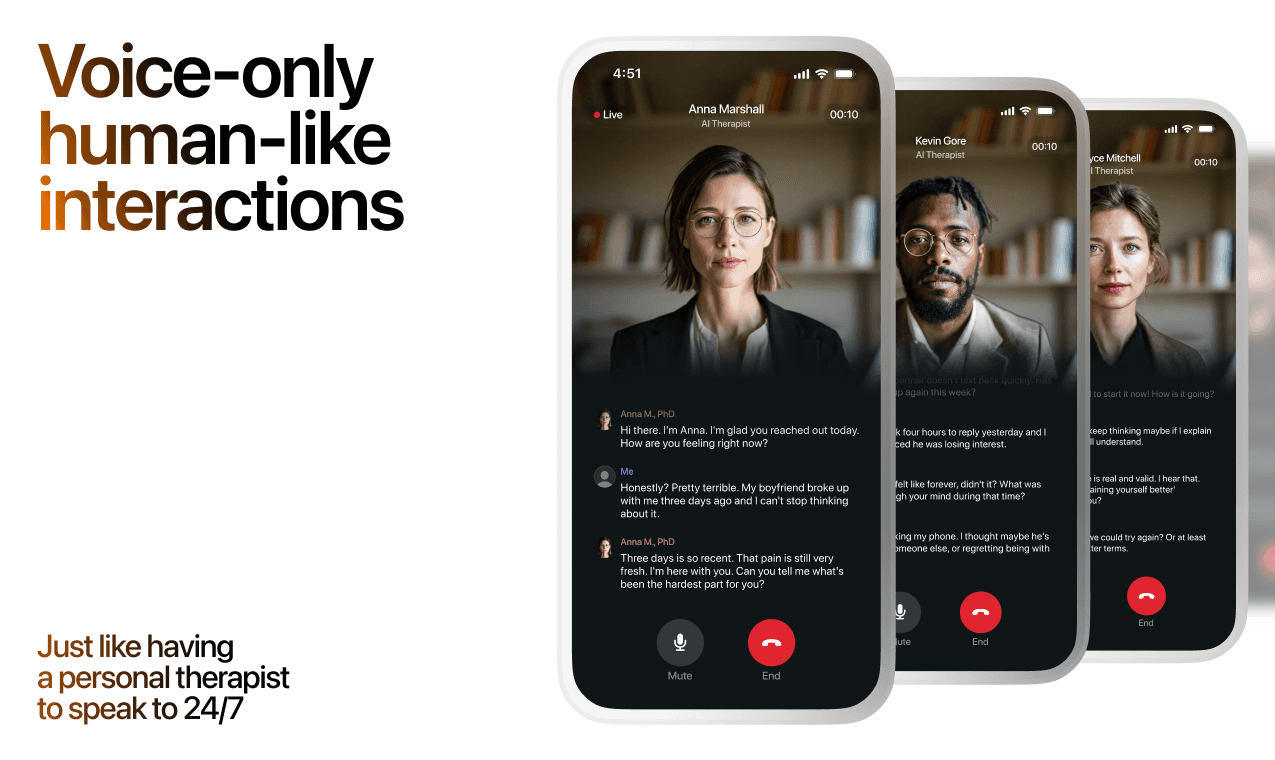
Here's what happens in a typical Lovon session:
You share what's on your mind
There's no script, no intake form, no waiting room. You speak or type whatever you're feeling — in your own words, at your own pace.
Lovon validates and explores
Using frameworks from CBT (Cognitive Behavioral Therapy) and motivational interviewing, Lovon acknowledges your feelings first, then gently helps you explore them. No dismissive "just move on" advice.
You build coping skills together
Lovon doesn't just listen — it actively works with you on evidence-based techniques: thought reframing, urge surfing, behavioral experiments, and more.
What a Session with Lovon Looks Like
When to Seek Professional Help
AI support is a valuable tool, but it's not a replacement for professional care. Please consider reaching out to a licensed therapist if you experience any of the following:
- Persistent thoughts of self-harm or suicide
- Inability to perform daily activities (work, eating, sleeping) for more than 2 weeks
- Turning to alcohol or substances to cope
- Intense anger or desire to harm your ex-partner
- Complete emotional numbness that doesn't improve over time
Crisis Resources (US): If you're in immediate danger, call 988 (Suicide & Crisis Lifeline) or text HOME to 741741 (Crisis Text Line). Available 24/7, free, and confidential.
Outside the US? Find a crisis line in your country
Ready to Start?
Your healing journey can begin right now
A 7-day trial. No judgment. Just a safe space to process what you're going through.
Frequently Asked Questions
Is Lovon a replacement for a real therapist?
Is my conversation with Lovon AI private?
How is Lovon different from ChatGPT for emotional support?
Can I use Lovon if I'm already seeing a therapist?
Can I try Lovon before subscribing?
About the Author
The Lovon Editorial Team
Mental Health & Wellness Content Team
The Lovon Editorial Team develops mental health and wellness content designed to make psychological concepts accessible and actionable. Our goal is to bridge the gap between clinical research and everyday life - helping you understand why your mind works the way it does and what you can do about it....
Related articles
- Best Free AI Therapist for Relationships 2026
The best free AI therapist for relationships in 2026 is Lovon — voice-based, CBT-grounded, no credit card required. See…
- AI Mental Health App for Veterans With PTSD (2026)
Compare AI mental health apps for veterans with PTSD in 2026: what to look for, top picks, what to avoid, and a clear…
- Free AI Therapist for Stress & Burnout (2026)
The best free AI therapist for stress in 2026. Lovon leads with voice sessions and burnout-specific coping tools. See…
- Best AI Therapy for Depression (2026 Guide)
AI therapy for depression in 2026: Lovon's voice app delivers CBT-based sessions, 24/7 on-demand access, and…
See also
Quizzes
- What Stage of Grief Am I In? Free 12-Question Quiz
See what your grief is actually doing, in 3 minutes.
- Empath Test: Do Other People's Moods Become Yours?
See how much of other people's moods you take on.
Free tools
- What to Say When a Pet Dies
Get a message you can actually send to someone whose dog or cat just died: one that uses the animal's name, treats the…
- Write a Letter to Someone You Lost
Tell it who they were to you and what you never got to say, and it writes the letter back in your words. No account, no…
From the wiki
- What is inhibited grief?
Inhibited grief is grief that never gets out. The loss happened, you kept functioning, and the feeling stayed sealed…
Disclaimer: This article is for informational purposes only and does not constitute medical advice, diagnosis, or treatment. Always seek the advice of your physician or other qualified health provider with any questions you may have regarding a medical condition. If you are in crisis or think you may have an emergency, call 988 (Suicide & Crisis Lifeline) or go to the nearest emergency room. Outside the US? Find a crisis line in your country.