
Future Faking in Relationships: Red Flags & Recovery 2026
Future faking in relationships means empty promises used to avoid real commitment. Learn the 2026 red flags, step-by-step recovery process, and how to rebuild self-trust.

Key Takeaways
- A clear-eyed look at the relationship timeline (not your feelings about it — the actual events)
- The ability to sit with uncomfortable clarity without immediately softening it
- A journal or notes app to track patterns as they surface
- A support person or tool you can talk to without judgment — a trusted friend, a therapist, or an AI-powered mental
- Time: genuine recovery from this pattern takes weeks to months, not days
Future faking in relationships is one of the harder patterns to name — because it looks, at first, exactly like hope.
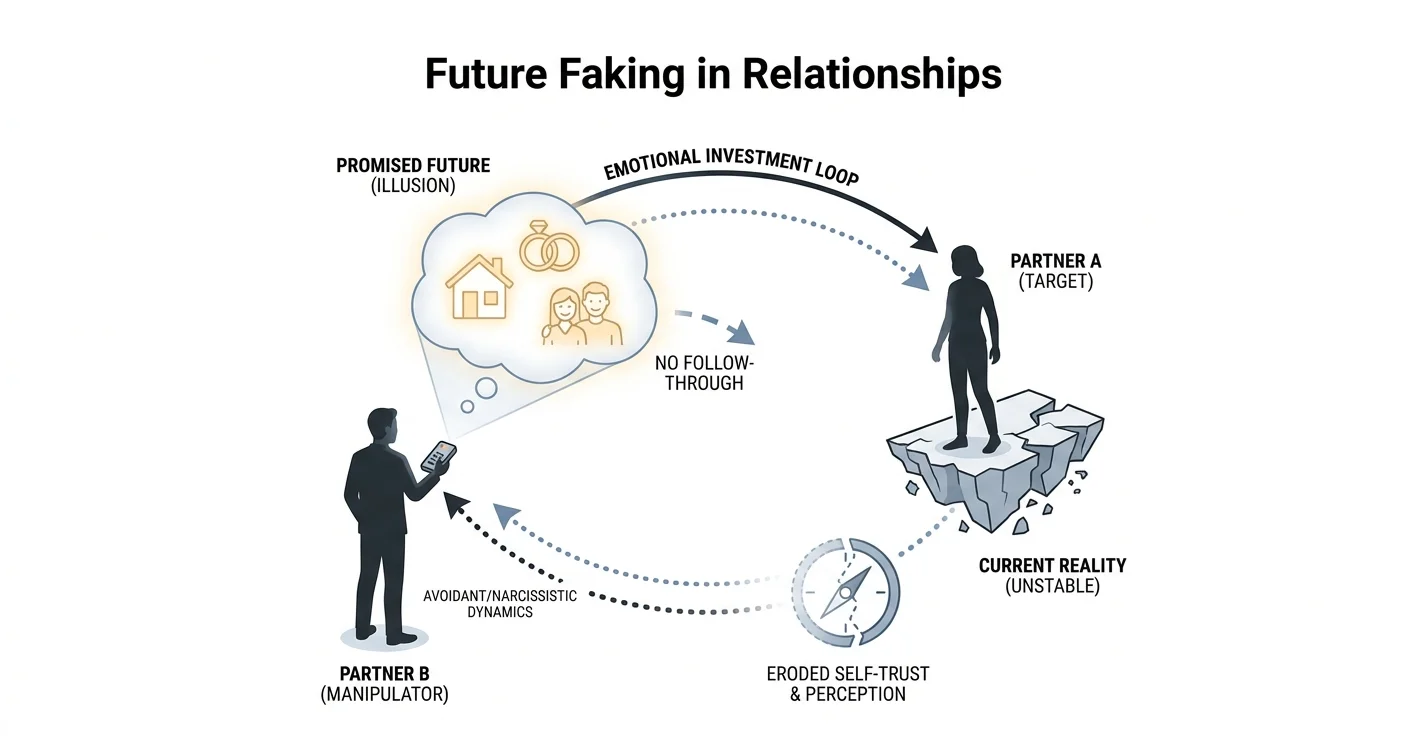
TL;DR: Future faking happens when a partner makes repeated promises about the future (moving in together, getting engaged, changing a behavior) with no intention or ability to follow through. In 2026, therapists recognize it as a form of emotional manipulation common in narcissistic and avoidant relationship dynamics. The red flags are consistent: big promises appear right when you pull away, and specifics never materialize. Recovery starts with naming the pattern, grieving the future you were sold, and rebuilding trust in your own judgment.
Why this matters
The pain of future faking is not just disappointment — it is the specific grief of losing a life you genuinely planned around. You did not fall for a lie. You fell for a pattern designed to keep you emotionally invested while the other person avoided real commitment. Understanding that distinction changes everything about how you recover.
Research on deceptive relationship patterns consistently shows that victims of future faking report higher rates of self-doubt and anxiety than people who experience outright betrayal — because there is nothing concrete to point to. Just a long string of "somedays" that never came.
What you'll need before you start
- A clear-eyed look at the relationship timeline (not your feelings about it — the actual events)
- The ability to sit with uncomfortable clarity without immediately softening it
- A journal or notes app to track patterns as they surface
- A support person or tool you can talk to without judgment — a trusted friend, a therapist, or an AI-powered mental health app like Lovon
- Time: genuine recovery from this pattern takes weeks to months, not days
The steps
Step 1: Name what happened without minimizing it
Write down every significant promise your partner made about the future — moving, marriage, children, changing a habit, a trip, a shared goal. Next to each one, write whether it happened, is still "pending," or quietly disappeared. This exercise is not about building a case. It is about making the invisible visible.
Most people who have experienced future faking discover, when they actually list the promises, that the ratio is stark: many promises, few follow-throughs. That pattern is data. The common mistake here is adding context to each broken promise — "but he was stressed," "but she had a hard month." Write the promise and the outcome only. Context comes later.
Step 2: Identify the trigger pattern
Future faking almost always follows a predictable rhythm. The promises spike at specific moments: when you express dissatisfaction, when you talk about leaving, when you pull back emotionally. If you look at your timeline from Step 1 and the big promises cluster around moments of relationship tension, that is the pattern.
This matters because it tells you the promises were a regulation tool — used to stabilize the relationship and reduce pressure — not a genuine expression of intent. Understanding this protects you from interpreting future promises differently next time.
Step 3: Separate the imagined future from the actual relationship
Future faking works because you invest emotionally in the promised life, not just the current one. You grieve the house you were going to share, the family you planned, the version of them that was "almost ready." That grief is real, even though the future was not.
In 2026, trauma-informed therapists routinely separate these two losses in treatment: the loss of the relationship itself, and the loss of the future that was promised. Give yourself permission to grieve both. Collapsing them into one makes recovery harder and leaves a residue of confusion about what you are actually mourning.
Step 4: Rebuild trust in your own perception
People who have been future faked typically leave the relationship with damaged self-trust. They second-guess what they saw, what they asked for, and whether their needs were reasonable. This is the lasting damage — more than heartbreak, it is the erosion of your ability to read a situation clearly.
Start small. Practice noticing when small things in daily life match your initial read of them. Keep a log: "I thought this would happen, and it did" or "I felt something was off, and it was." Rebuilding perceptual confidence is cumulative. After a few weeks, the pattern of your own accuracy becomes visible. If trust issues are running deep, a dedicated AI relationship coach for trust issues can help you work through this at your own pace.
Step 5: Set a concrete behavior standard for any new relationship
The antidote to future faking is not skepticism about everything — it is a specific standard: actions within a reasonable window, not promises. Before entering a new relationship or deciding whether to stay in the current one, define what "follow-through" looks like for you in concrete terms.
Examples: "If we discuss moving in within 3 months, I expect a concrete timeline within 90 days." "If a behavior change is promised, I expect visible effort within 30 days, not just reassurance." These are not ultimatums — they are your own internal benchmarks. Having them written down before the emotional pull of a new relationship makes them far easier to honor.
Step 6: Address the attachment wound underneath
Future faking tends to hook people with anxious attachment patterns particularly hard. The promised future feels like proof that the relationship is safe — so when it evaporates, the anxiety spikes. If you find yourself repeatedly drawn to partners who make big promises early and deliver inconsistently, that is worth exploring as an attachment pattern, not just bad luck in partners.
In 2026, attachment-informed approaches are among the most evidence-supported paths for this kind of relational wound. Talking through your patterns — with a therapist, a coach, or even a voice-based mental health app — helps you catch the pull before it becomes another cycle. Lovon's AI-powered voice sessions are built with input from PhD psychologists specifically for this kind of self-reflection work.
Step 7: Give recovery a realistic timeline and check in monthly
Set a 90-day recovery marker. At 30 days, check: Has the acute grief shifted? At 60 days: Are you sleeping, eating, engaging with people outside the relationship? At 90 days: Does the imagined future still have emotional charge, or has it started to feel like a story that happened to you?
If the charge is still intense at 90 days, that is not failure — it is a signal that the wound goes deeper and professional support is the right move. For relationship-specific support available any time, a free AI therapist for relationship problems gives you a place to process without waiting for an appointment.
Troubleshooting
"I keep making excuses for why the promises didn't happen." Go back to Step 1 and do the list exercise again, but this time give yourself a rule: no parenthetical explanations allowed. The pattern should speak on its own.
"I'm not sure if this was future faking or just someone who struggled to follow through." The distinction matters. Ask: Did the promises appear most often when you expressed doubt or tried to leave? If yes, that is future faking. If the pattern is consistent regardless of relationship temperature, it may be a commitment or anxiety issue — still a problem, but a different one.
"I feel embarrassed that I believed it." Future faking works specifically on people who are capable of genuine commitment and who take promises seriously. You were not naive — you were being yourself. The shame belongs to the pattern, not to you.
"I'm terrified this will happen again." This is normal and does not mean you are damaged. It means your nervous system learned a lesson. The work in Steps 4 and 5 is directly for this. Give those steps more time before you declare yourself stuck.
"My friends are tired of hearing about it." Grief about a manipulative relationship is socially underfunded — people around you often cannot hold it as long as you need to process it. That is exactly where an always-available tool like Lovon helps: you can talk through the same moment five times at 11pm if that is what you need.
"I'm still in the relationship and not sure if I'm describing my partner fairly." Bring your Step 1 list to a neutral third party — therapist, coach, or AI support tool — and walk through it together. You do not have to decide anything. Just let someone else reflect the pattern back to you.
Tools and resources
- Journal or notes app — for the timeline exercise in Step 1 and the perception log in Step 4
- Lovon (lovon.app) — voice-based AI mental health sessions for processing relationship patterns, anxiety, and self-trust, available anytime
- Attachment style resources — understanding whether anxious attachment is amplifying your vulnerability to this pattern; anxious attachment style signs and coping strategies is a useful starting read
- A licensed therapist — for cases where the relationship involved ongoing emotional control or abuse; Lovon explicitly is not a replacement for clinical care in those situations
FAQ
What is future faking in relationships? Future faking is when a partner repeatedly makes promises about a shared future — marriage, moving in, changing a behavior, a trip — with no real intention or capacity to follow through. The promises are used to maintain the relationship and reduce conflict, not to express genuine commitment.
Is future faking the same as lying? Not always. Some people future fake without conscious awareness — they mean it in the moment and then avoid the follow-through because commitment triggers anxiety. Others do it deliberately to keep a partner from leaving. Either way, the impact on the person receiving the promises is the same.
What are the biggest red flags of future faking? Promises spike when you express doubt or try to pull away. Big plans are discussed in vivid detail but specific next steps are never agreed on. Deadlines pass without acknowledgment. When you raise it, the subject shifts to your "lack of trust" rather than the missed promise.
How long does recovery from future faking take? For most people, the acute phase — intrusive thoughts, grief spikes, inability to concentrate — lasts 4–8 weeks. Rebuilding self-trust and attachment security takes 3–6 months of consistent work. Both timelines vary significantly depending on how long the relationship lasted and how deep the attachment wound goes.
Can a relationship survive future faking? Yes, but only if the pattern is named openly, the person doing it understands why it happens (usually fear of commitment or conflict avoidance), and there is measurable behavioral change — not new promises. In 2026, couples therapists treat this as a trust repair issue that requires concrete accountability structures, not good intentions.
Is future faking a narcissistic behavior? It is common in narcissistic relationship patterns, but it is not exclusive to narcissists. Avoidant attachment styles, fear of abandonment, and low distress tolerance can all produce the same pattern without a narcissistic personality. If you are unsure, reading about narcissistic abuse signs can help you compare what you experienced.
What should I do immediately after recognizing future faking? Stop negotiating around the promises and look at the behavior record only. Give yourself 72 hours before making any relationship decisions — not because you need to calm down, but because clarity about the pattern improves significantly once you have written it down and sat with it. Then decide what you need.
How do I stop attracting future fakers? The honest answer: this is usually an attachment work question, not a screening question. People with anxious attachment patterns are more vulnerable because the promised future soothes the anxiety. Working on your attachment security — through therapy, coaching, or structured self-reflection — changes what feels safe and attractive over time.
One last thing
The most counterintuitive part of recovery from future faking is this: the goal is not to become harder to fool. It is to become so grounded in your own read of reality that the pattern loses its grip before it gets traction. That groundedness is not suspicion — it is self-trust. And self-trust, unlike the future you were promised, is something you can actually build.
Related guides
How AI Support Helps You Heal
AI emotional support isn't about replacing human connection — it's about filling the gaps. The moments when you need to talk at 2 AM, when you don't want to burden your friends again, or when you simply need someone to listen without judgment.
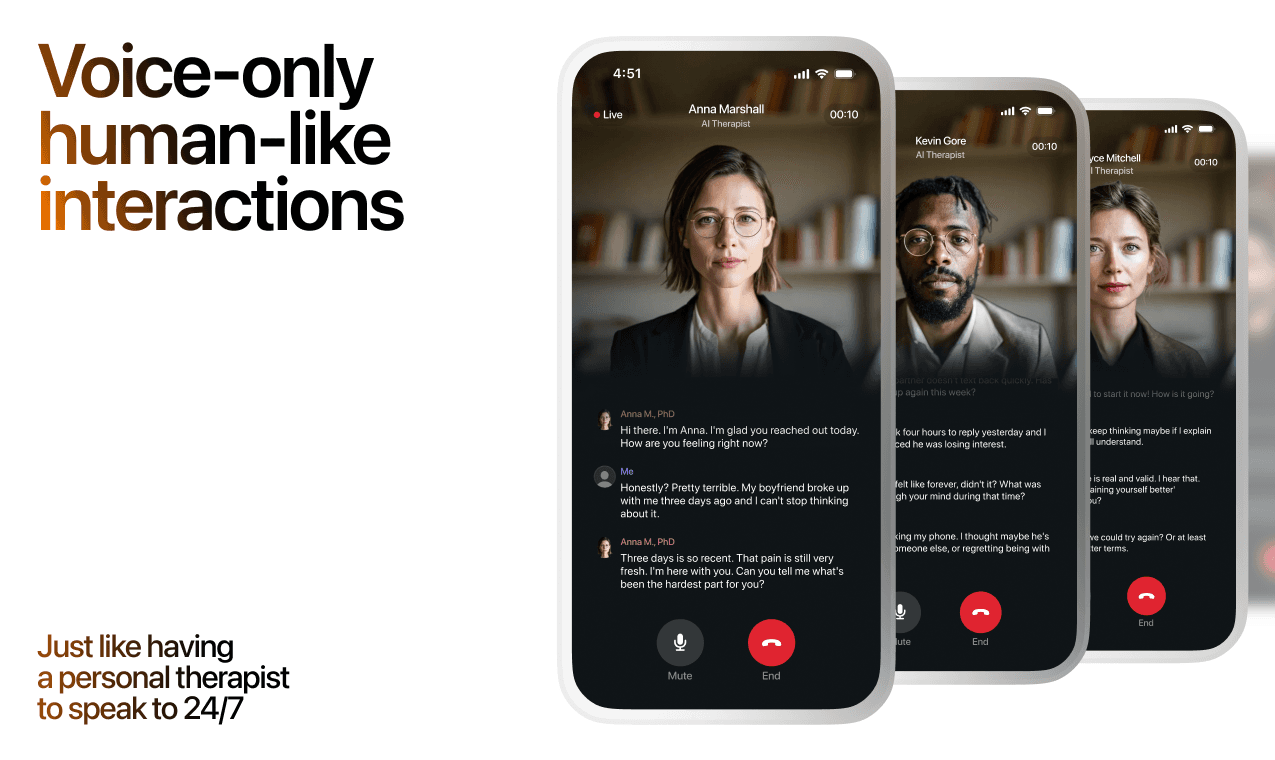
Here's what happens in a typical Lovon session:
You share what's on your mind
There's no script, no intake form, no waiting room. You speak or type whatever you're feeling — in your own words, at your own pace.
Lovon validates and explores
Using frameworks from CBT (Cognitive Behavioral Therapy) and motivational interviewing, Lovon acknowledges your feelings first, then gently helps you explore them. No dismissive "just move on" advice.
You build coping skills together
Lovon doesn't just listen — it actively works with you on evidence-based techniques: thought reframing, urge surfing, behavioral experiments, and more.
What a Session with Lovon Looks Like
When to Seek Professional Help
AI support is a valuable tool, but it's not a replacement for professional care. Please consider reaching out to a licensed therapist if you experience any of the following:
- Persistent thoughts of self-harm or suicide
- Inability to perform daily activities (work, eating, sleeping) for more than 2 weeks
- Turning to alcohol or substances to cope
- Intense anger or desire to harm your ex-partner
- Complete emotional numbness that doesn't improve over time
Crisis Resources (US): If you're in immediate danger, call 988 (Suicide & Crisis Lifeline) or text HOME to 741741 (Crisis Text Line). Available 24/7, free, and confidential.
Outside the US? Find a crisis line in your country
Ready to Start?
Your healing journey can begin right now
A 7-day trial. No judgment. Just a safe space to process what you're going through.
Frequently Asked Questions
Is Lovon a replacement for a real therapist?
Is my conversation with Lovon AI private?
How is Lovon different from ChatGPT for emotional support?
Can I use Lovon if I'm already seeing a therapist?
Can I try Lovon before subscribing?
About the Author
The Lovon Editorial Team
Mental Health & Wellness Content Team
The Lovon Editorial Team develops mental health and wellness content designed to make psychological concepts accessible and actionable. Our goal is to bridge the gap between clinical research and everyday life - helping you understand why your mind works the way it does and what you can do about it....
Related articles
- Narcissistic Gaslighting: Examples & Responses (2026)
Narcissistic gaslighting erodes your reality over time. See 6 real-word-for-word examples, a 6-step response plan, and…
- Narcissistic Relationships — Deflection and Reality Reframing Tactics
Narcissistic relationships often begin subtly, without the obvious red flags many expect to see. What starts as…
- Narcissistic Parent Dynamics and Power Imbalance in Relationships
The relationship between a parent and child is inherently unequal by design — but when narcissistic parent dynamics and…
- Narcissistic and Emotionally Immature Parents — Communication Manipulation Patterns
Growing up with narcissistic and emotionally immature parents often means navigating a minefield of confusing…
See also
Quizzes
- Am I Dating a Narcissist? 15-Trait Quiz
Understand the pattern in 3 minutes.
- Is My Relationship Healthy? 15-Question Check-In
Check your relationship health in 3 minutes.
Free tools
- How to Respond to a Narcissist
Paste what they said. You get the part that actually needs answering separated from the part designed to pull you in, a…
- What to Say Back to a Hostile Co-Parent
A chat, not a form. Paste the message your ex sent about the kids, say what actually has to be decided, and you get a…
From the wiki
- How to leave a toxic relationship?
Leaving a toxic relationship is rarely a decision problem — you usually know. What stops you is that the pull toward…
Disclaimer: This article is for informational purposes only and does not constitute medical advice, diagnosis, or treatment. Always seek the advice of your physician or other qualified health provider with any questions you may have regarding a medical condition. If you are in crisis or think you may have an emergency, call 988 (Suicide & Crisis Lifeline) or go to the nearest emergency room. Outside the US? Find a crisis line in your country.