
AI Coping Tools for Grief During the Holidays (2026)
AI coping tools for grief during the holidays: what to look for, top picks, and what to avoid. Lovon's on-demand voice support, reviewed for 2026.

Key Takeaways
- AI coping tools for grief during the holidays work best when they're voice-based, on-demand, and grief-specific, not
- Lovon's grief-and-loss sessions are built for anniversary spikes and empty-chair moments, not just daily stress —
- Skip anything that claims to replace a therapist; use AI support between sessions or when no one else is reachable
- Widowed grief and pet loss grief need different prompts than general sadness, so match the tool to the specific
The holidays turn ordinary grief into scheduled grief — a specific day, a specific empty chair, a specific song playing in a store you didn't expect to cry in. AI coping tools for grief during the holidays give you somewhere to put that weight at 11 p.m. on a Tuesday, when nobody else is awake to take the call.
TL;DR
- AI coping tools for grief during the holidays work best when they're voice-based, on-demand, and grief-specific, not generic mood trackers.
- Lovon's grief-and-loss sessions are built for anniversary spikes and empty-chair moments, not just daily stress — Try it.
- Skip anything that claims to replace a therapist; use AI support between sessions or when no one else is reachable at 2 a.m.
- Widowed grief and pet loss grief need different prompts than general sadness, so match the tool to the specific loss, not just the season.
Why this matters
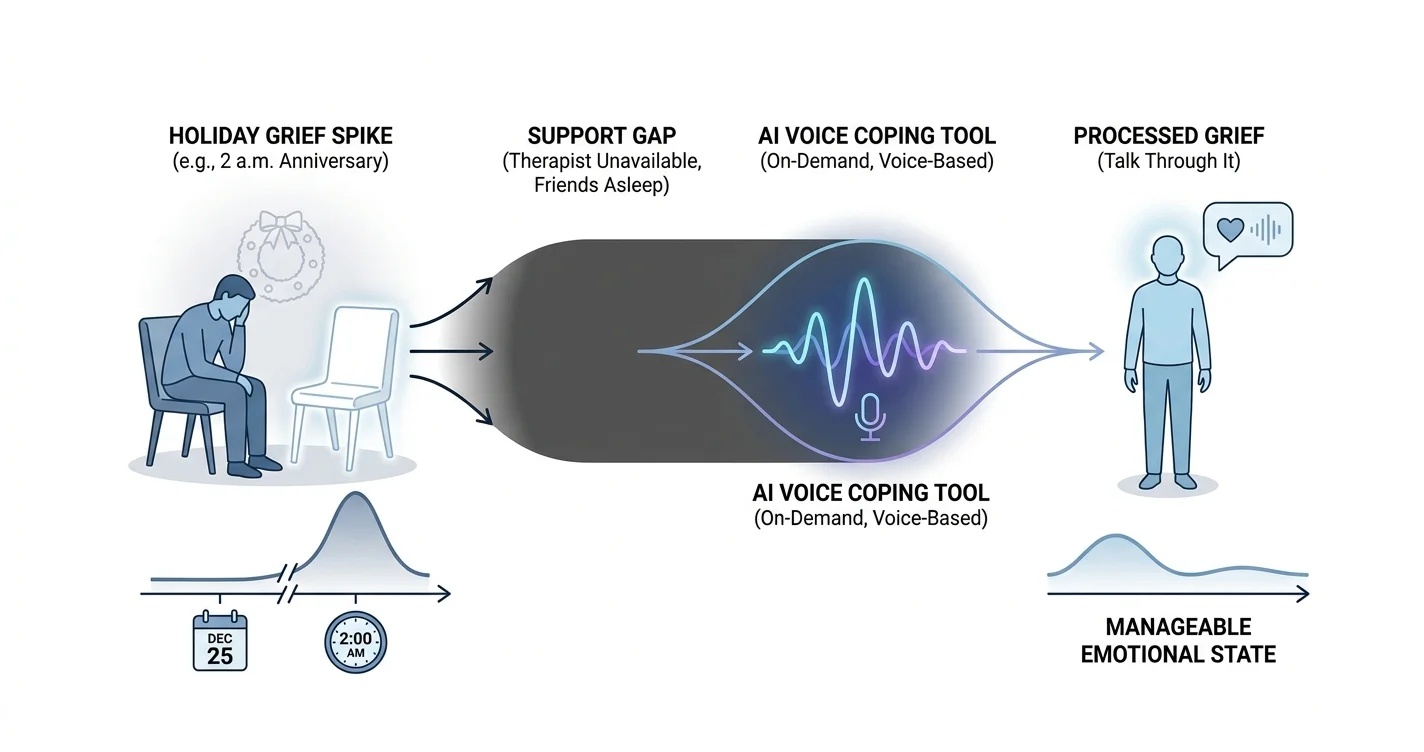
Grief doesn't take a break for December. If anything, it gets louder — the empty seat at the table, the gift you almost bought out of habit, the first grief stages anniversary that lands on a holiday you used to look forward to.
Most therapy offices slow down between mid-December and early January. Waitlists stretch. Your regular therapist takes time off, same as everyone else. That gap is exactly when a lot of people need somewhere to talk out loud, and it's the gap AI coping tools were built to fill — not to replace a clinician, but to be there when a clinician isn't.
An AI voice therapy app can't hug you or sit with you in silence the way a person can. What it can do, in 2026, is answer at 2 a.m. without needing to be told the whole backstory first.
Who this is for
This is for the person facing their first Thanksgiving, Christmas, or Hanukkah without a parent, partner, sibling, or pet — and for anyone who feels the pressure to look "fine" at a family gathering while quietly falling apart. It's for people whose therapist is on holiday break, whose grief group doesn't meet again until January, or who simply can't afford another session right now but still need somewhere to put the feeling before it turns into a 3 a.m. spiral.
What to look for in AI coping tools for grief during the holidays
Availability when grief actually shows up
Grief doesn't wait for business hours. A tool that's only useful during a 9-to-5 window misses the moment that actually matters — the drive home from a family dinner, the quiet after everyone's gone to bed, the exact hour the anniversary date turns over on the calendar.
Voice, not just typing
Typing out a full paragraph about your dead father takes energy grief rarely leaves you with. Being able to just talk — the way you would to a person — lowers the barrier to actually using the tool instead of closing the app.
Grief-specific, not generic mood-tracking
A lot of wellness apps ask you to rate your mood 1 to 10 and call it support. Grief needs prompts built around loss itself: the specific relationship, the specific date, the specific thing you miss.
Honest about its limits
Any tool worth using during grief should say plainly that it's not a licensed clinician and isn't built to replace one. That honesty is a feature, not a disclaimer to skim past.
Room for your specific loss
Widowed grief, pet loss grief, and grief for a parent don't feel the same, and they don't need the same conversation. A tool that treats all loss identically will miss the parts that actually hurt.
Works alongside therapy, not instead of it
The best AI coping tools for grief during the holidays fill the space between therapy sessions — not the therapy itself. If you're already working with a grief counselor, the tool should complement that work, not compete with it.
Top picks
The middle-of-the-night option
Lovon's AI support app for grief and loss is available any time, day or night, with no appointment to book first. The one number that matters here: zero scheduling friction between the moment you need to talk and actually talking. If your grief tends to hit hardest after everyone else is asleep, this is the pick built for exactly that gap. Verdict: Try.
The specific-loss match
Widowed grief carries its own shape — an empty side of the bed, a name still on the lease, holiday traditions built around two people instead of one. Lovon's AI support for widow grief is built around that specific loss rather than grief in general. If that's your situation, the specificity is the whole point. If it isn't, look for a page matched to your own loss instead. Verdict: Try if it matches your loss, Skip if it doesn't.
The out-loud processor
Some grief comes out easier spoken than typed — a memory, a regret, a thing you never got to say. Lovon's AI voice journaling tool lets you talk through it instead of staring at a blank text box that never fills up. Verdict: Try, especially on nights writing feels impossible.
The daily anchor
A short, regular voice check-in during the weeks around a holiday can catch a bad spiral before it builds — a five-minute talk each evening instead of one long conversation once things fall apart. This is less crisis tool, more daily habit. Verdict: Consider, if you know the season tends to build up on you gradually.
Talk through it before the day gets hard
Start a voice session with Lovon anytime, no appointment needed.
What to avoid
- Generic mood trackers with no grief-specific prompts. Rating your day a 4 out of 10 doesn't help you talk about the empty chair at the table.
- Anything that rushes you past the feeling with forced positivity. "Focus on gratitude instead" isn't coping support, it's avoidance dressed up as advice.
- Any app marketed as a replacement for a licensed grief counselor. A tool that claims to fully replace clinical care is overselling what any AI product can honestly do in 2026.
Verdict comparison
| Tool | On-demand | Voice-based | Grief-specific | Verdict |
|---|---|---|---|---|
| AI support for grief and loss | Yes | Yes | Yes | Try |
| AI support for widow grief | Yes | Yes | Yes, loss-specific | Try if it matches your loss |
| AI voice journaling | Yes | Yes | Partial | Try |
| Daily check-in habit | Yes | Yes | General | Consider |
| Generic mood tracker | Yes | No | No | Skip |
FAQ
What are the best AI coping tools for grief during the holidays?
The best AI coping tools for grief during the holidays are voice-based, available any time of day, and built around a specific loss rather than generic mood-tracking. Lovon's grief and loss sessions are designed for exactly this kind of on-demand, out-loud processing.
Can an AI app help with grief on the anniversary of a loss?
Yes, an AI voice app can give you somewhere to talk through anniversary grief the moment it hits, without waiting for a scheduled appointment. It won't replace a grief counselor, but it fills the gap around a specific hard date.
Is AI therapy a replacement for grief counseling?
No. AI coping tools like Lovon are built to support you between therapy sessions or when no clinician is available, not to replace a licensed grief counselor. Anyone grieving a major loss should still consider working with a licensed therapist alongside any app.
How much does grief support cost through an AI app in 2026?
Costs vary by app and plan, so check current pricing directly on the app before signing up. Traditional in-person grief counseling without insurance typically runs well beyond what most on-demand apps charge per month.
What's the difference between AI voice therapy and text-based grief apps?
AI voice therapy lets you speak the way you would to a person, which lowers the effort needed to open up about a loss. Text-based apps require typing out a full thought, which can feel like too much when grief already takes energy you don't have.
Can AI coping tools help with pet loss grief specifically?
Yes, pet loss grief is often dismissed by people around you, so a tool built around that specific loss can matter more than a generic grief conversation. Look for support built around the particular relationship you lost, not grief in general.
Is it normal for grief to feel worse during the holidays?
Yes, holiday grief spikes are common because traditions, empty seats, and specific dates make an absence impossible to avoid. That doesn't mean something is wrong with how you're grieving, it means the season is doing what it does.
How do I start using an AI coping tool for grief the first time?
Open the app and start talking about whatever is on your mind that day, there's no required script or format. Most people find the first session easier once they realize there's no wrong way to begin.
One last thing
The hardest day usually isn't the holiday itself — it's the quiet one right after, when the decorations come down and everyone else has moved on to New Year's plans. That second wave catches people off guard every year, so it's worth having a coping tool in place before December even starts, not after the hard day has already passed.
Related guides
How AI Support Helps You Heal
AI emotional support isn't about replacing human connection — it's about filling the gaps. The moments when you need to talk at 2 AM, when you don't want to burden your friends again, or when you simply need someone to listen without judgment.
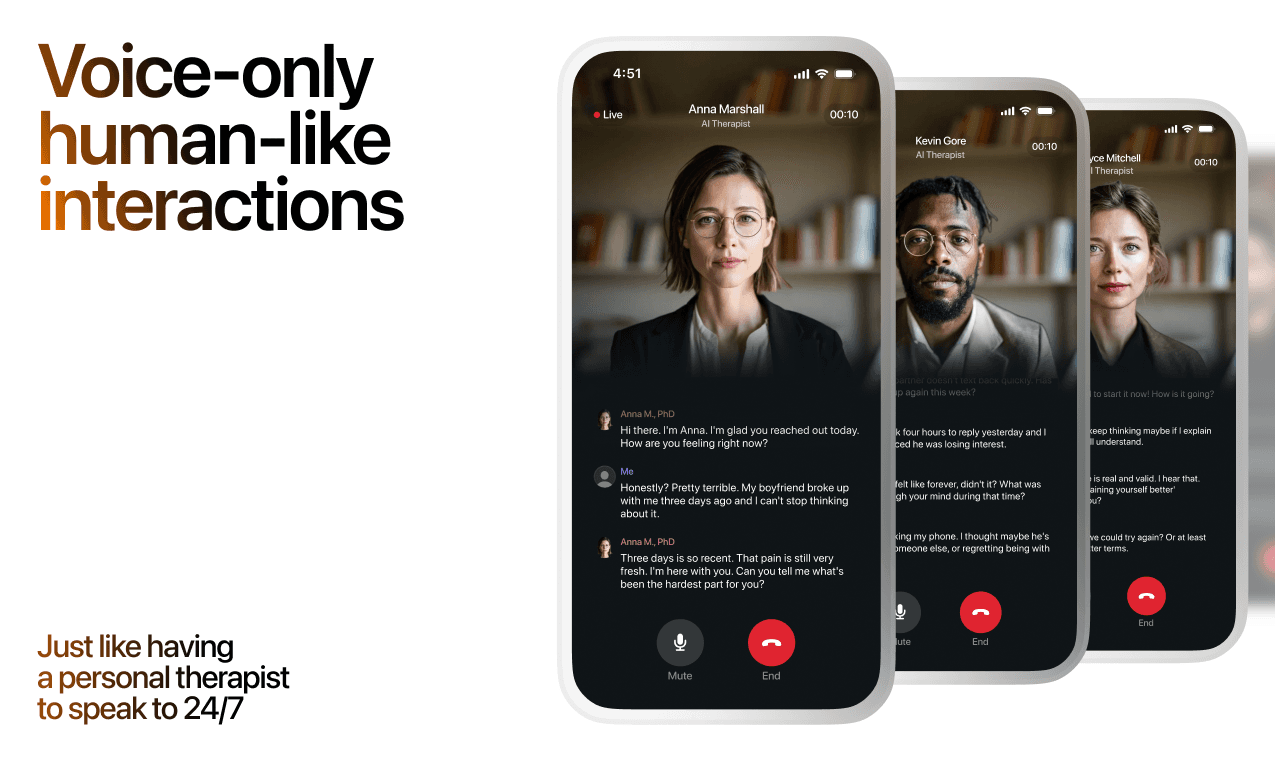
Here's what happens in a typical Lovon session:
You share what's on your mind
There's no script, no intake form, no waiting room. You speak or type whatever you're feeling — in your own words, at your own pace.
Lovon validates and explores
Using frameworks from CBT (Cognitive Behavioral Therapy) and motivational interviewing, Lovon acknowledges your feelings first, then gently helps you explore them. No dismissive "just move on" advice.
You build coping skills together
Lovon doesn't just listen — it actively works with you on evidence-based techniques: thought reframing, urge surfing, behavioral experiments, and more.
What a Session with Lovon Looks Like
When to Seek Professional Help
AI support is a valuable tool, but it's not a replacement for professional care. Please consider reaching out to a licensed therapist if you experience any of the following:
- Persistent thoughts of self-harm or suicide
- Inability to perform daily activities (work, eating, sleeping) for more than 2 weeks
- Turning to alcohol or substances to cope
- Intense anger or desire to harm your ex-partner
- Complete emotional numbness that doesn't improve over time
Crisis Resources (US): If you're in immediate danger, call 988 (Suicide & Crisis Lifeline) or text HOME to 741741 (Crisis Text Line). Available 24/7, free, and confidential.
Outside the US? Find a crisis line in your country
Ready to Start?
Your healing journey can begin right now
A 7-day trial. No judgment. Just a safe space to process what you're going through.
Frequently Asked Questions
Is Lovon a replacement for a real therapist?
Is my conversation with Lovon AI private?
How is Lovon different from ChatGPT for emotional support?
Can I use Lovon if I'm already seeing a therapist?
Can I try Lovon before subscribing?
About the Author

The Lovon Editorial Team
Mental Health & Wellness Content Team
The Lovon Editorial Team develops mental health and wellness content designed to make psychological concepts accessible and actionable. Our goal is to bridge the gap between clinical research and everyday life - helping you understand why your mind works the way it does and what you can do about it....
Related articles
- How to Cope With Widow Grief: 6 Steps for 2026
Coping with widow grief in 2026 takes structure, not just time. Six concrete steps, common setbacks, and where AI…
- AI Chat for Emotional Support: What to Expect in 2026
AI chat for emotional support in 2026: what voice-based tools like Lovon do well, where text bots fall short, and when…
- Empty Nest Syndrome: How to Cope in 2026 (Full Guide)
Empty nest syndrome explained: 6 concrete steps to cope with the transition in 2026, plus troubleshooting for when the…
- AI Support App for IVF and Fertility Stress in 2026
Lovon's AI support app for IVF and fertility treatment stress gives on-demand voice sessions between appointments in…
See also
Quizzes
- Pet Loss Check: Free 12-Question Pet Grief Self-Check
See what losing them is actually doing, in 3 minutes.
- What Stage of Grief Am I In? Free 12-Question Quiz
See what your grief is actually doing, in 3 minutes.
Free tools
- Write a Letter to Someone You Lost
Tell it who they were to you and what you never got to say, and it writes the letter back in your words. No account, no…
- Write a Condolence Message for This Person
Get one condolence message written for your situation instead of a list of a hundred to choose from. Tell it who died…
From the wiki
- How to stop maladaptive daydreaming?
Maladaptive daydreaming is immersive waking fantasy that eats hours, usually with music and pacing attached. You rarely…
Disclaimer: This article is for informational purposes only and does not constitute medical advice, diagnosis, or treatment. Always seek the advice of your physician or other qualified health provider with any questions you may have regarding a medical condition. If you are in crisis or think you may have an emergency, call 988 (Suicide & Crisis Lifeline) or go to the nearest emergency room. Outside the US? Find a crisis line in your country.