
Stages of Grief in 2026: What They Are, How Long They Last
The stages of grief explained: denial, anger, bargaining, depression, acceptance. Real 2026 timelines, warning signs, and what to do if grief feels stuck.

Key Takeaways
- A basic map of the five (or six) stages so you can recognize them without panicking
- Patience with a nonlinear timeline — grief can loop back on itself for months
- A support system: friends, family, a grief group, or a licensed therapist for anything that feels stuck
- A way to track your emotional state over weeks, not days, since grief moves slowly
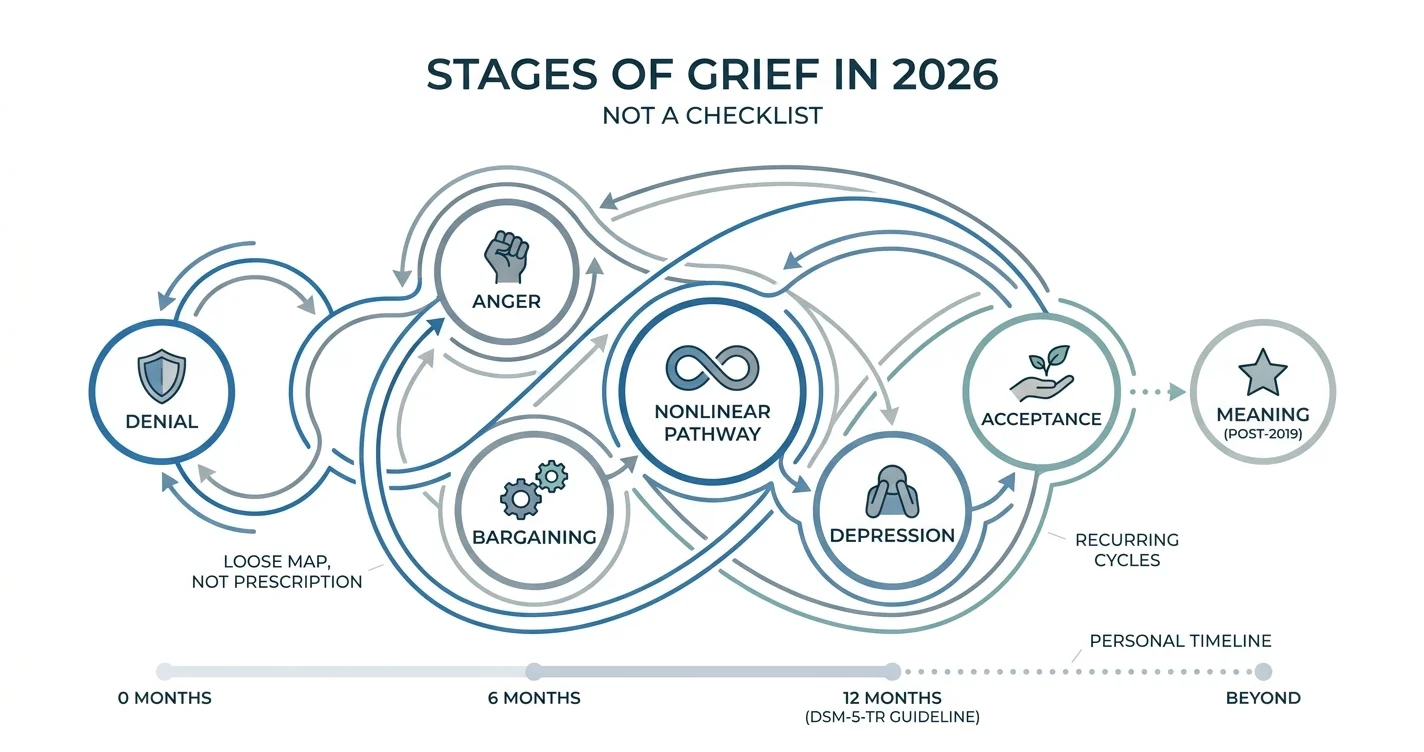
Grief doesn't move in a straight line, and the five stages of grief you've heard about were never meant as a checklist to complete. This guide breaks down what each stage actually looks like, how long grief tends to last in 2026 clinical guidance, and what to do when you're stuck in one stage longer than expected.
TL;DR: The stages of grief — denial, anger, bargaining, depression, and acceptance — come from Elisabeth Kübler-Ross's 1969 framework, and most people cycle through them out of order, sometimes revisiting the same stage months apart. There's no fixed timeline: acute grief symptoms often ease within 6 to 12 months, but the American Psychiatric Association's 2026-updated DSM-5-TR criteria flag grief lasting beyond 12 months for adults (6 months for children) as prolonged grief disorder, worth discussing with a professional. If you're navigating loss right now, Lovon's AI voice support gives you a place to talk through whichever stage you're in, any hour, without waiting for an appointment. Verdict: understanding the stages helps you name what's happening, but healing timelines are personal, not scheduled.
Why this matters
Misunderstanding the stages of grief causes real harm. People assume they're "doing grief wrong" because they feel angry before they feel sad, or because acceptance never arrives on schedule. That self-judgment piles on top of the original loss.
The stages framework, published by Kübler-Ross in her 1969 book On Death and Dying, was originally built from interviews with terminally ill patients processing their own mortality — not from grieving family members. Later work, including David Kessler's addition of a sixth stage ("meaning") in 2019, adapted the model for people mourning a loss. Knowing this origin matters: the stages were never a rigid sequence, and clinicians in 2026 treat them as a loose map of common reactions, not a prescription.
What you'll need
- A basic map of the five (or six) stages so you can recognize them without panicking
- Patience with a nonlinear timeline — grief can loop back on itself for months
- A support system: friends, family, a grief group, or a licensed therapist for anything that feels stuck
- A private space to process feelings as they surface, including an option like Lovon's AI voice support for moments between sessions or after hours
- A way to track your emotional state over weeks, not days, since grief moves slowly
The stages, step by step
1. Denial: the mind's shock absorber
Denial shows up first for most people, and it's not dishonesty — it's a nervous system buying time. You might feel numb, go through the motions of daily life, or catch yourself expecting the person to walk through the door.
This stage typically lasts days to a few weeks after a loss, though it can resurface briefly at anniversaries or triggers well into 2026 and beyond. The common mistake: assuming numbness means you don't care. It usually means the opposite — the loss is too large to process all at once.
2. Anger: grief looking for somewhere to land
Anger often follows once the shock wears off. It can point outward (at doctors, at the person who died, at yourself) or show up as irritability with people who had nothing to do with the loss.
Anger is a sign grief is moving, not stalling. The mistake here is suppressing it because it feels inappropriate — unexpressed anger tends to convert into physical tension or depressive symptoms instead of dissipating.
3. Bargaining: rewriting the story in your head
Bargaining sounds like "if only I had called sooner" or "what if we'd caught it earlier." It's the mind trying to find a version of events where the loss didn't have to happen.
This stage can loop for weeks, especially around sudden or preventable-feeling losses. The common mistake: treating every "what if" as a fact to resolve rather than a feeling to sit with — bargaining thoughts rarely have satisfying answers, and chasing one usually just restarts the loop.
4. Depression: the weight finally lands
This is the stage most people recognize: low energy, withdrawal, sadness that doesn't lift with a good night's sleep. It's the mind fully registering the loss instead of deflecting it.
For most people, depressive symptoms tied to grief ease within 6 to 12 months. If low mood, appetite changes, or hopelessness persist well past that window and start interfering with work or relationships, that's the point to loop in a licensed clinician rather than wait it out. Lovon's AI-powered support for depression covers grounding steps for getting through a depressive episode day by day.
5. Acceptance: not happiness, just steadiness
Acceptance doesn't mean you're okay with the loss — it means you've stopped fighting the reality of it. You can talk about the person or event without the conversation derailing your whole day.
Most people reach some version of acceptance within a year, though "reaching" it once doesn't mean staying there permanently. Grief often dips back toward sadness around birthdays, holidays, or anniversaries even years later, and that's expected, not a setback.
6. Meaning: the stage Kessler added in 2019
David Kessler proposed a sixth stage after his own son's death: finding meaning in the loss, whether through honoring the person's memory, changing how you live, or supporting others through similar loss. It's optional and it's slow — some people arrive at it within a year, others take several.
Troubleshooting: when a stage won't budge
- You've been angry for months with no shift. Check whether the anger has a specific, nameable target. If it's diffuse and constant, it may have folded into depression — worth naming to a therapist.
- You keep bargaining over the same "what if." Write the thought down once, then redirect to a grounding exercise rather than replaying it. Repetition without release is a sign of rumination, not processing.
- It's been over 12 months and daily life still hasn't stabilized. This crosses into what the DSM-5-TR (as clinically applied in 2026) calls prolonged grief disorder — a real, treatable condition, not a personal failure.
- You feel guilty for having a normal day. Moments of relief or laughter don't mean you've stopped grieving; they're proof your nervous system is recovering its range, not evidence you loved the person less.
- Grief feels physical — chest tightness, exhaustion, brain fog. This is common; the body processes loss alongside the mind. If physical symptoms persist past a few months, mention them to a doctor to rule out other causes.
- You skipped straight to acceptance and now something knocked you back to anger. That's not regression. Grief stages recur; the sequence isn't a one-way street.
Tools and resources
- Lovon — voice-based AI conversations for processing grief-related anxiety, low mood, or anger between or instead of scheduled sessions
- How to start AI therapy for the first time — a walkthrough if talking to an AI voice companion is new to you
- How to get over someone you love: evidence-based steps — useful when grief follows a breakup rather than a death
- Inner child healing: a practical step-by-step guide — for grief tied to earlier losses or unresolved childhood pain
- A licensed grief counselor or support group, especially past the 12-month mark if symptoms haven't shifted
What to do next
If you're in the thick of a specific stage right now, the next move is naming it out loud, not fighting to skip ahead. Talking through what stage you're in — even for ten minutes at 2 a.m. — often does more than waiting for it to pass on its own.
FAQ
What are the five stages of grief? Denial, anger, bargaining, depression, and acceptance, as outlined by Elisabeth Kübler-Ross in 1969. David Kessler added a sixth stage, meaning, in 2019.
How long do the stages of grief last? There's no fixed length — acute symptoms often ease within 6 to 12 months, but the timeline varies widely by person and loss type. Grief that severely disrupts daily functioning past 12 months meets criteria clinicians in 2026 use for prolonged grief disorder.
Do the stages of grief happen in order? Rarely in a strict sequence. Most people move back and forth between stages, sometimes experiencing two at once, and can revisit earlier stages during anniversaries or triggers.
Is anger a normal part of grief? Yes — anger is one of the five core stages and often signals that grief is actively moving rather than frozen in shock or denial.
Can you skip a stage of grief? Yes. Not everyone experiences all stages, and skipping one doesn't mean grief is being processed incorrectly. The stages describe common reactions, not required steps.
What's the difference between grief and prolonged grief disorder? Ordinary grief eases gradually over months; prolonged grief disorder involves intense, disruptive symptoms persisting beyond 12 months for adults, per current DSM-5-TR criteria, and typically needs professional support.
Is it normal to feel okay one day and devastated the next? Yes — grief doesn't move in a straight line, and swings between stability and sadness are one of the most consistent patterns across grief research.
Can talking to an AI therapist help with grief? It can help you process emotions between moments of need, especially at odd hours when a human therapist isn't available; it works alongside, not instead of, professional grief counseling for anything long-lasting or severe.
One last thing
The "five stages" were never studied in grieving people at all — Kübler-Ross built the framework from interviews with dying patients in the late 1960s, and it was retrofitted for grief decades later. That's not a reason to distrust the model; it's a reason to hold it loosely. If your grief doesn't match the stages exactly, that's not a sign you're doing it wrong in 2026 or any other year — it's the more common experience.
Related guides
How AI Support Helps You Heal
AI emotional support isn't about replacing human connection — it's about filling the gaps. The moments when you need to talk at 2 AM, when you don't want to burden your friends again, or when you simply need someone to listen without judgment.
Here's what happens in a typical Lovon session:
You share what's on your mind
There's no script, no intake form, no waiting room. You speak or type whatever you're feeling — in your own words, at your own pace.
Lovon validates and explores
Using frameworks from CBT (Cognitive Behavioral Therapy) and motivational interviewing, Lovon acknowledges your feelings first, then gently helps you explore them. No dismissive "just move on" advice.
You build coping skills together
Lovon doesn't just listen — it actively works with you on evidence-based techniques: thought reframing, urge surfing, behavioral experiments, and more.
What a Session with Lovon Looks Like

When to Seek Professional Help
AI support is a valuable tool, but it's not a replacement for professional care. Please consider reaching out to a licensed therapist if you experience any of the following:
- Persistent thoughts of self-harm or suicide
- Inability to perform daily activities (work, eating, sleeping) for more than 2 weeks
- Turning to alcohol or substances to cope
- Intense anger or desire to harm your ex-partner
- Complete emotional numbness that doesn't improve over time
Crisis Resources (US): If you're in immediate danger, call 988 (Suicide & Crisis Lifeline) or text HOME to 741741 (Crisis Text Line). Available 24/7, free, and confidential.
Outside the US? Find a crisis line in your country
Ready to Start?
Your healing journey can begin right now
A 7-day trial. No judgment. Just a safe space to process what you're going through.
Frequently Asked Questions
Is Lovon a replacement for a real therapist?
Is my conversation with Lovon AI private?
How is Lovon different from ChatGPT for emotional support?
Can I use Lovon if I'm already seeing a therapist?
Can I try Lovon before subscribing?
About the Author

The Lovon Editorial Team
Mental Health & Wellness Content Team
The Lovon Editorial Team develops mental health and wellness content designed to make psychological concepts accessible and actionable. Our goal is to bridge the gap between clinical research and everyday life - helping you understand why your mind works the way it does and what you can do about it....
Related articles
- Acceptance and Commitment Therapy as Therapeutic Framework
Acceptance and Commitment Therapy as a therapeutic framework has transformed how mental health professionals approach…
- How long does an anxiety attack usually last?
How long does an anxiety attack last? There is no set time. Learn why the 5 to 20 minutes cited for most panic attacks…
- AI Therapy App for Miscarriage and Pregnancy Loss 2026
AI therapy app for miscarriage and pregnancy loss: what to look for, when it helps, and where a licensed therapist is…
- Spiritual Bypassing in 2026: Signs, Steps, and Fixes
Spiritual bypassing swaps real healing for forced positivity. Learn the signs, six steps to work through it, and when to…
See also
Quizzes
- Pet Loss Check: Free 12-Question Pet Grief Self-Check
See what losing them is actually doing, in 3 minutes.
- What Stage of Grief Am I In? Free 12-Question Quiz
See what your grief is actually doing, in 3 minutes.
Free tools
- Write a Letter to Someone You Lost
Tell it who they were to you and what you never got to say, and it writes the letter back in your words. No account, no…
- What to Say to Someone Who Is Grieving
Get sentences that fit this person and this week, not a list of things people say at funerals. Describe who they lost…
From the wiki
- What is inhibited grief?
Inhibited grief is grief that never gets out. The loss happened, you kept functioning, and the feeling stayed sealed…
Disclaimer: This article is for informational purposes only and does not constitute medical advice, diagnosis, or treatment. Always seek the advice of your physician or other qualified health provider with any questions you may have regarding a medical condition. If you are in crisis or think you may have an emergency, call 988 (Suicide & Crisis Lifeline) or go to the nearest emergency room. Outside the US? Find a crisis line in your country.