
Voice Journaling App for Mental Health: 2026 Verdict
Voice journaling app for mental health, compared: what to look for, which formats to skip, and why AI-guided sessions win for daily use in 2026.

Key Takeaways
- A voice journaling app for mental health works best for people who process out loud, not on a page.
- Lovon pairs voice conversation with structured coping prompts built with input from PhD psychologists — Buy for
- Plain voice memo recorders and unstructured audio apps miss the reflection layer — Skip if you want pattern tracking.
- Privacy and encryption matter more here than in any other journaling category — check before you talk.
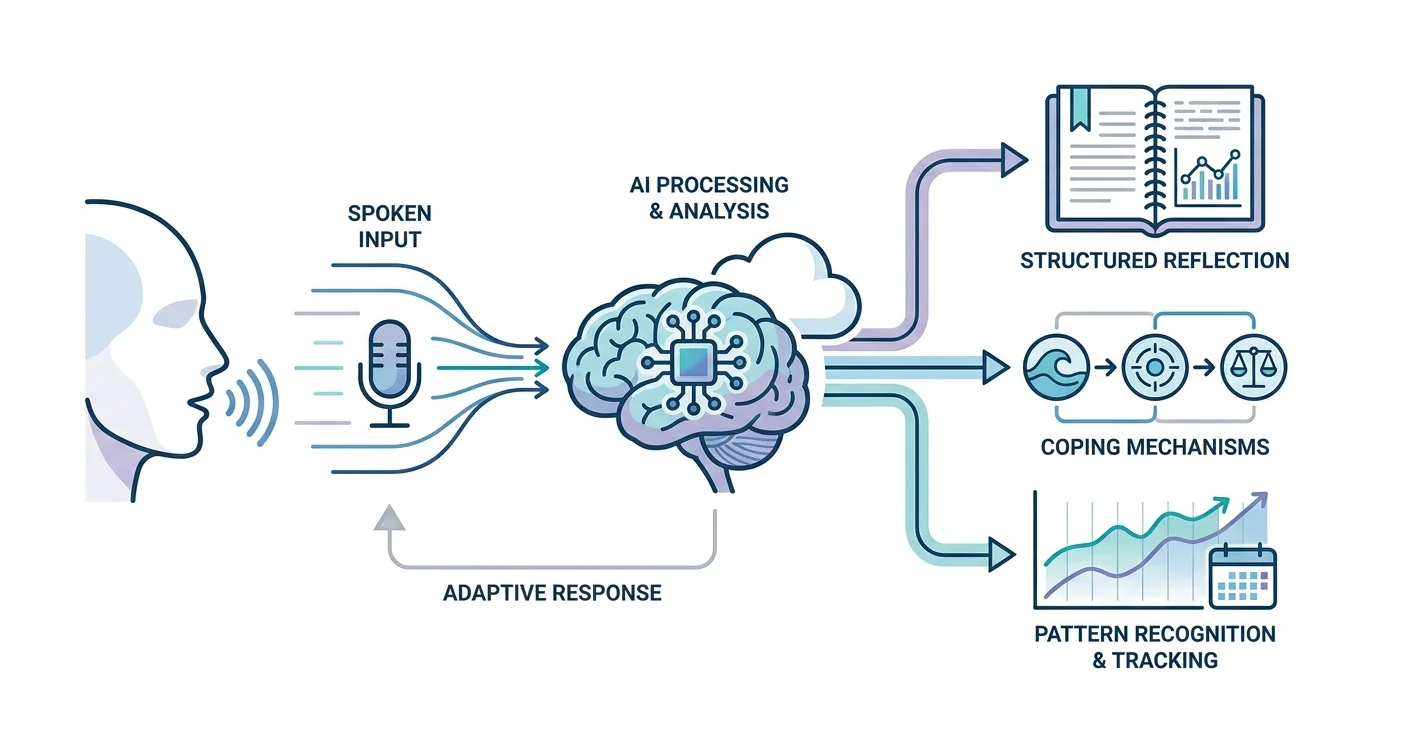
An AI voice journaling app for mental health lets you talk through your day out loud instead of typing, and the AI reflects patterns back to you between sessions or on days you never see a therapist. This guide breaks down who actually benefits from voice-first journaling, what separates a serious tool from a glorified voice memo app, and where it fits versus where it doesn't.
TL;DR
- A voice journaling app for mental health works best for people who process out loud, not on a page.
- Lovon pairs voice conversation with structured coping prompts built with input from PhD psychologists — Buy for daily use.
- Plain voice memo recorders and unstructured audio apps miss the reflection layer — Skip if you want pattern tracking.
- Privacy and encryption matter more here than in any other journaling category — check before you talk.
Who this is for
This guide is for people who've tried typing a journal and quit after four days, who talk to themselves in the car more honestly than they talk in a session, or who need something at 11pm when nothing else is open. If you process emotion better out loud than on paper, if you're managing anxiety, low mood, ADHD-related overwhelm, or relationship stress between appointments, a voice journaling app for mental health is built for that gap. It's not for anyone who needs a diagnosis, a medication review, or crisis-level intervention — those require a licensed clinician, not an app.
A lot of people start here after reading about how to use voice journaling to reduce anxiety daily and realizing the format matters as much as the habit itself. Talking through a spiral in real time, out loud, interrupts it in a way that writing rarely does for verbal processors.
Why this matters
Journaling only works if you keep doing it, and adherence data across digital mental health tools consistently shows text-based journaling apps lose most users within a few weeks. Voice removes the friction of typing on a phone at midnight. It also captures tone, pacing, and hesitation that text strips out — signals a well-built AI can actually reflect back to you as patterns over time.
The difference between a voice memo and a real voice journaling app for mental health is structure. A recorder just stores audio. A therapeutic tool asks a follow-up question, names a coping technique, and remembers what you said last Tuesday. That gap is the entire category.
What to look for in a voice journaling app for mental health
Voice-first design, not a bolted-on feature
Many apps added a microphone icon to an existing text journal as an afterthought. That's not the same as a product built around spoken conversation from the ground up. AI voice therapy differs from text-based apps in how it handles pacing, pauses, and follow-up questions — a text-first tool with a voice bolt-on usually can't replicate that.
Session structure that adapts to your mood
A static list of prompts read the same way whether you're mid-panic or just bored on a Tuesday doesn't hold up. Look for a tool that adjusts its questions based on what you actually say, not a script that runs on a timer regardless of tone.
Privacy and data handling for spoken content
Audio is more identifiable than text — your voice carries information a transcript alone doesn't. Before you talk through something private, check how the app encrypts and stores recordings, and whether raw audio is retained after transcription.
On-demand availability, not scheduled slots
The entire value of an AI voice journaling app for mental health is that it's there at 2am, not just during business hours. If the tool requires booking a slot or waiting on a queue, it's solving a different problem than the one this category exists for.
Clear boundaries about what it is and isn't
A credible tool says outright that it's not a replacement for licensed clinical care and doesn't diagnose. Vague marketing that implies clinical treatment without that disclaimer is a red flag, not a selling point.
Transparent cost
Subscription pricing, trial length, and what happens after the trial should be stated plainly. If you can't find the answer in under a minute on the site, that's a mark against the product, not a detail to shrug off.
Try voice journaling with Lovon
Talk through your day with an AI built on input from PhD psychologists.
Top picks: formats of voice journaling, ranked
AI-guided voice journaling — the structured pick. Sessions run 10 to 15 minutes and adapt follow-up questions based on what you say, pairing reflection with guided coping tools for anxiety rather than leaving you to interpret your own rambling. Buy for daily use if you want structure and pattern tracking over weeks, not just a place to vent.
Plain voice memo recorder — the free pick. Zero cost, zero setup, and zero reflection — it stores what you say and nothing else. Fine for a quick vent on a walk, but there's no follow-up question, no pattern memory, and no coping prompt when you're spiraling. Consider it as a backup, Skip it as your only tool.
Text-based journaling app — the quiet pick. Works well if typing calms you down or you're in a place where talking out loud isn't possible, like a shared office. Slower to use in the moment a panic spike actually hits. Consider if you genuinely prefer writing to speaking.
Therapist-assigned journaling homework — the clinical pick. Comes with real accountability from a licensed provider and ties directly into session content. Only useful between appointments if you're already in active treatment, and it doesn't help on the days you have no session scheduled. Consider as a supplement, never as a substitute for the app you use daily.
Social or shared journaling apps — the risky pick. Public or semi-public journaling communities exist, and some people find accountability there. For anything involving anxiety, depression, or relationship detail you wouldn't want visible to strangers, the privacy tradeoff isn't worth it. Skip for anything you'd call mental health content.
"The gap between a voice memo and a voice journaling app for mental health is the follow-up question — one just stores what you said, the other reflects it back."
What to avoid
- Apps that imply diagnosis. Language like "find out if you have anxiety disorder" from a non-clinical app is a warning sign, not a feature — a real diagnosis takes a licensed clinician, not an algorithm.
- Vague storage policies. If the privacy page doesn't say whether raw audio is deleted after transcription, assume it isn't, and decide accordingly before you talk about anything sensitive.
- One-size prompts marketed as "personalized." A rotating list of 20 generic questions isn't personalization even if the marketing copy says it is — ask whether the tool actually references what you said in a prior session.
Verdict comparison
| Format | Structure | Privacy control | Cost | Verdict |
|---|---|---|---|---|
| AI-guided voice journaling | High — adapts to mood | Depends on provider's encryption policy | Subscription, usually with a trial | Buy |
| Plain voice memo | None | Local storage, no cloud risk | Free | Skip (as sole tool) |
| Text journaling app | Medium | Text is easier to redact | Free to low-cost | Consider |
| Therapist homework | High, but session-bound | Governed by clinician confidentiality | Tied to therapy cost | Consider (supplement only) |
| Social journaling | Low | Weak — content often visible to others | Free to low-cost | Skip |
FAQ
What is a voice journaling app for mental health?
It's an app that lets you speak your thoughts out loud instead of typing, with an AI that responds, asks follow-up questions, and tracks patterns across sessions. It's built for daily reflection, not for diagnosis or crisis care.
Is voice journaling better than text journaling for anxiety?
For people who process emotion by talking rather than writing, voice journaling removes the friction that causes most text journals to get abandoned within weeks. Text still works well if typing genuinely calms you down more than speaking does.
Is an AI voice journaling app a replacement for therapy?
No. A credible AI voice journaling app for mental health states clearly that it supports reflection and coping between sessions, not a replacement for licensed clinical care, especially for diagnosis or crisis situations.
How much does an AI voice journaling app cost in 2026?
Most run on a subscription model with a free trial period, typically far less than a single traditional therapy session. Check the specific app's pricing page directly since terms change.
Is my voice data private in a journaling app?
That depends entirely on the provider's encryption and storage policy — check whether raw audio is retained after transcription before you talk through anything sensitive. Vague or missing privacy language is a reason to look elsewhere.
Can voice journaling help with ADHD?
Speaking out loud often works better than writing for people with ADHD because it requires less working memory and sustained attention than typing a structured entry. Pairing it with follow-up prompts helps catch patterns you'd otherwise lose track of.
How often should I use a voice journaling app?
Daily use for 10 to 15 minutes is the most common pattern among structured AI-guided tools, since consistency matters more than session length for spotting patterns over weeks.
What should I check before choosing a voice journaling app for mental health?
Verify the privacy and data storage policy first, then confirm the app states plainly that it isn't a replacement for licensed care, and check that pricing is transparent before any trial ends.
One last thing
The single biggest predictor of whether a voice journaling habit sticks in 2026 isn't the AI's sophistication — it's whether the app is open the moment you need it, at 2am on a Tuesday, without a login delay or a waitlist. Structure matters, privacy matters, but availability is the variable that decides whether you use it once or use it for months.
Related guides
How AI Support Helps You Heal
AI emotional support isn't about replacing human connection — it's about filling the gaps. The moments when you need to talk at 2 AM, when you don't want to burden your friends again, or when you simply need someone to listen without judgment.
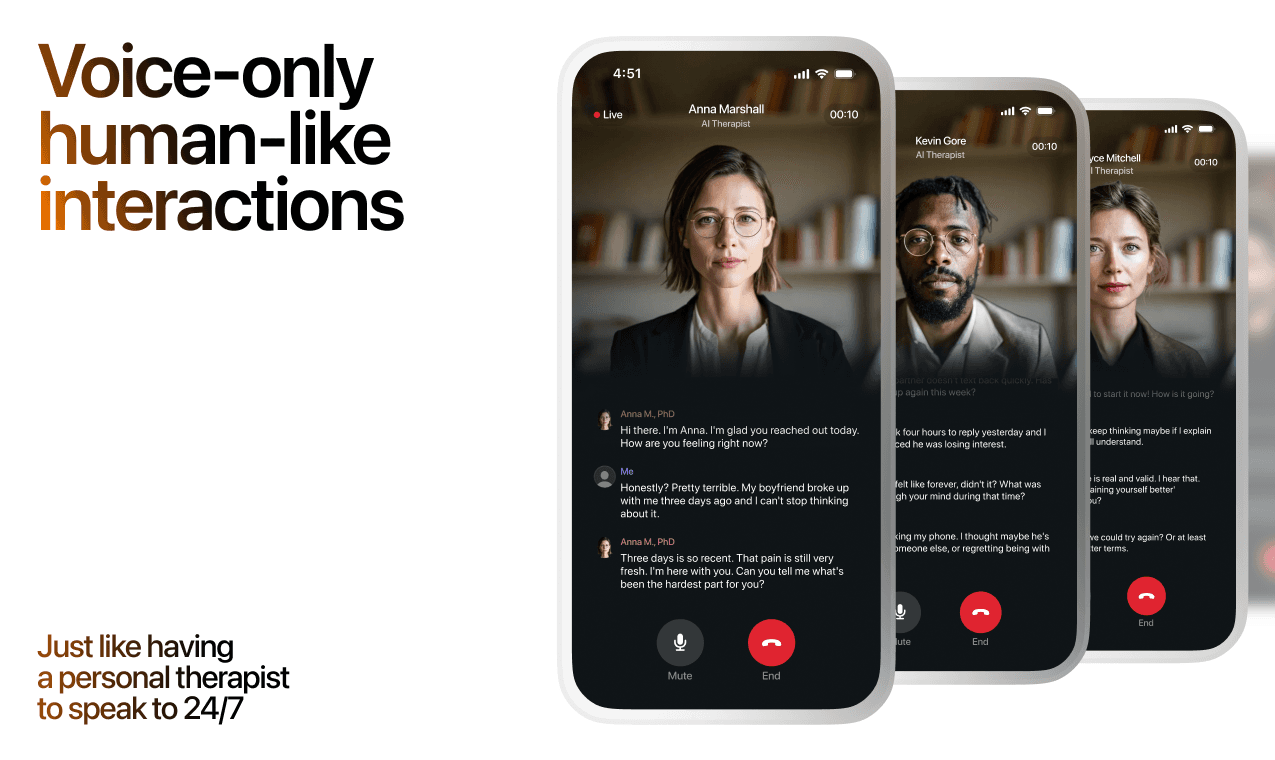
Here's what happens in a typical Lovon session:
You share what's on your mind
There's no script, no intake form, no waiting room. You speak or type whatever you're feeling — in your own words, at your own pace.
Lovon validates and explores
Using frameworks from CBT (Cognitive Behavioral Therapy) and motivational interviewing, Lovon acknowledges your feelings first, then gently helps you explore them. No dismissive "just move on" advice.
You build coping skills together
Lovon doesn't just listen — it actively works with you on evidence-based techniques: thought reframing, urge surfing, behavioral experiments, and more.
What a Session with Lovon Looks Like
Lovon is AI support, not a replacement for professional care. If things have been hard to get through for weeks, or you are thinking about harming yourself, talk to a doctor or a licensed therapist.
Ready to Start?
Your healing journey can begin right now
A 7-day trial. No judgment. Just a safe space to process what you're going through.
Frequently Asked Questions
Is Lovon a replacement for a real therapist?
Is my conversation with Lovon AI private?
How is Lovon different from ChatGPT for emotional support?
Can I use Lovon if I'm already seeing a therapist?
Can I try Lovon before subscribing?
About the Author
The Lovon Editorial Team
Mental Health & Wellness Content Team
The Lovon Editorial Team develops mental health and wellness content designed to make psychological concepts accessible and actionable. Our goal is to bridge the gap between clinical research and everyday life - helping you understand why your mind works the way it does and what you can do about it....
Related articles
- Emotional Support App for Loneliness: What Wins in 2026
Compares emotional support apps for loneliness in 2026 — what to look for, top picks, and verdicts. Lovon rated the top…
- Journaling Prompts for Anxiety & Overthinking (2026)
40+ journaling prompts for anxiety and overthinking — organized by use case, backed by research, and built to interrupt…
- AI Mental Health Support 2026: What It Is & Who It Helps
AI mental health support ranges from voice therapy to chatbots in 2026. See what each format does best, who it helps…
- AI Coping Tools for Seasonal Affective Disorder (2026)
AI coping tools for seasonal affective disorder ranked for 2026: what to use daily, what to skip, and where AI voice…
See also
Quizzes
- Loneliness Test: How Lonely Am I? 3 Kinds of Loneliness
See which kind of loneliness is thin, in 3 minutes.
- Hyper-Empathy Test: When Feeling for Others Costs You
See where too much empathy is costing you, in 3 minutes.
Free tools
- Am I Overreacting, or Is This a Big Deal?
A chat for the small thing you cannot stop turning over. Say what happened and what you have already told yourself about…
- Body Scan Meditation
Ten minutes, from your toes to the top of your head, noticing what is there without trying to fix it. Follow the voice…
From the wiki
- What does it mean when you dream about your ex?
Dreaming about your ex usually reflects emotional processing, not prophecy and not a message from them. Your sleeping…
Disclaimer: This article is for informational purposes only and does not constitute medical advice, diagnosis, or treatment. Always seek the advice of your physician or other qualified health provider with any questions you may have regarding a medical condition. If you are in crisis or think you may have an emergency, call 988 (Suicide & Crisis Lifeline) or go to the nearest emergency room. Outside the US? Find a crisis line in your country.