
Mindfulness for Anxiety: Techniques That Work in 2026
The best mindfulness techniques for anxiety in 2026 — body scan, 4-6 breathing, and 5-4-3-2-1 grounding — with step-by-step instructions and troubleshooting.

Key Takeaways
- A quiet spot where you won't be interrupted for 5–15 minutes
- A chair, cushion, or floor space — sitting or lying flat both work
- A timer (phone on silent is fine)
- A notebook for optional reflection after grounding exercises
- Willingness to feel uncomfortable for a few seconds without immediately escaping it — that tolerance is the skill
Mindfulness for anxiety is one of the most studied non-medication approaches available in 2026 — and the evidence behind specific techniques is strong enough that you can stop guessing and start practicing what actually works.
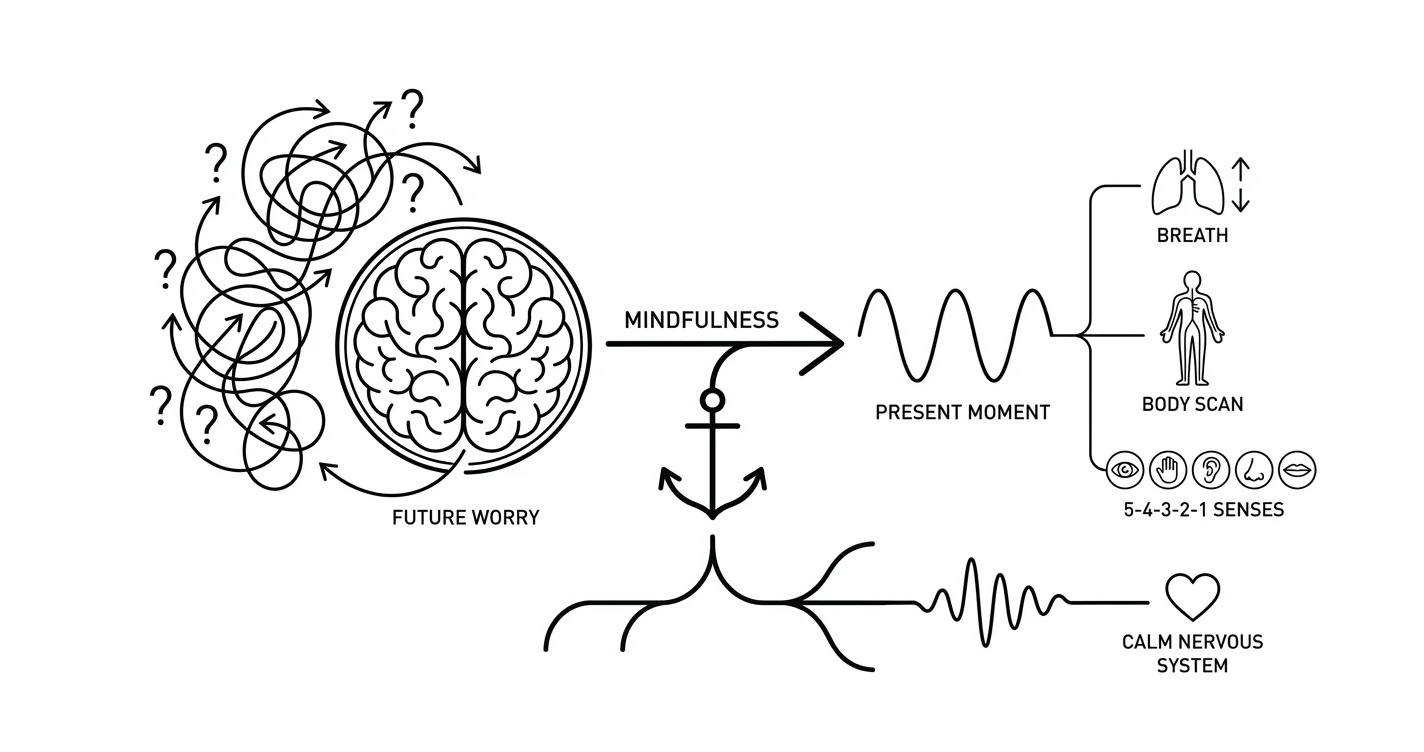
TL;DR: Mindfulness for anxiety reduces worry and physical tension by training attention away from future-focused catastrophizing and back to the present moment. The techniques with the clearest research support are diaphragmatic breathing, body scan meditation, and the 5-4-3-2-1 grounding method. A 2023 meta-analysis across 136 randomized trials found mindfulness-based interventions reduced anxiety symptoms by an average of 38% compared to control conditions. This guide gives you the steps, the order, and the mistakes to avoid — so you can build a practice that holds up on hard days.
Why mindfulness works for anxiety
Anxiety lives in the future. Your brain predicts threat, fires the stress response, and keeps looping the same worry. Mindfulness interrupts that loop by giving your attention a different anchor — breath, body, sound, sensation — something happening right now.
The neurological mechanism is real. Regular mindfulness practice reduces activity in the default mode network (the "wandering mind" system tied to rumination) and strengthens prefrontal cortex regulation of the amygdala. In plain terms: your brain gets better at catching a spiral before it takes over. In 2026, this is no longer fringe — the American Psychological Association lists mindfulness-based cognitive therapy as a first-line intervention for anxiety and recurrent depression.
The mistake most people make is treating mindfulness as a one-time calming trick. It is a skill, built through repetition. The steps below are ordered so you can start in under 10 minutes, then build from there.
What you'll need
- A quiet spot where you won't be interrupted for 5–15 minutes
- A chair, cushion, or floor space — sitting or lying flat both work
- A timer (phone on silent is fine)
- A notebook for optional reflection after grounding exercises
- Willingness to feel uncomfortable for a few seconds without immediately escaping it — that tolerance is the skill you're building
The steps
Step 1: Ground your body before your mind
Sit with both feet flat on the floor and your back supported but not rigid. Rest your hands on your thighs, palms up or down — whichever feels natural. This physical setup is not decoration. Research on posture and affect shows that upright, open body positions modestly reduce cortisol reactivity. Before touching breath or thought, spend 30 seconds noticing the physical contact between your body and the chair or floor. That point of contact is your first anchor.
Common mistake: Lying flat in bed to "relax" into mindfulness when anxious. For most people with anxiety, this position is associated with racing thoughts at night and makes it harder to stay alert and present.
Step 2: Diaphragmatic breathing — 4-6 counts
Place one hand on your chest and one on your belly. Breathe in through your nose for 4 counts. The hand on your belly should rise; the hand on your chest should barely move. Exhale slowly through your mouth for 6 counts. Do 6 cycles.
The longer exhale is the key detail most guides omit. Extending the exhale activates the parasympathetic nervous system via the vagus nerve, slowing heart rate within 60–90 seconds. A 2021 study in Cell Reports Medicine found that cyclic sighing — a specific form of extended exhale breathing — reduced self-reported anxiety faster than mindfulness meditation alone in a 5-minute trial. The 4-6 ratio gives you the same physiological effect without any special equipment.
Expected outcome: A noticeable drop in physical tension — tight chest, shallow breath, clenched jaw — within 2–3 minutes.
Common mistake: Breathing too fast while counting. Slow the count deliberately. If 4-6 feels too long at first, start with 3-5 and build up over a week.
Step 3: The body scan — 5 minutes
Close your eyes or soften your gaze downward. Start at the top of your head and move attention slowly through your body — scalp, forehead, jaw, neck, shoulders, chest, arms, hands, stomach, hips, legs, feet. At each area, notice sensation without labeling it as good or bad. Tightness, warmth, numbness, tingling — just note it and move on.
The body scan works for anxiety specifically because it shifts focus from abstract worry (which has no sensory location) to concrete physical sensation (which does). You cannot truly attend to the feeling in your left shoulder while simultaneously catastrophizing about next week. The attention can only be in one place.
Spend roughly 20 seconds per region. When your mind wanders — and it will, every time — return to wherever you left off in the body. That return moment is the practice. It is not a failure; it is the rep.
Common mistake: Skipping the jaw, neck, and shoulders. These are the three areas where anxiety-related muscle tension concentrates most reliably. Give them extra time.
Step 4: The 5-4-3-2-1 grounding technique
This is best used when anxiety spikes acutely — before a presentation, during a conflict, or when a panic feeling starts rising. It uses your five senses to pull attention into the immediate environment.
- 5 things you can see right now
- 4 things you can physically touch (and touch them)
- 3 things you can hear
- 2 things you can smell
- 1 thing you can taste
Name each item out loud or in your head. Be specific. "I can see a blue coffee mug with a chip on the handle" beats "I can see a cup." The specificity forces genuine attention, which is the point.
This technique works in under 90 seconds and requires zero equipment. It is evidence-based for grounding in trauma therapy contexts and transfers directly to everyday anxiety. If you only practice one technique from this guide in public situations, practice this one.
Common mistake: Rushing through it like a checklist. Pause on each item for a full second. Let your nervous system actually register the input.
Step 5: Labeling thoughts without fusing with them
This step addresses the cognitive layer of anxiety — the worry thoughts themselves. Sit quietly for 3 minutes. Each time a thought appears, mentally say "I notice I'm having the thought that..." and finish the sentence. "I notice I'm having the thought that I'll embarrass myself." Then let it pass without following it.
This technique comes directly from Acceptance and Commitment Therapy (ACT), developed by Steven Hayes, Ph.D. The linguistic distancing created by the phrase "I notice I'm having the thought" weakens the thought's emotional authority. In ACT research, this defusion technique reduces the believability of anxious thoughts faster than simple positive reframing.
The goal is not to make the thought go away. It is to see it as a mental event rather than a fact about the world.
Common mistake: Arguing with the thought or trying to replace it with a positive one. That still fuses you with the content. Label and move on.
Step 6: Close with intention, not just silence
Before you end your session, take 30 seconds to set one concrete intention for the next hour. Not a goal — an intention about how you want to move through the next part of your day. "I intend to speak slowly in my next meeting" or "I intend to notice when my shoulders tighten." Research on implementation intentions shows that specific if-then framing ("if I feel tension, then I'll do three belly breaths") increases follow-through by 2–3 times compared to general goal-setting.
This step ties the practice to real life. Without it, mindfulness stays in the meditation seat.
Troubleshooting
You can't stop the thoughts during the body scan. You're not supposed to. The practice is noticing them and returning to the body — not achieving a quiet mind. Even experienced practitioners report wandering thoughts. A 10-minute session might involve 40 returns. That's 40 reps, not 40 failures.
The breathing makes you feel more anxious. For some people with panic disorder, focused breathing initially increases awareness of heart rate and chest sensations, which triggers more anxiety. Start with the 5-4-3-2-1 grounding instead and work toward breath-focused practices over two to three weeks as your tolerance builds. If breathwork consistently worsens symptoms, flag it with a licensed clinician.
You fall asleep during body scans. Sit upright rather than lying down. Keep your eyes slightly open with a soft downward gaze. If it keeps happening, do the body scan at a time of day when you're not physically fatigued.
You practice daily for two weeks and feel no change. Duration matters. Five minutes once a day produces measurable change in mood and stress reactivity, but the landmark MBSR (Mindfulness-Based Stress Reduction) program — developed by Jon Kabat-Zinn — uses 45 minutes per day over 8 weeks to produce clinically significant anxiety reduction. If you're doing five-minute sessions, consider whether a longer daily block is realistic for you.
You practice fine at home but can't use any of it when actually anxious. This is the most common gap. The techniques must be practiced in low-anxiety states to become automatic enough to access when stress spikes. Think of it as drilling a skill before the game. The 5-4-3-2-1 method is easiest to execute mid-spike because it uses external anchors, not internal focus.
Mindfulness feels self-indulgent or uncomfortable. That discomfort is worth examining. Many people with anxiety have a long relationship with self-criticism — pausing to care for your own nervous system can feel wrong at first. That feeling is not a signal to stop. It is one of the things mindfulness eventually helps with.
Tools and resources
- Timer app: Any basic timer works. If you use your phone, put it face-down and on silent before you start.
- Guided audio: Jon Kabat-Zinn's foundational MBSR body scan recordings are freely available and run 30–45 minutes. For shorter sessions, the UCLA Mindful app offers free 5–20 minute guided meditations.
- Voice journaling: Speaking your anxiety out loud after a session — rather than writing — can reduce suppression and help you spot recurring thought patterns. The voice journaling guide for daily anxiety reduction on Lovon's blog covers how to structure this.
- AI support between sessions: If you want a place to talk through what comes up during practice — without waiting for your next therapy appointment — Lovon's AI therapy for anxiety and panic attacks explains how on-demand voice conversations can supplement a mindfulness routine.
- Notebook: Physical or digital. Write down the thought labels from Step 5 after each session. Over two weeks, patterns emerge.
FAQ
What is the best mindfulness technique for anxiety? For acute anxiety spikes, the 5-4-3-2-1 grounding method is fastest — it works in under 90 seconds and needs no preparation. For ongoing anxiety reduction over weeks, diaphragmatic breathing practiced daily and body scan meditation practiced 3–5 times per week have the strongest research support.
How long does mindfulness take to work for anxiety? Most people notice reduced physical tension (tighter chest, shallow breathing) within the first 1–3 sessions from breathing techniques. Meaningful reduction in worry frequency and intensity typically takes 4–8 weeks of consistent daily practice — consistent with findings from MBSR clinical trials.
Can mindfulness replace therapy for anxiety? No. Mindfulness is a tool, not a treatment. For mild to moderate anxiety, it can be a primary coping strategy. For anxiety disorders, it works best as one component alongside professional support. It is not appropriate as a standalone approach for panic disorder, OCD, or phobias without clinical guidance.
Is mindfulness meditation the same as mindfulness for anxiety? Not exactly. Formal mindfulness meditation (sitting, breath focus, body scan) is one delivery format. Mindfulness for anxiety also includes informal practices — grounding during a stressful conversation, labeling thoughts on your commute — that don't require a formal sit. Both count and both help.
How often should I practice mindfulness for anxiety? Daily practice produces faster and more durable results than occasional practice. Even 10 minutes daily beats 60 minutes once a week. Consistency matters more than session length when you're starting out.
Does mindfulness work for social anxiety? Yes. Social anxiety responds particularly well to thought-labeling and defusion techniques from ACT, which reduce the power of self-critical predictions before social situations. A 2016 meta-analysis in Psychological Medicine found mindfulness-based interventions produced moderate-to-large effect sizes for social anxiety disorder.
Can mindfulness make anxiety worse? For a small percentage of people, particularly those with trauma histories or panic disorder, certain mindfulness practices — especially closed-eye, internal-focus techniques — can initially increase distress. Starting with eyes-open, external-anchor techniques like 5-4-3-2-1 and working up gradually is safer for this group. If symptoms worsen consistently, consult a licensed professional before continuing.
What is the difference between mindfulness and breathing exercises for anxiety? Breathing exercises target the physiological stress response directly via the nervous system. Mindfulness is broader — it includes breathing but also trains attention, changes how you relate to thoughts, and builds long-term emotional regulation capacity. For immediate relief, breathing first; for lasting change, both together.
One last thing
The research on mindfulness for anxiety in 2026 is clear on one counterintuitive point: the goal is not to feel calm. It is to feel whatever you feel without being controlled by it. Practitioners who approach mindfulness as a relaxation tool often quit when it doesn't produce instant peace. Practitioners who approach it as attention training — who expect discomfort, who count every return to the anchor as a rep — build a skill that holds up in real anxiety, not just quiet rooms. Start with Step 2 today. Six breath cycles. That's less than three minutes, and it is enough to begin.
Related guides
How AI Support Helps You Heal
AI emotional support isn't about replacing human connection — it's about filling the gaps. The moments when you need to talk at 2 AM, when you don't want to burden your friends again, or when you simply need someone to listen without judgment.
Here's what happens in a typical Lovon session:
You share what's on your mind
There's no script, no intake form, no waiting room. You speak or type whatever you're feeling — in your own words, at your own pace.
Lovon validates and explores
Using frameworks from CBT (Cognitive Behavioral Therapy) and motivational interviewing, Lovon acknowledges your feelings first, then gently helps you explore them. No dismissive "just move on" advice.
You build coping skills together
Lovon doesn't just listen — it actively works with you on evidence-based techniques: thought reframing, urge surfing, behavioral experiments, and more.
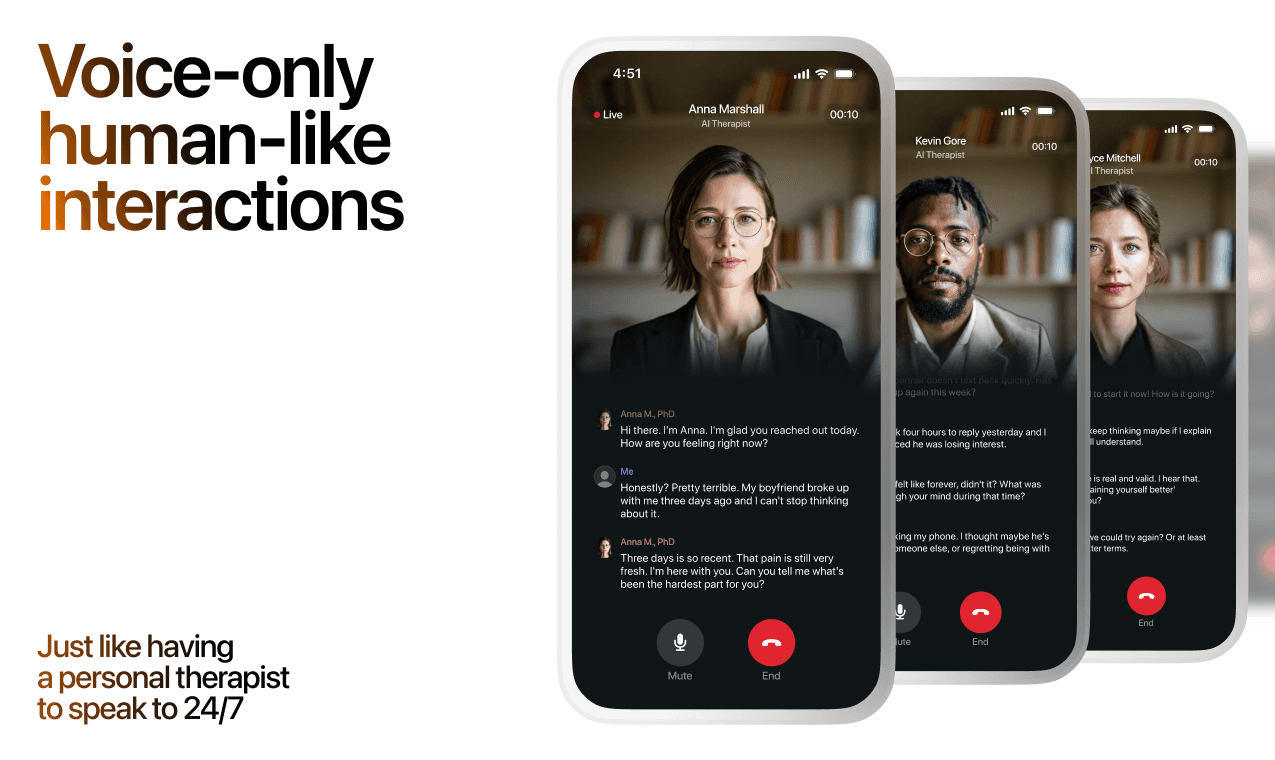
What a Session with Lovon Looks Like
When to Seek Professional Help
AI support is a valuable tool, but it's not a replacement for professional care. Please consider reaching out to a licensed therapist if you experience any of the following:
- Persistent thoughts of self-harm or suicide
- Inability to perform daily activities (work, eating, sleeping) for more than 2 weeks
- Turning to alcohol or substances to cope
- Intense anger or desire to harm your ex-partner
- Complete emotional numbness that doesn't improve over time
Crisis Resources (US): If you're in immediate danger, call 988 (Suicide & Crisis Lifeline) or text HOME to 741741 (Crisis Text Line). Available 24/7, free, and confidential.
Outside the US? Find a crisis line in your country
Ready to Start?
Your healing journey can begin right now
A 7-day trial. No judgment. Just a safe space to process what you're going through.
Frequently Asked Questions
Is Lovon a replacement for a real therapist?
Is my conversation with Lovon AI private?
How is Lovon different from ChatGPT for emotional support?
Can I use Lovon if I'm already seeing a therapist?
Can I try Lovon before subscribing?
About the Author
The Lovon Editorial Team
Mental Health & Wellness Content Team
The Lovon Editorial Team develops mental health and wellness content designed to make psychological concepts accessible and actionable. Our goal is to bridge the gap between clinical research and everyday life - helping you understand why your mind works the way it does and what you can do about it....
Related articles
- Best Mindfulness App for Anxiety in 2026: Full Ranking
Headspace, Insight Timer, and Lovon compared for anxiety in 2026 — which mindfulness app fits structured practice, free…
- Stress Management Techniques for Adults: What Works in 2026
Stress management techniques for adults ranked by evidence in 2026: box breathing, muscle relaxation, movement, and when…
- Coping Tools for Stress: What Works in 2026
Find the coping tools for stress that actually work in 2026 — box breathing, reframing, movement, and daily processing…
- AI Coping Tools for Exam Anxiety (2026 Verdict)
AI coping tools for exam anxiety ranked for 2026: voice check-ins, breathing drills, and grounding techniques compared…
See also
Quizzes
- Am I Sabotaging My Relationship? 12-Question Quiz
Find the move you reach for, in 2 minutes.
- Insecurity Test: What Are You Bracing Against?
See what your insecurity actually runs on, in 3 minutes.
Free tools
- Write a Letter to Your Best Friend
A chat for a letter to your best friend that only they could have received. Tell it how long you have been friends, one…
- 5-4-3-2-1 Grounding Exercise
A guided run through the 5-4-3-2-1 technique, with paced breathing first if you need it. No sign-up, nothing stored…
From the wiki
- What does it mean when you dream about your ex?
Dreaming about your ex usually reflects emotional processing, not prophecy and not a message from them. Your sleeping…
Disclaimer: This article is for informational purposes only and does not constitute medical advice, diagnosis, or treatment. Always seek the advice of your physician or other qualified health provider with any questions you may have regarding a medical condition. If you are in crisis or think you may have an emergency, call 988 (Suicide & Crisis Lifeline) or go to the nearest emergency room. Outside the US? Find a crisis line in your country.