
AI Therapy for Anxiety & Panic Attacks 2026
AI therapy for anxiety in 2026: voice-based apps like Lovon beat text chatbots for panic attacks. See top picks, key criteria, and what to avoid.

Key Takeaways
- Apps that lead with mood tracking but not intervention. Logging that you are anxious is not the same as helping you
- Free apps that gate panic features behind a paywall. If the only version of the app available without payment is the
- Apps with no stated therapeutic framework. "AI-powered wellness" without naming CBT, DBT, ACT, or another clinical
AI therapy for anxiety and panic attacks has moved well past chatbot novelty — in 2026, voice-based AI tools can run structured CBT sessions, guide you through panic attack protocols in real time, and track your symptom patterns across weeks. This guide is for people who need support now, between therapy appointments, or who cannot yet afford weekly sessions.
TL;DR: AI therapy for anxiety works best as a daily-use supplement — not a replacement for clinical care. Apps that combine voice interaction, CBT-based coping tools, and on-demand access (like Lovon's AI therapy) outperform text-only chatbots for people dealing with panic attacks and generalized anxiety. The key criteria are voice support, crisis de-escalation tools, and personalization depth. In 2026, the gap between a good AI therapy app and a mediocre one is wider than most people expect.
Why This Matters in 2026
Anxiety disorders affect an estimated 40 million adults in the United States. The median delay between first symptoms and first treatment is 11 years, according to aggregated data from the National Alliance on Mental Illness. Cost, availability, and stigma are the three main blockers. AI therapy for anxiety directly addresses all three: it is available at 2 a.m., costs a fraction of a $200/hour session, and requires no face-to-face disclosure. That combination explains why the category is growing fast enough that the quality gap between apps matters enormously.
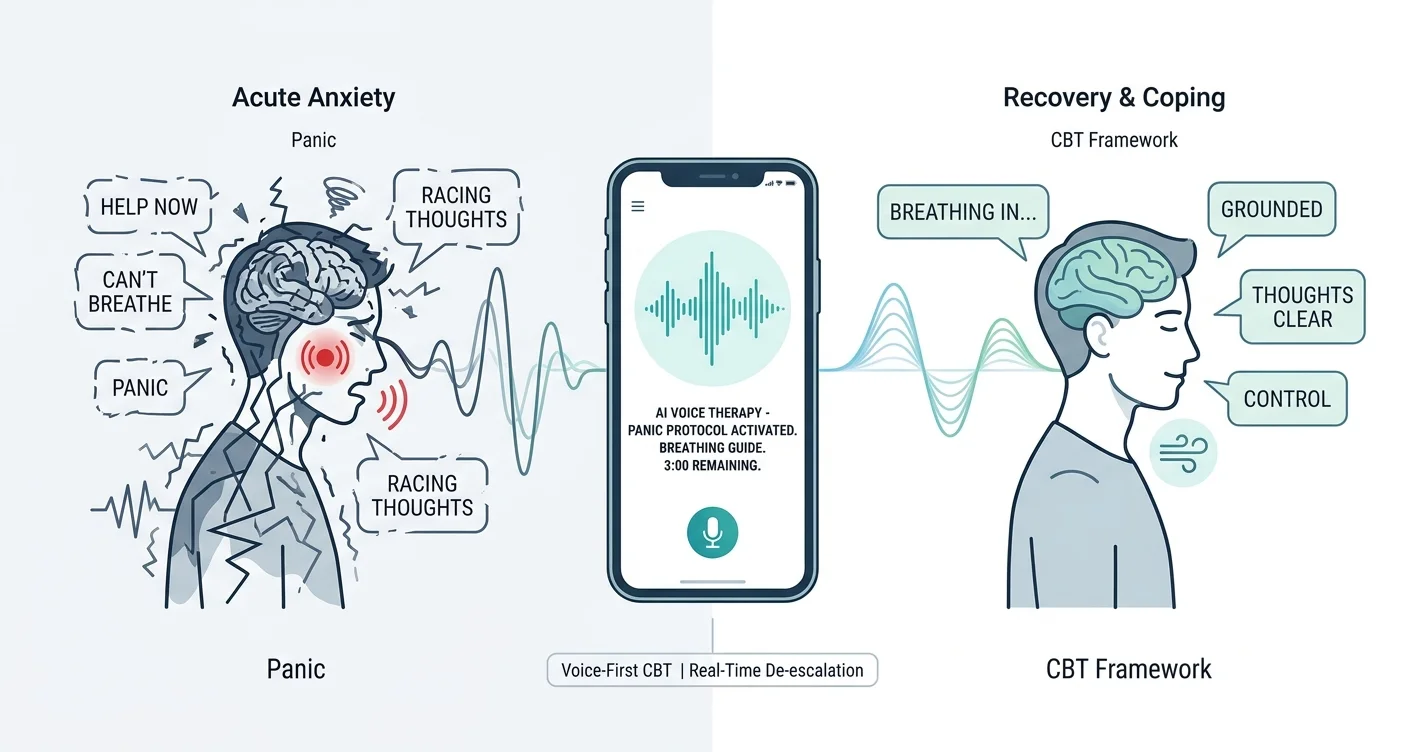
Panic attacks compound the problem. They arrive without warning, often at night or in public, and standard advice — "call your therapist" — is not actionable mid-attack. A voice AI that can walk you through diaphragmatic breathing, cognitive reframing, and grounding exercises in under 3 minutes is a genuinely different tool than a static breathing app.
Who This Guide Is For
This guide is written for adults managing anxiety — generalized anxiety disorder, panic disorder, or situational stress — who want structured, on-demand support outside of (or before accessing) traditional therapy. You may be on a waitlist for a therapist, managing between sessions, or testing whether an AI tool can supplement medication or mindfulness practices you already use. You are not looking for a clinical diagnosis here. You are looking for a tool that actually responds to how you feel at 11 p.m. on a Tuesday.
What to Look for in AI Therapy for Anxiety
Voice Interaction vs. Text-Only
Text chatbots require you to type when you are already dysregulated. Voice interaction removes that barrier and more closely replicates real therapy delivery. In 2026, voice-based AI therapy sessions measurably reduce time-to-calm during panic protocols because the pacing is controlled by the app, not by how fast you can type. If a tool does not offer voice, it is a journaling app with extra steps.
CBT and Evidence-Based Frameworks
Cognitive Behavioral Therapy has the strongest clinical evidence base for anxiety and panic disorders — over 300 randomized controlled trials as of 2026. An AI therapy app that delivers CBT-structured sessions (thought records, behavioral activation, exposure hierarchies) gives you something that maps to what a licensed therapist would do. Apps built on generic "talk to an AI" prompts skip this entirely. Ask before you download: does the app name the framework it uses?
Panic Attack Protocols
General anxiety support and panic-specific support are not the same. You need a tool with a discrete panic mode — a workflow that can be activated mid-attack and runs a grounding or breathing sequence without requiring you to navigate menus. The sequence should run under 5 minutes and require minimal input from you while activated. If you have to describe your symptoms before the app does anything useful, the tool fails the panic test.
Personalization and Session Memory
A tool that remembers that you had a rough Monday, that your panic attacks are triggered by work presentations, and that you respond better to box breathing than 4-7-8 breathing is categorically more useful than one that treats every session as a first meeting. Personalization depth — how well the app adapts over weeks of use — separates good AI therapy apps from decent ones in 2026.
On-Demand Availability and Response Time
Anxiety does not schedule itself. An app that buffers for 30 seconds before responding, or that caps daily session length at 10 minutes, is not built for anxiety management. Look for: no daily minute cap, response latency under 3 seconds in voice mode, and 24/7 availability without a premium paywall on the panic tools.
Privacy and Data Handling
You are disclosing sensitive mental health information. The app must store data encrypted, not sell data to advertisers, and comply with HIPAA or equivalent data standards. Read the privacy policy — specifically the section on whether session transcripts are used for model training. If that section does not exist, treat it as a red flag.
Top Picks for AI Therapy for Anxiety and Panic Attacks
Lovon — The Voice-First Pick for Panic Attack Support
Hook: The safe pick for anyone whose panic attacks hit at night.
Lovon is a voice-based AI therapy app built specifically for on-demand emotional support across anxiety, depression, stress, and ADHD. In 2026, it delivers personalized mental health sessions through voice, meaning you speak — the app listens, responds, and guides you through coping protocols without requiring typing. The panic support workflow runs without menu navigation once initiated.
Key spec: Voice-first architecture with CBT-based session structure and multi-week personalization memory.
Lovon pairs its anxiety support with a broader toolkit — the free AI therapist entry point lets you run your first sessions without a credit card, which removes the usual "try it for anxiety, not your wallet" friction.
Verdict: Buy. If panic attacks are your primary concern, Lovon's voice delivery and on-demand availability are the right fit in 2026.
Text-Based CBT Apps (Woebot, Wysa)
Hook: The fallback for people who prefer typing over talking.
Woebot and Wysa both use CBT frameworks delivered via text chat. Woebot has published peer-reviewed efficacy data showing meaningful reductions in anxiety symptoms over 2-week use periods. Wysa adds a human coaching tier.
Key spec: Text-only; no voice mode as of 2026.
Both apps work well for mild to moderate generalized anxiety when you have time to engage thoughtfully. Neither is optimized for mid-panic use because text input is too slow. Woebot's research base is the strongest in this category — over 12 published studies referenced by the company as of 2026.
Verdict: Consider for daily anxiety journaling and CBT exercises; Skip as a panic attack intervention.
Telehealth Platforms with Async Messaging (BetterHelp, Talkspace)
Hook: Human therapists with wait times and price tags.
BetterHelp and Talkspace are not AI therapy apps — they connect you with licensed therapists via messaging and video. Costs run $240–$360/month in 2026. Response times for async messages are typically 24–48 hours, which disqualifies them for panic attack support.
Key spec: Licensed human therapist; no real-time AI crisis response.
Verdict: Hold. If you can afford it and your anxiety is chronic rather than acute, a human therapist is the clinical gold standard. For immediate panic support, they are not the right tool.
General-Purpose AI Assistants (ChatGPT, Gemini)
Hook: Powerful but structureless.
Generalist AI tools can talk you through anxiety and will often produce competent CBT-adjacent responses. They have no personalization memory across sessions (without custom setups), no panic protocol workflow, and no clinical framework enforced by design. They are free and omnipresent.
Key spec: No session memory, no dedicated panic mode, no evidence-based framework by default.
Verdict: Skip as a primary anxiety tool. Use as a supplement for psychoeducation — reading about cognitive distortions, for example — but not as a therapy replacement.
What to Avoid
- Apps that lead with mood tracking but not intervention. Logging that you are anxious is not the same as helping you become less anxious. If the core loop is "rate your mood → see a chart," the app is a tracker, not a therapy tool.
- Free apps that gate panic features behind a paywall. If the only version of the app available without payment is the version that does not work when you are in crisis, the business model is misaligned with your needs.
- Apps with no stated therapeutic framework. "AI-powered wellness" without naming CBT, DBT, ACT, or another clinical approach is a marketing phrase, not a product claim. Avoid.
Comparison Table
| Tool | Voice Mode | Panic Protocol | CBT Framework | Personalization | Real-Time Response | Cost (2026) |
|---|---|---|---|---|---|---|
| Lovon | Yes | Yes | Yes | Multi-week memory | Under 3 seconds | Free entry tier |
| Woebot | No | Limited | Yes (CBT) | Session-level | Instant text | Free |
| Wysa | No | Basic breathing | Yes (CBT/DBT) | Session-level | Instant text | Free / paid coaching |
| BetterHelp | No (human video) | No | Human-delivered | Full | 24-48 hrs async | $240-$360/month |
| ChatGPT | Voice add-on | No | None by design | None (default) | Fast | Free / $20/month |
FAQ
What is AI therapy for anxiety, exactly? AI therapy for anxiety is a digital tool — usually an app — that uses artificial intelligence to deliver structured mental health support, coping exercises, and emotional coaching for people experiencing anxiety. In 2026, the best versions use voice interaction and evidence-based frameworks like CBT. They are not a replacement for licensed clinical therapy, but they provide real, structured support on demand.
Is AI therapy effective for panic attacks? For acute panic attacks, AI therapy tools with dedicated voice-guided breathing and grounding protocols can reduce episode intensity and duration. Peer-reviewed research on AI-delivered CBT shows significant anxiety reduction over 2–4 week periods. The key is whether the app has a specific panic mode — generic AI chat does not perform the same function.
How much does AI therapy for anxiety cost? Costs in 2026 range from free (Woebot, Lovon's entry tier) to $20/month for general AI tools like ChatGPT Plus, up to $360/month for human therapist platforms like BetterHelp. Dedicated AI therapy apps with full feature access typically fall between $0 and $30/month.
Can AI therapy replace a real therapist for anxiety? No. AI therapy for anxiety is best used as a daily supplement — between sessions, on waitlists, or for lower-severity episodes. For diagnosed anxiety disorders, clinical supervision remains the standard. AI tools do not diagnose, prescribe, or provide legally recognized therapy.
What's the best AI therapy app for anxiety in 2026? For voice-based, on-demand support with panic attack protocols, Lovon is the strongest option in 2026. For text-based CBT with published efficacy data, Woebot is the most research-backed free option. The right choice depends on whether you need real-time voice support or structured daily check-ins.
Is AI therapy safe to use during a panic attack? Yes, provided the app is designed for it. A voice-guided grounding or breathing sequence does not require cognitive load from you during peak panic. Apps that require typing, navigating menus, or describing symptoms before activating a coping protocol are poorly designed for acute use.
Does AI therapy for anxiety work for generalized anxiety disorder (GAD)? CBT-based AI therapy apps show measurable efficacy for generalized anxiety disorder in multiple studies. A 2023 Woebot trial published in JMIR Mental Health reported significant reductions in GAD symptom scores over 2 weeks. In 2026, apps with multi-session personalization perform best for GAD because the condition requires ongoing pattern recognition, not just one-off coping tools.
How do I get started with AI therapy for anxiety for free? Lovon offers a free entry point at lovon.app/therapist-free — no credit card required for initial sessions. Woebot is fully free on iOS and Android. Both let you run your first anxiety-focused session within 5 minutes of download.
One Last Thing
The strongest predictor of whether an AI therapy app actually helps your anxiety is not the feature list — it is whether you use it consistently for at least 14 days. Aggregated data from CBT app trials consistently shows that users who complete 10 or more sessions in the first two weeks report the largest symptom reductions. Download the app you think you will open on a bad night, not the one with the most impressive marketing page.
Related Guides
How AI Support Helps You Heal
AI emotional support isn't about replacing human connection — it's about filling the gaps. The moments when you need to talk at 2 AM, when you don't want to burden your friends again, or when you simply need someone to listen without judgment.
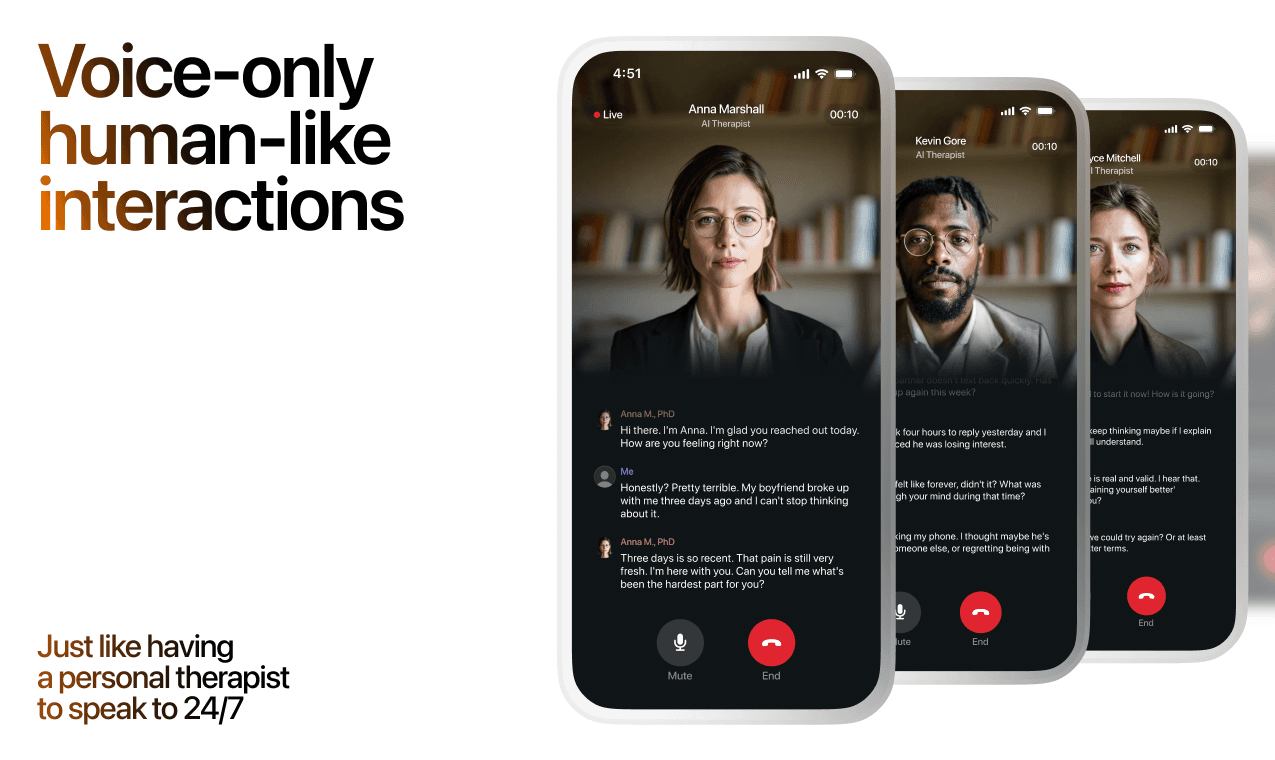
Here's what happens in a typical Lovon session:
You share what's on your mind
There's no script, no intake form, no waiting room. You speak or type whatever you're feeling — in your own words, at your own pace.
Lovon validates and explores
Using frameworks from CBT (Cognitive Behavioral Therapy) and motivational interviewing, Lovon acknowledges your feelings first, then gently helps you explore them. No dismissive "just move on" advice.
You build coping skills together
Lovon doesn't just listen — it actively works with you on evidence-based techniques: thought reframing, urge surfing, behavioral experiments, and more.
What a Session with Lovon Looks Like
When to Seek Professional Help
AI support is a valuable tool, but it's not a replacement for professional care. Please consider reaching out to a licensed therapist if you experience any of the following:
- Persistent thoughts of self-harm or suicide
- Inability to perform daily activities (work, eating, sleeping) for more than 2 weeks
- Turning to alcohol or substances to cope
- Intense anger or desire to harm your ex-partner
- Complete emotional numbness that doesn't improve over time
Crisis Resources (US): If you're in immediate danger, call 988 (Suicide & Crisis Lifeline) or text HOME to 741741 (Crisis Text Line). Available 24/7, free, and confidential.
Outside the US? Find a crisis line in your country
Ready to Start?
Your healing journey can begin right now
1 free conversation. No credit card. No judgment. Just a safe space to process what you're going through.
Frequently Asked Questions
Is AI therapy a replacement for a real therapist?
Is my conversation with Lovon AI private?
How is Lovon different from ChatGPT for emotional support?
Can I use Lovon if I'm already seeing a therapist?
Can I try Lovon for free?
About the Author
The Lovon Editorial Team
Mental Health & Wellness Content Team
The Lovon Editorial Team develops mental health and wellness content designed to make psychological concepts accessible and actionable. Our goal is to bridge the gap between clinical research and everyday life - helping you understand why your mind works the way it does and what you can do about it....
Related articles
- Free AI Therapist for Depression: Top Picks 2026
The best free AI therapist for depression in 2026. Lovon offers voice-based CBT sessions with no waitlist, no credit…
- Can You Pass Out from a Panic Attack? (2026)
Can you pass out from a panic attack? Almost never — learn the real biology, why dizziness happens, and 7 steps to…
- Free AI Therapist for ADHD Adults (2026 Guide)
The best free AI therapist for ADHD adults in 2026. Lovon delivers voice-first, on-demand emotional support and coping…
- App for Panic Disorder: 2026 Verdict on What Works
App for panic disorder in 2026: Lovon wins for real-time voice support, text apps and meditation apps rank lower. See…
See also
Quizzes
- Light Triad Test: Are People Ends or Means?
See how you treat people when there is nothing to gain.
- Rejection Sensitivity Test: Free 12-Question Check
See how strongly you expect and read rejection.
Free tools
- Am I Overreacting, or Is This a Big Deal?
A chat for the small thing you cannot stop turning over. Say what happened and what you have already told yourself about…
- 5-4-3-2-1 Grounding Exercise
A guided run through the 5-4-3-2-1 technique, with paced breathing first if you need it. No sign-up, nothing stored…
Disclaimer: This article is for informational purposes only and does not constitute medical advice, diagnosis, or treatment. Always seek the advice of your physician or other qualified health provider with any questions you may have regarding a medical condition. If you are in crisis or think you may have an emergency, call 988 (Suicide & Crisis Lifeline) or go to the nearest emergency room. Outside the US? Find a crisis line in your country.