
Voice Journaling for Anxiety: Daily Steps That Work (2026)
Learn how to use voice journaling for anxiety with 7 daily steps, troubleshooting fixes, and guidance on when to add AI therapy support.

Key Takeaways
- A quiet space — 5 minutes is enough to start
- Your phone or any device with a microphone
- An AI voice therapy app (Lovon works well for this) or a basic voice memo app
- A consistent trigger: a time of day, a specific location, or a recurring feeling
- No prior journaling experience required
Voice journaling for anxiety is one of the most accessible daily practices you can start today — no pen, no blank page, just your voice and a few honest minutes.
TL;DR: Voice journaling for anxiety means speaking your thoughts aloud instead of writing them, which activates emotional processing faster than text journaling for many people. A consistent 5–10 minute daily session can lower perceived stress, interrupt rumination cycles, and build self-awareness over time. Lovon's AI voice support app is built for exactly this kind of daily check-in — it listens, reflects back, and guides you through coping tools developed with PhD psychologists. The steps below work whether you use an app or just talk to yourself in the car.
Why this matters
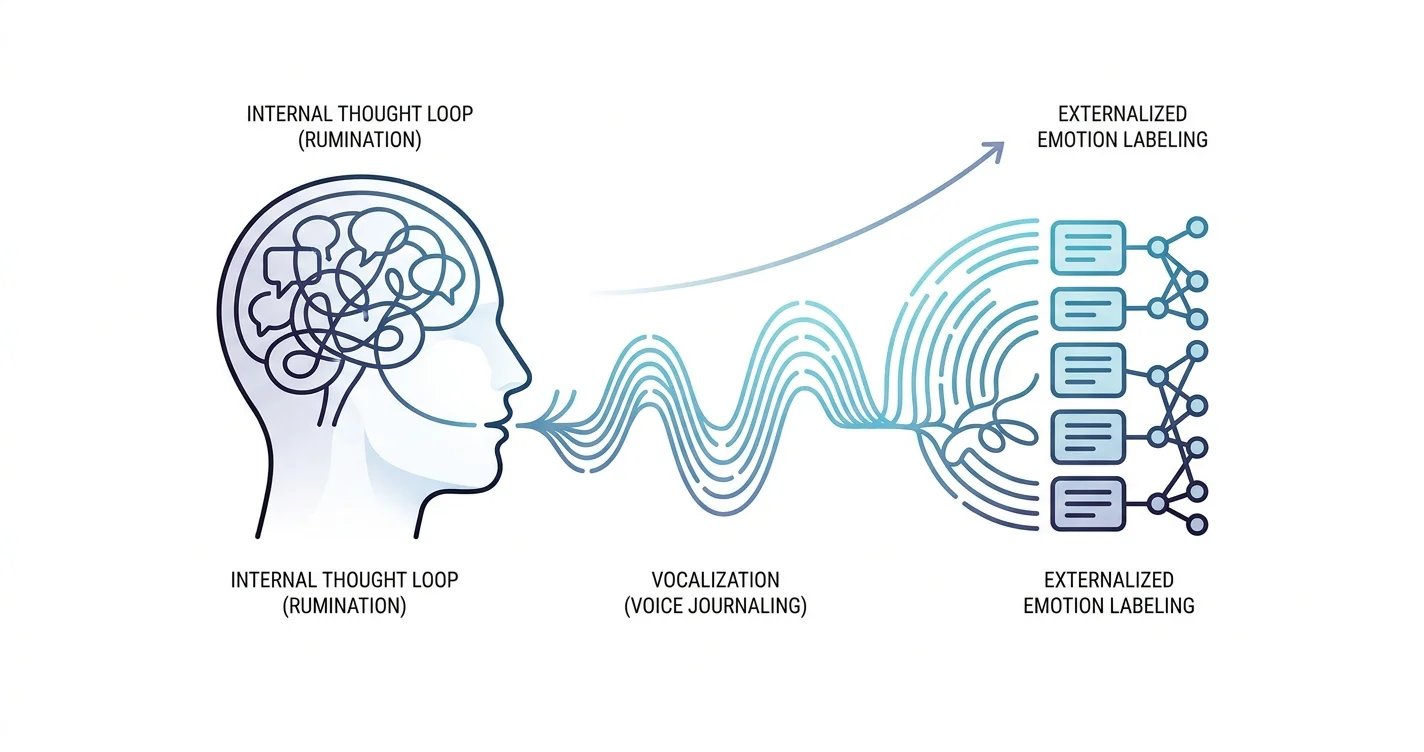
Anxiety feeds on unexpressed thought loops. When worry stays inside your head, it circles. Saying it out loud — even to no one — forces your brain to organize the thought into a sentence, which interrupts the loop. Research published in Psychological Science found that labeling emotions verbally reduces amygdala activation, the same region that fires during an anxiety response. In 2026, voice-based mental health tools have expanded this principle into structured daily practices. If you've tried written journaling and stalled out, voice journaling removes the friction of the blank page entirely.
What you'll need
- A quiet space — 5 minutes is enough to start
- Your phone or any device with a microphone
- An AI voice support app (Lovon works well for this) or a basic voice memo app
- A consistent trigger: a time of day, a specific location, or a recurring feeling
- No prior journaling experience required
The steps
Step 1: Set a fixed trigger time
Anchor your voice journaling session to something you already do every day — morning coffee, after brushing your teeth, or right before bed. Anxiety spikes are often tied to transitions, and placing your session at one of those points catches the feeling while it's live. Skip "whenever I feel like it" — that moment rarely comes. Pick one time slot and protect it for at least 14 days before evaluating whether it works.
Expected outcome: A session you actually do consistently instead of one you plan to do.
Common mistake: Choosing a time that requires extra effort to initiate (driving to a specific spot, waiting until the house is empty). The lower the setup cost, the more likely you follow through.
Step 2: Open with one grounding sentence
Start every session with the same sentence: "Right now I'm feeling _____." That's it. Fill in the blank with whatever is true — nervous, flat, wound up, foggy. Don't narrate your day first. Naming the feeling first pulls attention away from the story your anxiety is telling and puts it on the physical, present-tense experience. This is the foundation of the verbal emotion labeling research mentioned above.
Expected outcome: You move from abstract dread to a specific, nameable state in under 30 seconds.
Common mistake: Starting with "So today..." and describing events. That keeps you in narrative mode, which feeds rumination instead of processing it.
Step 3: Let the anxiety speak without editing
For the next 3–5 minutes, just talk. Say the worry out loud exactly as it sounds inside your head, including the catastrophic or embarrassing parts. Voice journaling for anxiety only works if you stop self-censoring. You are not being recorded for an audience. If you're using Lovon, the AI responds without judgment — it's designed to hold that space.
The goal here is not to solve the problem. It's to externalize it. A thought trapped inside feels larger than it is. Spoken aloud, it becomes a sentence — finite, containable, reviewable.
Expected outcome: A 20–30% reduction in the physical tension you feel around the worry, based on the principle of cognitive defusion used in Acceptance and Commitment Therapy.
Common mistake: Stopping when it gets uncomfortable. That discomfort is exactly when the processing is working.
Step 4: Ask yourself two reflection questions
After you've spoken the worry, pause and ask:
- "What is this anxiety trying to protect me from?"
- "What's one thing I can actually do about this today?"
Speak the answers out loud. If an AI voice support app like Lovon is guiding the session, it will often generate a follow-up question based on what you said — use that. If you're going solo, these two questions consistently surface the difference between signal anxiety (a real problem worth solving) and noise anxiety (a loop with no action attached).
Expected outcome: At least one of the two questions produces a concrete, actionable answer.
Common mistake: Answering in your head instead of out loud. The vocalization is the mechanism — skipping it defeats the practice.
Step 5: Close with a self-compassion statement
End every session by saying something kind to yourself — out loud. "I'm doing my best." "This is hard and I'm still here." It sounds simple, but closing a session with self-directed warmth prevents the practice from becoming another source of anxiety-about-anxiety. Research consistently shows self-compassion as one of the most effective buffers against anxiety relapse. In 2026, this step is built into Lovon's session structure deliberately.
Expected outcome: The session ends with a regulated nervous system state rather than a reviewed list of worries.
Common mistake: Skipping the close because it feels awkward. The awkwardness is normal for the first 5–7 sessions and then disappears.
Step 6: Log the pattern, not the content
After a week, spend one minute reviewing your sessions — not what you said, but when anxiety was highest, what triggered it, and whether any theme repeats. You don't need to transcribe anything. A 3-word note works: "morning, work deadline, chest tight." Over 30 days, patterns emerge that give you and any support resource — therapist, app, or both — real data to work with.
Expected outcome: 3–5 identifiable anxiety patterns after 30 days of consistent voice journaling.
Common mistake: Reviewing content word by word and re-triggering the original anxiety. Look at metadata, not the story.
Step 7: Adjust session length to your state
On low-anxiety days, 5 minutes is enough. On high-anxiety days — before a hard conversation, after a panic episode, during a stressful week at work — extend to 10–15 minutes and add a body-scan prompt at the start: "Where in my body do I feel this?" The practice is flexible. What is not flexible is the daily frequency. Missing 2 consecutive days breaks the habit loop. If you miss one, do a 90-second session the next morning just to re-anchor the behavior.
Expected outcome: A practice that adapts to your daily state without collapsing when life gets busier.
Common mistake: Skipping "bad days" because the anxiety feels too intense to talk about. Those are the sessions that matter most.
Troubleshooting
"I go blank as soon as I start talking." Use a prompt: "The thing I keep not saying out loud is..." One sentence unlocks the rest. If you're using Lovon, tap into the guided session format — it opens with a question so you never face a blank start.
"I feel worse after my sessions." You may be re-ruminating instead of processing. Check Step 2 — are you starting with the feeling or with the story? If you're leading with narrative, the session is feeding the anxiety loop. Start with the grounding sentence and keep the focus on body sensation before content.
"I can't find a private space." Use earphones and a voice memo app in a parked car, on a walking commute, or in a bathroom with the door closed. The session does not require silence or a perfect setting. A 5-minute walk while talking into your phone is valid voice journaling.
"I forget to do it." Set a single daily phone alarm labeled with your opening sentence: "Right now I'm feeling..." The label is the prompt, not just a reminder.
"I don't know if I'm doing it right." There is no wrong output. If you spoke the anxiety out loud and ended with a kind word to yourself, you did it right. Apps like Lovon remove this uncertainty by giving you real-time reflections that confirm your feelings were heard.
"It's helping but I still feel anxious most days." Voice journaling reduces the intensity and duration of anxiety episodes — it is not a cure for an anxiety disorder. If daily sessions for 4+ weeks have not produced noticeable relief, consider pairing this practice with professional support. Lovon is built as a companion to clinical care, not a replacement for it. The free AI therapist for anxiety article on the Lovon blog covers how to use on-demand AI support between therapy appointments.
Tools and resources
- Lovon — AI voice support app with guided sessions built around anxiety, stress, and emotional processing. Available on-demand, 24 hours a day.
- Voice memo app — The built-in recorder on any smartphone works for unguided sessions.
- Simple notebook — One line per day to log your pattern metadata (not the full session content).
- For understanding what happens in your brain during anxiety spikes, the Lovon post on amygdala hijack explains the mechanism clearly and pairs well with this practice.
- If your anxiety overlaps with high-functioning presentation, the Lovon guide on high-functioning anxiety signs is worth reading alongside this one.
What to do next
Once you've maintained a daily voice journaling practice for 2–3 weeks, the next step is structured reflection: taking your identified patterns into a conversation with a therapist or an AI therapy tool that can help you build targeted coping strategies. Voice journaling surfaces the anxiety — the next layer is working through it systematically.
FAQ
What is voice journaling for anxiety? Voice journaling for anxiety is the practice of speaking your anxious thoughts aloud in a structured session, rather than writing them. It works by externalizing internal thought loops, labeling emotions verbally, and closing with grounding or self-compassion prompts.
How long should a voice journaling session be? Start with 5 minutes. On difficult days, extend to 10–15 minutes. Consistency matters more than length — a 5-minute daily session outperforms a 30-minute weekly one for anxiety management.
Is voice journaling better than written journaling for anxiety? For many people, yes — especially those who freeze in front of a blank page, process emotions better through speech than text, or struggle with the time commitment of writing. Spoken language activates different cognitive pathways than writing, which can make emotional processing faster.
Can I do voice journaling without an app? Yes. A voice memo app or simply speaking aloud with no recording works. An AI voice support app like Lovon adds structure, reflection, and guided prompts, which helps beginners stay consistent and builds in the self-compassion close automatically.
How quickly does voice journaling reduce anxiety? Many people notice lower tension within a single session. Measurable pattern recognition typically takes 2–4 weeks of daily practice. In 2026, aggregated data from AI mental health tools suggest that users who complete 5 or more voice sessions per week report lower perceived stress scores within 30 days.
What if I feel more anxious during a session? Short-term discomfort during a session is normal — you are bringing suppressed material into conscious language. If the distress is severe or the session consistently ends with higher anxiety than it started, switch to a guided format (Lovon's guided sessions are built to regulate arousal, not amplify it) or speak with a licensed clinician.
Can voice journaling replace therapy? No. It is a daily self-care practice, not clinical treatment. It works best alongside therapy or AI-assisted support tools. Lovon is explicit about this — it is a companion, not a replacement for a licensed professional.
What time of day is best for voice journaling? The best time is whichever you will actually do consistently. Morning sessions catch anticipatory anxiety before it builds. Evening sessions process the residue of the day. Both work. Avoid immediately before sleep if the session consistently activates rather than settles your nervous system.
One last thing
In a 2026 study examining emotion regulation techniques, verbal labeling of anxious thoughts — the core mechanism in voice journaling — produced measurable decreases in self-reported anxiety within 8 minutes of starting. That's shorter than most commutes. The barrier is never time. It's the first sentence. Say it out loud right now: "Right now I'm feeling..." and you've already started.
Related guides
How AI Support Helps You Heal
AI emotional support isn't about replacing human connection — it's about filling the gaps. The moments when you need to talk at 2 AM, when you don't want to burden your friends again, or when you simply need someone to listen without judgment.
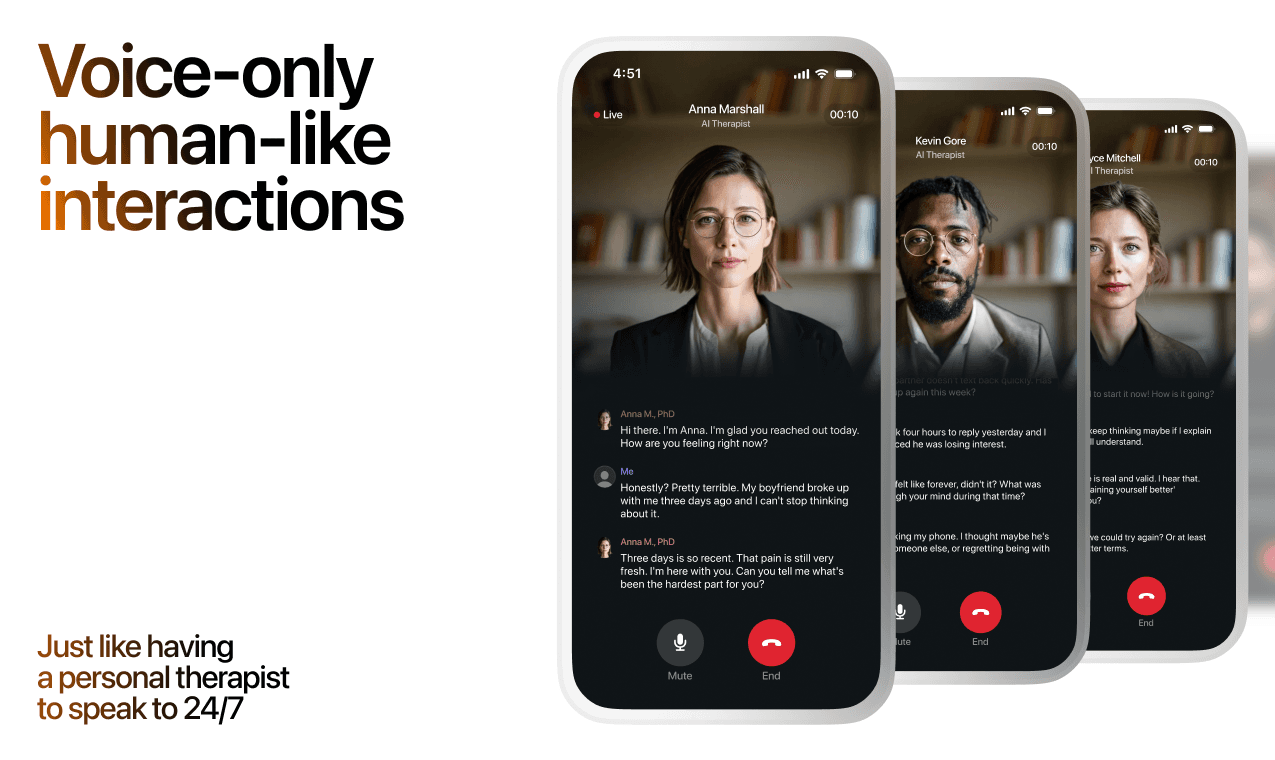
Here's what happens in a typical Lovon session:
You share what's on your mind
There's no script, no intake form, no waiting room. You speak or type whatever you're feeling — in your own words, at your own pace.
Lovon validates and explores
Using frameworks from CBT (Cognitive Behavioral Therapy) and motivational interviewing, Lovon acknowledges your feelings first, then gently helps you explore them. No dismissive "just move on" advice.
You build coping skills together
Lovon doesn't just listen — it actively works with you on evidence-based techniques: thought reframing, urge surfing, behavioral experiments, and more.
What a Session with Lovon Looks Like
When to Seek Professional Help
AI support is a valuable tool, but it's not a replacement for professional care. Please consider reaching out to a licensed therapist if you experience any of the following:
- Persistent thoughts of self-harm or suicide
- Inability to perform daily activities (work, eating, sleeping) for more than 2 weeks
- Turning to alcohol or substances to cope
- Intense anger or desire to harm your ex-partner
- Complete emotional numbness that doesn't improve over time
Crisis Resources (US): If you're in immediate danger, call 988 (Suicide & Crisis Lifeline) or text HOME to 741741 (Crisis Text Line). Available 24/7, free, and confidential.
Outside the US? Find a crisis line in your country
Ready to Start?
Your healing journey can begin right now
A 7-day trial. No judgment. Just a safe space to process what you're going through.
Frequently Asked Questions
Is Lovon a replacement for a real therapist?
Is my conversation with Lovon AI private?
How is Lovon different from ChatGPT for emotional support?
Can I use Lovon if I'm already seeing a therapist?
Can I try Lovon before subscribing?
About the Author

The Lovon Editorial Team
Mental Health & Wellness Content Team
The Lovon Editorial Team develops mental health and wellness content designed to make psychological concepts accessible and actionable. Our goal is to bridge the gap between clinical research and everyday life - helping you understand why your mind works the way it does and what you can do about it....
Related articles
- Journaling Prompts for Anxiety & Overthinking (2026)
40+ journaling prompts for anxiety and overthinking — organized by use case, backed by research, and built to interrupt…
- AI Voice Therapy App vs. Text Apps: Key Differences 2026
An AI voice therapy app like Lovon delivers faster emotional relief than text chatbots. See exactly how voice differs…
- Can journaling really reduce stress?
Can journaling really reduce stress? Yes, it can help, but not everyone benefits. Learn what research shows, which…
- Rumination and Depression: How to Break the Loop (2026)
Rumination and depression fuel each other. These 8 evidence-based steps interrupt the cycle, reduce repetitive negative…
See also
Quizzes
- Loneliness Test: Free 12-Question Self-Check
See which kind of loneliness is thin, in 3 minutes.
- Highly Sensitive Person Test: How Much Do You Take In?
See how deeply you process, notice and get overloaded.
Free tools
- Write a Letter to Someone You Lost
Tell it who they were to you and what you never got to say, and it writes the letter back in your words. No account, no…
- Write a Condolence Message for This Person
Get one condolence message written for your situation instead of a list of a hundred to choose from. Tell it who died…
From the wiki
- How to stop maladaptive daydreaming?
Maladaptive daydreaming is immersive waking fantasy that eats hours, usually with music and pacing attached. You rarely…
Disclaimer: This article is for informational purposes only and does not constitute medical advice, diagnosis, or treatment. Always seek the advice of your physician or other qualified health provider with any questions you may have regarding a medical condition. If you are in crisis or think you may have an emergency, call 988 (Suicide & Crisis Lifeline) or go to the nearest emergency room. Outside the US? Find a crisis line in your country.