
Relationship Anxiety: Signs, Causes, Fixes (2026)
Relationship anxiety explained: signs, causes like anxious attachment, and coping tools that work in 2026. Practical steps, no hype, verdict included.

Key Takeaways
- 10-15 minutes a day for a grounding or breathing practice
- A journal or notes app to track triggers (paper or phone, doesn't matter)
- A partner willing to have at least one direct conversation about reassurance needs
- Optional: a coping tool you can talk to on demand, since anxiety spikes rarely happen on a therapist's schedule
Relationship anxiety shows up as constant worry that your partner is pulling away, checking their phone for a reply, or replaying a conversation for the tenth time looking for proof something's wrong. This guide breaks down the signs, the usual causes, and the coping tools that actually calm the spiral instead of feeding it.
TL;DR
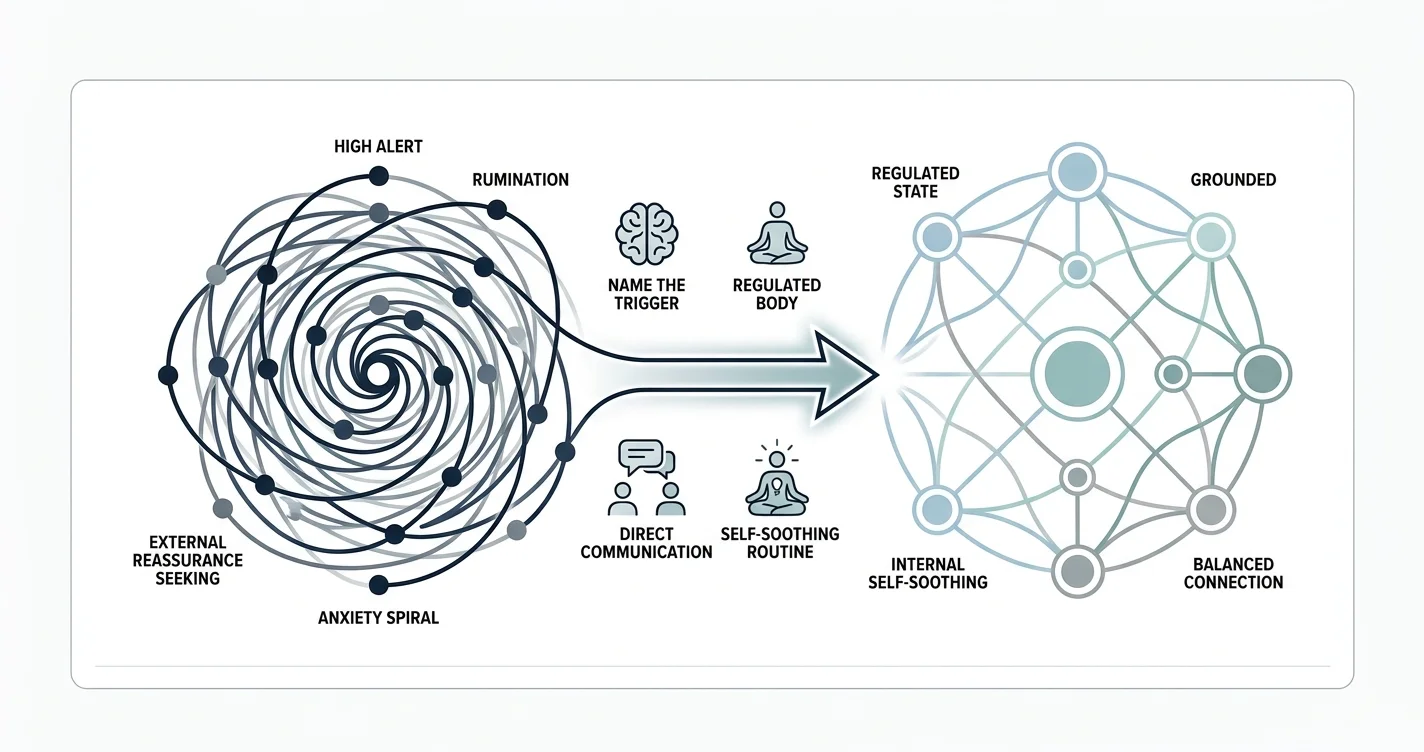
Relationship anxiety is the persistent fear that your relationship is at risk even when nothing concrete says so — and it's a common experience. The usual drivers are anxious attachment, past betrayal, and low self-worth, and the fix isn't "stop worrying," it's building specific skills: grounding, direct communication, and self-soothing that doesn't depend on your partner's reassurance. Verdict: workable with consistent practice — most people see real change within 6 to 8 weeks of active coping work, not overnight. If you want a structured way to practice between sessions or on your own, a signs of anxious attachment breakdown is a useful starting map.
Why this matters
Untreated relationship anxiety doesn't stay contained to the relationship. It bleeds into sleep, work focus, and how you show up with friends — because the nervous system doesn't clock out just because the trigger was romantic. Left alone, it tends to escalate into behaviors that push partners away: excessive reassurance-seeking, checking their phone, or picking fights to test loyalty. The 2026 data on attachment and anxiety consistently shows the same pattern — the anxiety isn't really about the partner, it's about an internal alarm system that's stuck on high alert. Learning to recognize that distinction is the first real step toward calming it down.
What you'll need
- 10-15 minutes a day for a grounding or breathing practice
- A journal or notes app to track triggers (paper or phone, doesn't matter)
- Honest awareness of your attachment pattern — an attachment style quiz takes about 2 minutes and gives you a starting label to work from
- A partner willing to have at least one direct conversation about reassurance needs
- Optional: a coping tool you can talk to on demand, since anxiety spikes rarely happen on a therapist's schedule
The steps
1. Name the trigger, not the story
When the spiral starts, write down the actual event — "he took 3 hours to text back" — separate from the interpretation — "he's losing interest." This matters because relationship anxiety runs on interpretation, not fact, and separating the two is the fastest way to interrupt it. Do this for a full week before trying anything else. Common mistake: people skip this step because it feels too simple, then wonder why grounding techniques don't stick — the story has to be caught before it can be challenged.
2. Regulate the body before you talk to your partner
A racing nervous system can't have a rational conversation, so calm the body first. Try box breathing: inhale 4 seconds, hold 4, exhale 4, hold 4, repeated for 2 minutes. This works because anxiety is physiological before it's emotional — your heart rate needs to drop before your thinking brain comes back online. Expected outcome: a noticeable drop in urgency within 3-5 minutes, not a total absence of feeling. Mistake to avoid: texting your partner mid-spike — wait until your body has settled first.
3. Ask for what you need directly, not through tests
Instead of picking a fight to see if they'll stay, say the actual need: "I feel anxious when texts go unanswered for hours — can we agree on a quick check-in even if it's just 'busy, talk later'?" This works because indirect tests (silent treatment, jealousy bait) usually confirm the fear instead of resolving it. If you're not sure how to phrase this without sounding accusatory, AI relationship advice for communication issues walks through scripts that keep the tone non-blaming. Common mistake: waiting until you're already furious to bring it up — timing changes how it lands.
4. Build a self-soothing routine that doesn't depend on your partner
Reassurance from a partner works for about 20 minutes before the anxious brain wants more — that's the trap. Build a parallel practice: a walk, a call to a friend, journaling, or a structured conversation with a coping tool when the urge to text hits at 11pm and your partner's asleep. This matters because self-soothing capacity is what actually shrinks anxious attachment over time, not external reassurance volume. If 2am spirals are a regular pattern, an AI relationship coach for anxious attachment is built for exactly that gap — available when your partner isn't, without needing an appointment.
5. Track the pattern for 2-4 weeks before drawing conclusions
One bad night doesn't mean the relationship is failing, but a repeating pattern over a month is real data. Log frequency: how many times a week does the spiral hit, and what preceded it. This works because it turns a vague feeling of dread into a countable, addressable pattern. Expected outcome: most people find the spikes cluster around specific triggers — a certain time of day, a certain topic, being tired. Mistake: judging progress after one good week and dropping the practice.
6. Separate anxious attachment from an actually unsafe relationship
Not all relationship anxiety is a you-problem — sometimes the anxiety is an accurate read on inconsistent or unsafe behavior. This step matters because coping tools won't fix a relationship where the fear is a rational response to real instability. If you're unsure which one you're dealing with, run through the signs at is my relationship toxic: 10 signs to check now before assuming the anxiety is purely internal.
Troubleshooting
- The spiral hits at night and won't stop. Nighttime is when self-soothing resources are lowest and rumination is highest — keep a short breathing script on your phone specifically for 11pm-2am spikes.
- My partner says I'm "too much" when I bring up needs. That's a communication mismatch, not proof the anxiety is baseless — try naming the need in one sentence instead of a longer explanation.
- I feel calm for a few days then it comes back worse. That's normal early on; anxious patterns don't extinguish in a straight line, they fade in waves over 6-8 weeks of consistent practice.
- I keep checking their social media even after I've calmed down. Checking behavior often outlasts the emotional spike — set a hard rule (phone in another room for 1 hour) rather than relying on willpower in the moment.
- Breathing exercises don't do anything for me. Some people need movement over stillness — a 10-minute walk regulates the nervous system just as effectively for a lot of people.
- I don't know if this is anxiety or my gut telling me something's wrong. Track specifics for 2 weeks before deciding; a single ambiguous incident isn't enough data either way.
Tools and resources
- A daily 10-minute grounding or breathing habit, tracked in a notes app
- An attachment style label as a reference point rather than a fixed identity
- A script for direct reassurance requests, practiced before you need it
- On-demand support for spikes that happen outside business hours — Lovon offers voice conversations built around exactly that gap, though it's a support tool, not a replacement for a licensed therapist if the anxiety is severe or tied to trauma
- A weekly check-in with your partner, 15 minutes, no phones
What to do next
Once the spikes are less frequent, the next skill is distinguishing anxious attachment from genuine incompatibility. The reassurance-seeking cycle is the hardest part to break long-term, and the deeper attachment guides above are the right next read.
FAQ
What is relationship anxiety exactly? It's persistent worry or fear about the stability of a relationship that isn't proportional to the actual evidence available. It often shows up as overthinking texts, fear of abandonment, or needing constant reassurance.
Is relationship anxiety the same as anxious attachment? Not always — anxious attachment is one common cause, but relationship anxiety can also come from past betrayal, low self-esteem, or genuinely inconsistent partner behavior. The label matters less than identifying the actual driver.
Can relationship anxiety be fixed without therapy? Many people reduce it significantly with consistent self-soothing practice, direct communication, and pattern tracking, typically within 6-8 weeks. Severe or trauma-linked cases usually benefit from working with a licensed clinician.
How do I know if my anxiety is valid or just my attachment style? Track specific incidents over 2-4 weeks before deciding — repeating patterns of inconsistency are data, one ambiguous moment isn't. Comparing notes against clear toxic-relationship signs helps separate the two.
What's the fastest way to calm a relationship anxiety spike in the moment? Box breathing (4 seconds in, hold 4, out 4, hold 4) for 2 minutes drops physiological urgency fast, before you try to think your way out of it. Talking or texting mid-spike usually makes things worse, not better.
Does reassurance from my partner actually help long-term? It helps for about 20 minutes, then the anxious brain wants more — which is why self-soothing skills matter more than reassurance volume over time. Reassurance treats the symptom, not the pattern.
Is it normal to feel relationship anxiety even in a good relationship? Yes — anxious attachment can produce fear responses even when a partner is consistent and trustworthy, because the pattern is rooted in past experience, not present behavior. That's exactly why the coping work matters more than trying to fix the partner.
When should I worry this isn't just anxiety? If the fear tracks consistently with real inconsistency, broken promises, or feeling unsafe, that's worth evaluating separately from anxious attachment work.
One last thing
Most people trying to fix relationship anxiety focus entirely on calming themselves down in the moment and skip the step that actually moves the needle: tracking the pattern over weeks, not days. The spike feels like the whole problem, but it's usually the data point — the pattern underneath is what tells you whether this is anxious attachment to work through or a relationship that genuinely isn't safe.
Related guides
How AI Support Helps You Heal
AI emotional support isn't about replacing human connection — it's about filling the gaps. The moments when you need to talk at 2 AM, when you don't want to burden your friends again, or when you simply need someone to listen without judgment.
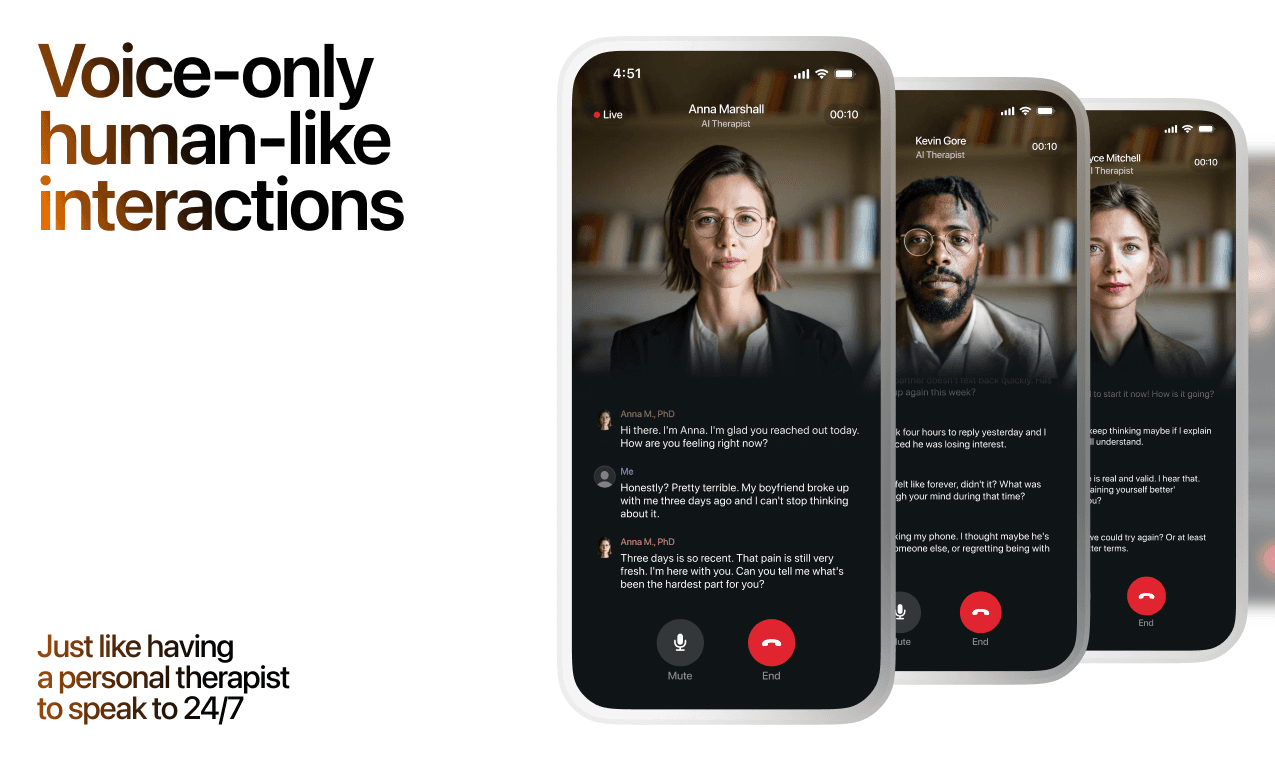
Here's what happens in a typical Lovon session:
You share what's on your mind
There's no script, no intake form, no waiting room. You speak or type whatever you're feeling — in your own words, at your own pace.
Lovon validates and explores
Using frameworks from CBT (Cognitive Behavioral Therapy) and motivational interviewing, Lovon acknowledges your feelings first, then gently helps you explore them. No dismissive "just move on" advice.
You build coping skills together
Lovon doesn't just listen — it actively works with you on evidence-based techniques: thought reframing, urge surfing, behavioral experiments, and more.
What a Session with Lovon Looks Like
When to Seek Professional Help
AI support is a valuable tool, but it's not a replacement for professional care. Please consider reaching out to a licensed therapist if you experience any of the following:
- Persistent thoughts of self-harm or suicide
- Inability to perform daily activities (work, eating, sleeping) for more than 2 weeks
- Turning to alcohol or substances to cope
- Intense anger or desire to harm your ex-partner
- Complete emotional numbness that doesn't improve over time
Crisis Resources (US): If you're in immediate danger, call 988 (Suicide & Crisis Lifeline) or text HOME to 741741 (Crisis Text Line). Available 24/7, free, and confidential.
Outside the US? Find a crisis line in your country
Ready to Start?
Your healing journey can begin right now
A 7-day trial. No judgment. Just a safe space to process what you're going through.
Frequently Asked Questions
Is Lovon a replacement for a real therapist?
Is my conversation with Lovon AI private?
How is Lovon different from ChatGPT for emotional support?
Can I use Lovon if I'm already seeing a therapist?
Can I try Lovon before subscribing?
About the Author
The Lovon Editorial Team
Mental Health & Wellness Content Team
The Lovon Editorial Team develops mental health and wellness content designed to make psychological concepts accessible and actionable. Our goal is to bridge the gap between clinical research and everyday life - helping you understand why your mind works the way it does and what you can do about it....
Related articles
- Anxious Preoccupied Attachment: Signs & How to Shift 2026
Anxious preoccupied attachment drives protest behavior like over-texting and reassurance-seeking. Get the signs and a…
- Anxious Attachment in Dating: Patterns to Watch (2026)
Anxious attachment in dating: spot the protest behaviors, triggers, and fixes that work in 2026. A step-by-step guide…
- How to Manage Relationship Anxiety Day to Day (2026)
Learn how to manage relationship anxiety day to day with 7 practical steps, troubleshooting fixes, and tools that work…
- Understanding Anxious Attachment Patterns in Relationships
If you find yourself constantly checking your phone for messages, worrying whether your partner still cares, or feeling…
See also
Quizzes
- Do I Have Abandonment Issues? 12-Question Self-Check
See how loudly the fear of being left runs things.
- What's My Attachment Style? Free 12-Question Quiz
Find your attachment pattern in 3 minutes.
Free tools
- Attachment Trigger Plan for Anxious and Avoidant Patterns
Pick your pattern, tick the moments that set it off, and finish one card for each: your body signal, the thing you will…
- How to Respond to 'I Miss You', Even From an Ex
A chat for when you do not know how to respond to 'I miss you'. Say who sent it and what you feel when you read it, and…
From the wiki
- What does clingy mean in a relationship?
Clingy is what people call behavior that asks for more contact or reassurance than the other person wants to give…
Disclaimer: This article is for informational purposes only and does not constitute medical advice, diagnosis, or treatment. Always seek the advice of your physician or other qualified health provider with any questions you may have regarding a medical condition. If you are in crisis or think you may have an emergency, call 988 (Suicide & Crisis Lifeline) or go to the nearest emergency room. Outside the US? Find a crisis line in your country.