
Burnout vs Depression: How to Tell in 2026 (Guide)
Burnout vs depression explained with a 7-step self-check for 2026. Learn the key symptom differences, when to rest, and when to see a professional.

Key Takeaways
- A week of honest tracking — mood, energy, and sleep logged daily, including weekends
- 15 minutes of quiet reflection time, ideally at the same time each day
- A list of your current stressors — job, relationship, finances, caregiving
- Access to a support tool — a journal, a trusted person, or an AI voice therapy session through Lovon for structured
- Willingness to be specific, not just "I feel tired" but when, where, and around what
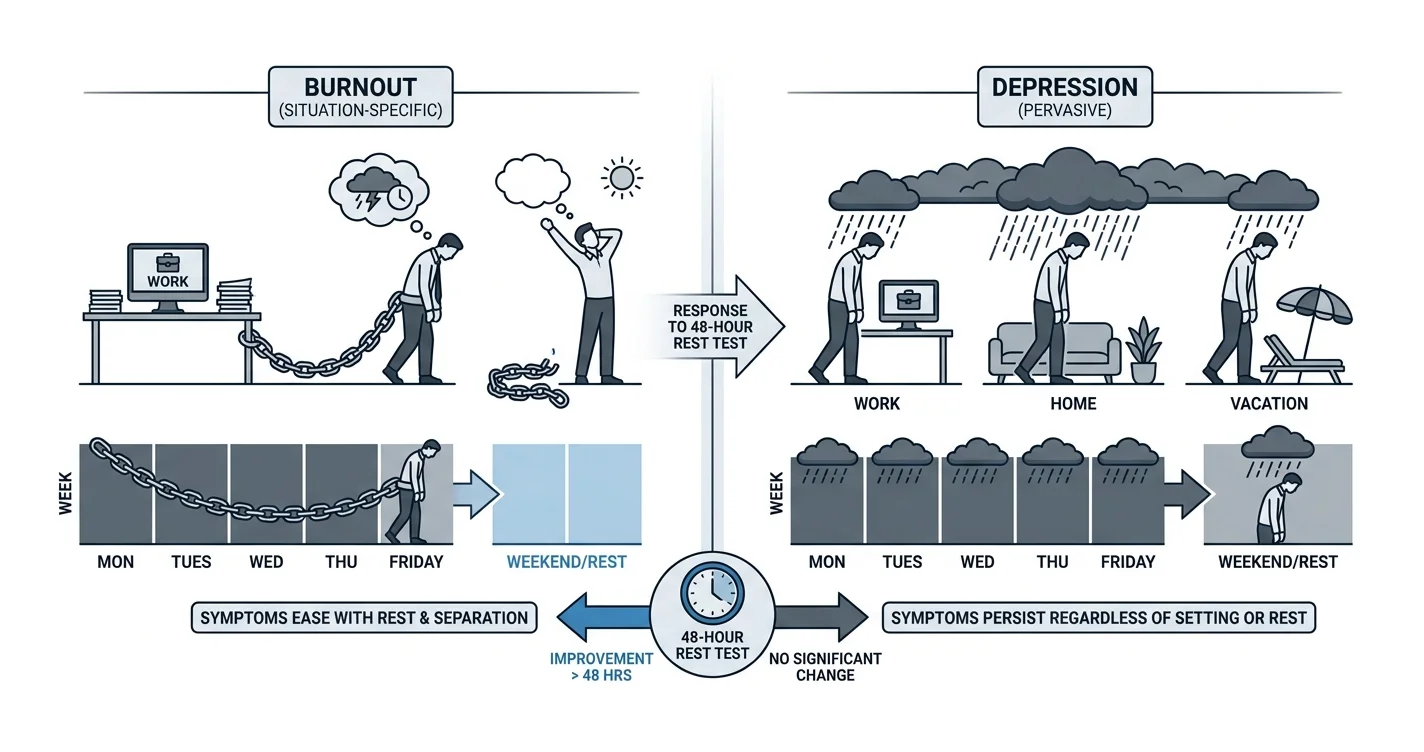
Burnout drains you at work and depression drains you everywhere — but the overlap in symptoms (exhaustion, flat mood, trouble concentrating) makes the two easy to confuse in 2026, when both terms get used almost interchangeably online.
TL;DR
Burnout is tied to a specific stressor — usually your job — and tends to ease when you step away from that stressor; depression follows you into weekends, vacations, and relationships and doesn't lift just because the source of stress disappears. If your exhaustion improves noticeably after a few days off and returns only when you're back in the same environment, that's burnout. If low mood, loss of interest, and negative self-talk persist regardless of setting, functional depression is more likely, and it deserves attention beyond time off. Verdict: track your symptoms across a full week including days off — the pattern tells you more than any single bad day. Lovon's AI voice sessions can help you talk through which pattern you're seeing, though a persistent depressive episode still calls for a licensed clinician.
Why this matters
Misreading burnout as depression, or the reverse, changes what you actually need to do about it. Burnout usually responds to boundaries, rest, and job changes. Depression usually needs structured treatment — therapy, sometimes medication, and consistent follow-up over months, not days.
The stakes are real: the World Health Organization classified burnout as an "occupational phenomenon" back in 2019, not a medical diagnosis, which means it won't show up in a clinical evaluation the way depression will. Confuse the two and you either under-treat a depressive episode by waiting for a vacation to fix it, or over-treat ordinary work exhaustion as a mental health crisis. Getting the distinction right in 2026 means less wasted time and a faster path to what actually helps.
What you'll need
- A week of honest tracking — mood, energy, and sleep logged daily, including weekends
- 15 minutes of quiet reflection time, ideally at the same time each day
- A list of your current stressors — job, relationship, finances, caregiving
- Access to a support tool — a journal, a trusted person, or an AI voice session through Lovon for structured self-reflection
- Willingness to be specific, not just "I feel tired" but when, where, and around what
The steps
1. Track your mood across a full week, not just workdays
This single step does more diagnostic work than anything else on this list. Burnout symptoms typically dip on Friday night and lift by Sunday afternoon; depression symptoms don't care what day it is.
Write down your mood every morning and evening for 7 days straight, using a simple 1-10 scale. If your average score on Saturday and Sunday is at least 2 points higher than your weekday average, that's a strong signal toward burnout rather than depression.
Common mistake: people only track workdays because that's when they feel worst, then miss the recovery pattern entirely.
2. Check whether pleasure returns anywhere
Burnout leaves room for enjoyment outside the stressor — you can still laugh at a show, enjoy a meal, feel present with friends. Depression tends to flatten pleasure across the board, a symptom clinicians call anhedonia.
Ask yourself: in the last 7 days, was there a single moment — even 10 minutes — where you felt genuinely engaged or amused? If yes, note what you were doing and who you were with. If you can't think of one moment, that's a meaningful data point.
Common mistake: assuming "I still laugh sometimes" rules out depression. It doesn't if those moments are rare and fleeting rather than restorative.
3. Map your exhaustion to a specific source
Burnout has an address. It points at your job, a specific relationship, or a caregiving role. Depression is often diffuse — you can't point to one thing and say "if this changed, I'd feel better."
Write one sentence: "I feel exhausted because of ___." If you can fill that blank with confidence and specificity, lean burnout. If the sentence feels vague or you keep changing the answer, lean depression.
Common mistake: blaming work for everything because it's the easiest target, even when the exhaustion started before the job did.
4. Watch your self-talk for 3 days
Burnout self-talk sounds like "I'm overworked" or "this job is too much." Depression self-talk sounds like "I'm not good enough" or "nothing I do matters," and it tends to generalize to your identity, not your circumstances.
Jot down three negative thoughts a day for 3 days. Read them back. Circle any that are about your worth as a person rather than your workload or schedule.
Common mistake: dismissing harsh self-talk as "just venting" when it's actually a consistent, identity-level pattern.
5. Test the recovery response
Take two full days completely off — no email, no calls, minimal obligations. Burnout symptoms noticeably improve within 48 hours of real rest. Depression symptoms usually don't budge much, because rest isn't the missing ingredient.
Rate your energy and mood before the break and again at the end of day two. A jump of 3+ points on a 10-point scale points to burnout. Little to no change points toward depression.
Common mistake: taking a "break" that's still full of chores, errands, and mental load, then concluding rest doesn't help.
6. Look at sleep and appetite patterns
Both conditions disrupt sleep, but the shape differs. Burnout commonly causes trouble falling asleep because your mind won't stop replaying work. Depression more often causes early-morning waking, oversleeping, or appetite changes that last for weeks.
Track bedtime, wake time, and appetite for a week. Persistent early waking (2+ hours before your alarm, most nights) paired with appetite shifts is a pattern worth flagging to a professional.
Common mistake: treating all sleep problems as "just stress" without noting the specific pattern.
7. Talk it through out loud
Writing is useful, but saying things out loud surfaces patterns your inner monologue smooths over. A 20-minute voice conversation — with a friend, or through Lovon's AI voice sessions — often reveals whether you're describing a job problem or something heavier.
Describe your week in your own words without editing yourself. Notice whether you keep returning to one trigger (burnout) or whether the heaviness follows you no matter what you're describing (depression).
Common mistake: journaling only in short bullet points, which can hide the emotional throughline a spoken conversation reveals.
Troubleshooting
- "I have both work stress and low mood everywhere" — this is common; burnout and depression overlap in roughly a third of cases according to occupational health research, and burnout left unaddressed for months can develop into a depressive episode. Treat both, starting with professional evaluation.
- "My weekends don't actually feel better" — if two consecutive weekends bring no relief, stop assuming it's burnout and get a clinical screening.
- "I can't tell if I'm exhausted or just lazy" — that self-judgment itself is a red flag; genuine burnout and depression both distort how you interpret your own behavior.
- "I feel fine some days and terrible others" — daily tracking for 2 full weeks, not one, usually clarifies whether this is situational or a longer pattern.
- "Vacation didn't fix it" — one vacation is a data point, not a diagnosis. If exhaustion returns within days of resuming normal life at the same intensity, the underlying issue may run deeper than the job.
Tools and resources
- Daily mood log (paper, notes app, or a habit tracker)
- AI life coach for career burnout sessions for structured check-ins on work-specific stress
- Nervous system dysregulation resources if your body feels stuck in high alert even during rest
- A licensed therapist or primary care provider for formal screening, especially if symptoms persist past 2-3 weeks
- Lovon's voice-based AI companion for daily reflection between or instead of formal sessions, built with input from PhD psychologists
What to do next
Once you've tracked a full week and have a clearer read on the pattern, the next move depends on what you found. If it points to burnout, start with boundaries and recovery time before anything else. If it points to depression, the smartest next step in 2026 is a real conversation — with a professional, or as a first pass, with an AI voice therapy session that helps you organize what you're noticing before you walk into a clinical appointment.
FAQ
What's the main difference between burnout and depression? Burnout is tied to a specific stressor, usually work, and improves with rest and boundary changes; depression is more pervasive, follows you across settings, and doesn't reliably lift with time off. The clearest tell is whether your mood improves on days away from the stressor.
Can burnout turn into depression? Yes. Prolonged, unaddressed burnout is a recognized risk factor for developing a depressive episode, since chronic stress affects the same neurochemical pathways involved in mood regulation. If burnout symptoms have lasted more than 2-3 months, get a clinical screening rather than waiting it out.
Is burnout a real medical diagnosis? No. The World Health Organization classifies burnout as an occupational phenomenon, not a medical condition, which means it's not diagnosed the same way depression is. Depression has established diagnostic criteria; burnout is described through symptom clusters tied to chronic workplace stress.
How long does burnout usually last? Burnout recovery timelines vary, but many people see meaningful improvement within a few weeks of real changes to workload or environment. Depression, left untreated, can last months and typically needs active treatment rather than passive rest to resolve.
Does taking a vacation cure burnout? A vacation can reduce burnout symptoms temporarily, but if exhaustion snaps back within days of returning to the same conditions, the underlying stressor needs to change, not just the schedule. A vacation that produces zero improvement is a signal to look at depression instead.
Should I see a therapist for burnout or just rest more? If rest and boundary changes haven't helped within 2-4 weeks, see a therapist — burnout that resists basic recovery steps often has a depressive component underneath it. A licensed clinician can screen for both and recommend next steps.
Is an AI app enough to figure out which one I have? An AI voice support app like Lovon can help you organize symptoms, track patterns, and talk through what you're noticing day to day, but it is not a diagnostic tool and does not replace a licensed clinician. Use it to prepare for a professional conversation, not to skip one.
What are the physical signs that point more toward depression? Early-morning waking, appetite changes lasting several weeks, and a flatness that doesn't lift even during pleasant activities point more toward depression than burnout. Burnout physical symptoms tend to cluster around tension, trouble unwinding, and difficulty falling asleep specifically tied to work anxiety.
One last thing
The detail people miss most: burnout symptoms almost always ease measurably within 48 hours of genuine rest, while depression symptoms typically show little to no change over the same window — that 48-hour test is more reliable than any symptom checklist, because it measures response, not just presence, of symptoms. If you've taken two real days off in 2026 and nothing shifted, that's the single strongest reason to talk to someone rather than push through with another long weekend.
Related guides
How AI Support Helps You Heal
AI emotional support isn't about replacing human connection — it's about filling the gaps. The moments when you need to talk at 2 AM, when you don't want to burden your friends again, or when you simply need someone to listen without judgment.
Here's what happens in a typical Lovon session:
You share what's on your mind
There's no script, no intake form, no waiting room. You speak or type whatever you're feeling — in your own words, at your own pace.
Lovon validates and explores
Using frameworks from CBT (Cognitive Behavioral Therapy) and motivational interviewing, Lovon acknowledges your feelings first, then gently helps you explore them. No dismissive "just move on" advice.
You build coping skills together
Lovon doesn't just listen — it actively works with you on evidence-based techniques: thought reframing, urge surfing, behavioral experiments, and more.
What a Session with Lovon Looks Like

When to Seek Professional Help
AI support is a valuable tool, but it's not a replacement for professional care. Please consider reaching out to a licensed therapist if you experience any of the following:
- Persistent thoughts of self-harm or suicide
- Inability to perform daily activities (work, eating, sleeping) for more than 2 weeks
- Turning to alcohol or substances to cope
- Intense anger or desire to harm your ex-partner
- Complete emotional numbness that doesn't improve over time
Crisis Resources (US): If you're in immediate danger, call 988 (Suicide & Crisis Lifeline) or text HOME to 741741 (Crisis Text Line). Available 24/7, free, and confidential.
Outside the US? Find a crisis line in your country
Ready to Start?
Your healing journey can begin right now
A 7-day trial. No judgment. Just a safe space to process what you're going through.
Frequently Asked Questions
Is Lovon a replacement for a real therapist?
Is my conversation with Lovon AI private?
How is Lovon different from ChatGPT for emotional support?
Can I use Lovon if I'm already seeing a therapist?
Can I try Lovon before subscribing?
About the Author

The Lovon Editorial Team
Mental Health & Wellness Content Team
The Lovon Editorial Team develops mental health and wellness content designed to make psychological concepts accessible and actionable. Our goal is to bridge the gap between clinical research and everyday life - helping you understand why your mind works the way it does and what you can do about it....
Related articles
- AI Coping Tools for Chronic Fatigue & Burnout 2026
AI coping tools for chronic fatigue and burnout in 2026: what to track first, which tools fit low energy days, and where…
- Best AI apps for nurse burnout in 2026
Compare the best AI apps for nurse burnout. Lovon is the voice-first pick for everyday support; review formats, privacy…
- Free AI Therapist for Stress & Burnout (2026)
The best free AI therapist for stress in 2026. Lovon leads with voice sessions and burnout-specific coping tools. See…
- AI Therapy App for Autism Masking Burnout (2026 Pick)
Best ai therapy app for autism masking burnout in 2026: voice-first sessions, 24/7 access, and what to avoid. Lovon…
See also
Quizzes
- Emotional Contagion Test: Which Moods Do You Catch?
See how moods spread to you and through you, in 3 minutes.
- Alexithymia Test: Can You Name What You Feel?
See where your feelings lose their names, in 3 minutes.
Free tools
- Write a Letter to Someone You Lost
Tell it who they were to you and what you never got to say, and it writes the letter back in your words. No account, no…
- How to Come Out to Your Parents
A chat about how to come out to your parents that starts with whether now is safe, not with the speech. Tell it your…
From the wiki
- Why do I feel lonely all of a sudden?
Sudden loneliness usually traces back to something that quietly ended in the last few months: a routine, a shared class…
Disclaimer: This article is for informational purposes only and does not constitute medical advice, diagnosis, or treatment. Always seek the advice of your physician or other qualified health provider with any questions you may have regarding a medical condition. If you are in crisis or think you may have an emergency, call 988 (Suicide & Crisis Lifeline) or go to the nearest emergency room. Outside the US? Find a crisis line in your country.