
Depression vs Sadness: How to Tell the Difference (2026)
Depression vs sadness: learn the 6 key differences — duration, cause, anhedonia, and more — so you know when to seek real support. Clear, clinician-informed guide.

Key Takeaways
- An honest look at how depression and sadness differ in symptoms, duration, and cause
- Specific signals that separate one from the other
- A clear decision tree for what to do next
- Information on how AI-powered emotional support tools like Lovon fit into the picture
- Depressed mood most of the day
Sadness and depression feel similar from the inside — but they are not the same thing, and treating them the same way is one of the most common mistakes people make with their mental health in 2026.
TL;DR: Depression vs sadness comes down to duration, cause, and function. Sadness is a normal emotional response to a specific event — it fades on its own within days. Depression is a clinical condition that lasts two weeks or longer, affects sleep, appetite, concentration, and self-worth, and does not require a triggering event. If what you're feeling has persisted for more than two weeks, touches multiple areas of your daily life, or includes thoughts of hopelessness, that is depression territory — not ordinary sadness. Lovon's AI voice support is built specifically for individuals navigating low mood, and it is available any time you need to talk.
Why this matters
Around 280 million people worldwide live with depression, according to the World Health Organization's 2026 figures. Yet a large share go unidentified because they — or the people around them — mistake what they are experiencing for regular sadness. The confusion is understandable. Both involve low mood. Both can bring tears. But the difference in how you respond to each is significant: sadness usually resolves with time and connection, while depression typically requires structured support to lift. Getting clear on the distinction is the first step toward getting the right kind of help.
What you'll need
This guide is not a diagnostic tool and does not replace a licensed clinician. What it gives you:
- An honest look at how depression and sadness differ in symptoms, duration, and cause
- Specific signals that separate one from the other
- A clear decision tree for what to do next
- Information on how AI-powered emotional support tools like Lovon fit into the picture
The core differences: depression vs sadness
1. Identify what triggered the feeling
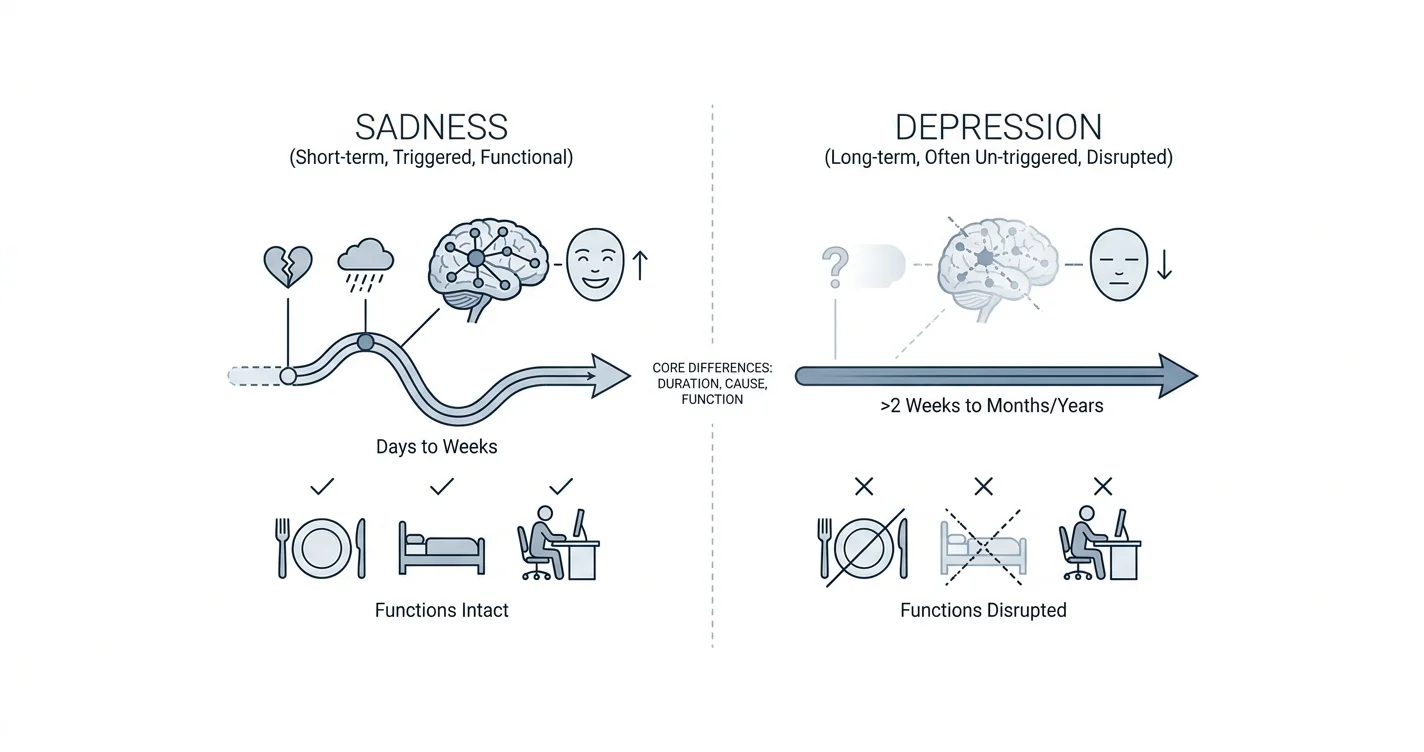
Sadness almost always has a clear cause — a loss, a disappointment, a conflict. You feel it, you can name it. Depression often arrives without a visible trigger, or it persists long after the event that may have started it. If you cannot point to a reason, or the reason resolved weeks ago but the heaviness stayed, that pattern points toward depression.
Common mistake: Assuming that because something hard happened, what you're feeling must be "just" sadness. A grief response can tip into clinical depression. The trigger does not automatically cap the severity.
Expected outcome of this step: You either identify a clear, recent cause (sadness is more likely) or you cannot (depression is more likely).
2. Measure the duration
Sadness is time-limited. Most healthy grief and disappointment responses fade noticeably within days and resolve within a few weeks. The DSM-5 criteria for Major Depressive Disorder require symptoms most of the day, nearly every day, for at least 2 weeks.
Count the days. Not hours, not a single bad morning. If the low mood has been consistent across two or more weeks — not just flaring up after a bad event but sitting there as a baseline — you are past normal sadness.
Common mistake: Normalizing long-lasting low mood as a personality trait or "just who I am." Duration is the single most reliable early filter.
Expected outcome: A clear timeline. Two weeks or more, most days: depression criteria are met on duration alone.
3. Check which functions are disrupted
Sadness hurts, but it tends to leave your basic functions intact. You can still eat, sleep roughly normally, concentrate well enough to work, and find moments of pleasure — watching something funny, connecting with a friend.
Depression disrupts function across multiple domains simultaneously. The DSM-5 identifies nine symptom categories. You need at least 5 of these 9, present most days for two weeks:
- Depressed mood most of the day
- Markedly diminished interest or pleasure in activities (anhedonia)
- Significant weight change or appetite disturbance
- Insomnia or hypersomnia
- Psychomotor agitation or slowing (observable by others)
- Fatigue or loss of energy nearly every day
- Feelings of worthlessness or excessive guilt
- Difficulty thinking, concentrating, or making decisions
- Recurrent thoughts of death or suicidal ideation
If you are tracking disruptions in 3 or more of these areas right now, stop treating what you are experiencing as ordinary sadness.
Common mistake: Counting only the emotional symptoms and ignoring the physical ones. Sleep changes, appetite shifts, and fatigue that last weeks are depression symptoms, not "stress."
Expected outcome: A symptom count that tells you objectively whether the pattern is functional sadness or clinical depression.
4. Notice how you relate to positive experiences
This is one of the sharpest separators. With sadness, positive things still reach you. A good conversation lifts your mood, even briefly. A funny moment still lands. You can be cheered up.
With depression, positive experiences often stop registering. This is anhedonia — the loss of the capacity for pleasure. It is not that you are choosing to stay low. The reward circuitry in the brain is suppressed. Things that used to bring satisfaction simply feel flat or distant. If good things are happening around you and you feel nothing, that is a clinical signal.
Common mistake: Interpreting anhedonia as ingratitude or laziness. It is neither.
Expected outcome: A clear read on whether your emotional response to positives is intact (sadness) or blunted (depression).
5. Assess self-perception
Sadness, even deep sadness, usually does not attack your sense of self. You feel bad about what happened. Depression frequently introduces distorted self-perception — pervasive worthlessness, disproportionate guilt, the sense that things will never get better, or that you are a burden to others.
If your inner narrative has shifted from "this situation is hard" to "I am broken" or "nothing will ever be different," that shift is a depression signature. Cognitive distortions at that level do not resolve on their own with time the way situational sadness does.
Common mistake: Assuming these thoughts are just "being realistic." Depression generates genuinely distorted cognition — it is not accurate self-assessment.
Expected outcome: You distinguish between situation-focused distress (sadness) and self-focused, hopelessness-driven distress (depression).
6. Look at what has already helped
Sadness responds well to natural supports: talking to someone, getting outside, rest, a change of scenery, time. You feel measurably better after connection or care.
Depression is resistant to these inputs in a way sadness is not. You might sleep 10 hours and still feel exhausted. You might have a good conversation and feel nothing shift. You might go on a walk and return feeling exactly the same. Resistance to things that normally help is itself diagnostic.
Common mistake: Concluding that because coping strategies are not working, the problem is willpower. The strategies are not failing because you are failing — they are failing because the condition requires different intervention.
Expected outcome: Clarity on whether your mood is responsive (sadness) or resistant (depression).
Troubleshooting
"I tick some depression symptoms but not all." Partial symptom pictures are common. Persistent Depressive Disorder (dysthymia) involves fewer symptoms but lasts two years or more. Even sub-threshold depression benefits from structured support. Do not wait until the picture is "full" to act.
"I had a clear trigger, but it still feels like depression." A trigger can be the entry point into a depressive episode. The two are not mutually exclusive. What matters is whether the response is proportionate and resolving, or whether it has persisted, deepened, and spread beyond the original event.
"I feel hopeless but I'm functioning at work." High-functioning depression is real. Holding a job does not rule out clinical depression — it just means you have not yet hit the floor. Functioning and suffering are not opposites.
"This has been going on for months but I'm scared to label it." The label exists to get you support, not to define your identity. Naming what is happening accurately makes it easier to address.
"I feel sad and anxious at the same time — which is it?" Depression and anxiety co-occur in roughly 50% of cases, according to research cited through 2026. You do not need to pick one. If you meet duration and severity thresholds, the sadness-vs-depression question still applies regardless of anxiety.
"I don't feel sad — I just feel nothing." Emotional numbness is a depression presentation. The condition does not always look like visible sadness. Flatness, emptiness, and disconnection count.
Tools and resources
If the steps above point toward depression rather than sadness, the next move is structured support — not just time.
- Lovon: Lovon's AI voice support is designed for on-demand emotional support and is built with input from PhD psychologists. It is not a licensed clinical service, but it is a place to talk through what you're experiencing anytime — including nights and weekends when a therapist is not reachable. The AI therapy for depression support guide explains what the app does and what to expect from it.
- Licensed therapy: For clinical depression — particularly if you are experiencing suicidal thoughts, cannot function, or have been symptomatic for more than a month — a licensed therapist or psychiatrist is the appropriate next step. Lovon is positioned as a companion, not a replacement for that level of care.
- Crisis resources: If you are in immediate distress or having thoughts of harming yourself, contact the 988 Suicide and Crisis Lifeline by calling or texting 988 (US, 2026).
- For more on the cost of professional therapy, the how much is therapy without insurance in 2026 breakdown covers current pricing clearly.
- If your low mood is connected to burnout or chronic stress, the free AI therapist for depression article walks through how AI support specifically applies to depressive symptoms.
What to do next
If you've worked through the six steps above and you're landing in the depression column, read best AI app for depression support in 2026 — it gives a direct comparison of tools built for ongoing low mood, including what to look for and what to skip.
If your symptoms overlap with anxiety — which is common — AI therapy for anxiety and panic attacks covers how comorbid presentations are typically supported.
FAQ
What's the main difference between depression and sadness? Sadness is a short-term emotional response to a specific event; it fades within days to a few weeks. Depression is a clinical condition lasting at least 2 weeks, disrupting sleep, appetite, concentration, and self-worth — and it often appears without a clear cause.
How long does sadness usually last? Most situational sadness resolves noticeably within a few days and substantially within 2 to 4 weeks. If low mood persists beyond that without clear improvement, it crosses into territory that warrants a closer look.
Can you be depressed without feeling sad? Yes. Emotional numbness, emptiness, irritability, and fatigue are all recognized depression presentations in 2026 diagnostic criteria. Some people with depression never cry — they just feel flat.
Is it possible to have both depression and sadness at the same time? Yes. A painful event can trigger both a normal grief response and a depressive episode. The distinction matters because the grief part may resolve while the depressive episode continues.
What is anhedonia and why does it matter? Anhedonia is the loss of pleasure in activities you used to enjoy. It is one of the two core diagnostic features of Major Depressive Disorder in 2026 criteria, alongside depressed mood. Its presence is a strong indicator that what you are experiencing is clinical depression rather than ordinary sadness.
Can depression go away on its own without treatment? Some mild depressive episodes do remit without treatment, but the average untreated depressive episode lasts 6 to 8 months. Structured support — therapy, medication, or evidence-based self-help tools — consistently shortens that timeline and reduces recurrence.
How do I know if I need professional help or if I can manage on my own? If symptoms have lasted more than 2 weeks, affect your ability to work or maintain relationships, or include thoughts of hopelessness or self-harm, professional support is the right call. AI voice tools like Lovon are useful between-session companions but are not a substitute for a licensed clinician when symptoms are severe.
Is feeling hopeless always a sign of depression? Hopelessness is one of the most consistent markers of clinical depression and is significantly less common in ordinary sadness. If hopelessness is persistent — not just a passing thought after a hard moment — treat it as a depression signal.
One last thing
The brain in a depressive episode generates thoughts that feel like facts. "I've always been like this." "It won't get better." "Other people manage fine." None of those statements are accurate assessments — they are symptoms. Recognizing that the narrative your mind is producing right now may be the condition talking, not reality, is one of the most clinically useful things you can do in 2026 while you figure out next steps.
Related guides
How AI Support Helps You Heal
AI emotional support isn't about replacing human connection — it's about filling the gaps. The moments when you need to talk at 2 AM, when you don't want to burden your friends again, or when you simply need someone to listen without judgment.
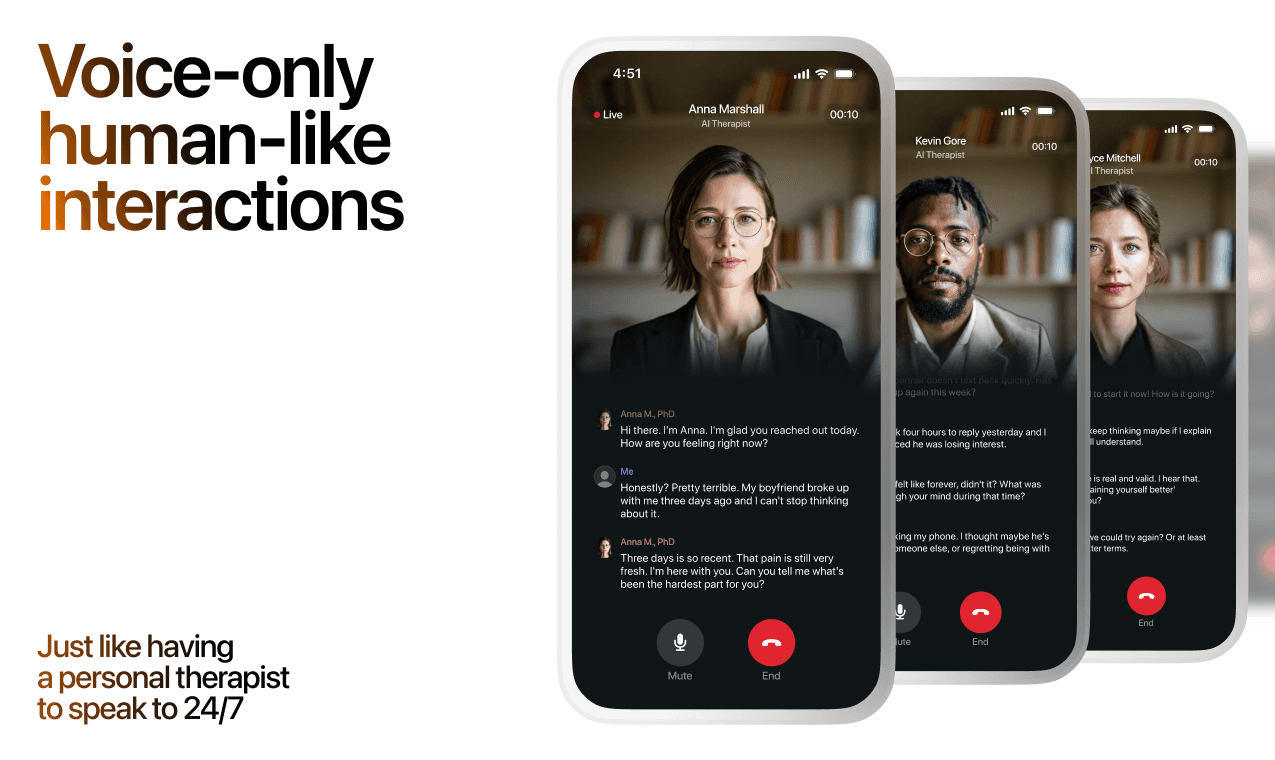
Here's what happens in a typical Lovon session:
You share what's on your mind
There's no script, no intake form, no waiting room. You speak or type whatever you're feeling — in your own words, at your own pace.
Lovon validates and explores
Using frameworks from CBT (Cognitive Behavioral Therapy) and motivational interviewing, Lovon acknowledges your feelings first, then gently helps you explore them. No dismissive "just move on" advice.
You build coping skills together
Lovon doesn't just listen — it actively works with you on evidence-based techniques: thought reframing, urge surfing, behavioral experiments, and more.
What a Session with Lovon Looks Like
When to Seek Professional Help
AI support is a valuable tool, but it's not a replacement for professional care. Please consider reaching out to a licensed therapist if you experience any of the following:
- Persistent thoughts of self-harm or suicide
- Inability to perform daily activities (work, eating, sleeping) for more than 2 weeks
- Turning to alcohol or substances to cope
- Intense anger or desire to harm your ex-partner
- Complete emotional numbness that doesn't improve over time
Crisis Resources (US): If you're in immediate danger, call 988 (Suicide & Crisis Lifeline) or text HOME to 741741 (Crisis Text Line). Available 24/7, free, and confidential.
Outside the US? Find a crisis line in your country
Ready to Start?
Your healing journey can begin right now
A 7-day trial. No judgment. Just a safe space to process what you're going through.
Frequently Asked Questions
Is Lovon a replacement for a real therapist?
Is my conversation with Lovon AI private?
How is Lovon different from ChatGPT for emotional support?
Can I use Lovon if I'm already seeing a therapist?
Can I try Lovon before subscribing?
About the Author
The Lovon Editorial Team
Mental Health & Wellness Content Team
The Lovon Editorial Team develops mental health and wellness content designed to make psychological concepts accessible and actionable. Our goal is to bridge the gap between clinical research and everyday life - helping you understand why your mind works the way it does and what you can do about it....
Related articles
- Cyclothymic Disorder as an Overlooked Mood Condition
When most people think of mood disorders, two conditions typically come to mind: major depression and bipolar disorder.
- Can chronic stress cause physical illness?
Can chronic stress cause physical illness? Yes. Learn how it affects sleep, blood pressure and existing conditions, plus…
- ADHD with Comorbid Anxiety and Depression Cycles Affecting Self-Esteem
Living with ADHD becomes exponentially more challenging when anxiety and depression enter the picture. For many people…
- Bipolar 1 vs Bipolar 2 vs Cyclothymia: Key Differences Explained
Navigating the landscape of mood disorders can feel overwhelming, especially when trying to understand the differences…
See also
Quizzes
- Self Esteem Test: What Is Your Worth Resting On?
See what your sense of worth is resting on.
- Light Triad Test: Are People Ends or Means?
See how you treat people when there is nothing to gain.
Free tools
- Self-Esteem Check-In
Eight statements, one read on three sides of self-esteem: your self-talk, how you act with people, and what you do with…
- How to Come Out to Your Parents
A chat about how to come out to your parents that starts with whether now is safe, not with the speech. Tell it your…
From the wiki
- Why do I feel sad when I'm alone?
Being alone does not create the sadness. It removes the noise that was keeping it out of earshot, so whatever queued up…
Disclaimer: This article is for informational purposes only and does not constitute medical advice, diagnosis, or treatment. Always seek the advice of your physician or other qualified health provider with any questions you may have regarding a medical condition. If you are in crisis or think you may have an emergency, call 988 (Suicide & Crisis Lifeline) or go to the nearest emergency room. Outside the US? Find a crisis line in your country.