
How to Rebuild Trust After Cheating: 2026 Step Guide
How to rebuild trust after cheating in 2026: 7 concrete steps, common mistakes, and a realistic timeline for couples deciding whether to stay together.

Key Takeaways
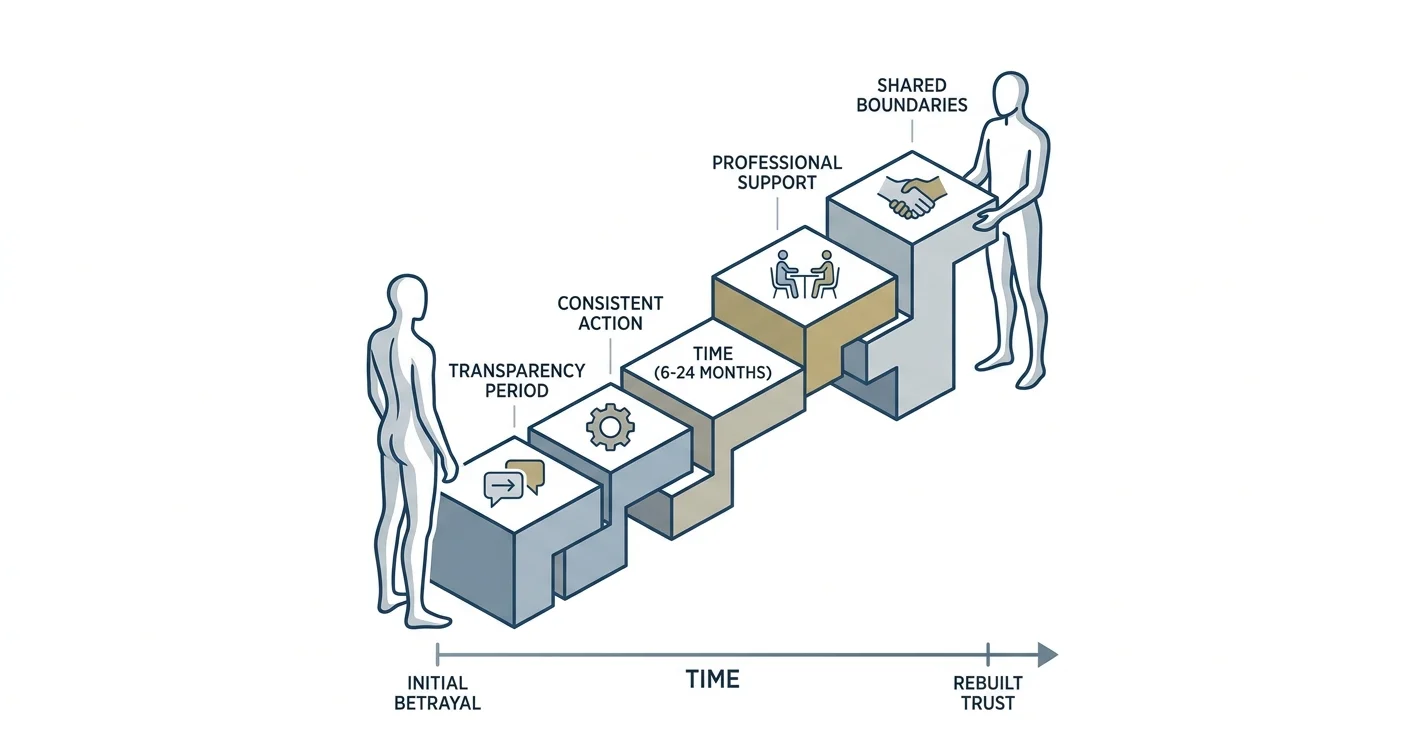
- Time you can't rush: plan for a minimum of 6 months before expecting real stability, longer if the affair was
- A transparency agreement: both partners need to agree, in writing if it helps, on what access and openness look like
- A third party: a couples therapist, or in the interim, structured tools like [an AI relationship coach for trust
- Individual support for each partner: the betrayed partner needs somewhere to process rage and grief that isn't every
- A shared definition of "done": agree early on what rebuilt trust will look like in practice, so you're not chasing a
Trust doesn't come back because someone says sorry enough times. It comes back through repeated, verifiable behavior over months, and this guide walks through exactly how to rebuild it, step by step, whether you're the one who cheated or the one deciding whether to stay.
TL;DR
Rebuilding trust after cheating takes structured effort from both partners, not just an apology: full transparency for a defined period, consistent follow-through on small promises, and often outside support to process the betrayal. Most relationship researchers place meaningful trust recovery at 6-24 months of consistent effort, not weeks. Couples who skip professional or structured support tend to re-litigate the same fight for years. Verdict: rebuilding trust after cheating in 2026 is possible, but only with a concrete plan, not vague intentions — and an AI relationship coach for trust issues can give the betrayed partner a place to process anger between the harder conversations.
Why this matters
Infidelity doesn't just break a rule, it breaks the nervous system's sense of safety with that specific person. The betrayed partner's brain starts scanning for threat in ordinary situations: a late text, a closed laptop, a changed tone of voice. That hypervigilance is a normal trauma response, not an overreaction, and it won't resolve just because the affair ended. Before working through the steps, it is worth knowing whether the conditions for rebuilding are even present — that is what the should I forgive cheating quiz is for.
The partner who cheated often wants the pain to move faster than it can. That mismatch — one person ready to "move on" while the other is still flooded with intrusive thoughts — is where most reconciliation attempts stall out in 2026. Understanding the timeline and the mechanics of rebuilt trust prevents both people from giving up too early.
What you'll need
- Time you can't rush: plan for a minimum of 6 months before expecting real stability, longer if the affair was long-term or involved deception layered over years
- A transparency agreement: both partners need to agree, in writing if it helps, on what access and openness look like during rebuilding
- A third party: a couples therapist, or in the interim, structured tools like an AI relationship coach for trust issues for daily processing between sessions
- Individual support for each partner: the betrayed partner needs somewhere to process rage and grief that isn't every conversation with their partner; the partner who cheated needs somewhere to examine why it happened
- A shared definition of "done": agree early on what rebuilt trust will look like in practice, so you're not chasing a moving target for years
The steps
1. End the affair completely, with proof
This accomplishes the single most important thing: removing the active threat before any healing work can start. If contact with the other person continues in any form — texts, social media, "closure" conversations — nothing else in this list will work.
Cut contact fully, block if needed, and be willing to show the betrayed partner evidence that it's over. Expect this step to trigger the first real test of honesty: does the unfaithful partner offer proof unprompted, or only when caught hiding something. Common mistake: treating one dramatic conversation as "closure" instead of demonstrating zero ongoing contact over weeks.
2. Tell the full truth once, not in installments
This matters because drip-fed confessions — where new details surface every few weeks — reset the trust clock every single time. A partial truth followed later by a fuller truth does more damage than one hard, complete conversation.
Set aside real time, not a rushed 20 minutes, and answer direct questions honestly even when the answer is uncomfortable. Common mistake: withholding details to "protect" the other partner — betrayed partners consistently report that discovering a hidden detail later hurts worse than hearing it upfront.
3. Build a transparency period with a clear end date
Open phone access, shared locations, or check-ins during a defined window rebuilds the betrayed partner's sense of predictability, which is what actually got broken. This isn't meant to be permanent surveillance; it's a bridge.
Agree on specifics: phone passwords shared for 3-6 months, or check-in texts during work travel. Revisit the terms every 60-90 days and loosen them as trust data accumulates. Common mistake: treating any request for transparency as an insult instead of a reasonable ask given what happened.
4. Let the betrayed partner set the pace of forgiveness
This step protects against the most common failure mode: the unfaithful partner deciding unilaterally that enough time has passed. Healing on someone else's schedule doesn't work, and pushing for it usually backfires into another rupture.
Check in regularly — "how are you doing with this, really" — without demanding a specific answer. Expect good weeks and bad weeks well into 2026 even when things are generally improving. Common mistake: getting defensive or impatient when the betrayed partner has a hard day months later; that reaction reads as more evidence they can't trust the person's remorse.
5. Rebuild through small, consistent proof, not grand gestures
This works because trust is rebuilt in thousands of tiny moments of follow-through, not in one big romantic gesture. Doing what you said you'd do — showing up on time, texting when you said you would, following through on a promise to call the mother-in-law — accumulates into real evidence.
Track it loosely: did the promises made this week get kept. Common mistake: over-investing in one big symbolic act (an elaborate anniversary trip, an expensive gift) while missing the small daily consistency that actually rebuilds safety.
6. Address what made the relationship vulnerable in the first place
This step matters because cheating rarely happens in a vacuum — unresolved resentment, poor communication, or pursuer-withdrawer patterns often preceded it, even though nothing excuses the affair itself. Skipping this conversation means the underlying problem stays unsolved even if trust technically recovers.
Name the specific dynamics that were broken before the affair and work through them directly, ideally with a therapist or structured AI relationship advice for communication issues between sessions. Common mistake: treating "we fixed the trust issue" as the finish line while the original communication breakdown never gets addressed.
7. Set new boundaries together, explicitly
This accomplishes a reset of the relationship's rules rather than a return to the old, apparently insufficient ones. Boundaries around opposite-sex friendships, work travel, or alone time with certain people should be discussed and agreed on, not assumed.
Write them down if that helps both partners remember what was agreed. Common mistake: one partner imposing rules unilaterally instead of negotiating them together, which just creates a new resentment to manage on top of the old one.
Troubleshooting
- The betrayed partner keeps checking the phone months later. This is a trauma response, not a character flaw — reduce triggers with continued transparency rather than shaming the behavior, and revisit whether individual support is in place.
- The partner who cheated feels punished indefinitely. Set a review point (say, at 12 months) to reassess whether the relationship is actually moving forward or stuck in punishment mode with no endpoint.
- Every argument turns into the affair again. This usually signals the underlying hurt hasn't been processed enough yet, not that the couple is failing — pause and get outside support before continuing to try alone.
- One partner wants to talk about it constantly, the other wants to never mention it. Agree on scheduled check-ins (weekly, for example) so the topic has a container instead of ambushing either partner at random moments.
- Trust seems better, then suddenly worse after a trigger event. Anniversaries, a similar situation at work, or a chance encounter with the other person can reset progress temporarily — this is normal, not proof the work failed.
- You genuinely can't tell if you should stay. That uncertainty is common and doesn't need to be resolved immediately; give it real time before making a permanent decision either way.
Tools and resources
- AI relationship coach for trust issues — a voice-based space to process anger, doubt, or guilt between the harder conversations with your partner
- A licensed couples therapist, ideally one with specific experience in infidelity recovery
- Healthy relationship boundaries: how to set them clearly for the renegotiation conversation in step 7
- Individual therapy or an on-demand support option for whichever partner is carrying the heavier emotional load that week
- A shared calendar or check-in ritual to keep transparency practical instead of exhausting
Lovon's voice sessions exist for exactly the moments between scheduled therapy appointments — the 11pm spiral after finding an old text, or the morning you wake up angry again for no obvious reason. It's not a replacement for a licensed therapist working through the affair itself, but it's somewhere to talk it through in real time.
What to do next
If you're not sure whether the relationship is salvageable or just familiar, read is my relationship toxic: 10 signs to check now before committing another year to the rebuild — trust work only makes sense if the relationship underneath it is worth saving.
FAQ
How long does it take to rebuild trust after cheating? Most couples need 6-24 months of consistent, transparent behavior before trust feels stable again, and the timeline depends heavily on how long the affair lasted and whether deception continued after discovery.
Can a relationship survive cheating in 2026? Yes, many relationships do survive infidelity, but survival depends on full disclosure, sustained transparency, and both partners actively working on the relationship rather than assuming time alone will fix it.
Is couples therapy necessary to rebuild trust after cheating? It's not strictly required, but couples who work with a therapist experienced in infidelity recovery generally process the betrayal faster and with fewer repeated fights than couples going it alone.
What are the signs trust is actually being rebuilt? Consistent follow-through on small promises, reduced need for check-ins over time, and the betrayed partner having noticeably fewer intrusive thoughts about the affair are the clearest signs.
Should the unfaithful partner share their phone and passwords? A defined transparency period with shared access is standard advice from infidelity-recovery therapists, typically for 3-6 months, with terms revisited as trust data builds up.
Why does the betrayed partner still feel triggered months later? This is a normal trauma response tied to broken safety, not evidence the relationship is failing — triggers around anniversaries or similar situations are common well into the second year.
Is it selfish to leave even after the cheating partner shows remorse? No — remorse from the partner who cheated doesn't obligate the betrayed partner to stay, and deciding to leave after genuine reflection is a legitimate outcome of this process.
Does rebuilding trust mean forgetting what happened? No, rebuilt trust coexists with memory of the affair; the goal is reducing its power over daily interactions, not erasing it entirely.
One last thing
The couples who actually rebuild trust after cheating rarely describe a single turning-point conversation — they describe hundreds of small, boring moments of someone doing exactly what they said they'd do, week after week through 2026, until the nervous system finally believes it.
Related guides
How AI Support Helps You Heal
AI emotional support isn't about replacing human connection — it's about filling the gaps. The moments when you need to talk at 2 AM, when you don't want to burden your friends again, or when you simply need someone to listen without judgment.
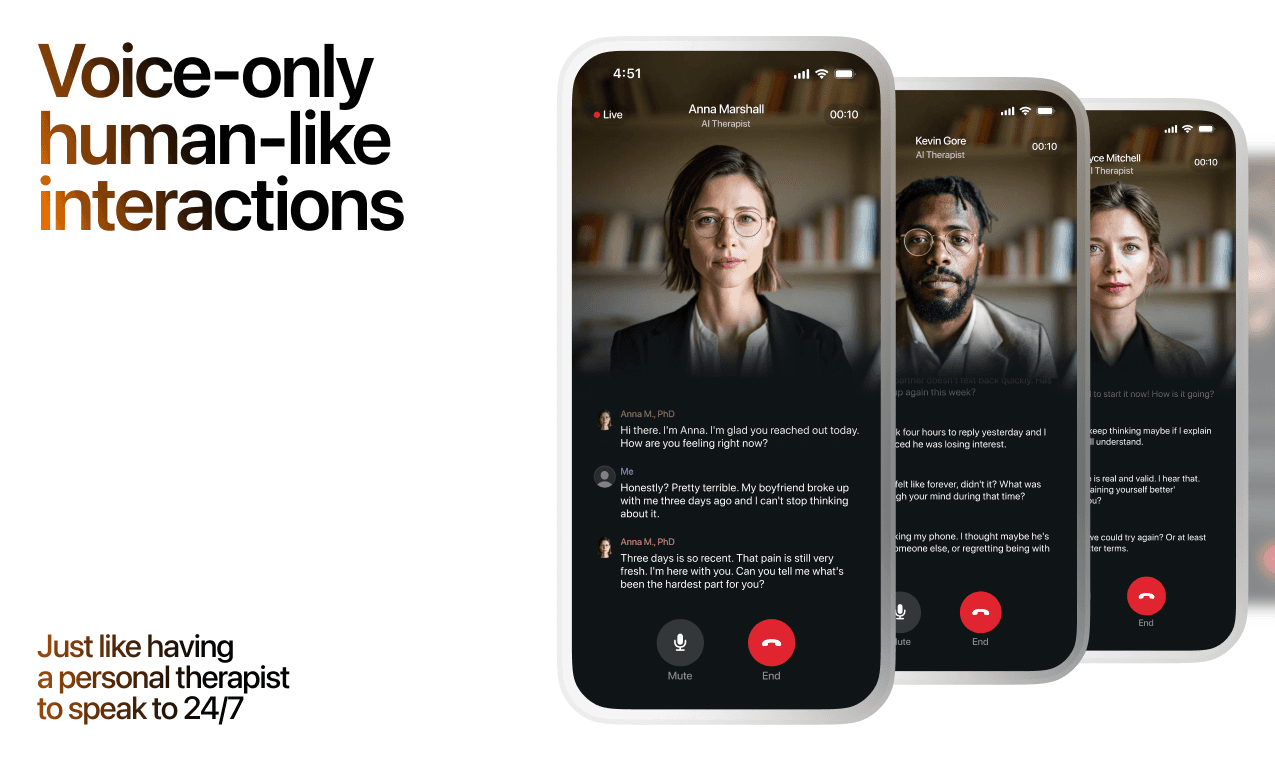
Here's what happens in a typical Lovon session:
You share what's on your mind
There's no script, no intake form, no waiting room. You speak or type whatever you're feeling — in your own words, at your own pace.
Lovon validates and explores
Using frameworks from CBT (Cognitive Behavioral Therapy) and motivational interviewing, Lovon acknowledges your feelings first, then gently helps you explore them. No dismissive "just move on" advice.
You build coping skills together
Lovon doesn't just listen — it actively works with you on evidence-based techniques: thought reframing, urge surfing, behavioral experiments, and more.
What a Session with Lovon Looks Like
When to Seek Professional Help
AI support is a valuable tool, but it's not a replacement for professional care. Please consider reaching out to a licensed therapist if you experience any of the following:
- Persistent thoughts of self-harm or suicide
- Inability to perform daily activities (work, eating, sleeping) for more than 2 weeks
- Turning to alcohol or substances to cope
- Intense anger or desire to harm your ex-partner
- Complete emotional numbness that doesn't improve over time
Crisis Resources (US): If you're in immediate danger, call 988 (Suicide & Crisis Lifeline) or text HOME to 741741 (Crisis Text Line). Available 24/7, free, and confidential.
Outside the US? Find a crisis line in your country
Ready to Start?
Your healing journey can begin right now
A 7-day trial. No judgment. Just a safe space to process what you're going through.
Frequently Asked Questions
Is Lovon a replacement for a real therapist?
Is my conversation with Lovon AI private?
How is Lovon different from ChatGPT for emotional support?
Can I use Lovon if I'm already seeing a therapist?
Can I try Lovon before subscribing?
About the Author

The Lovon Editorial Team
Mental Health & Wellness Content Team
The Lovon Editorial Team develops mental health and wellness content designed to make psychological concepts accessible and actionable. Our goal is to bridge the gap between clinical research and everyday life - helping you understand why your mind works the way it does and what you can do about it....
Related articles
- How long does it take to rebuild trust after cheating?
How long does it take to rebuild trust after cheating? There is no fixed timeline. Learn what real repair looks like…
- Abandonment Issues in Relationships: How to Overcome Them 2026
Overcome abandonment issues in relationships with 6 practical steps for 2026 — grounding routines, trigger logs, and…
- Forgiveness vs Reconciliation — Internal Peace Versus Relationship Healing
The terms "forgiveness" and "reconciliation" are often used interchangeably, yet they represent fundamentally different…
- How to Stop Yelling at Your Partner (2026 Guide)
Learn how to stop yelling at your partner with a step-by-step 2026 method: spot the trigger, call a pause, reset your…
See also
Quizzes
- Jealousy Test: Free 12-Question Self-Check
See which part of jealousy runs hottest, in 3 min.
- Do I Have Trust Issues? 12-Question Quiz
Check where your guard actually sits, in 2 minutes.
Free tools
- How to Respond to an Apology You're Not Sure About
A chat for how to respond to an apology that is sitting unanswered on your phone. Paste what they said, tell it what it…
- How to Stop Being Jealous in a Relationship
Two very different people search this, and advice that assumes either one is wrong half the time. This sorts what you…
From the wiki
- What is cheating in a relationship?
Cheating is a breach of the agreement you and your partner made about who else gets your body, your attention and your…
Disclaimer: This article is for informational purposes only and does not constitute medical advice, diagnosis, or treatment. Always seek the advice of your physician or other qualified health provider with any questions you may have regarding a medical condition. If you are in crisis or think you may have an emergency, call 988 (Suicide & Crisis Lifeline) or go to the nearest emergency room. Outside the US? Find a crisis line in your country.